

"I made the payment."
"No, I haven't received it."
I see this argument all the time. The sender blames the receiver. The receiver blames the sender. Then both blame their banks, and each bank points at the other. Nobody is lying. Nobody knows.
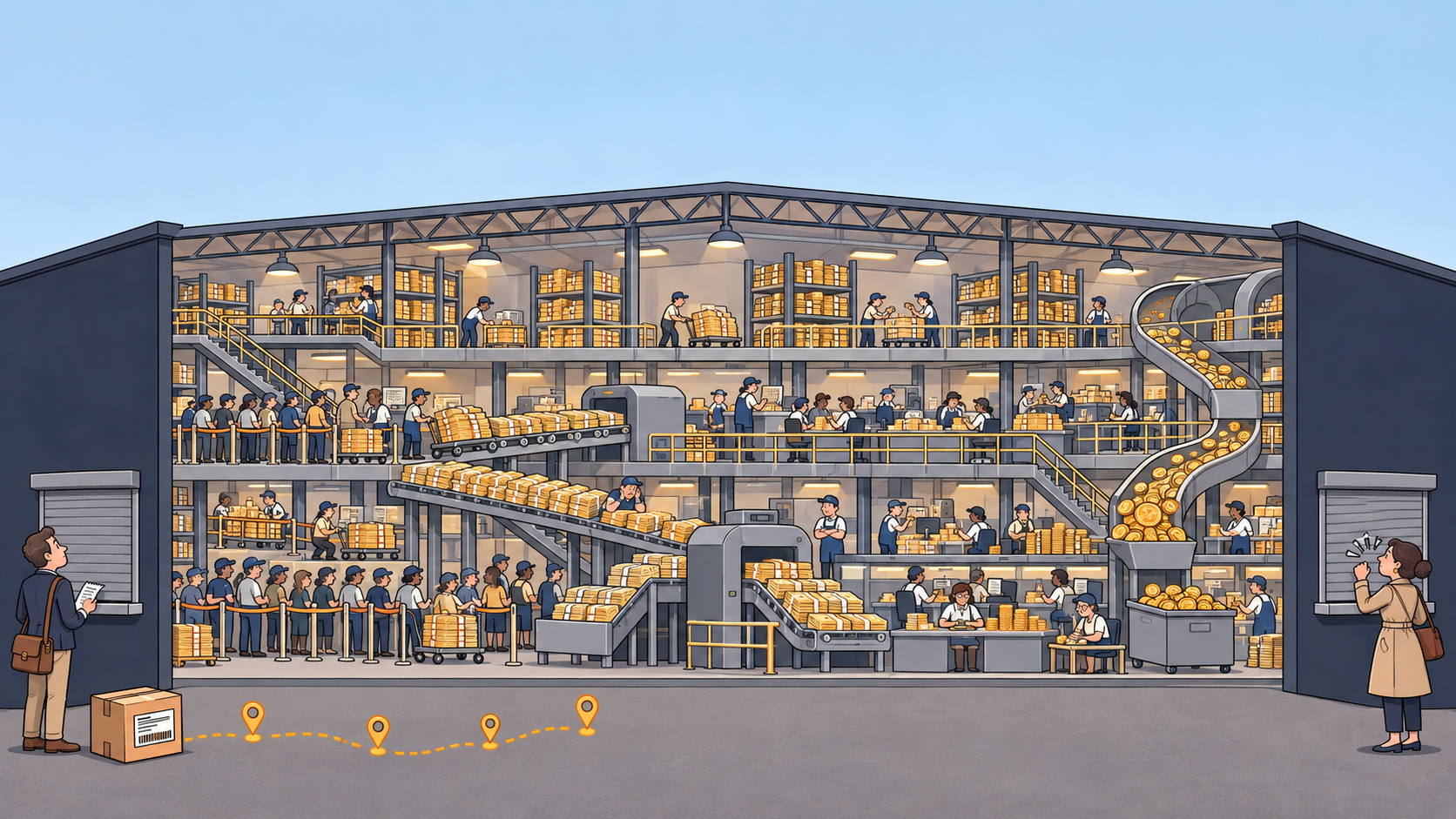
I always tell my clients to picture a warehouse.
The Window, the Receipt, and the Shutter
Think of a huge, really busy warehouse. It is three or four football fields long. It has many floors, and hundreds of people work inside.
At the front there is one small window. You walk up and say, "Can you please give this money to so-and-so?" The window takes your money, hands you a receipt, and shuts.
That is the last you see of it.
At the far end of the warehouse there is another small window. The person you paid is standing there. They knock and ask, "Has my money arrived?" The answer comes back: "No, it hasn't arrived." And that window shuts too.
Now ask what happens in between. Where is the money? Who has it? Why do they have it? How long will they hold it? Which floor is it on?
You have no idea. Neither does the person at the other window.
It is all a black box.
So What Is Inside the Warehouse?
Let's say Harry in London sends $10,000 to Lucy in Manila (round numbers, just to keep it simple).
Harry's bank has no account with Lucy's bank. So it hands the payment to a correspondent bank, which is a bank that holds accounts for other banks and moves money for them. That bank may hand it to a second one. Each bank on the way has its own compliance desk, its own cut-off time, and its own queue. One may stop the payment to ask a question. Another may take a fee out of it.
Harry's receipt shows none of this. It says the money left. Lucy's bank cannot see a payment that has not reached it yet.
So Harry is telling the truth. Lucy is telling the truth. The staff at both banks are telling the truth as well.
Everyone at the windows is honest, and everyone is blind.
Now Send a Parcel
Send a pair of shoes with DHL and you get a tracking number. Picked up. Left Istanbul. Arrived in Leipzig. Held at customs. Out for delivery. You can follow every stop from your phone.
A $40 parcel gets a full travel history. A $40,000 payment gets a receipt and a shut window.
Think about that for a minute.
Just a side note, the banks already have a tracking number. SWIFT, the messaging network banks use to send payment instructions to each other, runs a tracker called gpi, and each payment carries a UETR, which is a Unique End-to-End Transaction Reference. The trouble is who gets to see it. Mostly the banks do. Few of them pass it to you in a form you can read.
So the tracking exists. It just lives inside the warehouse. The staff can look it up. The two people standing at the windows cannot.
People complain about the speed and the fees of international payments. IMHO, the bigger fault is that the end-user cannot see a thing. A slow payment you can follow is a delay. A slow payment you cannot follow is a fight between two people who are both right.
Give money the same tracking as a DHL parcel.
If your bank already shows you every stop your payment makes, please let me know which bank. I'd be curious to know.