
You tap a card or phone against a terminal.
There is a beep.
A moment later, the screen says Approved.
To the customer, the transaction feels complete.
It is not.
What happened in those few seconds was primarily an authorization process: a rapid exchange of payment data between the merchant side of the card system and the bank that issued the card. The actual financial completion of the transaction—clearing, settlement, and merchant funding—happens separately and usually takes much longer.
Infographic #4 of 52 · Card Payments Explained
Core idea: The decision is fast. The money is not.
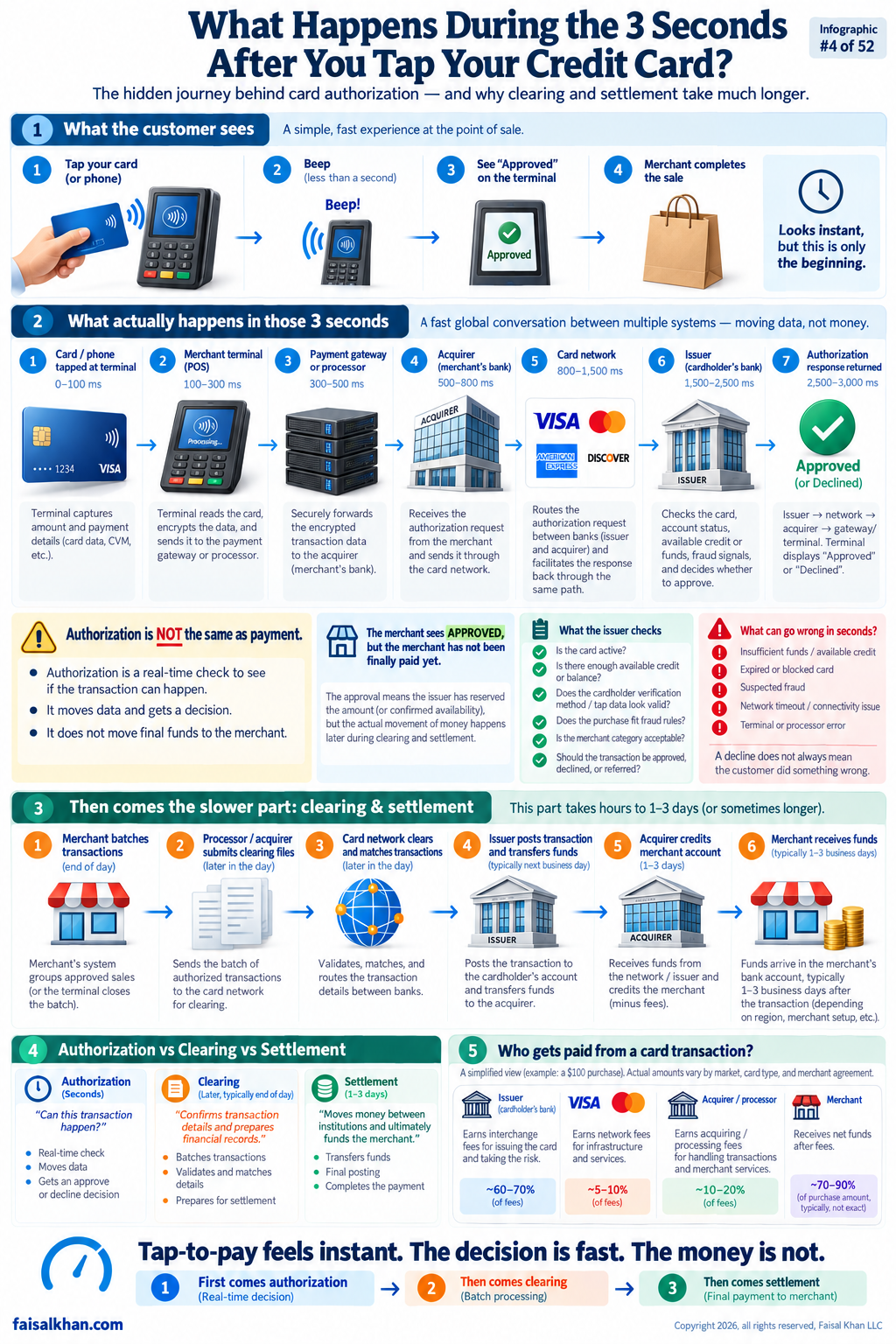
What the Customer Sees
The customer experiences four simple steps:
Tap → Beep → Approved → Take the purchase
That apparent simplicity is one of the achievements of modern card infrastructure.
A payment terminal, merchant systems, processors, acquiring institutions, card networks, and issuing banks can exchange enough information to make an authorization decision in only a few seconds.
But the green check mark on the terminal does not mean the merchant has already received the money.
It means the issuer has authorized the transaction to proceed.
That distinction is the key to understanding card payments.
What Actually Happens During Authorization
A typical card authorization can be represented conceptually as:
Card or phone → Terminal → Gateway/Processor → Acquirer → Card Network → Issuer → Response back to the terminal
The exact architecture varies. In some payment stacks, the gateway, processor, payment service provider, and acquiring functions are combined inside one provider. In others, they are separate companies and systems.
The infographic separates the roles because that makes the underlying payment architecture easier to understand.
The full round trip often completes within a few seconds.
The individual millisecond timings shown in the infographic are illustrative rather than guaranteed. Network conditions, merchant infrastructure, issuer systems, geography, authentication requirements, and transaction type can all affect response time.
Step 1: The Card or Phone Is Tapped
When a contactless card or mobile wallet is presented to the terminal, the terminal reads payment credentials using near-field communication.
Depending on the payment method, the information may include:
card or token credentials;
transaction amount;
terminal and merchant information;
cardholder-verification information;
security values or transaction-specific cryptographic data; and
other information required to construct the authorization request.
For a mobile wallet transaction, the credential presented may be a network or device token rather than the underlying card number.
At this stage, the merchant has captured the information required to request authorization.
No final payment to the merchant has occurred.
Step 2: The Merchant Terminal Creates the Payment Request
The point-of-sale terminal packages the transaction information and passes it into the merchant's payment infrastructure.
For an in-person transaction, the terminal may connect through a processor, payment service provider, or gateway environment.
A payment gateway is fundamentally a data layer. It captures or receives payment information, protects it, and forwards the authorization request into the processing chain.
This distinction matters:
The gateway moves transaction information. It does not itself represent the final movement of money to the merchant.
The same principle applies throughout authorization. Most of what is moving during these few seconds is data and decisioning.
Step 3: The Gateway or Processor Forwards the Transaction
The transaction now enters the processing infrastructure used by the merchant.
A processor may:
format the authorization message;
validate required transaction fields;
apply routing logic;
connect the transaction to the appropriate acquirer;
manage token or security information;
record the authorization attempt; and
relay the eventual approval or decline back toward the merchant.
The processor is effectively part of the machinery that allows many different merchant systems, banks, and card networks to communicate using standardized payment messages.
At this point, the payment still has not been finally settled.
Step 4: The Acquirer Receives the Authorization Request
The acquirer is the institution on the merchant side of the card transaction.
It provides—or sits behind—the merchant's ability to accept card payments and connect into the relevant card networks.
The acquirer and the issuer perform fundamentally different roles:
Acquirer: represents the merchant side.
Issuer: represents the cardholder side.
The acquirer receives the authorization request and sends it toward the appropriate card network.
Depending on the commercial setup, a processor or payment service provider may perform technical processing on behalf of the acquirer, while the acquirer remains the institution carrying the acquiring relationship and financial exposure.
Step 5: The Card Network Routes the Request
The card network connects the acquiring side of the transaction with the issuing side.
Networks such as Visa and Mastercard provide the rules, switching infrastructure, message standards, and settlement mechanisms that allow issuers and acquirers to transact with one another.
During authorization, the network identifies the relevant issuer and routes the authorization request to it.
The card network is therefore not simply a logo printed on a card.
It is part of the infrastructure that allows a merchant's bank and a cardholder's bank to communicate.
Step 6: The Issuer Makes the Decision
The issuer is the bank or financial institution responsible for the cardholder's card account.
This is where the critical authorization decision is made.
The issuer may evaluate several factors, including:
Is the card or account active?
Is the credential valid?
Is there sufficient available credit or account balance?
Does the transaction pass fraud and risk controls?
Is the transaction type permitted?
Does the merchant category raise any restrictions?
Do geographic, behavioral, velocity, or device signals create concern?
Is additional authentication or another action required?
The exact decision logic differs among issuers and transactions.
A US$20 coffee purchase and a US$4,000 electronics purchase do not necessarily receive the same risk treatment.
The issuer then decides whether to approve, decline, or in some environments request additional action.
Step 7: The Authorization Response Comes Back
Once the issuer makes its decision, the response travels back through the payment chain:
Issuer → Card Network → Acquirer/Processor → Merchant System → Terminal
If approved, the merchant receives an authorization response.
If declined, the merchant receives a decline response.
This round trip is why the terminal can display an answer within seconds.
But an approval does not mean that the merchant now possesses the settled funds.
It means the transaction has passed the authorization stage.
Authorization Is Not Payment
This is the most important concept in the entire infographic.
Authorization asks:
“Can this transaction proceed?”
The issuer checks the account and returns a real-time decision.
An approval may reduce the cardholder's available credit or place a hold against available funds, depending on the product and transaction.
But the merchant has not necessarily received final payment.
Settlement asks:
“How do the financial institutions complete the transaction?”
That occurs later.
The authorization provides the basis for the transaction.
Clearing creates and reconciles the financial records.
Settlement moves the resulting obligations between the institutions involved.
Merchant funding occurs when the merchant ultimately receives the proceeds according to its acquiring agreement.
These stages are connected, but they are not the same event.
Why a Transaction Can Be Declined in Seconds
Several things can cause an authorization to fail even when the cardholder believes the card should work.
Common reasons include:
insufficient available credit or funds;
expired or blocked credentials;
fraud or risk rules;
issuer restrictions;
transaction-type restrictions;
authentication failure;
connectivity or network problems;
malformed transaction data; or
terminal, gateway, processor, or issuer-side technical errors.
A decline does not automatically mean that the customer attempted something improper.
It means the authorization request did not receive an approval under the rules and conditions applied to that transaction.
Then Comes the Slower Part: Clearing and Settlement
Once a transaction has been authorized and subsequently captured by the merchant, the payment enters a different phase.
This is where the financial records are prepared and the obligations between institutions are calculated and settled.
The process is generally much slower than authorization.
It may occur later the same day, overnight, or over subsequent business days depending on the merchant, acquirer, network, geography, card product, processor, and funding arrangement.
The infographic separates this into six conceptual steps.
Step 1: The Authorized Transaction Is Captured
Authorization and capture are related but separate concepts.
Authorization reserves or confirms the ability to transact.
Capture tells the acquiring side to proceed with the financial transaction.
Some merchants capture transactions immediately.
Others capture later.
Hotels, car-rental companies, restaurants, e-commerce merchants, and businesses where the final amount can change may have more complex authorization and capture patterns.
A transaction can therefore be authorized without ultimately being captured and settled.
Step 2: Transactions Are Grouped for Clearing
Historically, merchants commonly closed a batch of transactions at the end of the business day.
Modern systems may automate much of this process, but the underlying idea remains useful:
authorized and captured transactions must be submitted for clearing.
The processing system sends the relevant financial records onward so the card network and participating institutions can reconcile what happened.
The payment is moving from real-time decisioning into financial accounting and settlement preparation.
Step 3: The Card Network Clears the Transactions
Clearing establishes the detailed financial positions arising from the day's transactions.
The network can:
validate transaction records;
match transaction information;
route clearing records between acquirers and issuers;
calculate applicable network and interchange-related amounts;
determine settlement obligations; and
create the information required for interbank settlement.
This is why authorization and clearing are separate.
The authorization message answers whether a purchase can proceed.
The clearing process establishes the financial record that will be settled.
Step 4: Settlement Occurs Between the Financial Institutions
Settlement is where financial obligations between the issuing and acquiring sides are completed through the network's settlement arrangements and the relevant banking infrastructure.
The cardholder's issuer owes value into the system for the cleared transaction.
The acquiring side receives value according to the applicable settlement process.
Importantly, settlement is commonly performed on net positions, rather than treating every retail purchase as a separate bank-to-bank payment.
An institution may have millions of transactions flowing in both directions.
The settlement system calculates what participating institutions ultimately owe one another after the relevant clearing calculations.
That is far more efficient than moving the gross value of every transaction individually.
Step 5: The Acquirer Funds the Merchant
After the acquiring side receives or recognizes the relevant settlement proceeds, the merchant can be funded under the terms of its agreement.
The merchant usually receives the transaction amount minus the applicable card-acceptance fees and adjustments.
Funding timing can vary substantially.
A merchant might receive funds on a next-day basis, after several business days, or under another agreed schedule.
High-risk businesses, cross-border merchants, new merchants, or businesses subject to reserve arrangements may experience different funding conditions.
So when a customer sees Approved, the merchant may still be hours or days away from receiving usable funds in its bank account.
Authorization vs. Clearing vs. Settlement
Stage | Primary Question | What Happens | Typical Character |
|---|---|---|---|
Authorization | Can this transaction happen? | The issuer evaluates the transaction and returns approve/decline | Real-time; usually seconds |
Capture | Should the approved transaction now be completed? | The merchant/acquirer acts on the authorization | Immediate or later |
Clearing | What exactly must each institution account for? | Transaction records are validated, exchanged, reconciled, and prepared for settlement | Usually later/batch-oriented |
Settlement | What does each institution ultimately owe? | Financial obligations are settled between participating institutions | Usually hours to business days |
Merchant Funding | When does the merchant get usable proceeds? | The acquirer/processor credits the merchant according to its funding schedule | Depends on merchant agreement |
The terminology is important because the word payment often gets used to describe all five stages as though they were one event.
Operationally, they are distinct.
Who Gets Paid From a Card Transaction?
A card transaction also creates an economic chain.
The merchant normally does not receive the full purchase amount.
Different components of the merchant's card-acceptance cost can include:
Interchange
Interchange is generally paid through the acquiring side to the issuing side under card-network rules.
It compensates the issuing side for its role in the card system and varies based on factors such as card type, geography, merchant category, transaction method, and regulatory environment.
Network or Scheme Fees
Card networks charge fees for access to and use of network infrastructure and related services.
These are separate from interchange.
Acquirer, Processor, Gateway, or PSP Charges
The acquiring and processing side charges for merchant acquiring, transaction processing, gateway services, fraud tools, settlement, support, and other services depending on the commercial model.
Merchant Net Proceeds
The merchant receives the remaining transaction proceeds after the applicable fees, adjustments, reserves, refunds, or other contractual deductions.
Important: There is no universal percentage split among issuer, network, acquirer, processor, and merchant. Pricing varies significantly by market, card product, merchant category, transaction type, commercial agreement, and regulation.
The fee panel in the infographic should therefore be read as a conceptual illustration of who participates economically, not as a universal rate card.
Why the System Is Designed This Way
At first glance, separating authorization, clearing, and settlement may seem unnecessarily complicated.
There are good reasons for the architecture.
Speed at Checkout
Customers and merchants need a decision almost immediately.
The system therefore performs authorization as a fast message exchange.
It would be impractical to complete the entire financial settlement process before allowing the customer to leave the checkout.
Risk Control
The issuer can evaluate available credit, account status, fraud indicators, and other signals before allowing the merchant to proceed.
Efficient Settlement
Clearing and net settlement allow enormous numbers of transactions to be reconciled and settled efficiently rather than requiring an individual interbank money transfer for every card purchase.
Reconciliation
Merchants, processors, acquirers, networks, and issuers all need consistent records explaining what was authorized, captured, cleared, settled, refunded, disputed, or reversed.
Separating the stages makes that accounting possible.
The Three Different Things Happening in a Card Payment
A useful mental model is to separate the transaction into three layers.
1. Data
During authorization, payment information and decision messages travel extremely quickly.
This includes credentials, transaction details, security information, routing information, and approval or decline responses.
2. Risk and Permission
The issuer determines whether the transaction should be allowed.
Fraud controls, account status, available funds or credit, authentication, and other rules influence that decision.
3. Money and Accounting
Later, clearing and settlement turn the approved transaction into financial obligations between institutions and ultimately into merchant funding.
These three layers interact, but they should not be confused.
The customer experiences one tap. The card system experiences data movement, risk decisioning, financial clearing, interbank settlement, and merchant funding.
Why “Approved” Can Be Misleading
From a user-experience perspective, Approved appears final.
Financially, it is closer to:
“The issuer has agreed that this transaction may proceed under the current authorization.”
Several things can still happen afterward.
A transaction may be:
reversed;
voided;
partially captured;
captured for a different final amount where permitted;
refunded;
disputed;
charged back; or
fail to complete under unusual circumstances.
Authorization therefore creates an important commitment in the process, but it is not identical to final settlement.
Frequently Asked Questions
Does tapping a credit card actually move money instantly?
No.
The tap initiates a real-time authorization process. The final financial settlement and merchant funding occur separately.
What is the difference between an issuer and an acquirer?
The issuer is on the cardholder side and issued the card or account credential.
The acquirer is on the merchant side and enables the merchant to accept card transactions.
What does the card network do?
The network provides the infrastructure and rules that connect acquiring and issuing institutions. It routes authorization and clearing information and facilitates settlement between participating institutions.
Is a payment gateway the same as an acquirer?
No.
A gateway is primarily a technology and connectivity layer used to capture and transmit payment information.
An acquirer is the financial institution responsible for the merchant-side acquiring relationship.
A single commercial provider can offer both capabilities, which is why the terminology is sometimes blurred.
Why does the merchant not get paid immediately after approval?
Because approval is authorization, not settlement.
The transaction must still be captured, cleared, settled, and funded according to the merchant's acquiring arrangement.
How long does settlement take?
There is no single universal time.
Merchant funding can occur on different schedules depending on the acquirer, processor, market, card network, merchant category, risk profile, weekend or holiday timing, and commercial agreement.
A common merchant experience is funding within one to several business days, but the exact timing varies.
Does every card payment follow exactly the same seven authorization steps shown in the infographic?
No.
The infographic separates functional roles for educational clarity.
In a real payment stack, one provider may perform the gateway, processor, payment-service-provider, and acquiring functions together.
The functional logic remains broadly similar even when the organizational structure is different.
The Big Picture
A contactless card payment feels almost instantaneous because the part visible to the customer is the fastest part of the process.
The terminal is not waiting for the entire financial system to settle the purchase.
It is waiting for a decision.
That decision travels through a sophisticated chain of payment infrastructure and returns within seconds.
Only afterward do the slower financial processes begin.
So when the terminal flashes Approved, remember what it actually means:
Authorization happened.
Clearing comes next.
Settlement comes after that.
Merchant funding comes last.
The best way to summarize the entire infographic is:
Tap-to-pay feels instant. The decision is fast. The money is not.
Technical References
These references support the conceptual distinction between authorization, clearing, settlement, issuers, acquirers, and payment processing:
Mastercard — Mastercard Switching Explained:
https://www.mastercard.com/eea/switching-services/our-technology/transaction.htmlVisa Developer — VisaNet Connect — Acceptance:
https://developer.visa.com/docs/visanet-connect-acceptanceStripe — Card Authorization Explained:
https://stripe.com/resources/more/card-authorization-explainedStripe — How Card Payment Processing and Settlement Works:
https://stripe.com/resources/more/credit-card-payment-authorization-and-transaction-settlement-process