
A crypto mixer also called a cryptocurrency mixer, tumbler, or mixing service is a service or mechanism intended to make the relationship between incoming and outgoing blockchain transactions less obvious.
The important distinction is that a mixer does not erase a blockchain transaction. Public blockchains continue to record transactions. The mixer attempts to weaken the easy, direct link between a particular input wallet and a particular output wallet.
Core idea: a mixer is an obfuscation layer. It is designed to make transaction linkability harder—not to make blockchain history disappear.
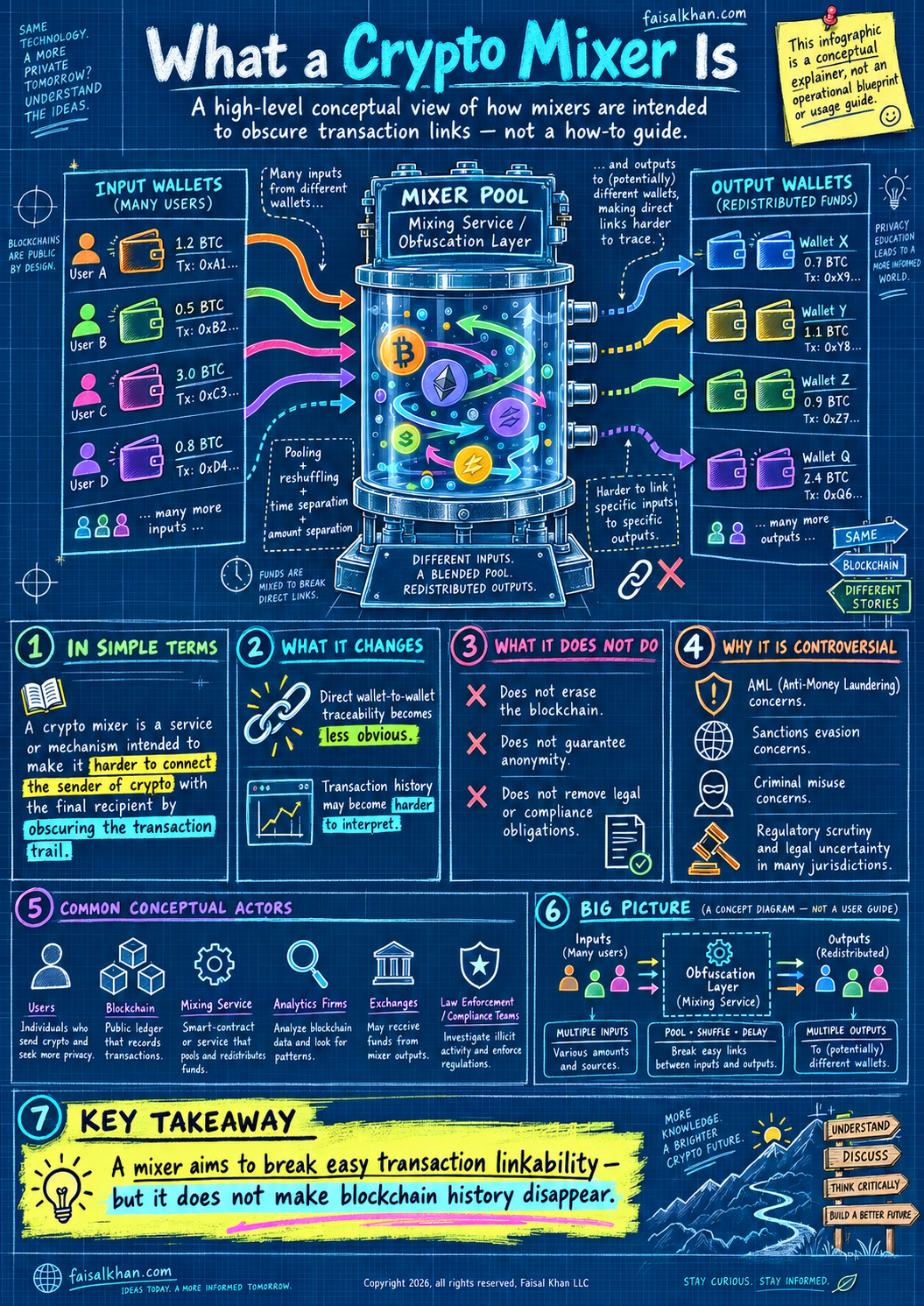
The infographic presents a conceptual view only. It is intended to explain the role of a mixer in a transaction graph, not provide instructions for operating or using one.
Start With an Ordinary Blockchain Transaction
Without an obfuscation layer, a blockchain transfer can create a relatively straightforward relationship between a sending address and a receiving address.
A blockchain explorer can show that value moved from one address to another. Depending on the blockchain and the surrounding data, investigators, compliance teams, exchanges, and analytics providers may then try to connect those addresses with known entities, services, or transaction histories.
The blockchain itself normally records addresses and transactions rather than a person’s name. The investigative question is therefore not simply, “What address sent the funds?” It is also, “Who or what controls that address?”
What the Mixer Changes
The center of the infographic represents the mixer as an obfuscation layer between multiple inputs and multiple outputs.
Conceptually, instead of presenting a clean visual relationship such as:
Wallet A → Wallet B
the transaction history may become more difficult to interpret because activity involving multiple users or addresses is combined, reorganized, or redistributed through the service.
The objective is to weaken obvious one-to-one transaction linkability.
That is why the infographic uses the image of a mixing chamber: many inputs enter, while outputs emerge without preserving a simple visual line that says, “this exact input became this exact output.”
This is a conceptual metaphor, not a literal description of every mixer. Different services and protocols can be designed differently.
What a Mixer Does Not Do
This is one of the most important parts of the infographic.
A mixer does not make the blockchain disappear.
It does not automatically guarantee anonymity.
It does not remove regulatory, sanctions, tax, reporting, or compliance obligations.
It does not mean that funds can never be traced or attributed.
Public blockchain data remains available. Analytics providers, financial institutions, law-enforcement agencies, and investigators can use transaction history, known service addresses, exchange records, customer information, and other data sources to assess the provenance and destination of funds.
So the practical distinction is:
Obscured does not mean erased.
Why People Associate Mixers With Privacy
There is a legitimate privacy discussion around public blockchains.
On many public networks, transaction histories are visible indefinitely. Once an address becomes associated with a real person or business, prior and subsequent activity involving that address can become easier to analyze.
A privacy-oriented user may therefore object to the idea that every counterparty should be able to inspect the financial history associated with a wallet.
This is part of the reason privacy-enhancing technologies exist.
But privacy technology and illicit-finance risk can overlap. A mechanism that makes legitimate users harder to profile can also make stolen funds, ransomware proceeds, sanctions evasion, fraud proceeds, or other illicit activity more difficult to follow.
That dual-use characteristic is why mixers receive unusually intense regulatory and compliance attention.
Why AML and Compliance Teams Care
For a regulated financial institution, exchange, payment company, or stablecoin business, exposure to a known mixing service can materially change the risk assessment of a transaction.
The concern is not that every transaction associated with a mixer is automatically criminal. The concern is that an obfuscation service can reduce transparency about the source or destination of funds.
That can make several questions harder to answer:
Where did the assets originate?
Is there exposure to stolen funds or fraud proceeds?
Is a sanctioned person or service involved?
Can the customer explain the economic purpose of the transaction?
Does the activity fit the customer’s expected profile?
Does the transaction require escalation or investigation?
Crypto and stablecoin businesses therefore commonly combine customer due diligence with wallet screening, transaction monitoring, sanctions controls, and blockchain analytics. Faisal Khan’s page on compliance and AML controls for stablecoin businesses explains how those controls fit into a broader crypto compliance program.
The Five Actors Shown in the Infographic
The infographic simplifies the ecosystem into five conceptual actors.
1. Users
Users control wallets and initiate blockchain transactions.
They may have many different reasons for seeking additional privacy, but their transactions still exist within the broader blockchain and regulatory ecosystem.
2. The Blockchain
The blockchain is the public or shared ledger that records the transactions.
The mixer does not remove that ledger. Instead, it attempts to make the relationship between transaction inputs and outputs less straightforward to interpret.
3. The Mixing Service or Protocol
This is the obfuscation layer.
Its role is to reduce obvious transaction linkability between incoming and outgoing activity.
The exact architecture varies by service or protocol, so the infographic intentionally treats this as a conceptual black box rather than an operating blueprint.
4. Blockchain Analytics Providers
Analytics companies examine blockchain data, identify known services and addresses, build transaction graphs, and assign risk or attribution information to blockchain activity.
Their analysis is probabilistic and evidence-based rather than magical. An address can be easy, difficult, or impossible to attribute with confidence depending on the available information.
5. Exchanges, Compliance Teams, Regulators, and Law Enforcement
At the points where crypto interacts with regulated institutions, additional information can exist outside the blockchain itself.
That can include customer identity information, account records, transaction-monitoring alerts, sanctions screening, deposit and withdrawal records, and investigative information.
For regulated businesses, these controls sit within the wider AML and BSA compliance framework.
Why “Mixing” Is Not the Same as “Deleting the Trail”
Imagine a room containing hundreds of strings connecting inputs to outputs.
A normal transaction may look like one clearly visible string from Point A to Point B.
A mixer attempts to make the room considerably more complicated, so that a direct visual connection becomes less obvious.
But the room still exists.
The entry points still exist.
The exit points still exist.
The blockchain still contains transactions.
And other records may exist at exchanges, custodians, payment providers, or counterparties.
That is why the bottom of the infographic emphasizes:
A mixer aims to break easy transaction linkability—but it does not make blockchain history disappear.
Why Crypto Mixers Are Controversial
The controversy comes from the collision of two ideas.
The first is financial privacy. Public blockchains can expose transaction histories in ways that would be unusual in traditional consumer banking.
The second is financial transparency and crime prevention. Regulators and financial institutions need mechanisms to identify money laundering, sanctions evasion, ransomware proceeds, stolen assets, terrorist financing, fraud, and other illicit activity.
Mixers can sit directly between those objectives.
U.S. authorities have repeatedly identified mixing activity as an illicit-finance risk. FinCEN proposed special reporting measures for certain convertible virtual currency mixing activity, and the U.S. Treasury has sanctioned specific mixer services in connection with illicit finance and sanctions-evasion concerns.
That does not mean every privacy-enhancing technology is identical, every mixer operates the same way, or every user has the same intent. Legal and regulatory treatment depends on the service, jurisdiction, facts, counterparties, and applicable rules.
What a Compliance Team May See
The user may see only a wallet transaction.
A compliance team may see a much larger risk picture:
Customer identity → wallet history → service exposure → sanctions screening → blockchain analytics → transaction pattern → source-of-funds questions → escalation decision
The mixer therefore becomes one data point in a broader assessment rather than a standalone verdict.
A strong compliance process asks what the complete transaction history and customer context indicate.
Frequently Asked Questions
Is using a crypto mixer automatically illegal?
Not as a universal rule.
The legal position depends on jurisdiction, the particular service or protocol, sanctions status, licensing requirements, the origin and destination of the assets, and what the user or operator is doing.
Specific mixer services and operators have faced sanctions, enforcement actions, and criminal proceedings, so the relevant facts matter.
Does a mixer make cryptocurrency anonymous?
Not necessarily.
It may make direct transaction relationships harder to interpret, but blockchain activity remains recorded and other identifying information may exist outside the blockchain.
Can blockchain analytics still detect mixer exposure?
Often, yes.
Analytics providers may identify known services, transaction patterns, addresses, or other indicators associated with mixing activity. The strength of the attribution varies with the available evidence.
Is every transaction involving a mixer criminal?
No.
A mixer exposure indicator is a risk factor, not proof by itself that a particular user committed a crime.
Regulated institutions typically evaluate the complete context of the transaction and customer.
Why do banks and exchanges care about mixer exposure?
Because obfuscation can make source-of-funds, sanctions, fraud, and money-laundering risk harder to assess.
That can trigger enhanced review, additional questions, restrictions, reporting, or rejection depending on the institution’s policies and legal obligations.
The Big Picture
A crypto mixer should be understood as an obfuscation layer in a blockchain transaction graph.
It attempts to weaken easy links between transaction inputs and outputs.
It does not erase the blockchain.
It does not guarantee anonymity.
And it does not make legal or compliance obligations disappear.
The central lesson from the infographic is therefore simple:
Privacy can make a transaction harder to interpret. It does not make the transaction cease to exist.
Regulatory Context and Further Reading
FinCEN — Proposal of Special Measure Regarding Convertible Virtual Currency Mixing
https://www.fincen.gov/news/news-releases/fincen-proposes-new-regulation-enhance-transparency-convertible-virtual-currencyU.S. Department of the Treasury — First-Ever Sanctions on a Virtual Currency Mixer
https://home.treasury.gov/news/press-releases/jy0768