
Remittance cost calculator
Plug in every charge a transfer picks up on its way out, and see what it really costs the sender. Every percentage is taken on the original send amount, and all charges come off the send side before conversion.
This remittance cost calculator lets you name your own charges, switch any of them off, and compare a single amount against a standard ladder from 100 to 5,000. Nothing you enter leaves your browser.
FK-R003 · Remittance cost calculator v3
Amount
Sending side charges
Everything charged on the sending side: KYC, authentication, compliance, processing, revenue share.
Correspondent banking charges
Intermediary bank fees on the way across. Off by default.
Payout partner charges
What the partner paying out on the receive side charges. Off by default.
Exchange rate
Result
Cost to send 250.00 USD
Total charges 0.00 USD
No charges switched on yet. Add values above to see the cost.
How to read the remittance cost calculator
The headline number is the total cost as a percentage of the amount sent. It is the only figure that compares honestly across corridors and across send sizes — a flat 5 is cheap on 1,000 and ruinous on 50. Underneath it, the bar splits that cost by who takes it, which is usually more useful than the total: a corridor where most of the cost sits with a payout partner is a commercial problem, and one where most of it sits in your own processing is an engineering problem.
The three sections separate charges by where they arise, not by who pays them. Sending side covers everything you levy or absorb before the money leaves: onboarding checks, authentication, compliance screening, card or ACH processing, fraud tooling, and anything shared with a referral partner. Correspondent banking is what an intermediary deducts in transit — real on SWIFT routes, absent on local rails. Payout partner is what the receiving end charges to put the money in a hand, an account or a wallet.
Switch the remittance cost calculator to its table view once the charges are set. Nine send amounts, the same charges, and a cost column that shows you exactly where fixed fees stop dominating. That crossover point is the single most useful number in remittance pricing, and it is the reason minimum send amounts exist.
The exchange rate is usually the largest fee
A transfer advertised at zero fees is not free. The margin has simply moved into the rate, where the customer cannot see it without looking up the mid-market rate and doing the arithmetic themselves. On many consumer corridors the FX spread is several times the visible fee, and on some it is the entire revenue model.
This remittance cost calculator does not assume a spread, because it cannot know yours. Enter your customer-facing rate and the margin is already inside the receiver figure, invisible in the cost breakdown. Enter the mid-market rate instead, add a percentage charge for the spread, and you will see the cost the way a regulator, a price-comparison site, or a well-informed customer would see it — which is the view worth designing against.
The optional rate fetch exists for convenience and nothing more. It calls a public endpoint from your browser, it is not a price feed, and it is not a source to quote from. If it fails, enter the rate by hand; nothing else on the page depends on it.
What the remittance cost calculator does not model
The remittance cost calculator is a per-transaction model, so it says nothing about the costs that do not scale with a transfer: licensing and bonding, the compliance function, banking relationships, pre-funding and the working capital trapped in it, treasury losses, chargebacks and fraud write-offs, or the platform itself. A corridor can look healthy here and lose money in every other respect.
It also assumes charges are deducted before conversion and that percentages apply to the original send amount. Where your arrangement deducts sequentially, or takes a fee in the receiving currency after conversion, treat the output as close rather than exact — and when the difference matters enough to argue about, it is worth modelling the real waterfall rather than adjusting this one.
Questions we are asked most
How is the cost of a remittance actually made up?
Almost never by a single fee, which is why this remittance cost calculator asks for each layer on its own. A transfer picks up charges in layers: what the sending business charges to onboard and screen the customer, what its processor charges to take the money in, what it pays away in revenue share, what an intermediary bank deducts in transit, and what the partner paying out on the other side takes. On top of all of that sits the exchange rate, which is where the largest and least visible margin usually lives. Separating them is the only way to see which layer is actually expensive.
Are the percentages taken on the send amount or on what is left?
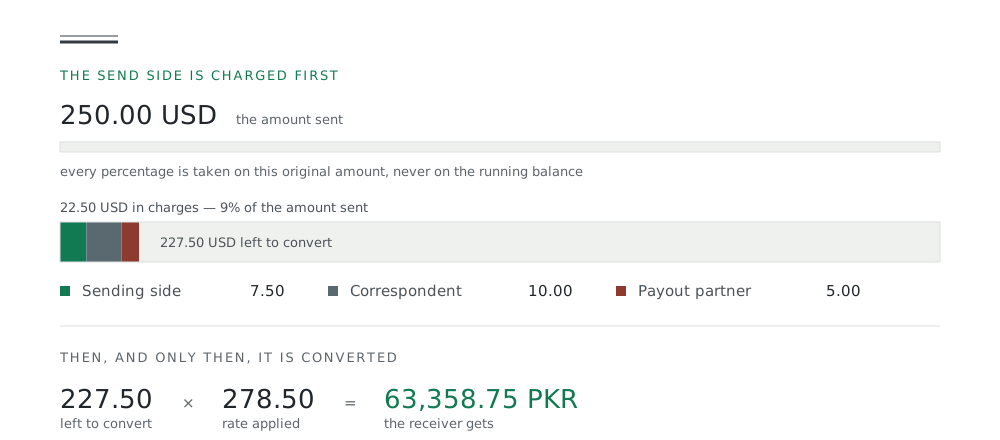
On the original send amount, every time. That is a deliberate modelling choice and it is what makes the sections add up: a 1% charge is 1% of the amount sent wherever it appears in the list, so the section subtotals sum to the total without compounding. If your real arrangement deducts sequentially — each party taking its cut from the diminishing balance — the true cost will be slightly lower than this shows, and the difference grows with the number of percentage-based charges.
Why are correspondent banking and payout partner charges switched off by default?
Because plenty of routes do not have them. A transfer that settles on a local rail, or one where you own the payout side, never sees a correspondent deduction. Leaving them on by default would build a pessimistic number into every model somebody ran without thinking about it. Switch them on when the corridor actually has them, and the bar chart will show you how much of the cost sits outside your own business.
Does the calculator include the FX margin?
Only if you put it there. The rate field applies whatever rate you enter, so if you enter the mid-market rate you will see a cost that excludes FX margin entirely, and if you enter your customer-facing rate the margin is already inside the amount the receiver gets. To see the margin as an explicit line, enter the mid-market rate and add a percentage charge for the spread. That is usually the more honest way to look at it, because it puts the largest cost in the same list as all the small ones.
What does “left to convert” mean?
The amount remaining after every switched-on charge has been deducted on the sending side — the figure that actually gets multiplied by the exchange rate. This tool assumes all charges come off before conversion, which is how most send-side pricing works. Where a fee is genuinely deducted on the receive side in local currency, model it as a payout partner charge and read the receiver figure as an approximation.
Can the charges be larger than the amount being sent?
On small amounts with several fixed fees, easily — and the calculator will tell you so rather than hiding it. That is not a bug in the model, it is the single most important thing about remittance economics: fixed costs make small transfers disproportionately expensive. Switch to the table view and compare the cost percentage at 100 against the same charges at 5,000. The gap is the reason corridors have minimum send amounts.
Where does the exchange rate come from?
From you, by default. The tool is a cost model, not a rate feed, and the rate you should be modelling with is usually your own rather than a public one. There is an optional mode that fetches a reference rate from a public endpoint in your browser; it is convenient for a sanity check and it is not a source you should price against. If it fails — and it can, because it is a third-party service we do not control — enter the rate by hand and nothing else on the page is affected.
Does the remittance cost calculator send anything I enter to you?
No. The calculation runs entirely in your browser and your inputs are kept in your browser’s local storage so the page remembers them when you come back. Nothing is transmitted to us, there is no form to submit, and clearing the page with “Reset everything” removes the stored values.
Once the numbers are on the table
A corridor is won on the charges you can remove, not the ones you can explain
A remittance cost calculator can only price the charges you already know about. Most of the cost in a route is structural: the rail it settles on, the partner paying out, where the pre-funding sits, and who you are licensed to be. Tell us the corridor, the volumes and the payout side, and we will map what the route actually requires and where the margin is recoverable.
See how we work on corridorsRegulatory notice and limitations
The transmission and movement of money are regulated activities and may require licences, registrations, approvals or other regulatory permissions in each jurisdiction in which you operate. This page is for general informational purposes only and does not constitute legal or regulatory advice; you should independently verify all applicable requirements and obtain appropriate professional and regulatory guidance before commencing any activity.
Faisal Khan LLC is an internet marketing and business development company. It is not a bank, money transmitter, broker-dealer, investment adviser or other regulated financial entity, and offers no financial services. Figures produced by this tool are illustrative and depend entirely on the values entered. Nothing here creates any advisory, fiduciary, agency or contractual relationship.
For what transfers cost in the market rather than in your own model, the World Bank’s Remittance Prices Worldwide publishes the average cost of sending money between specific country pairs each quarter, on a comparable basis. The reduction of those costs is also a formal policy target — UN Sustainable Development Goal 10.c commits to bringing remittance transaction costs to less than 3 per cent. Both are useful benchmarks for whatever percentage this calculator returns for your own route.