
The Triangle Every Currency Must Choose From
A country can promise three attractive things at once: your currency will stay steady, your money can move freely across borders, and your central bank can set interest rates for local needs. The problem is that global finance usually lets it keep only two. The third promise does not disappear politely. It breaks through the walls as a currency crisis, a capital-control notice, a drained reserve account, or a sudden change in bank behavior.
This is the impossible trinity, also called the monetary trilemma. It sounds like textbook economics, but it is really a street map for understanding why some countries restrict foreign transfers, why some pegs survive and others snap, why dollar funding becomes scarce in emerging markets, and why payment companies sometimes discover that licensing is the easy part while liquidity is the hard part.
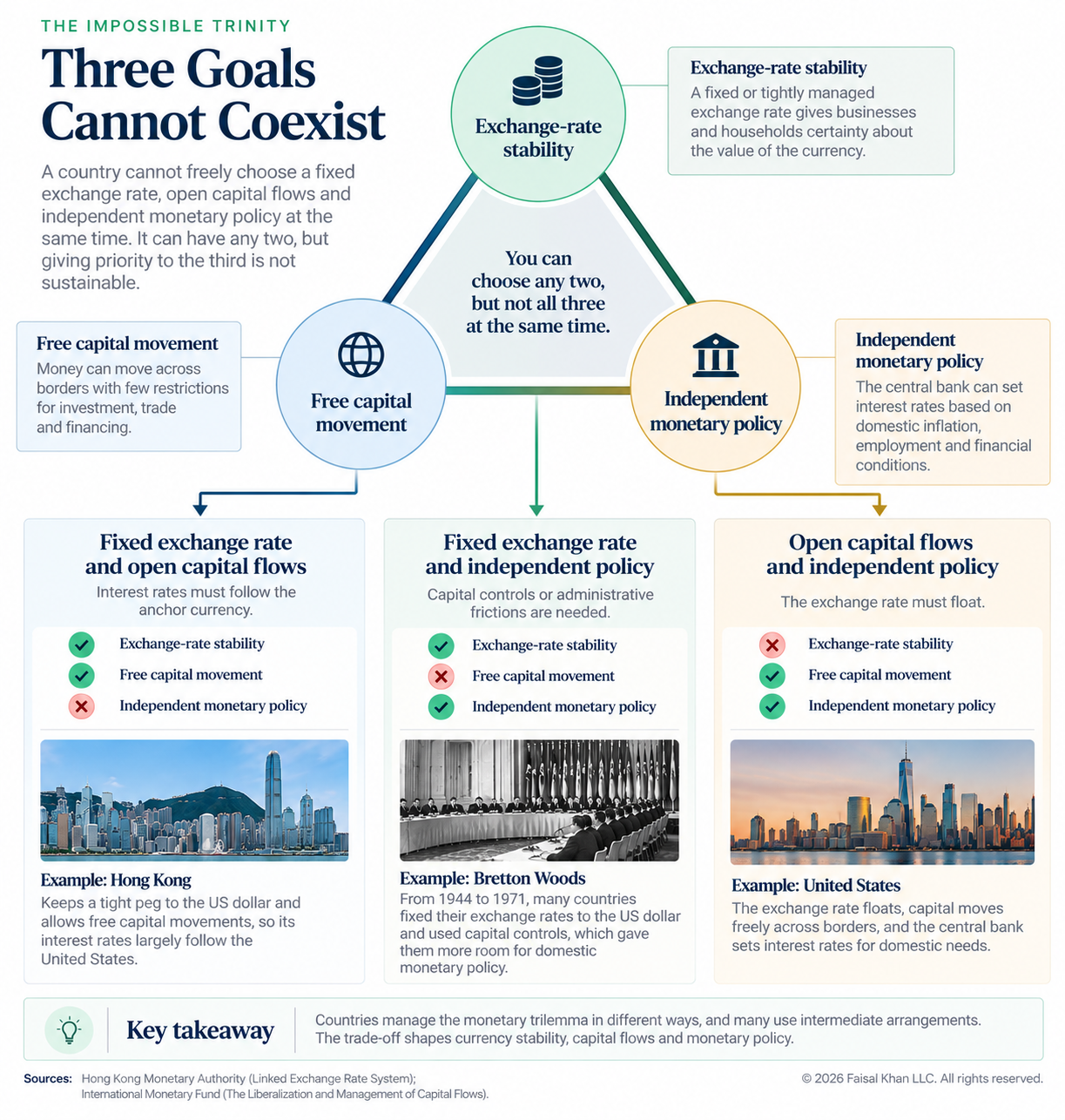
The trilemma says a country cannot fully maintain all three of the following at the same time: a fixed or tightly managed exchange rate, free movement of capital, and an independent monetary policy. You can pick any two. You cannot have all three in a durable way.
That is not because economists enjoy triangles. It is because money moves toward return, safety, and convertibility. If investors can move funds freely, they will compare domestic interest rates with foreign interest rates. If the exchange rate is fixed, they do not expect much currency loss. If the central bank tries to set domestic rates far away from the anchor country’s rates, capital will usually move in size. The central bank can fight that movement for a while, but the fight uses reserves, liquidity tools, credibility, or administrative restrictions.
The Three Corners
The first corner is exchange-rate stability. This can mean a hard peg, a currency board, a managed band, or a heavily managed currency. Stability helps importers, exporters, lenders, and households plan. If a merchant sells goods in local currency but pays suppliers in US dollars, a stable exchange rate can be the difference between manageable pricing and constant panic. It also helps governments that borrow in foreign currency because depreciation can make debt service more expensive overnight.
The second corner is free capital movement. This means residents and nonresidents can move money in and out with few restrictions. Foreign investors can buy local bonds. Local companies can hold offshore accounts. Banks can fund themselves internationally. Payment firms can repatriate balances, hedge exposure, and settle across borders without seeking case-by-case permission. This is attractive because it brings investment, liquidity, and integration into global markets.
The third corner is monetary-policy independence. This is the central bank’s ability to set interest rates based on domestic inflation, employment, credit growth, and financial conditions. If the economy is weak, the central bank may want lower rates. If inflation is too high, it may want higher rates. Independence matters because a country’s local cycle may not match the cycle of the United States, the euro area, or whichever currency it informally shadows.
The impossible trinity says these three desires collide. If you want a fixed exchange rate and open capital flows, your interest rates must largely follow the anchor currency. If you want open capital flows and independent interest rates, your exchange rate must float. If you want a fixed exchange rate and independent monetary policy, you need some form of capital control or administrative friction.
Why a Peg Changes Everything
Imagine a country pegs its currency to the US dollar. Investors believe one local unit will remain worth a fixed amount of dollars. Now suppose the Federal Reserve keeps rates high, but the local central bank cuts rates to support domestic lending. Money can earn more in dollars than in the local currency, and the exchange rate risk appears limited because of the peg. So capital starts leaving.
To defend the peg, the central bank sells dollars from its reserves and buys its own currency. That supports the exchange rate, but it also drains reserves. If the pressure continues, local liquidity can tighten, banks may become more cautious, and businesses may find that the published exchange rate exists but actual dollar access is slower, more expensive, or more documentary-heavy.
This is why a currency regime is never just a macroeconomic label. It becomes an operating condition for banks, fintechs, importers, payroll providers, remittance companies, and card acquirers. The law may say money can move. The banking system may quietly say: yes, but not today, not at that price, not without additional documents, or not above that amount.
Hong Kong is the cleanest modern example of the peg-plus-open-capital choice. The Hong Kong Monetary Authority says the Linked Exchange Rate System has operated since October 17, 1983, using a currency-board arrangement to keep the Hong Kong dollar within HK$7.75 to HK$7.85 per US dollar. That stability is powerful. But it also means Hong Kong interest rates are heavily influenced by US dollar conditions. The peg is not free. The price is a monetary system that must adjust through liquidity and rates rather than through an independent exchange-rate path.
Singapore shows a different version of the trade-off. The Monetary Authority of Singapore does not run monetary policy mainly by setting an overnight interest rate. It manages the Singapore dollar against a trade-weighted basket because Singapore is a very open economy where imports and exports are huge relative to GDP. MAS explains that exchange rates have a stronger influence on inflation than interest rates in Singapore, so the exchange-rate band becomes the central policy tool. Again, the point is not that Singapore lacks sophistication. It is that every open economy has to decide which instrument carries the burden.
The Bretton Woods Lesson
The trilemma also helps explain the old world of Bretton Woods. After World War II, many countries operated under fixed exchange rates, but capital controls were common. Money did not move as freely as it does today. That gave governments more room to manage domestic policy while keeping exchange rates stable. In trilemma language, the system chose exchange-rate stability and monetary-policy space, while limiting capital mobility.
When capital controls weakened and financial markets globalized, the bargain changed. Countries that wanted open capital markets had to tolerate more currency flexibility or import monetary conditions from the anchor currency. Many crises of the late twentieth century can be read as failed attempts to keep all three corners: stable exchange rates, mobile capital, and domestic policy freedom.
This is why crises often begin as a confidence question and end as a balance-sheet question. If people believe a peg can hold, money may stay. If they believe it cannot, everyone wants foreign currency before the adjustment happens. The very act of protecting oneself can make the peg harder to defend. A central bank can use reserves, raise rates, borrow externally, impose controls, or let the currency move. None of these choices is painless.
Capital Controls Are Not Always a Panic Button
Capital controls have a bad reputation because people associate them with crisis: blocked transfers, rationed dollars, frozen bank accounts, or emergency decrees. But in policy language, the category is wider. It can include limits on short-term foreign borrowing, taxes on speculative inflows, documentation requirements for offshore transfers, restrictions on residents buying foreign assets, or prudential rules that reduce banks’ foreign-currency mismatches.
The IMF’s modern view is more flexible than the older idea that capital-account liberalization is always best. The Fund recognizes that capital flows can bring benefits but also risks, and that capital-flow management measures may have a role in certain circumstances. That matters because it gives governments more policy legitimacy to use targeted tools rather than pretend the trilemma does not exist.
For payment and banking businesses, however, even reasonable controls create operating consequences. A rule designed to slow speculative flows may also affect merchant settlement, payout timing, prefunding, treasury movements, or the ability to centralize cash offshore. The policy may be macroprudential in intent, but it lands in product design, liquidity forecasting, and customer promises.
Stablecoins Make the Triangle More Interesting
Stablecoins add a modern twist. A dollar stablecoin can make dollar-like value easier to hold and transmit, especially in markets where local currency is volatile or banking access is limited. From the user’s perspective, it may feel like a faster payment rail. From the policymaker’s perspective, it may look like capital mobility with a better user interface.
This does not mean stablecoins automatically defeat capital controls. Governments can regulate exchanges, custodians, banks, on-ramps, off-ramps, and merchants. But stablecoins do change the texture of the trilemma. They can increase the speed at which people switch from local money to dollar-linked instruments. They can make offshore value storage more accessible. They can also expose the gap between a country’s official exchange-rate policy and the market’s revealed preference for dollar liquidity.
For consultants and product teams, the lesson is simple: a stablecoin corridor is not only a compliance question. It is also a macro question. If a jurisdiction is defending a currency, managing reserves, or tightening transfer rules, stablecoin activity may be seen less as payments innovation and more as pressure on the monetary perimeter.
Where the Trilemma Helps
The impossible trinity is useful because it prevents naive strategy. If a country has a hard peg, open capital markets, and a central bank that appears to be cutting rates independently, the consultant’s job is to ask what absorbs the pressure. Are reserves large enough? Are banks being guided informally? Are there hidden frictions in FX access? Are capital controls likely? Are payment firms expected to settle locally rather than repatriate daily? Are local customers exposed to currency mismatch?
It also helps explain why two countries with similar licenses can feel completely different operationally. In one market, an EMI, MSB, or payment institution can convert, hedge, and repatriate balances smoothly. In another, the same legal permission may sit on top of a fragile FX regime where banks ration access, correspondent banks worry about convertibility, and clients face settlement uncertainty.
The trilemma also explains why floating exchange rates, though politically unpopular, can be useful. A floating currency absorbs shocks through price. That can hurt importers and borrowers, but it may reduce the need for abrupt administrative controls. A peg can reduce daily volatility, but if it becomes misaligned, the eventual adjustment can be brutal. Stability is valuable, but artificial stability can be expensive.
Did You Know?
Hong Kong’s currency board is designed so that changes in the monetary base help keep the exchange rate within the official band. When the Hong Kong dollar weakens toward the weak side of the band, the system can drain local liquidity and push interest rates upward, making it more attractive to hold Hong Kong dollars.
Singapore is one of the rare major financial centers where the exchange rate, not the policy interest rate, is the main monetary-policy instrument. That makes sense for an economy where trade flows and import prices are central to inflation.
Capital controls can apply to inflows as well as outflows. Governments sometimes worry not only about money leaving, but also about too much short-term money entering, inflating asset prices, and then leaving suddenly.
A country can have a floating exchange rate on paper and still intervene heavily in practice. The real question is not just the label of the regime, but how much flexibility policymakers actually tolerate when pressure arrives.
Why It Matters Today
The trilemma matters more when the dollar is strong, global rates are high, commodity prices are volatile, or geopolitical risk pushes investors toward safety. Those are exactly the moments when emerging markets feel pressure in reserves, bank liquidity, import costs, and exchange-rate expectations. For cross-border businesses, this can change the feasibility of a market faster than a licensing update.
It also matters for banking access. Banks do not only underwrite AML risk. They underwrite convertibility risk, liquidity risk, sovereign risk, and reputational risk. A payment company operating in a country with worsening FX pressure may find that banking partners become more conservative even if the company itself is compliant. The bank is not only asking, “Is this client legal?” It is asking, “Can this client settle, convert, and return funds under stress?”
For crypto markets, the trilemma is one reason dollar-linked tokens become popular in unstable currency environments. They offer a private substitute for some functions of offshore banking. That popularity can create regulatory pushback because it touches the same nerve as capital flight, reserve depletion, and monetary sovereignty.
Practical Takeaway
Before advising a client to enter a market, do not start only with the license. Start with the triangle. Ask which two corners the country is trying to protect and which third corner is absorbing the strain.
If the country wants exchange-rate stability and monetary independence, expect controls, documentation, or informal banking friction. If it wants capital openness and monetary independence, expect FX volatility and hedging needs. If it wants a peg and open capital, expect local interest rates and liquidity to shadow the anchor currency more than domestic politics may admit.
The impossible trinity is not a slogan. It is a diagnostic tool. It tells you where the pressure will go before the pressure becomes visible in a client’s settlement account.
Important sources
Bank for International Settlements, Monetary policy spillovers, capital controls and exchange rate flexibility: https://www.bis.org/publications/working-paper-797-monetary-policy-spillovers-capital-controls-and-exchange-rate-flexibility-and-financial-channel-exchange-rates
Hong Kong Monetary Authority, Linked Exchange Rate System: https://www.hkma.gov.hk/eng/key-functions/money/linked-exchange-rate-system/
Monetary Authority of Singapore, Singapore’s Monetary Policy Framework: https://www.mas.gov.sg/monetary-policy/singapores-monetary-policy-framework
National Bureau of Economic Research, The Trilemma in History: Tradeoffs Among Exchange Rates, Monetary Policies, and Capital Mobility: https://www.nber.org/papers/w10396
International Monetary Fund, Liberalization and Management of Capital Flows: An Institutional View: https://www.imf.org/en/Publications/Policy-Papers/Issues/2016/12/31/The-Liberalization-and-Management-of-Capital-Flows-An-Institutional-View-PP4720