
Why Bond Markets Scare Governments
In September 2022, the British government announced a fiscal plan intended to accelerate growth. Within days, the price of long-dated government bonds collapsed, yields surged, pension funds came under pressure, and the Bank of England began emergency purchases to stop a self-reinforcing market spiral. A policy announced in Parliament had collided with a verdict delivered on trading screens.
The episode looked like a confrontation between democracy and finance: elected officials wanted to cut taxes, while anonymous investors seemed to say no. The truth was more complicated. The market move reflected doubts about fiscal arithmetic, but it was magnified by leveraged pension-fund strategies that were forced to sell gilts as prices fell. Even so, the political lesson was unmistakable. A government can pass a budget by vote. It cannot vote the price at which investors will refinance it.
That is why bond markets scare governments. They do not usually overthrow a policy in one dramatic moment. They alter the interest bill, the exchange rate, mortgage costs, bank balance sheets, pension funds, and the amount of room left for everything else. A government may control the law. The bond market prices the time.
Why governments borrow at all
Governments rarely collect taxes on the same schedule that they spend money. They also finance wars, recessions, infrastructure, pensions, health systems, and emergencies whose costs exceed current revenue. The gap is covered by issuing debt.
A government bond is a tradable promise. The state receives money now and agrees to make specified payments later. Short instruments may mature in weeks or months. Long bonds may remain outstanding for decades. Some pay fixed interest. Some are linked to inflation. Some are issued in the government’s own currency; others are payable in a currency the government cannot create.

Borrowing is not automatically a sign of failure. A deep sovereign-bond market gives pension funds, banks, insurers, foreign reserve managers, and households a relatively safe asset. It also creates a benchmark against which mortgages, corporate bonds, swaps, and other credit can be priced. The U.S. Treasury describes its debt-management objective as financing the government at the lowest cost over time through regular, predictable issuance and transparent auctions.
The danger appears when borrowing stops being a bridge and becomes a dependency: when large deficits must be financed every year, when old bonds mature faster than the government can comfortably replace them, or when investors begin to doubt the currency and policy framework behind the promise.
The price-yield seesaw
Bond prices and bond yields move in opposite directions. If an existing bond promises fixed payments and investors become less willing to hold it, its market price falls. A buyer purchasing at that lower price earns a higher return relative to the amount paid. The yield has risen.
This is not merely a loss for whoever owns yesterday’s bond. The secondary market becomes the reference price for tomorrow’s borrowing. If comparable five-year government bonds now yield 6%, a treasury will struggle to sell a new five-year bond at 3%. Investors can already buy similar risk in the market at the higher yield.
The market therefore disciplines a government without needing to reject an auction outright. It simply demands a more expensive price for time.
Refinancing is where fear becomes arithmetic
Suppose a government has US$100 billion of fixed-rate debt costing 1% a year. Its annual interest bill is US$1 billion. A market selloff does not instantly change the coupon on those existing fixed-rate bonds. But when they mature, the government must repay them or issue replacement debt.
If the replacement debt costs 5%, the annual interest bill on that US$100 billion becomes US$5 billion. The extra US$4 billion must come from higher taxes, lower spending, more borrowing, or money creation. None is politically free.
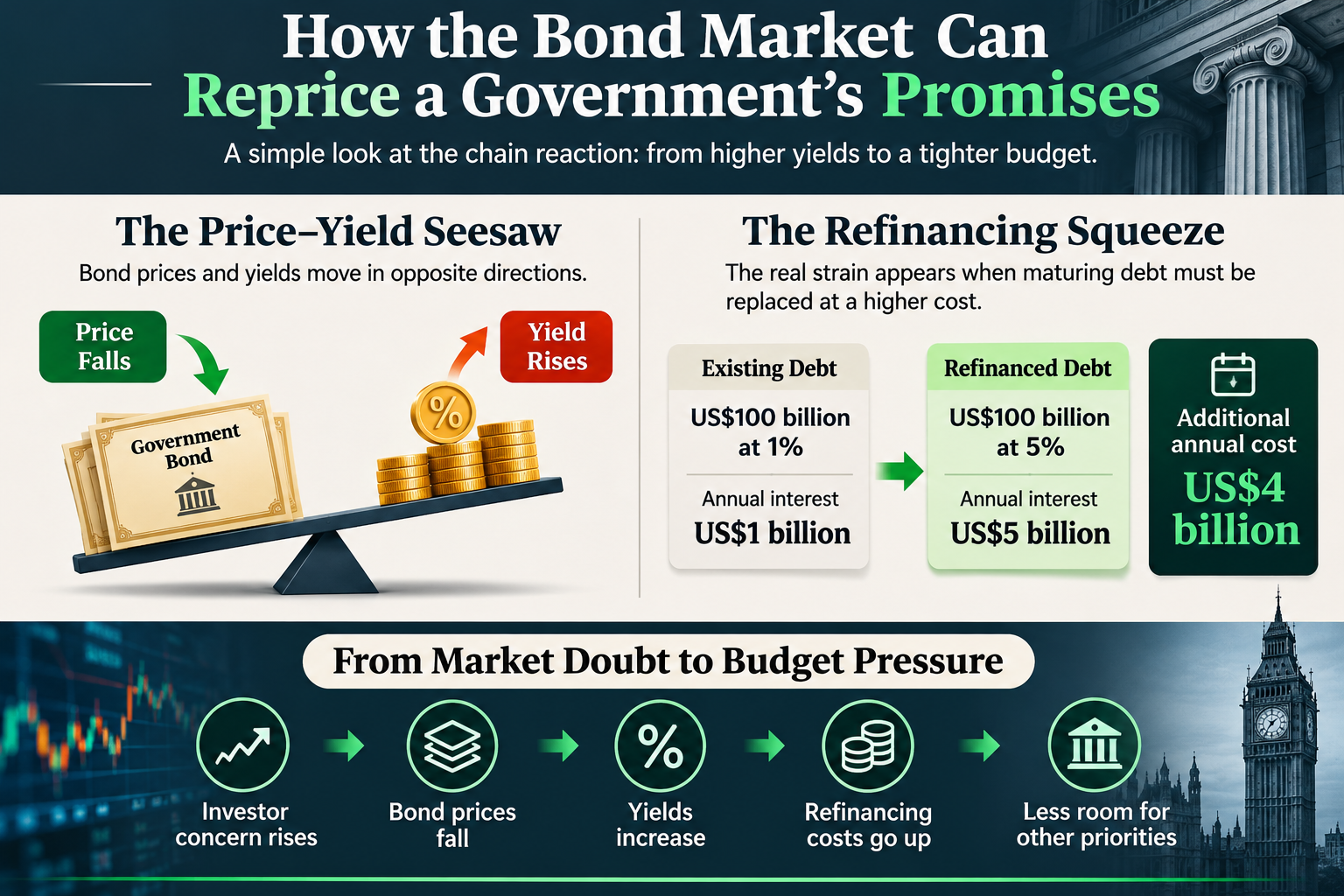
This is refinancing risk: the danger that maturing debt can be replaced only at a sharply higher cost—or cannot be refinanced on workable terms at all. The speed of the squeeze depends on the debt’s maturity profile. A government funded with long-term fixed-rate bonds has time. One dependent on short-term bills or floating-rate debt feels higher rates much faster.
Inflation-linked debt can shorten that fuse in another way. When inflation rises, its payments rise too. Debt held through a central bank can also become more rate-sensitive than it appears. Quantitative easing often replaces long-term government bonds with interest-bearing central-bank reserves; when policy rates rise, the public sector’s effective interest cost can reset quickly.
The United Kingdom offers a live illustration. In July 2026, the Office for Budget Responsibility reported that debt-interest spending had more than doubled as a share of GDP from just before the pandemic and reached £110 billion in 2025–26—then the country’s third-largest spending area after health and welfare. A yield chart had become a budget choice.
What the market is actually afraid of
Investors do not sell government bonds for one reason. They may fear inflation, because fixed future payments will buy less. They may expect central-bank rate increases. They may worry that a larger supply of bonds will overwhelm demand. They may question the credibility of the budget, the stability of the government, or the willingness of future taxpayers to support the debt.
For a country borrowing in foreign currency, the question is harsher. It may owe dollars or euros while collecting taxes in pesos, cedis, lira, or rupees. If the local currency falls, the debt becomes more expensive in domestic terms. The government cannot print the currency it owes, so a loss of market access can become an external-payment crisis.
Default risk and inflation risk are often substitutes. A government that cannot create the payment currency may default openly. A government that can create it is less likely to run out of nominal money, but investors may demand protection against inflation, depreciation, or financial repression. The printing press changes the form of the constraint; it does not abolish the constraint.
The people called bond vigilantes
Commentators sometimes call investors who punish loose fiscal or monetary policy “bond vigilantes.” The phrase is colorful but slightly misleading. There is no committee of masked traders deciding that a finance minister has behaved badly.
The market is a collection of institutions with different motives. Pension funds match long-term liabilities. Banks manage liquidity and regulatory capital. Insurers need assets against future claims. Foreign central banks hold reserves. Hedge funds trade relative value and leverage. Asset managers answer to clients who can withdraw money. Dealers must finance inventories. Each may sell for a different reason.
The result can still resemble collective discipline. If enough investors demand a higher yield at once, the government’s cost of capital rises. If leveraged holders face margin calls, selling can become mechanical. The market may then move beyond a reasoned reassessment of fiscal policy and enter a liquidity spiral: falling prices cause forced sales, which cause further falls.
What the UK gilt crisis actually showed
The 2022 British episode is often summarized as “markets rejected the mini-budget.” That is directionally true but incomplete.
Long-dated gilt yields had already been rising in a world of inflation and tighter monetary policy. The fiscal announcement added uncertainty about borrowing and credibility. At the same time, liability-driven investment funds used by pension schemes had leveraged exposure to long-dated gilts and derivatives. When gilt prices fell sharply, collateral calls arrived. To raise cash, funds sold more gilts, pushing prices down again.
The Bank of England judged the dysfunction a material threat to financial stability. It launched temporary, targeted purchases of long-dated conventional and index-linked gilts. Between September 28 and October 14, it bought £19.3 billion, giving funds time to reduce leverage and rebuild resilience. It later sold the portfolio back to the market.

This distinction matters. The central bank was not declaring the government’s budget affordable. It was stopping a fire-sale mechanism from damaging the wider financial system. Market functioning and fiscal credibility were separate problems that happened to erupt in the same asset.
Why some governments have more room than others
Not every sovereign faces the bond market on equal terms.
A country that borrows mainly in its own currency, has a credible central bank, a broad domestic investor base, long average maturities, reliable tax collection, and a liquid bond market can usually absorb more stress. Reserve-currency issuers receive an additional advantage because global institutions need their securities for reserves, collateral, and liquidity.
A country with short maturities, foreign-currency debt, thin reserves, weak tax capacity, political instability, or a narrow investor base can lose market access much faster. A rise in U.S. yields may pull capital away even if its own fiscal policy has not changed.
Debt-to-GDP is therefore not enough. Two governments with the same ratio can have completely different risks. One may owe long-term fixed-rate debt in its own currency to domestic pension funds. The other may owe short-term dollar debt to foreign investors. The headline number is identical; the refinancing problem is not.
Can the central bank simply defeat the market?
A central bank can buy government bonds, lend against them, or promise to cap certain yields. This can restore liquidity and, for a time, overpower private selling. The World War II-era United States and more recent Japan both demonstrate that yields are not forces of nature.
But the intervention moves the argument elsewhere. If the central bank suppresses yields while inflation is high, investors may sell the currency instead. If it creates reserves to absorb unlimited debt, monetary policy can become subordinate to fiscal needs—a condition often called fiscal dominance. If it protects every investor from loss, it can encourage greater leverage and weaken market discipline.
Central-bank support is most credible when the objective is clear. A temporary operation to repair market plumbing is different from a permanent promise to finance any deficit at a politically convenient rate. The first buys time. The second risks converting a bond-market problem into an inflation or currency problem.
The useful side of fear
Governments dislike rising yields, but a bond market that never objects is not necessarily healthy. Prices carry information. A widening risk premium can reveal that investors see inflation, debt, currency, or governance risks that official forecasts understate.
Bond markets also reward credibility. Transparent budgets, independent statistics, predictable issuance, resilient institutions, and a believable medium-term fiscal plan can widen the investor base and reduce borrowing costs. The market’s discipline is imperfect and sometimes brutal, but the alternative—administratively forcing institutions to fund the state—can hide risk until it emerges as inflation, capital flight, trapped savings, or a banking crisis.
The problem is not that markets have opinions. It is that they can change those opinions faster than governments can change budgets.
How to read a sovereign before the panic
Start with the maturity profile: how much debt must be refinanced in the next one, three, and five years?
Then compare the average interest rate on the existing debt with the yield on new borrowing. The gap estimates the direction of future debt-service costs.
Look at the share denominated in foreign currency, the portion linked to inflation or floating rates, the strength of foreign-exchange reserves, and who owns the bonds. A stable domestic pension base behaves differently from leveraged offshore funds.
Finally, compare interest spending with government revenue—not only GDP. Debt service is paid from the budget. A country can carry a large debt stock for years and still be forced into austerity when interest consumes the cash needed for public services.
The decisive question is not simply, “How much does the government owe?” It is, “At what price, in which currency, to whom, and how soon must it ask for the money again?”
The market at the edge of politics
A parliament can authorize a tax cut. A cabinet can promise a railway, a subsidy, a war, or a rescue package. A treasury can schedule an auction. But between the political promise and the money required to honor it sits a market that continuously recalculates the price of trust.
That market is not always wise. It can overshoot, panic, follow momentum, and amplify hidden leverage. Yet governments fear it because its mistakes do not make it powerless. A bond selloff can raise refinancing costs before economists agree on the diagnosis and before voters reach the next election.
Governments write obligations into law. Bond markets decide how expensive those obligations are to carry through time.
Important sources
Bank of England, Financial stability buy/sell tools: a gilt market case study:
Office for Budget Responsibility, Fiscal risks and sustainability – July 2026:
https://obr.uk/frs/fiscal-risks-and-sustainability-july-2026/
International Monetary Fund, Sovereign Debt – Focus Areas:
https://www.imf.org/en/topics/sovereign-debt/focus-areas
U.S. Department of the Treasury, Financing the Government:
https://home.treasury.gov/policy-issues/financing-the-government/