
The First Money Did Not Jingle
The first money may have looked less like treasure and more like paperwork. Imagine an administrator in an early farming settlement pressing a small clay cone into a wet tablet. The mark might represent a measure of grain owed to a temple, delivered to a storehouse, or promised to a worker. No coin changes hands. Yet value has been measured, an obligation has been recorded, and somebody’s claim can now be checked later.
That humble mark contains much of what modern finance still does. A bank balance, an invoice, a card payment, and a stablecoin transfer all depend on a record that says who owns what, who owes what, and whether an obligation has been settled. Coins eventually made money portable. But accounting may have made money possible.
The Story We Like to Tell
The familiar story begins with barter. A farmer has wheat but wants shoes. The shoemaker wants fish, not wheat, so trade fails until everyone agrees to use a convenient intermediate object—perhaps silver, shells, or eventually coins. Money appears as a clever solution to the “double coincidence of wants.”
It is a neat explanation, and barter certainly existed. The difficulty is treating it as a universal historical sequence: first barter, then money, then credit. Archaeology and surviving records show something less tidy. Long before minted coins, societies counted goods, measured dues, recorded loans, paid workers in standardized quantities, and carried balances forward. Credit and accounting were not late refinements added to cash. In several early economies, they were part of the monetary machinery from the start.
This does not mean that one person invented money on a particular afternoon, or that every society followed the Mesopotamian route. Cattle, shells, beads, metal by weight, reciprocal gifts, tally systems, and many other arrangements emerged in different places. Money has no single origin story. The stronger and more defensible claim is that important monetary functions existed thousands of years before coinage.
The Accountant Arrived Before the Mint
Agriculture created a new administrative problem. A mobile hunting group could rely heavily on memory, custom, and direct sharing. A settled community producing grain, oil, livestock, and textiles had to keep track of larger quantities over longer periods. Harvests entered storehouses. Rations went to laborers. Families owed dues. Temples and palaces redistributed goods. Promises made after planting might not be settled until harvest.
Memory alone was no longer enough.
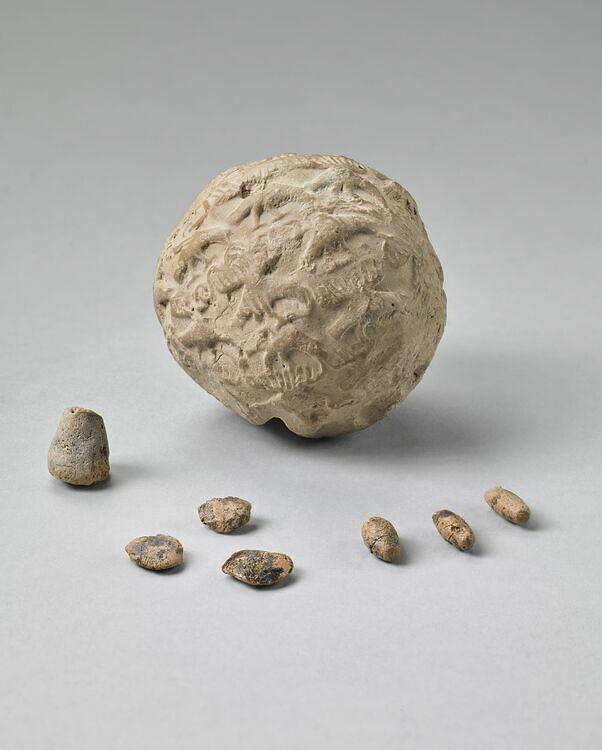
Across the ancient Near East, small clay tokens were used to represent quantities of goods. Archaeologist Denise Schmandt-Besserat traced such objects at sites dating from roughly 8000 to 3000 BCE. Cones, spheres, discs, cylinders, and other shapes served as counters. A particular shape could stand for a measure of grain; another could represent livestock or another commodity.
The important innovation was abstraction. The token was not valuable because anybody wanted to eat or wear it. Its value came from what it represented. That is already remarkably close to the logic of money: a physical object gains economic meaning because a community accepts the relationship between the sign and the underlying claim.
When the Token Became a Record
Tokens solved one problem but created another. If tokens represented a delivery or obligation, how could parties prevent them from being removed, added, or disputed? One response was to seal tokens inside hollow clay envelopes, often called bullae. The outside could be marked or sealed to identify the transaction or parties.
But a sealed envelope hid its own contents. To check it, someone might have to break it open. The next step was wonderfully practical: impress the shapes of the enclosed tokens onto the wet clay outside. Then the contents could be read without opening the envelope.
Eventually, the impression made the physical token unnecessary. Why place a clay cone inside an envelope if its sign could be pressed directly onto a flat tablet? Three-dimensional counters became two-dimensional marks. Administrative notation developed into proto-cuneiform, and writing expanded far beyond accounting.
This is one of history’s most consequential accidents of administration. Some of humanity’s earliest writing was not poetry, philosophy, or royal biography. It was recordkeeping: quantities of barley, distributions of goods, labor allocations, debts, and receipts. Civilization’s written memory began, in significant part, as a ledger.
Money Without Coins
To understand how this could be money, separate money’s functions from its physical form.
Economists usually describe money as performing three connected jobs. It is a unit of account, allowing values and obligations to be expressed in a common measure. It is a means of payment, allowing an obligation to be discharged. It is a store of value, allowing purchasing power or a claim to survive across time.
A single object does not always perform all three jobs equally well. In ancient Mesopotamian systems, barley could be used for rations and payments, while silver measured by weight could serve as a unit of value for larger obligations. A debt might be written in silver even when settlement occurred through goods. The shekel itself began as a unit of weight before it became the name of a coin and, much later, a modern currency.
This is the key idea: money can exist as a system of measurement and claims even when no standardized piece of currency circulates from hand to hand. If a temple records that a worker is entitled to grain, the record is a claim. If a merchant’s silver debt is documented and later discharged, the tablet helps create a credit relationship. If taxes, wages, and prices are expressed in a common unit, the unit is doing monetary work whether or not a coin exists.
The ledger does not merely describe the economy. It helps organize it.
What Coins Actually Changed
Minted coins appeared much later, commonly associated with Lydia and neighboring parts of western Anatolia in the late seventh century BCE. Metal had been weighed and exchanged long before that. The novelty was the stamp: an authority certified a piece of metal as a recognizable denomination.
That reduced verification costs. A trader no longer had to weigh and test every piece of metal from scratch. Coins were durable, portable, divisible, and useful in transactions between people who lacked an ongoing relationship. They could travel beyond the institution that kept a particular ledger.
Coins therefore solved a different problem from accounting. A ledger works especially well when participants recognize the recordkeeper and can enforce claims. A coin can function as a bearer instrument: possession itself carries the claim. It is closer to cash than to a bank account.
Coinage helped states pay soldiers, collect taxes, display political authority, and support wider markets. But it did not create the ideas of price, debt, payment, or standardized value. It packaged those ideas in a form that moved more easily.
The Power—and Danger—of the Ledger
Ledger money offers extraordinary advantages. It reduces the need to move bulky commodities. It allows payment to be delayed. It supports credit, specialization, taxation, and large organizations. Most importantly, it permits many transactions to be settled by changing records rather than transferring physical wealth each time.
But a ledger introduces power. Someone decides which entries are valid, who may hold an account, how disputes are resolved, and whether a balance can be frozen or erased. An accurate ledger can coordinate an economy; a corrupt or exclusionary ledger can become an instrument of control.
Physical money shifts some of that power toward the holder, but creates other risks: theft, counterfeiting, loss, debasement, and the cost of transport. Financial history repeatedly swings between these two designs—account-based money administered by an institution and token-based money controlled by whoever possesses it.
Neither model eliminates trust. It merely relocates it.
The Ancient Argument Inside Modern Payments
Today, most money does not jingle either. Commercial bank deposits are entries on bank ledgers. When a card payment occurs, the visible tap is only the instruction. Behind it, institutions authenticate the parties, update claims, calculate net obligations, and settle between banks.
Electronic money repeats the same pattern. A customer’s balance is a claim recorded by an issuer. Safeguarding rules matter because the number on the screen is only as reliable as the assets, controls, and legal rights behind it.
Stablecoins appear to return money to token form, but the distinction is not clean. The token moves on a blockchain ledger, while its value may depend on reserves held through banks, custodians, and government securities recorded on conventional ledgers. Even a supposedly bearer-like digital asset relies on rules about issuance, redemption, keys, consensus, and finality.
A blockchain is therefore not the opposite of ancient accounting. It is an ambitious answer to the oldest accounting question: how can a group agree on the state of a ledger when no single bookkeeper is fully trusted?
Did You Know?
The word “calculate” is related to the Latin calculus, meaning a small stone used for counting. The technology changes; the instinct to turn obligations into manageable symbols does not.
The shekel was originally a weight, not a coin. This is why ancient references to silver can describe weighed metal rather than minted currency.
Many surviving cuneiform tablets are economic documents: accounts, receipts, loans, wage records, and commodity distributions. Ancient bureaucracy endured because baked or dried clay can survive long after more glamorous materials disappear.
The Practical Takeaway
For a banking, payments, or crypto consultant, the history suggests a useful diagnostic. Whenever a product claims to have invented a new kind of money, ask five old questions: What is the unit of account? What asset or obligation supports the claim? Who controls the ledger? What event makes payment final? How can the holder redeem or enforce the balance?
Those questions separate a payment interface from a monetary system. A sleek wallet may be only a new window onto a conventional bank ledger. A stablecoin may be a transferable token resting on an old-fashioned reserve account. A cross-border platform may move no principal across borders at the moment of payment, but instead coordinate claims and later settle net balances.
The clay token and the digital token are separated by nearly ten thousand years, yet they perform a strangely similar intellectual trick. They turn something difficult to carry—a sack of grain, a debt, a claim on reserves—into a symbol that people can count, transfer, and trust.
Coins were revolutionary. But before money could be stamped, it had to be remembered.
Important sources
Denise Schmandt-Besserat, The Invention of Tokens, University of Texas at Austin: https://sites.utexas.edu/dsb/tokens/the-invention-of-tokens/
Denise Schmandt-Besserat, The Evolution of Writing, University of Texas at Austin: https://sites.utexas.edu/dsb/tokens/the-evolution-of-writing/
The Metropolitan Museum of Art, The Origins of Writing: https://www.metmuseum.org/essays/the-origins-of-writing
The British Museum, Money Gallery guide: https://www.britishmuseum.org/sites/default/files/2021-05/Money_Gallery_LPG_2020_Room_68.pdf
The Metropolitan Museum of Art, Cuneiform tablet: caravan account: https://www.metmuseum.org/art/collection/search/325851
Bank of England, Money in the modern economy: an introduction: https://www.bankofengland.co.uk/-/media/boe/files/quarterly-bulletin/2014/money-in-the-modern-economy-an-introduction
Cambridge University Press, The Origins of Money in the Iron Age Mediterranean World: https://www.cambridge.org/core/books/origins-of-money-in-the-iron-age-mediterranean-world/9D9895496388A8BD90FFF2E4C0D228D0