
When England Ran Part of Its Financial System on Split Wood
On October 16, 1834, Britain accidentally set fire to Parliament while trying to dispose of old financial records. The records were not paper ledgers. They were wooden sticks.
Workers fed two cartloads of obsolete Exchequer tally sticks into furnaces beneath the House of Lords. The furnaces overheated, nearby woodwork caught fire, and most of the old Palace of Westminster was destroyed. It was a spectacular ending for an accounting technology that had helped the English state collect revenue, acknowledge payments, and finance itself for centuries.
The strange part is not that medieval officials wrote numbers on wood. The strange part is that the wood sometimes behaved like money.
What exactly was a tally stick?
A tally stick was usually a piece of hazel marked with notches representing an amount. The notches were cut before the stick was split lengthwise. Each party received a matching portion, commonly described as the stock and the foil.
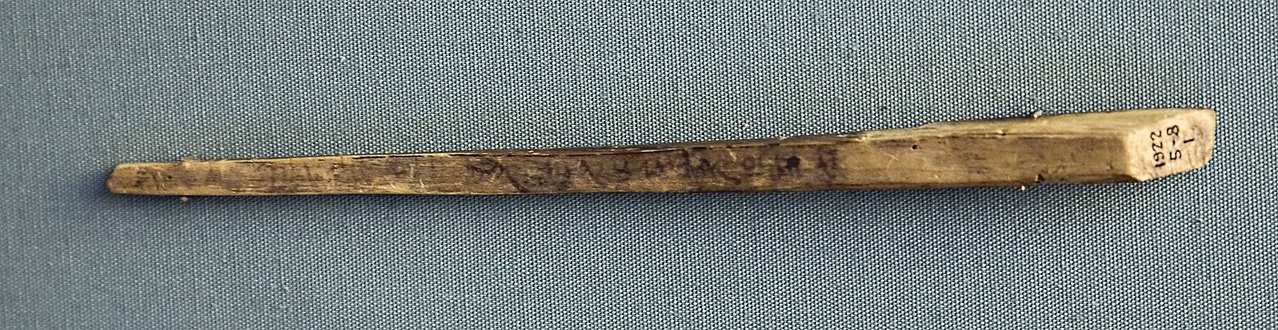
The two pieces preserved the same cuts and could later be fitted together. Altering one half was difficult because a newly carved notch would not appear on its counterpart, while replacing the entire piece meant reproducing the wood's grain, shape, and irregular split. It was not perfect security, but it was an ingenious physical checksum.
The system also worked in a society where literacy was limited and parchment was relatively costly. A person did not need to read a dense legal document to recognize a sequence of cuts or see whether two pieces matched. The object carried the evidence.
England's Exchequer used tallies from at least the Middle Ages to record money received, debts, and authorized payments. Government was not relying on wood instead of accounting. Tallies operated alongside written rolls, officials, witnesses, and legal obligations. The stick was one component in a wider institutional system.
From receipt to financial instrument
Imagine that a sheriff owed the Crown a fixed amount of tax revenue. When money was paid into the Exchequer, a tally could record the payment. One portion remained in the government's records and the other served as proof for the payer.
But tallies could do more than confirm a transaction that had already happened. The Crown could also use claims against future revenue to pay creditors. A supplier, soldier, financier, or royal official might receive an instrument tied to taxes that had not yet arrived.
That claim could be valuable before its final redemption. If another person trusted the Crown's obligation and believed the designated revenue would be collected, the holder could transfer the claim, often at a discount. A promise from the state had acquired a market price.
This is where the tally becomes more than an antique receipt. It begins to resemble short-term government paper: an obligation issued against expected revenue, transferable between holders, and ultimately settled through the fiscal system.
The Bank of England has described transferable debts recorded on tally sticks as functioning like money for large transactions. That distinction matters. A tally was not necessarily everyday currency used to buy bread. It could still perform important monetary functions within a network of taxpayers, merchants, creditors, and government officials.
Why would anyone accept a piece of wood?
The value was not in the hazel. Burning the stick for heat would destroy almost all of its financial worth. Its value came from the claim it evidenced and the system that recognized that claim.
Four elements made the arrangement credible:
Verification: the split pieces could be matched, making casual alteration detectable.
Recordkeeping: the physical tally was supported by the Exchequer's written accounts and administrative procedures.
Enforceability: the Crown and its revenue machinery stood behind the obligation, however imperfectly.
Redeemability: the instrument could discharge or claim value within the tax and payment system.
This is a recurring theme in monetary history. People often say money works because everyone believes in it. That is true but incomplete. Belief is usually anchored to something practical: a tax obligation, a legal claim, a redemption promise, a regulated balance sheet, a commodity market, or a network that reliably accepts the instrument.
A modern payment balance works for similar institutional reasons. The number displayed on a banking app has negligible physical substance. Its usefulness rests on who owes the balance, whether it can be transferred, where it is accepted, how disputes are resolved, and what happens if the issuer fails.
Was it really money?
The answer depends on what question is being asked.
If money means the dominant object used for ordinary retail purchases, tally sticks were not a substitute for coin. Medieval and early modern England still depended heavily on metallic currency.
If money includes transferable claims used to settle significant obligations, finance the state, and move purchasing power between parties, some tallies clearly entered monetary territory.
This prevents a common historical mistake: treating economies as if they used one pure form of money at a time. Coin, credit, bills, book entries, tax claims, and physical tokens could coexist. Today's mixture of central-bank reserves, bank deposits, cash, card balances, electronic money, money-market instruments, and stablecoins is not a historical exception. Monetary systems have almost always been layered.
The discount tells the truth
A government tally with a face value of 100 units might trade for less than 100. The difference reflected time, inconvenience, liquidity, and risk. How long would the holder wait? How easily could the claim be transferred? Was the assigned tax stream reliable? Would officials honor it without delay?
In other words, the market could price the state's promise before modern bond terminals, credit ratings, or benchmark yield curves existed.
This point matters because an instrument can be accepted as payment without being equivalent to cash at par. Liquidity has degrees. A bank deposit, a Treasury bill, a money-market fund share, and a stablecoin may all appear close to money in normal conditions, yet trade differently when redemption becomes uncertain or markets become stressed.
An old technology survived a new financial world
Tally sticks did not disappear the moment paper, literacy, or modern banking arrived. The Bank of England's museum holds a tally connected to one of the Bank's first loans to the government in 1694. The wooden instrument and the institution often associated with modern public finance briefly occupied the same system.
That overlap is revealing. Financial technologies rarely replace one another overnight. New arrangements grow around established legal rights, administrative habits, and trusted workflows. Paper can coexist with wood; banknotes with coin; instant payments with correspondent banking; stablecoins with conventional deposit accounts.
The English Exchequer stopped using the old tally system in 1826. Eight years later, the attempt to burn the accumulated leftovers destroyed much of Parliament. The obsolete records had outlived their operational purpose but retained enough physical presence to reshape London's skyline.
What tally sticks teach us about digital money
It is tempting to call tally sticks an early blockchain. That comparison is catchy and mostly unhelpful. Tallies did not create a decentralized consensus network, broadcast transactions globally, or execute programmable rules.
The better comparison concerns design principles.
Both old and new financial instruments must answer the same questions: Who issued the claim? What does the holder own? How is authenticity tested? Can ownership be transferred? What settles the obligation? What happens after fraud, loss, default, or disagreement?
A stablecoin reserve statement without enforceable redemption rights is not made safe by cryptography. A tokenized deposit is not useful merely because it moves on a distributed ledger. A fast payment message is not final settlement unless the governing system says that it is.
The tally stick succeeded because the physical object, the accounting records, the tax system, and the authority of the Exchequer reinforced one another. Remove that institutional structure and the stick becomes firewood.
The practical takeaway
For a banking, payments, licensing, or digital-asset consultant, the lesson is simple: never evaluate a financial product only by looking at the instrument.
Map the complete promise behind it. Identify the issuer, legal claim, backing assets, redemption path, settlement method, transfer restrictions, records of ownership, fraud controls, and failure procedure. Then ask whether the instrument remains usable when trust is tested rather than merely when everything is working.
The most durable payment innovations are rarely just clever objects or elegant software. They are agreements between technology, law, accounting, and state power.
Medieval England demonstrated that principle with a split piece of hazel.
Important sources
Bank of England, Payments Through Time: https://www.bankofengland.co.uk/museum/whats-on/2019/325-years-exhibition/payments-through-time
Bank of England, It's Time to Talk About Money: https://www.bankofengland.co.uk/-/media/boe/files/speech/2020/its-time-to-talk-about-money-speech-by-jon-cunliffe.pdf
UK Parliament, The Great Fire of 1834: https://www.parliament.uk/about/living-heritage/building/palace/architecture/palacestructure/great-fire/
UK Parliament, Medieval Tally Sticks: https://www.parliament.uk/about/living-heritage/building/palace/estatehistory/from-the-parliamentary-collections/fire-of-westminster/tallysticks/
Science Museum Group, Medieval Exchequer Tally Sticks: https://collection.sciencemuseumgroup.org.uk/objects/co60506/medieval-exchequer-tally-sticks