
The Certificate That Pays Like Debt but Claims to Own Something
A government wants to finance an airport. Investors want a predictable return. In a conventional market, the answer is straightforward: issue a bond, promise interest, and repay the principal at maturity. In Islamic finance, that simple contract raises a deeper question. If money itself is not supposed to earn a guaranteed return merely because time has passed, how can a government raise billions from investors who still expect to be paid?
The answer is sukuk—a security that may sit on the same trading screen as a bond, produce payments on nearly the same dates, and mature with almost the same result, yet reaches that result through a different legal road. Instead of saying, “You lent us money and we owe you interest,” the structure says, “You own a share of an asset, its use, or an investment activity, and your return comes from what that ownership produces.”
Sometimes that difference is profound. Sometimes it is uncomfortably thin.
What a Sukuk Actually Is
The word sukuk is the plural of sakk, an Arabic word associated historically with a written certificate or legal instrument. In modern finance, sukuk are certificates of equal value representing proportional interests in assets, their use, a project, or an investment venture.
A conventional bondholder is principally a creditor. The issuer owes principal and interest under a debt contract. A sukuk holder is supposed to have an ownership interest linked to something economically productive. The return may come from rent, trading profit, manufacturing, agency investments, or partnership income.
That does not mean every holder has a set of keys to an airport or a fraction of a power station recorded at the land registry. Ownership may be beneficial rather than formally registered, and it may pass through a special-purpose vehicle or trustee. The documents—not the marketing label—determine what the investor actually owns.
This distinction matters because Islamic commercial finance generally rejects riba, commonly understood in modern finance as prohibited interest on a loan. It also places limits on excessive uncertainty and purely speculative contracting. Profit is legitimate when connected to ownership, trade, services, enterprise, or the assumption of risk.
The Simplest Structure: Sell, Lease, Repurchase
Imagine a government owns an office building and wants to raise US$500 million.
It establishes a special-purpose vehicle, or SPV. The SPV issues sukuk certificates to investors and uses the proceeds to acquire the building—or a defined beneficial interest or right to use it—from the government.
The SPV then leases the building back to the government. The government pays rent, which funds periodic distributions to sukuk holders. At maturity, the government buys back the asset or interest, and the proceeds redeem the certificates.
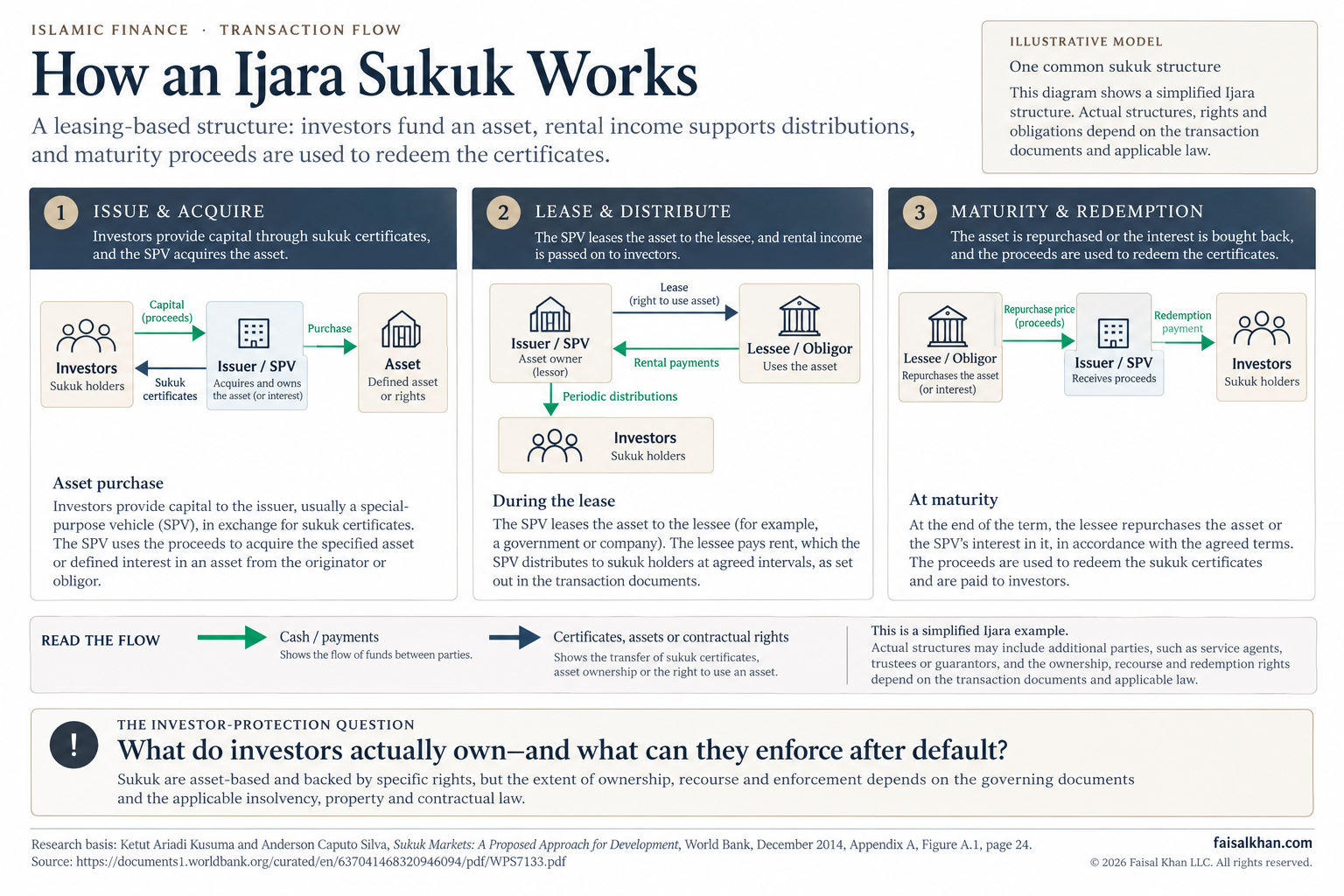
Economically, investors advanced US$500 million, received regular payments, and recovered US$500 million at maturity. That looks remarkably like a bond. Legally, however, the cash flow was designed as purchase price, rent, and repurchase proceeds rather than loan principal and interest.
This is an ijara sukuk, built around leasing. Other structures use different commercial relationships. Murabaha uses the purchase and resale of goods at a disclosed markup. Istisna can finance construction or manufacturing. Mudaraba and musharaka use forms of investment partnership. Wakala appoints an agent to invest in an agreed pool of Sharia-compliant assets.
Those names are not decorative Arabic alternatives for “bond.” They help determine where profit comes from, who bears loss, what investors own, and whether the certificates may be traded.
The Most Important Distinction: Asset-Based or Asset-Backed?
The language surrounding sukuk often suggests that investors own real assets. The critical question is whether that ownership gives them meaningful legal recourse.
In an asset-backed sukuk, assets are transferred through a genuine sale to a bankruptcy-remote vehicle. Investors rely substantially on the assets and their cash flows. If the originator fails, holders should have enforceable rights over the transferred pool, subject to the documents and local insolvency law.
In an asset-based sukuk, assets support the contractual structure, but investors may ultimately rely on the credit of the sovereign or company that promised to make payments or repurchase the assets. The transfer may be beneficial rather than a perfected legal sale. In a default, investors may have a claim against the obligor but little practical ability to seize or sell the supposed underlying asset.
This is the trapdoor beneath the elegant description of “ownership.” Two sukuk can use similar language and pay similar returns while offering very different recovery rights.
The World Bank summarizes the issue plainly: the difference turns on whether the asset transfer is effective against third parties and the originator’s insolvency estate. If it is not, an investor who thought he owned part of a building may discover that he mainly owns a claim against the company using it.
Why Sukuk Still Resemble Bonds
Institutional investors want predictable cash flows, recognizable credit risk, and repayment on a defined date. Issuers want financing costs they can budget. Markets therefore exert strong pressure on sukuk to behave like conventional fixed-income securities.
Periodic distributions are often priced using the same benchmarks used by conventional markets, such as SOFR or government bond yields, plus a spread. A purchase undertaking may promise to buy the assets at maturity for enough money to return the original investment. Reserve accounts, guarantees, and liquidity facilities may stabilize payments.
Using a conventional benchmark does not by itself turn rent or investment profit into prohibited interest. A benchmark can be a measuring stick rather than the legal source of the return.
The harder question is substance. If investors bear almost none of the risks normally associated with ownership, receive a return engineered to mirror interest, and are promised their principal regardless of asset performance, critics ask what meaningful difference remains.
Supporters reply that law routinely uses different contracts to reach similar commercial objectives. Leasing and borrowing can have comparable economics without becoming the same transaction. For them, the question is whether each sale, lease, agency, and undertaking is genuine and whether the required rights and risks are actually present.
This debate—form versus substance—is one of Islamic finance’s central tensions.
When Sharia and Secular Law Collide
A sukuk is governed by more than one system of judgment. Sharia scholars assess whether its contracts and activities are permissible. Securities regulators decide how it may be offered and traded. Courts determine whether its promises, transfers, and remedies are enforceable.
The 2017 Dana Gas dispute became a warning for the market. The UAE energy company argued that its mudaraba sukuk had become unlawful under UAE law because it was no longer Sharia-compliant. Parts of the transaction were governed by UAE law, while a purchase undertaking was governed by English law. The English High Court held the undertaking valid under English law while making clear that it was not deciding the disputed questions of UAE law.
The case exposed a troubling possibility: a structure could be approved when issued, later face a Sharia challenge, and then be divided among courts applying different laws to different documents.
It also showed why “Sharia-compliant” is not a substitute for legal due diligence. Investors need to know who gave the opinion, which standards were used, whether that opinion can change, which court has jurisdiction, and what remains enforceable if one part of the structure fails.
A Trillion-Dollar Market
Sukuk are no longer a niche experiment. The Islamic Financial Services Board reported that outstanding sukuk crossed US$1 trillion in 2025, reaching approximately US$1.10 trillion. Issuance during the year reached US$234.5 billion. The Gulf Cooperation Council and East Asia-Pacific markets accounted for about 91% of issuance.
Sovereigns use sukuk to finance budgets and infrastructure. Banks issue them for funding and regulatory capital. Companies use them to reach Islamic investors or diversify beyond conventional bonds. Green and sustainability sukuk connect Sharia-compliant capital with renewable energy, transport, water, and social projects.
Yet the same IFSB report warns that structural complexity, inconsistent definitions, opacity, shallow secondary markets, and concentrated issuance reduce comparability and liquidity. Growth has made standardization more important, not less.
Where Sukuk Help
Sukuk can broaden an issuer’s investor base. Governments and companies may reach Islamic banks, takaful operators, Sharia-compliant funds, and religiously observant investors who cannot hold conventional interest-bearing debt.
They can connect financing to identifiable assets and uses of proceeds. That can be particularly natural for airports, roads, hospitals, utilities, housing, and energy projects. Green sukuk can combine Islamic-finance screening with environmental commitments.
Sukuk also give Islamic banks instruments for liquidity and capital management. A banking system that cannot hold conventional interest-bearing securities needs high-quality alternatives for investing surplus liquidity and meeting regulatory requirements.
At their best, sukuk force finance to answer a useful question: what productive asset, service, or venture stands behind this return?
Where Sukuk Create Risk
The structure adds layers: originator, issuer SPV, trustee, asset transfer, lease or investment agreement, servicing arrangement, purchase undertaking, Sharia opinion, and multiple governing laws. Each layer can add cost and another place for ambiguity.
Tax systems may impose transfer taxes unless legislation provides neutrality. Foreign-ownership or land-registration rules may prevent a true sale. Insolvency law may not recognize the intended separation of assets. Sharia interpretations can vary across jurisdictions and scholars.
Investors also face ordinary financial risks: sovereign or corporate default, currency mismatches, benchmark changes, illiquidity, weak disclosure, and fraud. Calling a security Islamic does not remove credit risk. Calling it asset-linked does not prove the asset can be reached.
Did You Know?
A sukuk can be listed alongside conventional bonds and settled through the same international securities infrastructure, even though its internal contracts are different.
The asset does not always have to be a completed building. Depending on the structure, certificates may relate to usufruct—the right to use an asset—a project under construction, an investment pool, or a business venture.
A fixed-looking payment does not automatically mean interest, just as a variable payment does not automatically mean genuine risk sharing. The legal source of the return and the allocation of risk both matter.
Some sukuk cannot be freely traded at any price if their underlying pool consists mainly of cash or receivables. Sharia classification can therefore affect secondary-market liquidity.
The Practical Takeaway
When reviewing a sukuk, do not begin with its Arabic contract name. Begin with three questions: What do investors legally own? What produces the cash distributed to them? What can they enforce after default?
Then trace the structure. Confirm whether the asset transfer is a true sale or merely beneficial ownership. Identify who holds registered title, maintains and insures the asset, absorbs losses, funds the maturity payment, and faces investors if payments stop.
Read the Sharia opinion, but also read the purchase undertaking, trust documents, offering circular, tax analysis, insolvency assumptions, and governing-law clauses. Check whether the certificate can be marketed to retail or only professional investors, whether prospectus rules apply, and whether cross-border distribution triggers licensing obligations.
For a bank, fintech, or payments company, the same discipline applies whenever an “Islamic” product is offered through an app or platform. The label does not decide its regulatory classification. The underlying rights, payment flows, custody arrangements, marketing, and investor protections do.
Sukuk matter because they show finance trying to satisfy two demands at once: modern capital markets want standardized, tradable, predictable securities; Islamic commercial ethics wants returns tied to ownership, enterprise, and risk rather than money producing money by itself.
The market’s achievement is that it has built a trillion-dollar bridge between those worlds.
Its unresolved question is whether every vehicle crossing that bridge carries real ownership—or merely conventional debt dressed in more elaborate documents.
Important sources
Islamic Financial Services Board, Islamic Financial Services Industry Stability Report 2026: https://www.ifsb.org/wp-content/uploads/2026/06/IFSR-2026.pdf
Islamic Financial Services Board, Guiding Principles on Disclosure Requirements for Islamic Capital Market Products: https://www.ifsb.org/wp-content/uploads/2023/10/IFSB-19-Guiding-Principles-on-Disclosure-of-ICM-Products-final.pdf
International Monetary Fund, An Overview of Islamic Finance: https://www.imf.org/external/pubs/ft/wp/2015/wp15120.pdf
World Bank, Overview of Assets Recycling Through Islamic Finance: https://ppp.worldbank.org/overview-assets-recycling-through-islamic-finance
England and Wales High Court, Dana Gas PJSC v Dana Gas Sukuk Ltd and Others: https://www.bailii.org/ew/cases/EWHC/Comm/2017/2928.html
Securities Commission Malaysia, Bonds and Sukuk Guidelines: https://www.sc.com.my/regulation/guidelines/bonds-and-sukuk