
Every cross-border payment that stalls produces a second message: a query between banks.
Has it arrived? If not, who is holding it?
For years, banks asked each other those questions in free text. An MT 199 is a free-format message, so someone at the receiving bank had to read the request, work out which payment it referred to, and type a reply. A vague question produced a vague answer, and every follow-up added another round. Swift itself describes exceptions and investigations as “time-consuming and expensive.”
That is now changing. The message at the center of the change is the camt.110.
What Is camt.110?
camt.110 is the ISO 20022 Investigation Request. Its partner, camt.111, is the Investigation Response. In Swift’s own mapping, camt.110 takes over from MT 195, 198, 295, 298, 199 and 299 for investigation requests.
The bigger change is the route these messages take.
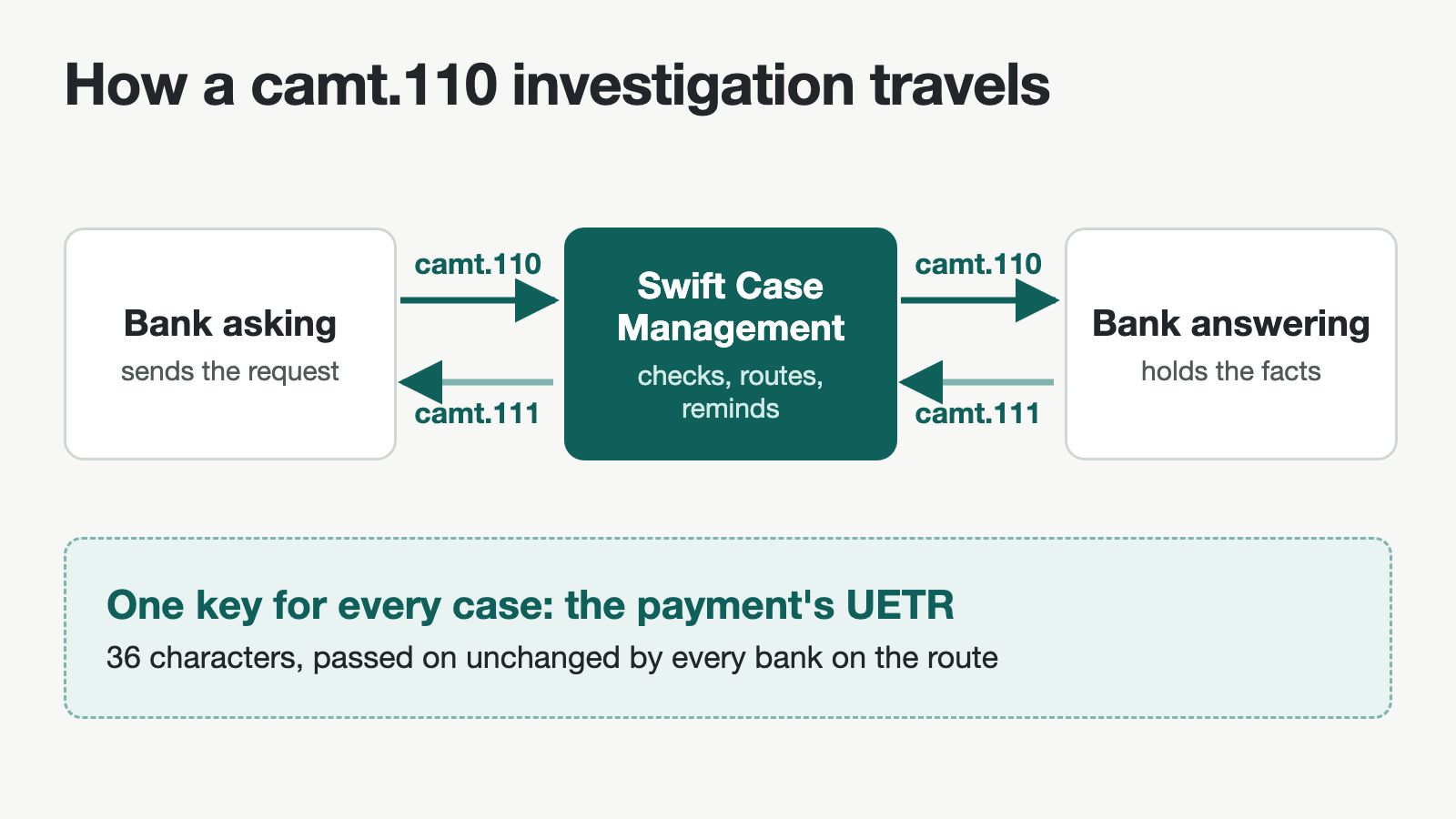
On Swift, camt.110 and camt.111 cannot be exchanged bilaterally. They run only through Case Management, specifically the service Swift calls the Case Orchestrator. It checks each request against business rules, routes it to the bank that should answer, sends automatic reminders and tracks every case with its own end-to-end investigation reference. Swift says more than 200 banks are already live on the service.
Why the UETR Sits at the Center of Swift Case Management
Case Management has two services, the Case Orchestrator for investigations and Stop and Recall for cancellations, and Swift says both rely on the payment’s UETR (Unique End-to-end Transaction Reference).
According to Swift, the UETR is “a string of 36 unique characters,” and it travels in every payment instruction message on the network. Intermediary banks must pass it on rather than create a new one, so one reference identifies the payment at every stop. When a client’s copy of the payment is laid out as an MT103, field 121 is where it sits. A sender who has never seen this reference before can learn where a UETR number appears and how to recognize one.
This matters more for investigations than it first appears. A free-text query often had to describe a payment in words: an amount, a date, a beneficiary name, perhaps a partial account number. A structured request anchored to the UETR points at exactly one payment.
It also connects investigations to UETR tracking. Swift’s Case Management includes what it calls pre-check logic, which uses payment tracker data to answer some requests automatically, based on the status already reported for the payment.
In other words, the status reported against a UETR increasingly decides what happens next in a case.
What a Payment Confirmation Does Not Prove
Many investigations begin with a misunderstanding about the sender’s paperwork.
A sending bank’s confirmation records that it accepted the customer’s instruction and passed it on. Whether the beneficiary’s bank has credited the account is a separate fact that the confirmation cannot settle. Before anyone opens a case, it is worth knowing the limits of a Swift payment confirmation.
For an investigation, three ISO 20022 status codes matter most. ACSP says the payment passed its checks and was taken on for execution somewhere along the route, and it says nothing yet about the beneficiary. ACCC marks the end point: settlement on the beneficiary’s own account is complete. RJCT says the instruction was refused, which calls for a different conversation altogether.
A payment that has shown ACSP for several days has not been rejected. The next step is to find out which institution updated it most recently, and what that institution still needs. Once ACCC appears, the money is on the beneficiary’s side, even if the beneficiary has not noticed it yet. In both cases, any investigation request that follows can be far more specific, and sometimes it is not needed at all.
What the SR 2026 Postponement Changed
SWIFT had planned a two-step move. From November 2026, every institution was to start accepting camt.110 requests through Case Management. From November 2027, investigation requests and responses were to move to Case Management over FINplus only, with free-format MT n99 messages retired for investigation purposes.
Then the calendar moved.
On 27th August 2026, SWIFT gave the industry more time for structured addresses and postponed the payments part of Standards Release 2026. On 21 September it set 12 June 2027 as the date of a deferred SR 2026 release, and listed exceptions and investigations messages among its contents. Swift’s own exceptions and investigations FAQ now opens with a notice that the Standards Release 2026 timeline has changed, and sends banks to its customer area for the latest dates.
What has not changed is the direction. SWIFT states that its strategic objective to retire MT messages and adopt ISO 20022 remains unchanged, and Case Management is already live for the banks that have adopted it.
For a payment company, the practical reading is simple: prepare for structured investigations now, and confirm the exact dates with your banking partners.
What Payment Companies Can Do Now
For money transfer operators, payment institutions and fintechs that send cross-border payments through partner banks, most of the work is operational rather than technical.
Store the UETR With Every Outgoing Payment
Keep it in the customer record, next to the payment it belongs to. Without it, every investigation starts with a search.
Look at the Latest Status Before Opening a Case
Partner banks often expose tracking to their clients, and some banks run public trackers. Third-party tools also exist; uetr.ai is one, a Swift gpi payment tracker that lets anyone with the UETR see what banks have reported, with no need to log in to a bank.
Write Complete Requests
A structured request is only as good as its data: amount, currency, value date, UETR and a single, clearly worded question.
Know Whose Move It Is
A payment under compliance review is usually waiting for an answer, often from the beneficiary or the sender. Ask the partner bank which institution raised the question, because the reply has to reach that institution.
Train the Support Team on the Vocabulary
An agent who can explain how to track an international wire transfer, and what ACSP or RJCT means, can close many tickets without escalating them.
Practical Takeaway
On its own, camt.110 does not speed up a payment. It changes how precisely the question about that payment can be asked.
“Can you look into a payment we sent last week for about ten thousand euros?” becomes a request that names one payment, one reference and one problem.
The firms that will gain most from the change are the ones that already treat the UETR as the primary key of every cross-border payment they send.