

Bank transfers are the simplest and most trusted way to move money between bank accounts. Whether it is a payroll deposit, a supplier invoice settlement, an international wire to a foreign correspondent, or a real-time personal payment, bank transfers are the backbone of the payment system. They are not the fastest-growing payment method, not the most innovative, and not the most discussed in fintech circles. But they process more value than any other payment method by a significant margin, and for businesses managing large payment flows, understanding how bank transfers work, which types are appropriate for which use cases, and how to access the best transfer infrastructure for your specific situation is commercially important. Faisal Khan LLC advises businesses and payment operators on bank transfer infrastructure, banking access, and the domestic and international payment network connectivity that bank transfers depend on.
Types of Bank Transfers
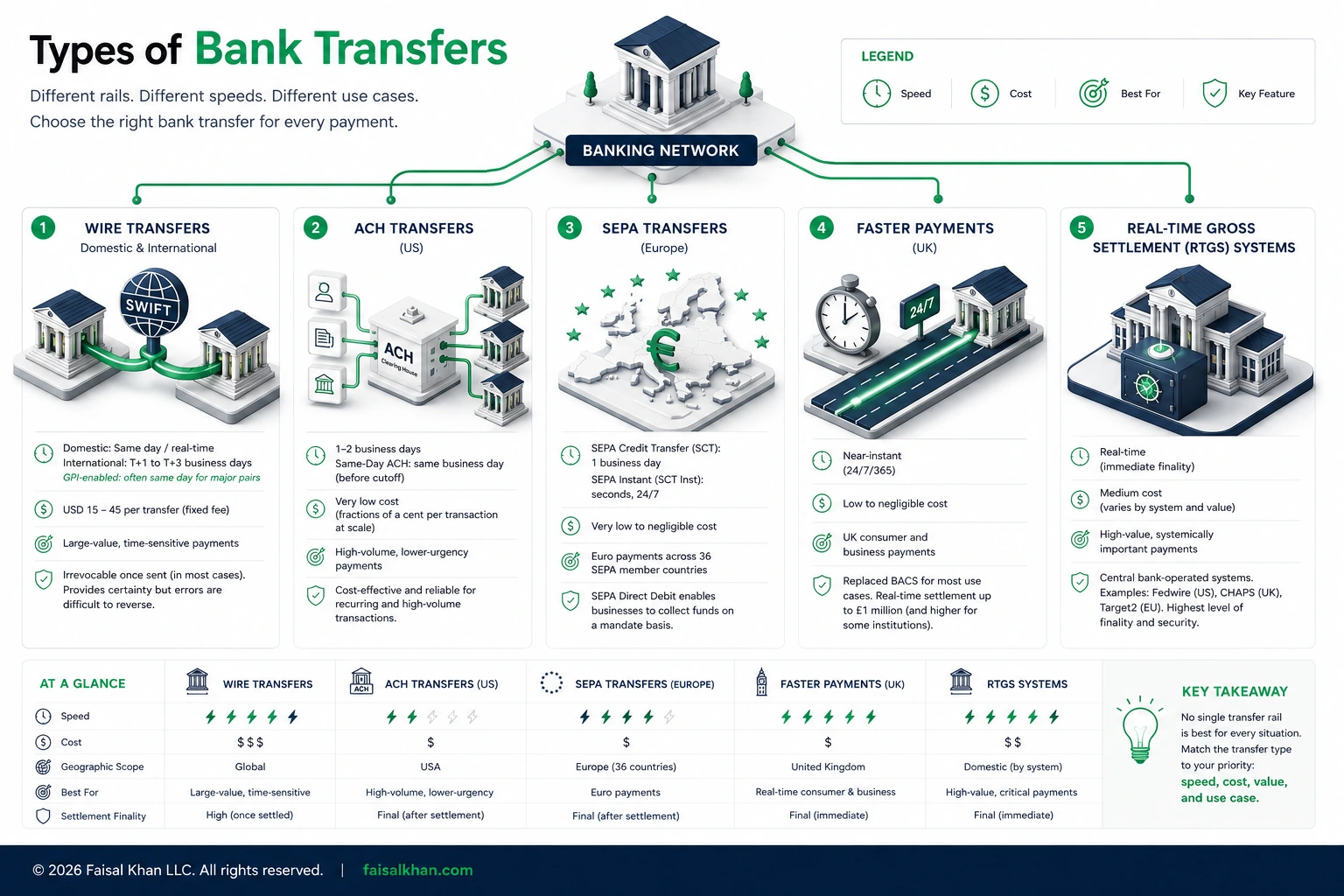
Wire transfers: A wire transfer is a direct, bank-to-bank electronic fund transfer. Domestic wire transfers (via Fedwire in the US, CHAPS in the UK, Target2 in the EU) typically settle on a same-day or real-time basis and are used for large-value, time-sensitive payments. International wire transfers use the SWIFT network and typically settle in T+1 to T+3 working days, with SWIFT GPI-enabled transfers increasingly settling same day for major currency pairs.
Wire transfers are irrevocable once sent (in most cases), which is both their strength (certainty for the recipient) and a risk factor for the sender (errors are difficult to reverse). They carry fixed fees (typically USD 15 to USD 45 per international wire) regardless of the transfer amount.
ACH transfers (US): ACH (Automated Clearing House) is the US batch electronic payment system. It processes direct deposits, business bill payments, and P2P transfers. Standard ACH settles in 1 to 2 business days. Same-Day ACH can settle on the same business day for transfers initiated before the cutoff. ACH is low-cost (often fractions of a cent per transaction at scale) and well-suited for high-volume, lower-urgency payments.
SEPA transfers (Europe): SEPA Credit Transfer (SCT) processes euro payments between accounts in any of the 36 SEPA member countries in 1 business day. SEPA Instant Credit Transfer (SCT Inst) processes in seconds, 24/7, at negligible cost. SEPA Direct Debit allows businesses to collect from customers across the eurozone on a mandate basis.
Faster Payments (UK): Real-time, 24/7 bank-to-bank transfers in GBP up to GBP 1 million (and higher for some institutions). Near-instant settlement. The standard for UK consumer and business bank transfers, replacing the older BACS system for most purposes.
Real-Time Gross Settlement (RTGS) systems: Central bank-operated systems that settle large-value payments in real time with immediate finality. Fedwire (US), CHAPS (UK), and Target2 (EU) are the major examples. Used for high-value, systemically important payments.
International Bank Transfers: How Correspondent Banking Works
International bank transfers are more complex than domestic transfers because they involve crossing the boundaries between different national banking systems, currencies, and regulatory jurisdictions.
The dominant mechanism is the SWIFT correspondent banking network. When a business in the US wants to transfer USD to a supplier's account in a Nigerian bank:
The US bank initiates a SWIFT message instructing its correspondent (a bank with a relationship in both the US and Nigeria) to credit the Nigerian bank
The correspondent routes the payment through the Nigerian banking system to the recipient's specific bank
Each bank in the chain adjusts the balances in its nostro/vostro accounts (accounts held with correspondent banks in foreign currencies)
The recipient's account is credited, typically in local currency after conversion
The cost and speed of international bank transfers depends heavily on the number of correspondents in the chain, the FX rate applied at conversion, and the specific banks and currencies involved.
Optimizing International Bank Transfer Costs
For businesses with significant international payment flows, the cost of bank transfers is a real operational expense that rewards optimization:
FX rate negotiation: The exchange rate applied to international wire conversions is one of the largest cost elements. Banks offer retail FX rates unless specifically negotiated. Businesses with USD 500,000 or more in monthly international transfers should negotiate FX pricing directly with their bank or use a specialist FX provider alongside their bank for transfer execution.
Reducing correspondent hops: Payments that travel through three or four correspondent banks pay multiple sets of fees and face multiple compliance review points. Choosing a bank with direct correspondent relationships in your most-used corridors reduces the number of intermediary hops.
SWIFT GPI: Payments sent via SWIFT GPI include end-to-end tracking and carry commitments from participating banks on same-day settlement and fee transparency. Using GPI-enabled banks reduces the risk of unexplained deductions and delayed settlement.
Alternative rails for high-volume routes: For specific corridors where you send high volume regularly, fintech payment platforms (Wise Business, Airwallex, WorldFirst) route transfers through local banking licenses rather than SWIFT in many countries, resulting in faster settlement and lower FX costs than traditional bank wire.
We advise businesses on how to optimize their international bank transfer infrastructure and connect them to banking partners and FX providers appropriate for their specific payment flows.
Getting Banking That Supports Your Transfer Needs
Not all business bank accounts are equal in their support for international bank transfers. Key factors to consider when evaluating banking for high-volume international transfers:
Multi-currency account capability: The ability to hold, send, and receive in multiple currencies without forced conversion at every step. Essential for businesses with regular multi-currency flows.
SWIFT GPI participation: Does the bank participate in GPI for outbound international wires? This affects tracking visibility and settlement speed.
Correspondent network depth: Does the bank have direct correspondent relationships in your most-used corridors, or does every transfer route through a generic global correspondent?
MSB/payment operator compatibility: If your business is classified as a Money Services Business, many mainstream banks will decline to serve you. Finding banks that are genuinely comfortable with MSB international transfer volumes requires specific knowledge of which institutions are truly open.
Pricing and fee structure: Monthly fees, per-wire fees, FX pricing, and minimum balance requirements all affect the true cost of banking.
Faisal Khan LLC connects businesses to banking partners appropriate for their international transfer needs, including MSB-friendly banks for payment operators and businesses in regulated financial services sectors.
Frequently Asked Questions
What information do I need to make an international bank transfer?
For international wires: recipient bank name, SWIFT/BIC code (8 or 11 characters identifying the specific bank and branch), account number or IBAN (for European accounts), recipient name exactly as on the account, and for some corridors, an intermediary bank's SWIFT code. Incorrect or incomplete beneficiary details are one of the most common causes of international wire delays or returns.
Can an international bank transfer be reversed?
International wire transfers are generally difficult to reverse after execution. Once the SWIFT instruction has been sent and the payment is in the correspondent network, the recipient bank has no obligation to return the funds without the recipient's consent. If an error is made (wrong account details, wrong amount), contacting your bank immediately to request a recall through the SWIFT network is the first step, but success is not guaranteed and recovery can take weeks or months.
How long do international bank transfers take?
SWIFT transfers for major currency pairs (USD-EUR, USD-GBP, USD-JPY) between banks with direct correspondent relationships can settle same day or T+1 with GPI. Less common currency pairs or markets without direct correspondent relationships: T+2 to T+5 or longer. Payment fintech platforms using local clearing rails can often settle faster than SWIFT for specific corridors.
What causes an international bank transfer to be returned?
The most common causes: incorrect SWIFT code or IBAN, incorrect or incomplete recipient name (must match account registration), compliance holds in the recipient country, the recipient's account being closed or frozen, or the transfer being flagged in the correspondent bank's AML screening. Returned wires take the same time as the original transfer to travel back and may incur return fees.
Build the Bank Transfer Infrastructure Your Business Needs
Bank transfers are the bedrock of serious payment operations. Getting the right banking, the right FX access, the right correspondent network depth, and the right understanding of international transfer mechanics makes a material difference to your operating costs and cash flow efficiency. Faisal Khan LLC advises on bank transfer infrastructure, connects businesses to banking partners with the international transfer capabilities their operations require, and helps payment operators and MSBs find banking that will actually serve their transfer volumes. Bank transfers are foundational. We help you build on the right foundation.