

Card payments are the dominant payment method for online commerce and a major channel for in-person retail globally. Visa and Mastercard alone process over 200 billion transactions per year across more than 200 countries. For businesses that want to serve customers internationally, accepting card payments is generally a baseline requirement. But card payment acceptance is not a simple commodity, particularly for international businesses, businesses serving customers in multiple currencies, or businesses in sectors that mainstream payment processors classify as elevated risk. Getting the right card payment infrastructure, at the right pricing, with the right acquirer stability, requires understanding how the card payment ecosystem actually works and who the right partners are for your specific situation. Faisal Khan LLC advises businesses on card payment strategy and connects them to acquiring banks, payment facilitators, and international processing solutions appropriate for their business model.
How Card Payments Work: The Acquiring Chain
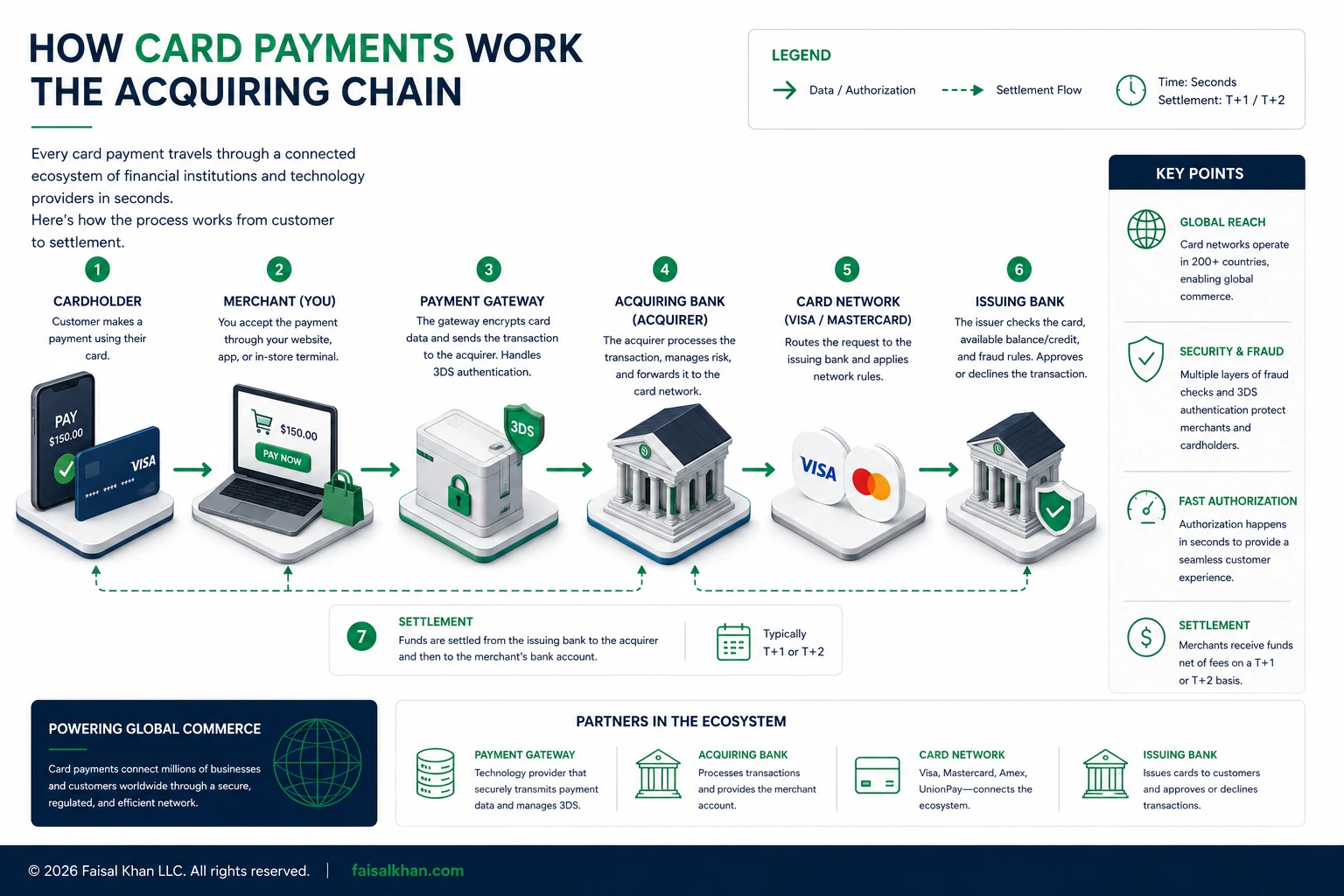
The merchant (you): Accepts card payments from customers through a payment terminal, online payment page, or in-app payment flow.
The payment gateway: Captures and encrypts card data, transmits it to the acquirer, and returns the authorization result to the merchant. For online payments, the gateway also handles 3DS (3D Secure) authentication challenges.
The acquiring bank (acquirer): The licensed financial institution that processes card transactions on the merchant's behalf. The acquirer has a direct relationship with Visa and Mastercard as a principal member and credits the merchant's settlement account with net transaction proceeds.
The card network (Visa, Mastercard, Amex, UnionPay): Routes authorization requests between the acquirer and issuer, enforces network rules, facilitates settlement between issuing and acquiring banks, and operates dispute resolution infrastructure.
The issuing bank: The bank that issued the customer's card. Checks the available balance or credit limit, applies its own fraud detection, and approves or declines the transaction.
All of these interactions happen in seconds. Settlement of the day's transactions typically occurs on a T+1 or T+2 basis after authorization.
International Card Acceptance: The Specific Challenges
Accepting cards from customers in multiple countries adds complexity to each layer of the chain:
Cross-border interchange: Card transactions between a cardholder in one country and a merchant in another attract higher interchange fees than domestic transactions. The difference can be significant, particularly for businesses with a primarily international customer base. Local acquiring (maintaining a merchant account with an acquirer in the same country as a significant share of your customers) reduces cross-border interchange on those transactions.
Currency and conversion: Customers prefer to see prices and pay in their local currency. Dynamic Currency Conversion (DCC) allows cardholders to pay in their home currency at the merchant's terminal, but DCC rates are typically poor for the customer. Multi-currency pricing with local currency charging (where the merchant charges in the customer's currency and settles in their own) is the better customer experience and reduces declines caused by card issuer international transaction flags.
Approval rates by country: Card approval rates vary significantly by country due to differences in issuer risk policies, fraud patterns, and the prevalence of international transaction blocking by issuers. Businesses with significant customer bases in markets with lower card approval rates may benefit from additional routing strategies (retry logic, network tokenization, local acquirers) to improve approval rates.
3DS authentication: The 3D Secure protocol (3DS2 is the current version) adds an authentication step to online card transactions to reduce fraud. 3DS reduces chargebacks but adds friction that can reduce conversion. Properly calibrated 3DS (applying friction selectively to higher-risk transactions) is important for international e-commerce.
High-Risk Card Acquiring: When Mainstream Processors Say No
Certain business types are systematically declined by mainstream payment processors due to elevated chargeback risk, regulatory complexity, or the processor's own risk appetite. If your business has been declined by Stripe, PayPal, Braintree, or similar processors, you are likely in a category that requires specialist card acquiring:
Regulated financial services: Forex and CFD platforms, cryptocurrency exchanges, money transfer operators, lending, and trading. These businesses face elevated chargeback risk (customers who lose money dispute charges) and regulatory complexity.
Online gambling and gaming: Licensed online casinos, sports betting platforms, poker rooms, and fantasy sports. Card networks restrict gambling transactions in many jurisdictions, requiring specific acquiring approval.
Adult content: Reputational risk for mainstream processors. Specialist adult content acquiring exists but requires specific compliance documentation and age verification infrastructure.
Nutraceuticals and CBD: Regulatory ambiguity and elevated chargeback risk. Specialist acquirers with experience in these sectors are available.
Travel: High-value, advance-purchase transactions with significant chargeback exposure from cancellations and disputes. Travel-specific acquiring solutions address the specific chargeback dynamics.
Subscription and negative option billing: Businesses with free trial to paid subscription models have elevated chargeback rates. Specialist acquirers with experience in subscription billing compliance are required.
High-risk acquiring is available for all of these categories, but comes with higher processing rates and often reserve requirements. The trade-off is access to card processing that mainstream processors will not provide. We connect businesses in these categories to appropriate high-risk acquiring solutions and help prepare the compliance documentation and chargeback management infrastructure that specialist acquirers require.
Card Issuance: Putting Cards in Your Customers' Hands
Beyond card acceptance, some businesses need to issue cards. Prepaid cards, corporate expense cards, payroll cards, and disbursement cards all require card issuance capability.
Card issuance requires a licensed card network member (a bank with Visa or Mastercard principal membership) as the card issuer, and a program manager who handles the product design, customer experience, and operational management of the card program.
BIN sponsorship: A fintech or payment operator obtains access to a range of card numbers (a BIN, or Bank Identification Number range) from a principal member bank. Under this arrangement, the bank issues the cards under its BIN, but the fintech manages the cardholder relationship and product experience.
Prepaid program management: Building a prepaid card program for disbursement, payroll, or stored value use cases. The program manager partners with a BIN-sponsoring bank and a card processor to deliver the end-to-end card issuance infrastructure.
We connect businesses seeking card issuance capability to BIN-sponsoring banks, card processors, and program management partners appropriate for their use case and geography.
Frequently Asked Questions
What is a chargeback ratio and why does it determine whether I can get card processing?
Card networks (Visa and Mastercard) set maximum chargeback ratios for merchants: typically 1% of transactions per month. Merchants who exceed this threshold are placed in a monitoring program and can eventually lose card processing privileges. Acquirers are responsible for their merchants' chargeback ratios and set their own (often lower) thresholds for new or higher-risk merchants. Business models with inherently higher chargeback rates face challenges getting or retaining standard card processing.
Do I need a local acquiring bank in each country where I sell?
Not necessarily, but local acquiring reduces cross-border interchange costs for transactions with customers in that country. For businesses with significant, consistent transaction volume in specific countries, local acquiring in those countries can be commercially justified. For smaller volumes, a single international acquirer is typically more practical.
What is interchange and who sets it?
Interchange is the fee paid by the merchant's acquiring bank to the cardholder's issuing bank for each card transaction. It is set by the card networks (Visa, Mastercard) and varies based on card type (debit/credit/commercial), transaction type (card-present/card-not-present), industry (MCC code), and whether the transaction is domestic or cross-border. In the EU and UK, interchange for consumer cards is regulated (capped at 0.2% for debit and 0.3% for credit). In the US, it is unregulated for most card types and significantly higher.
Can I accept UnionPay cards from Chinese customers?
Yes, but it requires specific acquiring setup. UnionPay (China's dominant card network) has expanded internationally, and Chinese tourists and international Chinese customers increasingly use UnionPay cards abroad. Accepting UnionPay requires an acquirer with UnionPay connectivity. Many international acquirers now offer UnionPay acceptance alongside Visa and Mastercard.
Get Card Payment Infrastructure That Works for Your Business
Card payments are not a solved problem for many internationally active businesses. The right acquiring relationships, the right pricing, the right geographic coverage, and for higher-risk businesses, the right specialist partner are all factors that materially affect your ability to accept payments, your processing costs, and your operating stability. Faisal Khan LLC advises businesses on card payment strategy, connects them to acquirers, ISOs, and payment facilitators appropriate for their business type and geographic footprint, and helps businesses in higher-risk categories find the specialist processing solutions their business model requires. We do not process card payments ourselves. We connect you to the infrastructure and help you navigate the requirements.