

Cross-border payments are the mechanism through which money moves between countries. Every international business transaction, every remittance sent home by a migrant worker, every cross-border e-commerce purchase, every intercompany transfer between subsidiaries in different countries is a cross-border payment. The global cross-border payment market processes over USD 150 trillion annually, and yet the infrastructure that powers it remains expensive, slow, and fragmented compared to the seamless domestic payment experiences most businesses and consumers now expect. Understanding how cross-border payments work, why they cost what they cost, and how to access better infrastructure is one of the most commercially valuable things any internationally active business can invest in. Faisal Khan LLC advises businesses, fintechs, and payment operators on cross-border payment infrastructure, connects them to banking and payment rail partners, and helps them navigate the licensing and compliance requirements that come with operating international payment flows.
How Cross-Border Payments Actually Work
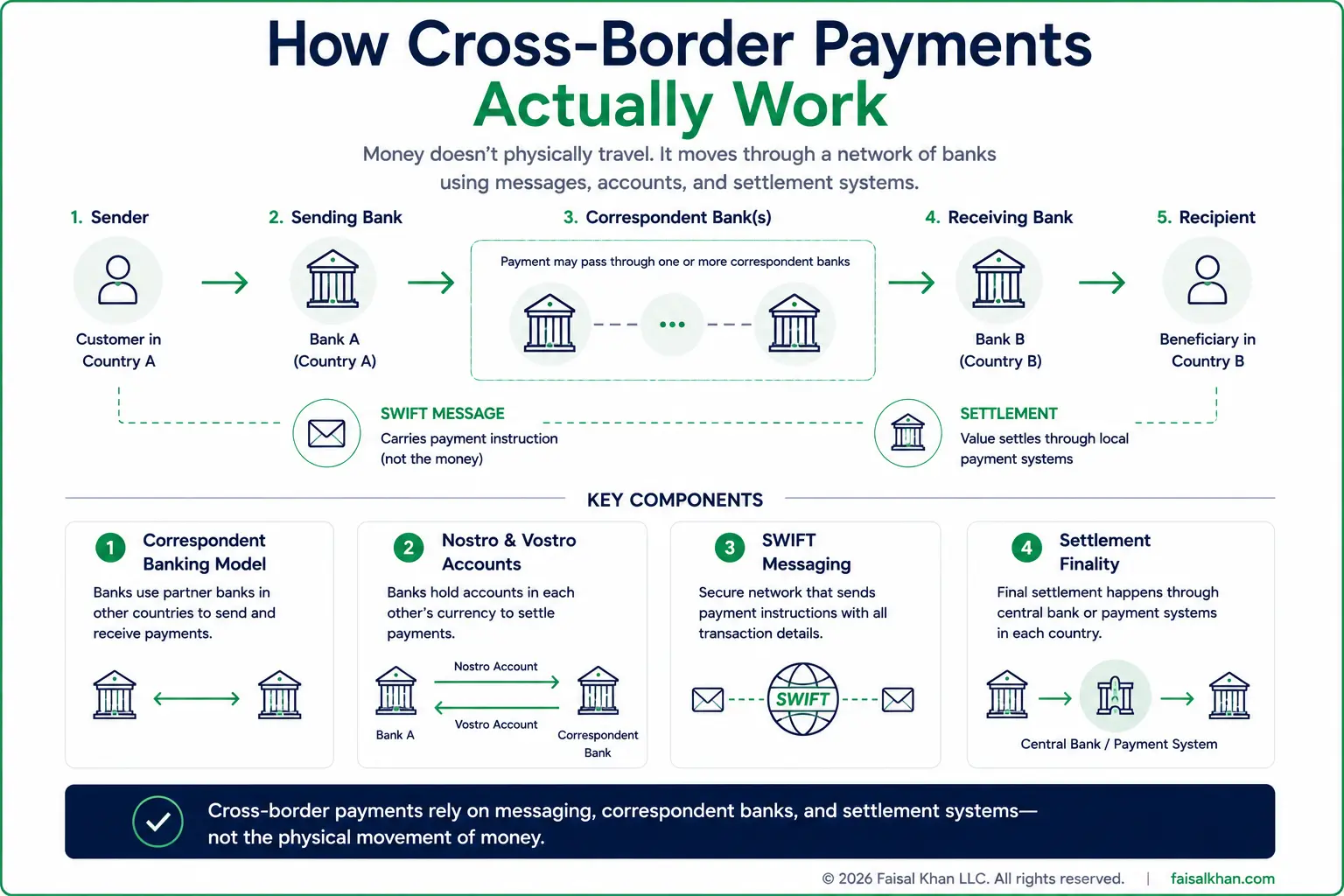
When money moves from one country to another, it almost never physically travels. What actually happens is a series of accounting entries across a network of correspondent banking relationships.
The correspondent banking model: Most international payments travel through the SWIFT network, which connects banks in different countries through correspondent relationships. Bank A in the US wants to send USD to Bank B in Nigeria. If A and B don't have a direct relationship, the payment routes through one or more correspondent banks that have relationships with both. Each step in the chain adds time, cost, and opacity.
Nostro and vostro accounts: Correspondent banks maintain accounts with each other in each other's currencies. Bank A holds a nostro account (an account denominated in another currency held at another bank) with its correspondent in Nigeria. When a payment is sent, the balance in this account is debited or credited as part of the settlement process.
SWIFT messaging: The SWIFT messaging network carries the payment instruction (not the money itself) between banks. SWIFT MT messages (the legacy format) and the newer ISO 20022 standard carry the details of who is paying, who is receiving, the amount, the currency, and the reference information needed to apply the payment.
Settlement finality: The actual settlement of value happens through central bank systems in each country (Fedwire in the US, CHAPS in the UK, Target2 in the Eurozone) for high-value transactions, or through multilateral netting systems for lower-value flows.
The Cost Problem in Cross-Border Payments
Cross-border payments are expensive by global standards. The G20 has set targets for reducing the average cost of international payments to below 1% of the transaction value, but the current global average remains above 6% for retail cross-border transfers.
The costs come from multiple layers:
FX conversion costs: The spread between the interbank exchange rate and the rate offered to business or retail customers. This is where a significant portion of cross-border payment revenue is made by banks and payment operators.
Transaction fees: Fixed fees charged by the sending bank, and potentially by correspondent banks in the payment chain. These are more impactful on smaller transactions.
Correspondent deductions: Intermediary banks in the payment chain may deduct their fees from the payment amount in transit, meaning the recipient receives less than the sender instructed.
Compliance and investigation costs: When a payment is flagged for compliance review, delayed, or returned, the administrative cost of resolution is real, even if no direct fee is charged.
Trapped liquidity: Pre-funding requirements in correspondent accounts tie up working capital that cannot earn returns while sitting in nostro accounts.
The Emerging Alternative Rails
The inefficiencies of correspondent banking have driven significant innovation in cross-border payment infrastructure over the past decade:
Real-time payment interlinks: Bilateral and multilateral linkages between national real-time payment systems. Singapore's PayNow, India's UPI, Malaysia's DuitNow, Thailand's PromptPay, and others are being linked in bilateral partnerships that allow real-time, low-cost cross-border transfers between participating countries within Southeast Asia and beyond.
Payment fintechs: Companies like Wise, Airwallex, WorldFirst, and others have built multi-currency infrastructure on top of local banking licenses and clearing memberships in multiple jurisdictions. By holding funds locally in each currency and clearing through local networks rather than SWIFT, they can settle cross-border payments faster and at lower FX cost than traditional bank wire.
Stablecoin and blockchain settlement: Using dollar-pegged stablecoins (USDT, USDC) on blockchain networks as the settlement layer. Near-instant, 24/7, low-cost transmission across borders, with the fiat interfaces (on-ramp and off-ramp) handled by licensed entities at each end. Increasingly used by MTOs and fintechs for corridor settlement.
Central Bank Digital Currencies (CBDCs): Multiple central banks are developing or piloting CBDCs specifically designed to improve cross-border payment efficiency. Project mBridge (involving the BIS, Hong Kong, China, UAE, and Thailand) is one of the most advanced cross-border CBDC initiatives. These remain experimental but may reshape the cross-border payment landscape over the next decade.
Licensing and Compliance for Cross-Border Payment Operators
Operating a cross-border payment business, as opposed to making cross-border payments as part of normal business operations, requires regulatory authorization. The specific requirements depend on the business model and jurisdictions involved:
In the United States: FinCEN MSB registration and state money transmitter licenses in each state where customers are located. Cryptocurrency-related activities require additional state-level licensing in many states.
In the United Kingdom: FCA authorization as a Payment Institution (PI) or Electronic Money Institution (EMI), or registration as a small PI or small EMI.
In the European Union: EMI or PI authorization under PSD2, with passporting rights across EU member states from a single authorization.
AML compliance programs, customer due diligence, sanctions screening, and transaction monitoring are mandatory across all jurisdictions and are the foundation of credible banking and partner relationships.
We advise on the full licensing and compliance pathway for cross-border payment operators and connect them to licensing counsel, banking partners, and compliance infrastructure providers.
Frequently Asked Questions
What is the difference between a cross-border payment and a wire transfer?
A wire transfer is a specific type of payment instruction transmitted electronically between banks, typically via SWIFT for international transfers. All international wire transfers are cross-border payments, but not all cross-border payments are wire transfers. Cross-border payments also include card payments (where the cardholder and merchant are in different countries), mobile money transfers, crypto transfers, and payments made through fintech platforms.
Why do cross-border payments sometimes arrive with a deduction from the amount sent?
This is caused by correspondent bank fee deductions in transit. When a payment travels through multiple correspondent banks on its way to the recipient, each correspondent may deduct its processing fee from the payment amount. SWIFT GPI has introduced protections against this for participating banks, but it has not been universally eliminated. Solutions include using a payment platform that routes around correspondent chains or using the OUR (sender pays all fees) instruction in SWIFT messages.
How can a business reduce its cross-border payment costs?
The main levers are: negotiating FX pricing directly with your bank or using a specialist FX provider, using a payment fintech for routine transfers on high-volume routes, understanding the correspondent bank structure for your most-used corridors and optimizing routing, and at high volumes, considering whether licensed payment infrastructure of your own could be cost-effective.
Do I need a license to receive cross-border payments from international customers?
Receiving payments from international customers for goods or services you provide does not require a payment license. Licensing becomes necessary when you are intermediating payments between others, holding funds on behalf of third parties, or operating a payment facilitation or remittance business model.
Navigate Cross-Border Payments With an Advisor Who Has Done This for Decades
Cross-border payments are complex, expensive, and constantly evolving. The operators who manage them most effectively are those who understand the infrastructure, have the right banking and payment rail relationships, and know how to build compliant operations that banks and regulators respect. Faisal Khan LLC has spent years working across the full cross-border payments stack. We advise businesses, fintechs, and payment operators on infrastructure optimization, connect them to the right banking and technology partners, and guide them through the licensing and compliance requirements of building international payment operations. We do not provide payment services directly. We connect, advise, and broker access to the infrastructure that makes cross-border payments work.