

Digital wallets are one of the fastest growing payment methods in the world. PayPal, Skrill, Neteller, Apple Pay, Google Pay, WeChat Pay, Alipay, GCash, M-Pesa, bKash, and dozens of regional equivalents have collectively shifted a massive share of online consumer payment volume away from direct card entry toward wallet-mediated payment. For businesses operating internationally, accepting digital wallets is no longer a nice-to-have. In many markets and demographics, it is the only way to capture a significant share of customer payments. And for payment operators, digital wallets represent both a competitive pressure (customers may prefer to receive funds into a wallet rather than a bank account) and an opportunity (building or integrating wallet-based payment flows for specific use cases). Faisal Khan LLC advises businesses and payment operators on digital wallet strategy, connects them to wallet integration partners and payment infrastructure providers, and helps structure compliant wallet-based payment flows.
The Digital Wallet Landscape: A Fragmented but Massive Market
Digital wallets are not a single product. They span a wide spectrum of functionality and market position:
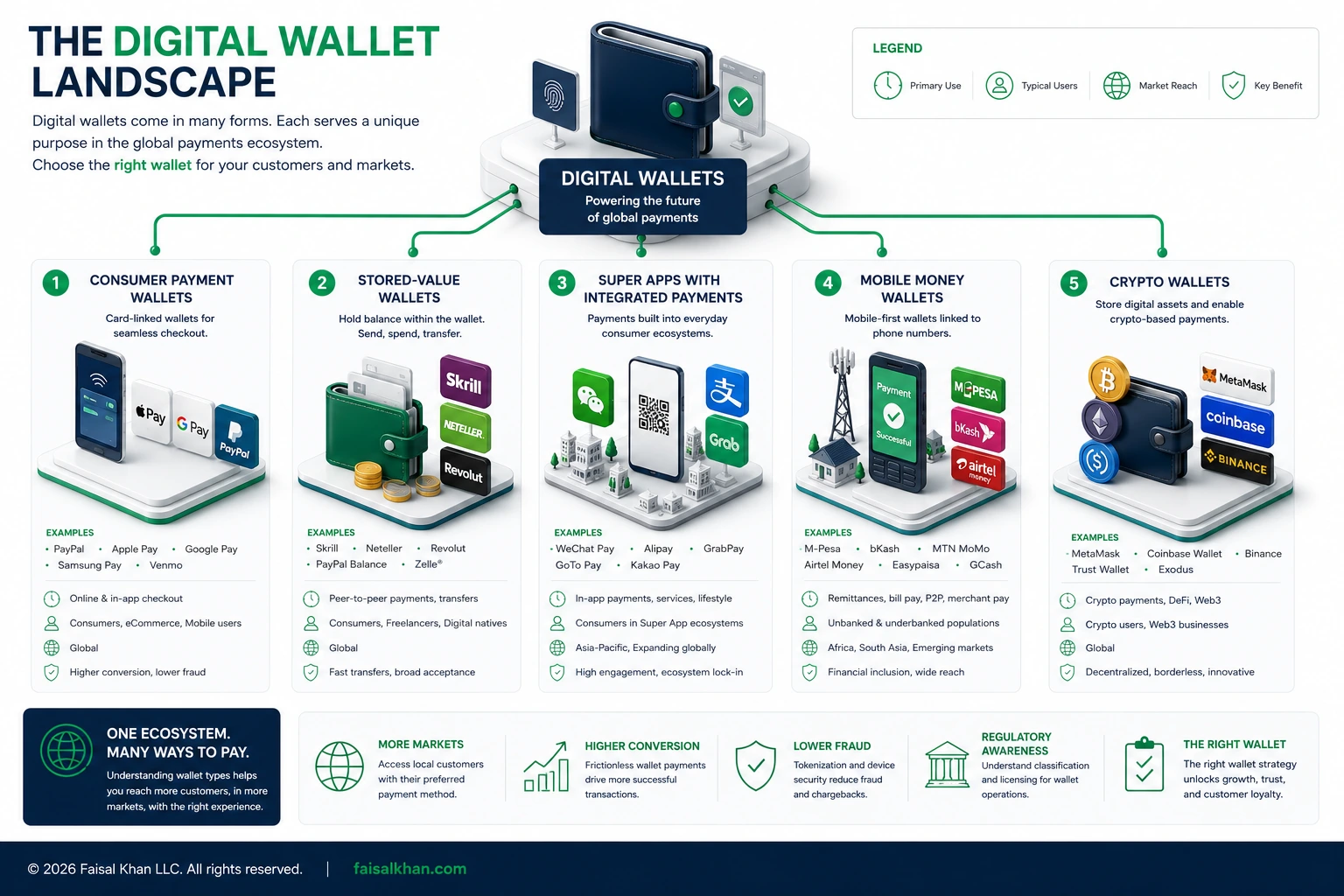
Consumer payment wallets: PayPal, Apple Pay, Google Pay, Samsung Pay, and similar wallets that store card details and allow consumers to pay without entering card information. These are accepted by merchants through standard payment processor integration. They reduce friction at checkout and improve approval rates for mobile commerce.
Stored-value wallets: Wallets that hold a balance (rather than just linking to a card). PayPal's balance, Skrill, Neteller, Revolut, and similar. These are regulated as e-money in the UK/EU (requiring EMI authorization) or as stored value in other jurisdictions. Merchants can receive transfers to these wallets directly from customers, without a card transaction.
Super-apps with integrated payments: WeChat Pay (China), Alipay (China and international expansion), GrabPay (Southeast Asia), and similar platforms where the payment wallet is embedded within a dominant consumer application. Accessing these requires specific integration partnerships.
Mobile money wallets: M-Pesa, MTN Mobile Money, Airtel Money, bKash, Easypaisa, and others. These operate primarily via mobile network operator infrastructure rather than bank accounts and are dominant in markets with lower banking penetration. They serve both consumer payments and remittance delivery.
Crypto wallets: Non-custodial wallets (like MetaMask) and custodial exchange wallets (Coinbase, Binance). Relevant for businesses accepting cryptocurrency payments and for stablecoin-based payment flows.
Why Digital Wallets Matter for International Businesses
Market access: In China, WeChat Pay and Alipay dominate online payments. A merchant who accepts only Visa and Mastercard loses the Chinese customer market almost entirely. In Southeast Asia, GrabPay, GCash, and OVO are primary payment methods for significant demographic segments. In Africa, mobile money is the primary payment method for large portions of the population. Accepting the right wallets in each market is a market access question, not a payment preference question.
Checkout conversion: Wallet payments at checkout convert at higher rates than card entry on mobile devices. The reason is simple: wallet payment requires biometric authentication (Face ID, fingerprint) or a single PIN versus typing a 16-digit card number, expiry date, and CVV on a small screen. Higher conversion rates mean more revenue from the same traffic.
Fraud reduction: Wallet payments carry lower fraud rates than direct card entry in many contexts. The tokenization and device binding used by Apple Pay and Google Pay, in particular, significantly reduce card-present counterfeit fraud.
Regulatory implications: Stored-value wallets are regulated products. Businesses that offer wallet-like functionality (holding customer balances, allowing multiple transactions from a stored balance) may be operating as e-money issuers and need the appropriate regulatory authorization. Understanding where the line falls between a payment method integration and an e-money product is important.
Integrating Digital Wallets: The Technical and Commercial Path
For consumer-facing merchants: Most major digital wallets (PayPal, Apple Pay, Google Pay) are integrated through your existing payment gateway or processor. If your gateway supports these wallets, enabling them is typically a configuration change rather than a major integration project. Check your gateway's wallet support coverage for the wallets most used by your customer base.
For regional wallets (WeChat Pay, Alipay, GrabPay, GCash, etc.), integration typically requires either a specialist payment processor that aggregates these wallets or a direct partnership agreement with the wallet operator. Specialist processors like 2C2P (Southeast Asia), Adyen, or Stripe have built multi-wallet acceptance infrastructure for specific regions.
For payment operators and fintechs: If your use case involves holding customer balances in a digital wallet structure, paying out to customer wallets, or building wallet-like functionality into your product, the requirements are more complex. You need to understand the regulatory classification of your wallet product, the appropriate licensing requirements in each jurisdiction, and the banking infrastructure to support wallet operations.
We advise payment operators on how to structure wallet-based payment flows, connect them to wallet integration partners and banking infrastructure providers, and help them understand the regulatory implications of different wallet product designs.
For remittance and payout operators: Digital wallet payout is one of the fastest-growing remittance delivery channels. Adding mobile wallet payout (M-Pesa, GCash, bKash, MTN MoMo) to your corridor delivery options significantly expands your recipient base. We connect MTOs and payout operators to mobile wallet integration providers and direct wallet operator relationships.
Compliance Considerations for Digital Wallet Payments
Digital wallet payments carry their own compliance dimensions:
E-money regulation: In the UK and EU, a digital wallet that stores value is an e-money product. Issuing e-money requires EMI (Electronic Money Institution) authorization or registration. Businesses that build wallet functionality without appropriate licensing face significant regulatory risk.
KYC requirements: Most stored-value wallets have tiered KYC requirements. Low-value wallets may allow operation with basic identity verification. Higher-balance or higher-transaction wallets require full identity verification. Understanding and applying the appropriate KYC tier to wallet users is a compliance obligation.
AML/transaction monitoring: Wallet-based payment flows must be monitored for suspicious activity. Wallets can be used to layer funds or break up large amounts into smaller wallet-to-wallet transfers. Transaction monitoring rules appropriate to the wallet use case must be configured.
OFAC and sanctions screening: Wallet holders and wallet-to-wallet transfers must be screened against sanctions lists. Wallet operators are responsible for ensuring they are not facilitating payments to or from sanctioned entities.
We advise on digital wallet compliance frameworks and connect businesses to compliance infrastructure providers appropriate for wallet-based payment operations.
Frequently Asked Questions
Do I need a license to accept PayPal or Apple Pay payments?
No. Accepting payments through consumer wallets like PayPal or Apple Pay as a merchant does not require a payment license. The wallet operators hold the regulatory authorization. Your obligation is to have an agreement with the wallet operator (or your payment gateway that has such an agreement) and to comply with their terms of service.
Can I use PayPal or Skrill to receive large business payments internationally?
These wallets can be used for business-to-business payments in some contexts, but they have limits on transaction sizes, hold policies for large transactions, and terms of service that restrict certain business types. For large, regular international business payments, dedicated business bank wire infrastructure is more appropriate. We advise on when wallet-based business payments are appropriate versus when bank infrastructure is the right choice.
What is the difference between a digital wallet and a prepaid card?
A digital wallet stores value or card credentials electronically and enables transactions via digital channels. A prepaid card is a physical (or virtual) card loaded with funds that can be used at any card-accepting merchant. Many digital wallets also issue companion prepaid or debit cards, blurring the distinction. Regulatory treatment depends on the specific product structure and jurisdiction.
Which digital wallets should my international e-commerce business accept?
It depends on where your customers are. For a customer base concentrated in China: WeChat Pay and Alipay. Southeast Asia: GrabPay, GCash, OVO. UK and Europe: PayPal, Apple Pay, Google Pay, plus local schemes (iDEAL in the Netherlands, Klarna in Nordic markets). US: PayPal, Apple Pay, Google Pay, Cash App. Africa: mobile money wallets by country. We advise on payment method strategy for specific geographic and demographic customer profiles.
Connect Your Business to the Digital Wallets Your Customers Use
Digital wallets are where your customers are paying, and the businesses that accept the wallets their customers prefer win the conversion battle. Faisal Khan LLC advises businesses on digital wallet strategy, connects them to multi-wallet acceptance infrastructure for international markets, and helps payment operators and fintechs understand the regulatory and technical requirements of building wallet-based products. Whether you need to accept WeChat Pay in a specific market, integrate mobile wallet payout into your remittance operation, or understand the regulatory classification of your wallet product, we can help.