

Starting a money transfer business is one of the most regulated, operationally complex, and genuinely rewarding ventures in the financial services industry. The money transfer business connects migrants to families, enables trade between countries, and serves communities that the banking system often underserves. It is also a business built on infrastructure: licensing, banking relationships, compliance programs, payout networks, technology platforms, FX access, and correspondent agreements. Get all of these elements right, and you have a durable, scalable business with strong community loyalty and genuine competitive barriers. Get any of them wrong, and you face regulatory enforcement, lost banking, failed payouts, and an operation that cannot grow. Faisal Khan LLC has spent over fifteen years advising, connecting, and supporting money transfer business operators at every stage, from first-license applicants to multi-corridor operators expanding into new markets. This is our deepest area of expertise and the core of what we do.
Is the Money Transfer Business Right for You?
The money transfer business suits a specific type of operator: someone with a connection to a community that needs remittance services, deep knowledge of a specific corridor or geographic market, the resilience to navigate a long and demanding licensing and banking process, and the capital to invest in infrastructure before generating meaningful revenue.
It is not a business for those looking for a quick entry to financial services. Licensing takes 6 to 24 months depending on the jurisdiction and scope. Banking relationships for MSBs are hard to establish and require a strong compliance foundation. Payout partnerships in receiving markets require trust-building and compliance due diligence. And the competitive landscape in most major corridors is fierce.
What makes the business attractive is the opposite of what makes it hard. The same barriers that make it difficult to enter make it difficult for competitors to displace you once you are established. A well-run money transfer operator with strong community relationships, stable banking, reliable payout networks, and competitive pricing builds a genuinely defensible business.
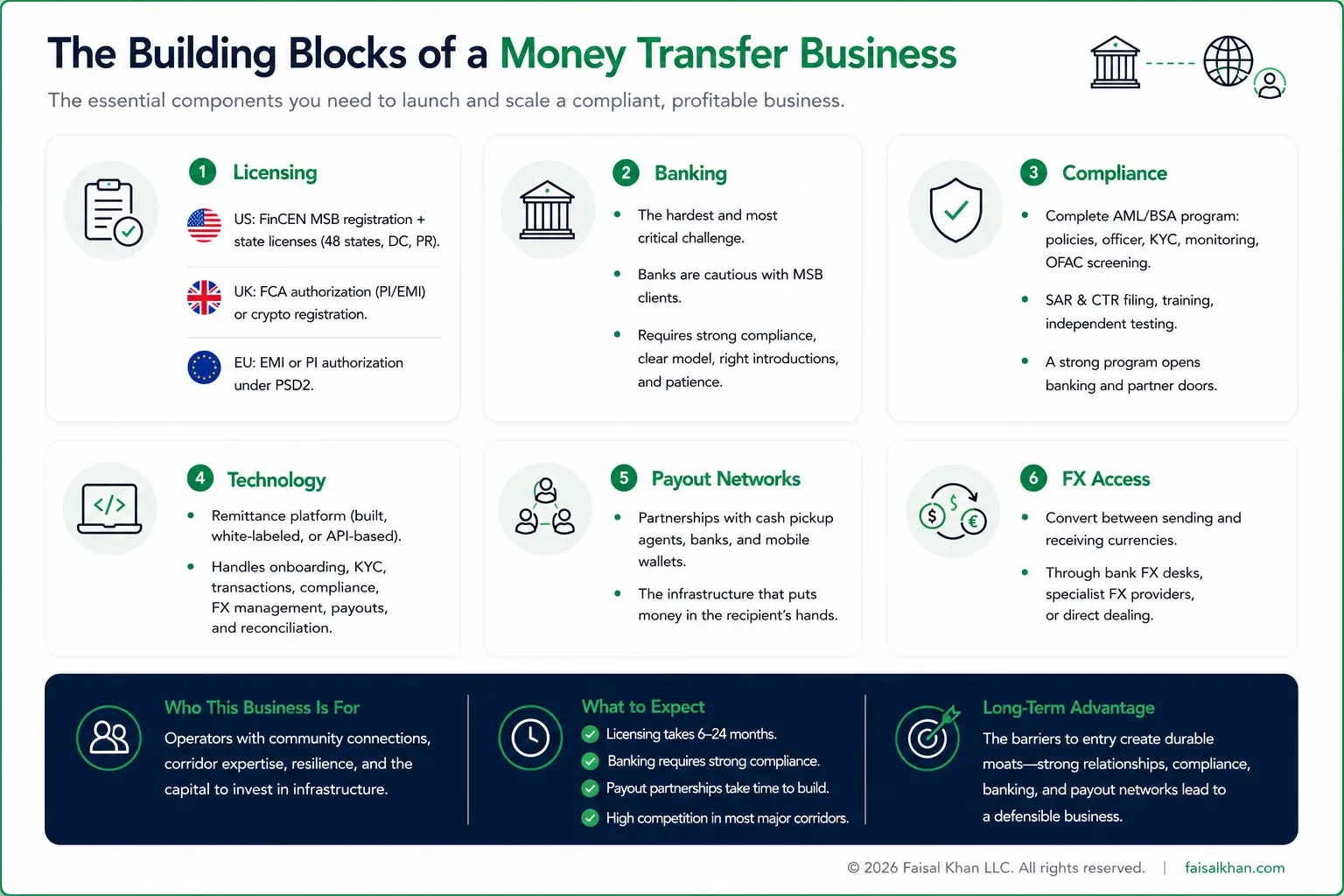
The Building Blocks of a Money Transfer Business
Licensing:
In the United States: FinCEN MSB (Money Services Business) registration is federal and mandatory. State money transmitter licenses are required in each state where you transmit money on behalf of customers. Full US coverage requires licenses in 48 states plus DC and Puerto Rico (Montana and South Carolina are exempted). Building a meaningful initial portfolio of 10 to 20 states is typically the starting approach, with full coverage as a multi-year goal.
In the United Kingdom: FCA authorization as a Payment Institution or Electronic Money Institution, or if handling crypto, registration as a cryptoasset business.
In the European Union: EMI or PI authorization under PSD2, with passporting to operate across EU member states.
Banking:
Getting and keeping a bank account is the most critical and most difficult operational challenge for a money transfer business. Banks are cautious about MSB clients due to compliance concerns, and many mainstream banks refuse to open accounts for money transfer operators entirely. Getting the right banking requires a strong compliance program, a well-documented business model, the right introduction to the right institution, and patience. This is one of Faisal Khan LLC's most specific areas of capability.
Compliance:
A complete AML/BSA compliance program: written policies, a qualified compliance officer, customer identification, transaction monitoring, OFAC screening, SAR and CTR filing procedures, employee training, and annual independent testing. This is not optional and not something to do minimally. A strong compliance program is the document that opens banking and payout partner doors.
Technology:
A remittance platform (built, white-labeled, or assembled from API components) that handles customer onboarding, KYC, transaction processing, compliance screening, FX rate management, payout instruction generation, and settlement reconciliation.
Payout networks:
Partnerships with cash pickup agents, banks, and mobile wallet operators in your receiving markets. The payout network is the infrastructure that puts money in the recipient's hands.
FX access:
The ability to convert between sending and receiving currencies at competitive rates. This can be through a bank FX desk, a specialist FX provider, or a direct dealing arrangement.
Three Routes to Market
Route 1: Build your own licensed MTO from scratch.
Apply for your own money transmitter licenses, establish your own banking, build your own compliance program and technology platform, and source your own payout partnerships. This gives maximum independence and the best long-term economics, but requires 12 to 24 months to reach meaningful operational capability and significant upfront capital.
Route 2: Start as an authorized delegate while your licenses are in progress.
Operate under the umbrella of an already-licensed money transmitter as their authorized delegate (or agent). This allows legal operation in licensed states from day one while your own license applications are pending. Revenue is shared with the licensing MTO, but it allows you to start serving customers and generating revenue while building toward independence.
Route 3: Acquire a licensed entity.
Purchase a company that already holds the licenses, banking, and operational infrastructure you need. This is the fastest route to full operational capability but requires significant capital and careful due diligence on the acquired entity's compliance history, banking relationships, and payout network quality.
Faisal Khan LLC advises on all three routes, helps evaluate the right approach for each client's situation, and connects clients to licensing counsel, banking partners, authorized delegate opportunities, and acquisition targets as appropriate.
Growing an Existing Money Transfer Business
Many of our engagements are not with new entrants but with existing money transfer operators who have hit a growth ceiling and need help breaking through it.
Common growth blockers we address:
Banking instability: An existing MTO loses banking and needs to find a replacement. We introduce operators to banking partners with genuine MSB appetite and help prepare the documentation that banking onboarding requires.
Payout network limitations: Current payout partners in key corridors are too expensive, have limited reach, or have reliability problems. We source alternatives and help structure new correspondent agreements.
Corridor expansion: The operator wants to enter new corridors and needs licensing strategy, banking for the new corridor's settlement, and payout partner introductions.
Compliance program gaps: A regulatory examination or bank-side compliance review has identified weaknesses in the AML program. We advise on what needs to be fixed and connect to compliance infrastructure providers.
FX optimization: The current FX pricing is eating too much margin. We advise on how to access more competitive FX rates and structure dealing relationships.
Frequently Asked Questions
How much does it cost to start a money transfer business in the US?
Costs include: state MTL application fees (ranging from a few hundred to several thousand dollars per state), surety bond premiums (a percentage of the required bond amount, which varies enormously by state from USD 25,000 to USD 1 million or more), net worth requirements, compliance program development, technology platform costs, and banking setup. A realistic initial budget for a focused 10 to 20 state US launch, including licensing, compliance, technology, and working capital, is USD 500,000 to USD 2 million depending on the scale and scope.
Can I start with a few states and expand later?
Yes, and this is the standard approach. Start with the states most relevant to your customer base and expand systematically. Using an authorized delegate arrangement to cover states where you do not yet hold a license is a common parallel strategy.
How long does a state money transmitter license take to get?
Processing times vary significantly by state: from 3 to 4 months in some states to 18 to 24 months in others (New York's NYDFS is notorious for long processing times). The average across a portfolio of state applications is typically 9 to 15 months. Applications that are complete and well-prepared process faster. Incomplete applications trigger deficiency letters that restart timelines.
Do I need a separate license for each corridor I want to operate?
No. Money transmitter licenses are based on where your senders are located, not on the destination corridor. A California MTL allows you to receive money in California and transmit it anywhere. You do need appropriate licensing in your receiving markets if you want to be the principal MTO on the receiving side (rather than using a correspondent or payout partner who holds the local license).
How We Help You Build and Grow a Money Transfer Business
The money transfer business is one of Faisal Khan LLC's deepest areas of expertise. We have helped structure, advise, and connect money transfer businesses across the full lifecycle: from first licensing applications through banking access, compliance program development, payout network sourcing, corridor expansion, and technology selection. We do not hold money transmitter licenses or process payments ourselves. We advise on strategy, make the right introductions, and help operators build the infrastructure they need to run a compliant, sustainable money transfer business. If you are building a money transfer business, expanding an existing one, or trying to solve a specific operational challenge, we are the right starting point.