

Payment networks are the shared infrastructure that allows money to move between banks, businesses, and individuals. Without payment networks, every financial institution would need a direct bilateral relationship with every other financial institution it ever needed to transfer money to. Payment networks solve this coordination problem by creating shared messaging standards, shared routing infrastructure, and shared settlement mechanisms that allow any member institution to send and receive payments with any other member. Understanding payment networks, which ones are relevant to your business, how to access them, and how they affect the cost and speed of your payment flows is fundamental to building efficient financial operations. Faisal Khan LLC advises businesses and payment operators on payment network access, connects them to the banking and licensing infrastructure needed to participate in relevant networks, and helps them understand how to optimize their payment routing across the available network infrastructure.
The Major Global Payment Networks
SWIFT (Society for Worldwide Interbank Financial Telecommunication):
SWIFT is the global messaging network that connects over 11,000 financial institutions in more than 200 countries. It carries the instructions for international wire transfers but does not itself move money: it transmits payment messages that trigger corresponding movements in correspondent bank accounts. Most international B2B payments and high-value cross-border transfers travel via SWIFT. SWIFT GPI (Global Payments Innovation) has added end-to-end tracking and same-day settlement aspirations to the network.
Access for businesses: Indirect, via their banking partners who are SWIFT members. Direct SWIFT membership requires being a financial institution or corporate with a strong business case, and is pursued by very large multinationals or payment operators.
Visa and Mastercard:
The two dominant global card networks, connecting card-issuing banks and card-accepting merchants (via their acquiring banks) in over 200 countries. The card networks set the rules for how their cards can be used, what interchange fees apply, and what liability applies to different transaction types. They also operate fraud detection and dispute resolution infrastructure.
Access for businesses: Through issuing banks (to issue cards) or acquiring banks (to accept cards). Direct network membership (becoming a principal member) requires being a licensed bank or financial institution meeting the networks' criteria.
ACH (Automated Clearing House) - United States:
The US domestic electronic payment network, operated by NACHA. ACH processes direct deposits, business-to-business payments, and consumer bill payments. Standard ACH settles in 1 to 2 business days. Same-Day ACH and real-time ACH (via RTP and FedNow) have added faster options. ACH is a batch-processing system: transactions are accumulated and processed in multiple settlement windows per day.
Access for businesses: Via their US bank, which is an ACH member. Direct ACH origination rights require a banking relationship and an ACH originator agreement.
SEPA (Single Euro Payments Area):
The EU-wide payment framework that standardizes euro payments across 36 European countries. SEPA Credit Transfer (SCT) provides 1-day settlement. SEPA Instant Credit Transfer (SCT Inst) provides real-time settlement, 24/7, for up to EUR 100,000 (with increasing limits). SEPA Direct Debit allows businesses to collect recurring payments from customers across the eurozone with a single mandate.
Access for businesses: Through their European bank or payment institution. Direct SEPA participation requires being a licensed payment institution or bank in a SEPA member country.
RTP (Real-Time Payments) and FedNow - United States:
Two competing real-time payment rails in the US. The Clearing House's RTP network (launched 2017) and the Federal Reserve's FedNow (launched 2023) both enable immediate, 24/7, final-settlement payments between member banks. RTP has a higher per-transaction limit (USD 1 million) than FedNow (USD 500,000 standard). Coverage depends on which US banks participate in each network.
Domestic Real-Time Payment Networks by Region
The proliferation of domestic real-time payment networks is one of the most significant developments in global payments over the past decade:
India: UPI (Unified Payments Interface), operated by NPCI. Over 10 billion transactions per month. Interoperable across all participating banks and payment apps. Free for users. A genuine model for other markets.
UK: Faster Payments Service, enabling near-instant bank transfers 24/7. Integrated with the major UK banks. Now processing billions of transactions annually.
Brazil: Pix, launched by the Central Bank of Brazil in 2020. The fastest adoption of any payment system in history. Free, instant, 24/7. Now the dominant payment method in Brazil across consumer and business payments.
Singapore: PayNow, enabling real-time transfers using mobile number or NRIC. Linked bilaterally to Thailand's PromptPay and India's UPI as part of ASEAN payment interoperability initiatives.
Australia: New Payments Platform (NPP), enabling real-time, 24/7 payments between Australian bank accounts with the Osko overlay for instant consumer and business payments.
Mexico: SPEI, the central bank-operated real-time settlement system. CoDi (Cobro Digital) is the QR code payment overlay. Both are widely used for domestic B2B and consumer payments.
For businesses operating in multiple markets, understanding which real-time payment networks are available in each market, and whether their banking infrastructure is connected to them, directly affects the speed and cost of collecting and disbursing local currency funds.
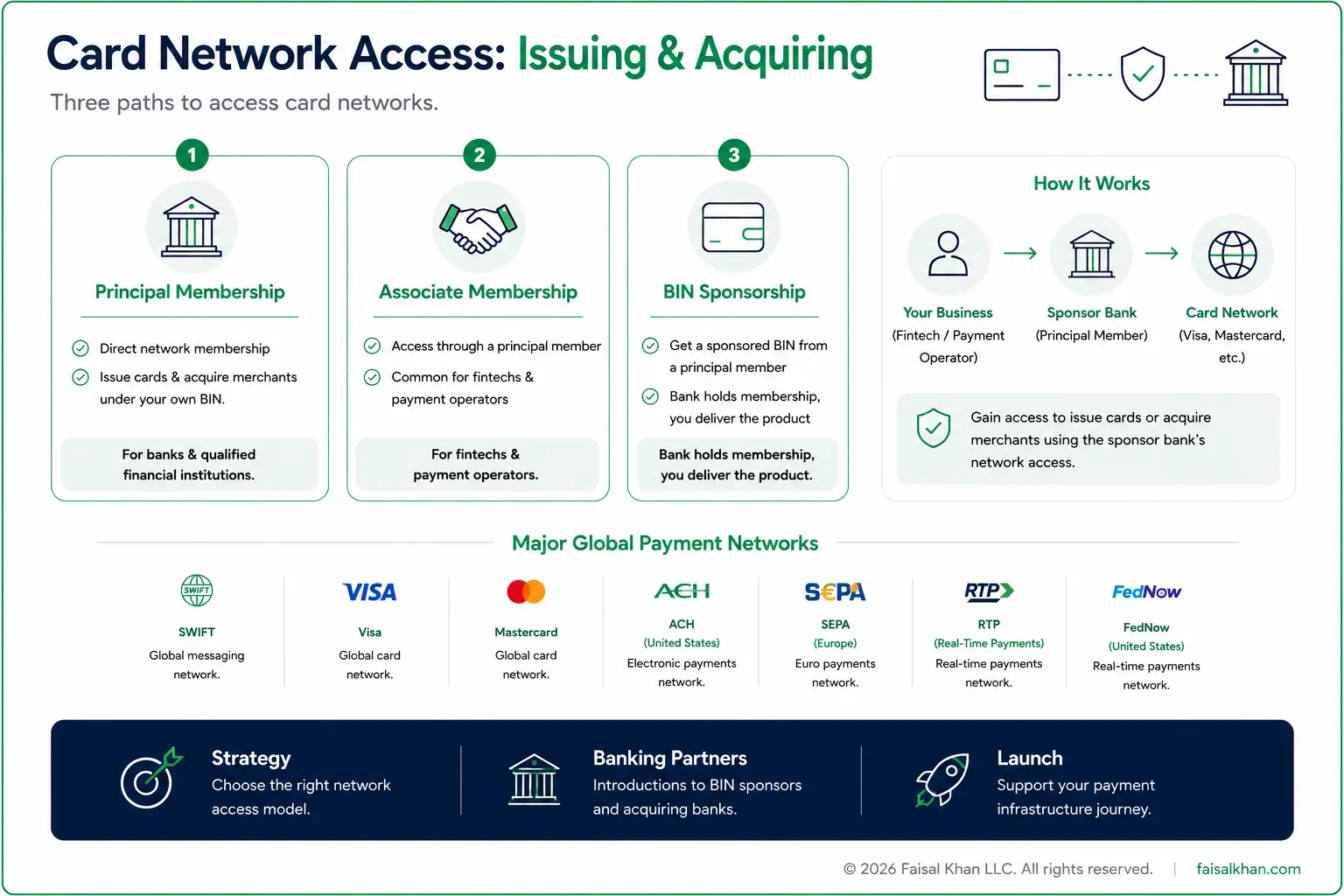
Card Network Access: Issuing and Acquiring Membership
For payment operators wanting to participate more directly in the card networks (rather than just accepting or issuing through a bank), understanding network membership structures is important:
Principal membership: Direct participation in the card network. Requires being a licensed bank or, in some cases, a licensed financial institution meeting the network's specific membership criteria. Principal members can issue cards and acquire merchants under their own BIN (Bank Identification Number).
Associate membership: Participation through sponsorship by a principal member. Non-bank entities (fintechs, payment fintechs, program managers) can issue cards or provide acquiring services by associating with a principal member bank that sponsors their access. This is how most fintech card programs and payment facilitators access the card networks.
BIN sponsorship: A specific form of associate membership for card issuance. A fintech obtains a sponsored BIN from a principal member bank and issues cards under that BIN. The bank holds the card network membership; the fintech provides the product and customer experience.
We advise payment operators and fintechs on card network access strategies, connect them to BIN-sponsoring banks and payment infrastructure partners, and help structure the agreements needed to access card network infrastructure.
Frequently Asked Questions
Can a non-bank business become a direct SWIFT member?
SWIFT offers a SWIFT for Corporates program that allows large multinational companies to connect directly to the SWIFT network for their own treasury and payment operations. This requires meeting SWIFT's eligibility criteria and significant investment in SWIFT connectivity infrastructure. For most businesses, indirect SWIFT access via their bank is the practical approach.
What is the difference between the Visa and Mastercard networks?
From a merchant's perspective, both networks function similarly: they connect issuers and acquirers and facilitate card transaction routing and settlement. The differences are primarily in global acceptance footprint (similar at the top level), specific regional strengths (Mastercard stronger in some markets, Visa in others), network rules and interchange rate structures, and the specific fraud and dispute management tools each offers. For most businesses, accepting both is the right approach.
How do I know which payment network a specific payment will travel through?
For card payments, the card number's BIN (the first 6 digits) identifies the issuing bank and the card network. For bank transfers, the payment method and currency determine the network: an international wire typically uses SWIFT, a euro payment within Europe uses SEPA, a US domestic transfer uses ACH or Fedwire.
What is ISO 20022 and why does it matter?
ISO 20022 is the new international messaging standard for financial transactions, replacing legacy SWIFT MT messages. It carries richer data (more complete beneficiary information, invoice references, purpose of payment) that enables better automation, compliance screening, and reconciliation. SWIFT is migrating to ISO 20022 on its cross-border payment rails. Banks and payment operators that complete the migration early will have a data quality advantage in their payment flows.
Access and Optimize Your Payment Network Infrastructure
Payment networks are the roads on which your money travels. Understanding which roads are available, how to access them, and how to route your payment flows for maximum efficiency and minimum cost is one of the highest-leverage optimization opportunities for any business with significant payment flows. Faisal Khan LLC advises businesses and payment operators on payment network access, connects them to the banking and licensing partners needed to participate in relevant networks, and helps them build the understanding of global payment infrastructure that drives better commercial decisions. Payment networks are complex. We make them navigable.