

Remittances are the transfer of money by migrant workers and diaspora communities to family members in their home countries. They are the most direct, most impactful, and most consistent financial flow between the world's wealthiest and developing economies. Global remittance flows to low and middle-income countries exceed USD 650 billion annually, dwarfing foreign direct investment and international aid combined in many receiving markets. For the families who receive them, remittances are not a financial product. They are school fees, medical bills, housing, and the difference between poverty and stability. For the operators who facilitate them, remittances represent one of the most durable, community-rooted, and ultimately defensible businesses in financial services. Faisal Khan LLC advises businesses on how to enter and grow in the remittance industry, connects operators to the banking, licensing, and payout infrastructure they need, and helps build the compliant, scalable operations that durable remittance businesses are built on.
Why Remittances Matter: The Scale of the Industry
The numbers are significant but it is the human dimension that makes remittances unlike any other payment category.
The United States alone generates over USD 150 billion in outbound remittances annually. The UK sends over USD 25 billion. Saudi Arabia, the UAE, Kuwait, Qatar, and Bahrain collectively send hundreds of billions more. These flows originate from migrant worker communities ranging from Mexican construction workers in Texas, to Filipino nurses in the UK, to Pakistani engineers in Dubai, to Indian IT professionals in Silicon Valley.
On the receiving side, remittances represent enormous shares of national income in many countries: over 20% of GDP in countries like Tonga, Lebanon, and Kyrgyzstan. In the Philippines, India, Mexico, Pakistan, and Bangladesh, remittances are among the largest sources of foreign exchange income in the entire national economy.
The communities at both ends of these remittance flows are loyal to operators they trust. A family that has been using the same remittance service for ten years will not switch for a few basis points of FX difference. Brand trust, reliability, and community connection are the competitive moats that make remittance businesses genuinely durable.
The Remittance Business Model: How Operators Earn
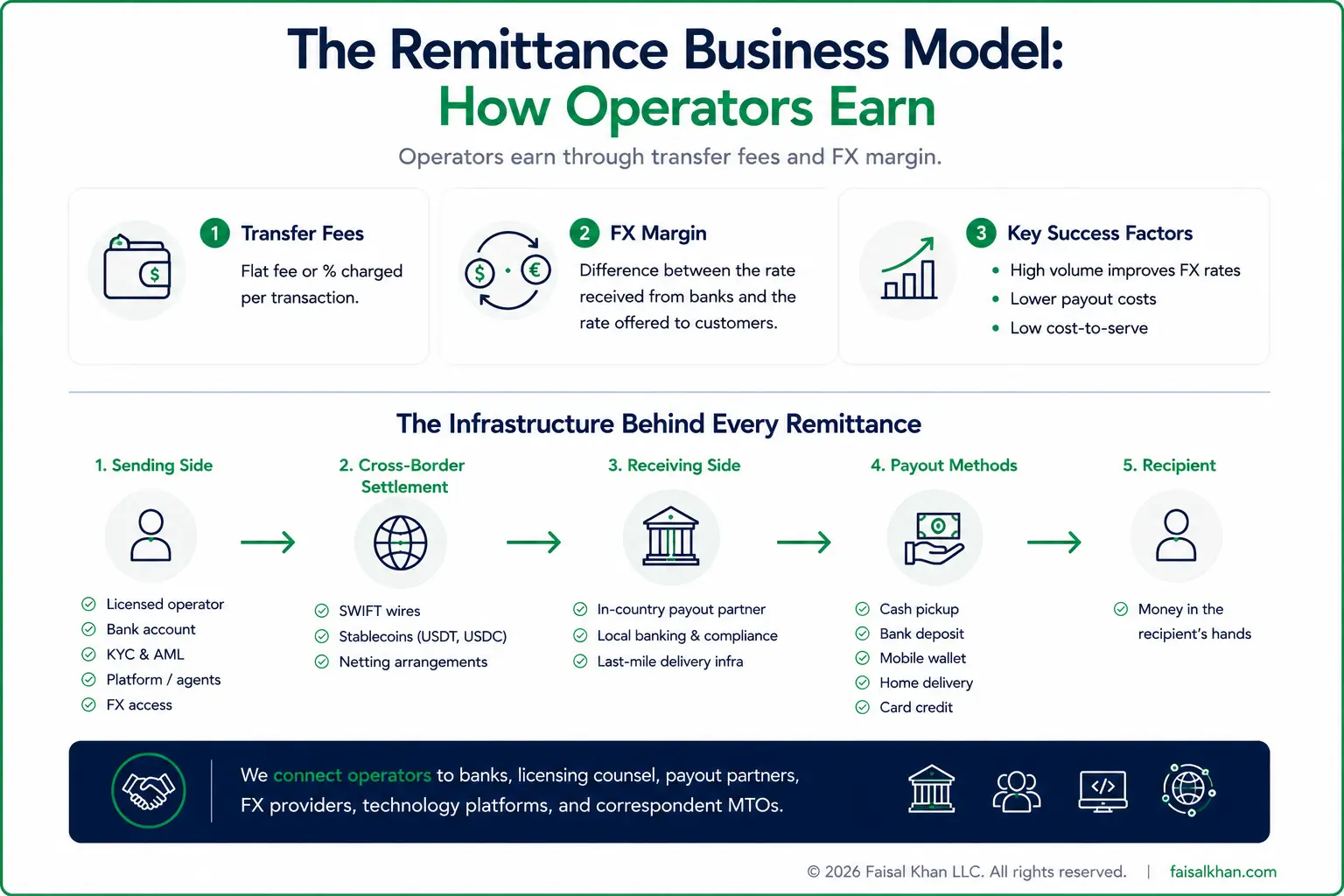
Remittance operators generate revenue through two primary mechanisms:
Transfer fees: A flat fee or percentage charged to the sender per transaction. Fees vary by operator, corridor, and transaction size. Many operators offer zero-fee transfers (particularly for digital channels) and compete primarily on the FX rate, effectively moving the fee into the exchange rate margin.
FX margin: The difference between the exchange rate the operator obtains from its bank or FX provider and the rate it offers to the customer. For a corridor like USD to Mexican Peso, the difference between the interbank rate and the customer rate represents the operator's FX revenue. On high-volume corridors, FX margin can be the dominant revenue source.
The two revenue sources are interconnected: operators who offer lower transfer fees often compensate with wider FX margins, and vice versa. Transparent operators (Wise, for example) show customers the interbank rate and charge an explicit fee. Traditional operators often embed most of their revenue in the FX rate.
At scale, remittance economics are driven by corridor volume, FX margin management, payout cost (what the operator pays to its payout partners for last-mile delivery), and operating cost. The operators with the best economics are those with the highest volumes (enabling the best FX pricing and payout fee negotiation) and the lowest cost-to-serve.
The Infrastructure Behind Every Remittance
A remittance from sender to recipient involves a full stack of infrastructure on both the sending and receiving sides:
Sending side: A licensed money transmitter or equivalent (EMI/PI in the UK/EU), a bank account that accepts customer funds, a compliance program including KYC and AML screening, a customer-facing platform (app, website, or retail agent), and FX access.
Cross-border settlement: The mechanism by which funds move from the sending operator to the receiving payout partner. This is typically a SWIFT wire, but increasingly stablecoin settlement (USDT, USDC) or bilateral netting arrangements are used for cost and speed efficiency.
Receiving side: A payout partner with the in-country licensing, banking, and last-mile delivery infrastructure to put money in the recipient's hands via cash pickup, bank deposit, mobile wallet, home delivery, or card credit.
Each link in this chain is a relationship to build, a compliance requirement to meet, and a commercial arrangement to negotiate. The depth and quality of these relationships is what separates well-run remittance operators from those who struggle to scale.
We connect operators at every point in this chain: to banks, to licensing counsel, to payout partners in specific receiving markets, to FX providers, to technology platforms, and to correspondent MTOs for new corridor entry.
Entering the Remittance Industry: Your Options
Build from scratch as a licensed operator: Apply for money transmitter licenses in your home jurisdiction, establish banking, build or source technology, develop payout partnerships in your target corridors, and launch as your own licensed MTO. The most independent and ultimately most rewarding route, but the longest and most capital-intensive.
Start as an authorized delegate under a licensed MTO: Operate under the license umbrella of an established licensed operator while building your own capability and applications. You can reach customers and build volume from day one, with revenue shared with the licensing partner. This is the fastest legal route to market and a common bridge strategy.
Build a specialized remittance product within an existing licensed entity: Partner with a licensed payment institution or bank to offer a remittance service under a white-label or banking-as-a-service arrangement. The licensed entity holds the regulatory standing; you build the customer-facing product and community relationships.
Focus on specific underserved segments: Some remittance corridors and customer segments are underserved by existing operators. Emerging diaspora communities, specific small-country corridors, or specific payment modality gaps (for example, a corridor where mobile wallet delivery is unavailable but in demand) represent genuine market opportunities for new entrants with the right community connections.
Frequently Asked Questions
What is the most important factor in remittance business success?
Community trust. The most successful remittance operators are deeply embedded in the communities they serve. Word-of-mouth referrals within diaspora communities are more powerful than any marketing spend. Building a reputation for reliability, transparency on FX rates, and consistently delivering funds on time is the foundation of a durable remittance business.
How competitive is the remittance market?
Intensely competitive in major corridors (US-Mexico, UK-India, UAE-Pakistan), with both established global players and aggressive digital-first entrants. Less competitive in smaller or more complex corridors. The competitive intensity in major corridors has been positive for consumers: transfer fees have dropped significantly and FX transparency has improved. For new operators, differentiation through community relationships, corridor specialization, or unique payout access is more viable than trying to out-price large established players.
How do I find a payout partner for a specific receiving country?
Payout partners in specific countries include local banks, agent networks, mobile money operators, and home delivery services. Finding credible, compliant partners requires industry relationships. This is one of the most specific and practical things we provide at Faisal Khan LLC: introductions to payout partners in corridors relevant to our clients.
What digital channels work best for remittances?
Mobile apps have become the dominant channel for digital remittances, particularly among younger diaspora communities. Web platforms remain important. For older or less digitally connected sender populations, retail agent networks (in-person send locations) remain critical. The right channel mix depends on the specific sending community and their preferences and digital literacy.
Enter or Grow in the Remittance Industry With the Right Foundation
Remittances are one of the most impactful and most durable businesses in the payments industry. They serve communities, not just customers. They generate recurring, loyal volume that compounds over time. And the infrastructure barriers to entry, once overcome, create genuine competitive protection. Faisal Khan LLC has spent over fifteen years building expertise and relationships across the remittance industry. We advise operators on strategy and structure, connect them to the licensing, banking, and payout infrastructure they need, and help them build operations that serve their communities for the long term. Whether you are starting from zero or growing an established business, we are the advisor and connector that the remittance industry's most capable operators turn to.