

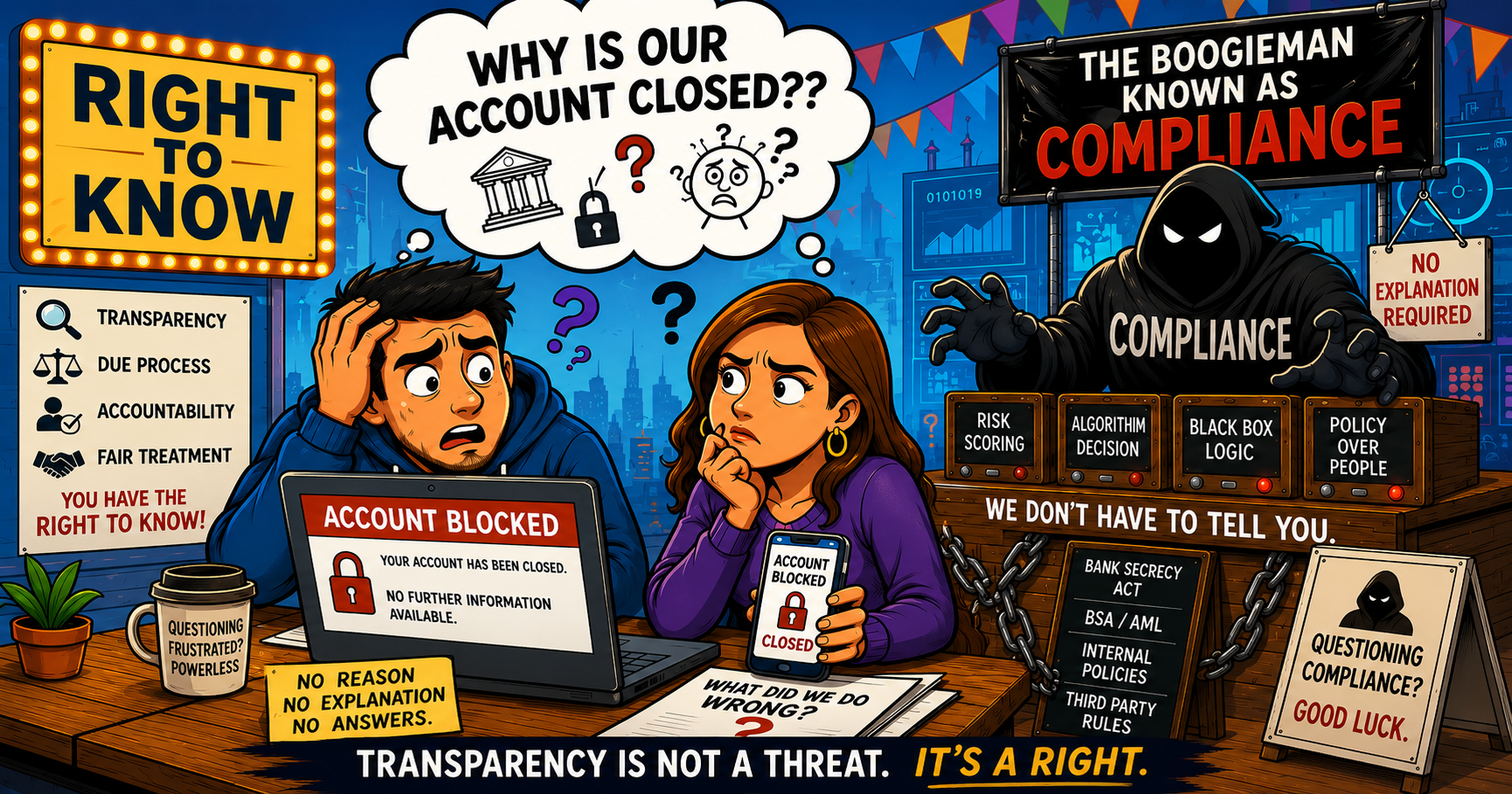
Banks and fintechs block accounts every day without telling customers why. This needs to stop. Customers have a right to know.
If something is denied to us, we want to understand why. It’s instinct. It’s also, in a functioning society, a basic expectation. You get a visa rejection, they give you a reason. You get fired, there’s a process. You get a parking ticket, it says what you did wrong and where.
Banks don’t play by those rules. Neither do most fintechs, payment platforms, or mobile money operators. And the more I’ve seen of this industry, the more convinced I am that the silence is not an accident. It is policy.
What Happened to Me
I’m going to share something personal, because abstract arguments about consumer rights are easy to dismiss. This one isn’t abstract.
A few weeks ago, both my bank accounts in Turkey were blocked simultaneously. No letter. No email. No SMS. No call. One day they worked. The next day they didn’t.
It turned out a prosecutor had frozen the accounts of everyone who had ever transacted with a specific individual under investigation. I had transacted with this person once. That was enough. I was swept up without any notification, without any warning, and without any explanation from either bank. Even the bank staff didn’t know. They sent me to headquarters. Headquarters sent me in circles. I eventually had to hire a lawyer to find out what had happened.
At the same time, my bank account in Pakistan was blocked and closed. The reason, when I eventually uncovered it, was a Common Reporting Standard issue. The bank had made the mistake. They closed my account because of their own error. No email. No SMS. No letter. Nothing. I only found out because a transaction kept failing and I called the CEO, who I happen to know personally. Most people don’t have that option.
And then, as if that wasn’t enough, my one remaining active prepaid account in Turkey was blocked as well. Money in the account. App working fine. ATM declining every transaction. When I eventually reached the CEO of that company, he told me compliance had blocked it. No reason given to me, just a note on their side that said compliance. He told me we’d talk about it at lunch in a few days.
Three accounts. Three different institutions. Three different reasons. Not one of them told me anything.
The Boogeyman Called Compliance
Every time an account gets blocked and a customer asks why, the answer is the same: compliance.
Compliance is the perfect word. It sounds official. It implies the bank had no choice. It deflects blame onto regulation, on government, on some unnamed rule that the institution is bravely following on your behalf. It tells you nothing, and it is designed to tell you nothing.
I have spent decades in banking and payments. I understand what compliance departments do and why they exist. AML controls, CRS reporting, sanctions screening, transaction monitoring, all of it has a legitimate purpose. I am not arguing against compliance.
I am arguing against using compliance as a black hole where customer rights go to disappear.
If your account is flagged by a monitoring system, that system knows why it flagged you. Someone made a decision. That decision was based on something specific. The institution knows what that something is. They are choosing not to tell you. That choice is deliberate, and in most jurisdictions, it is completely legal.
That needs to change.
What This Actually Costs People
Most people who read this article are not consultants with CEO contacts in their phones. They are ordinary people who depend on their bank account to pay rent, receive their salary, buy groceries, and run their lives.
When a bank account disappears without notice, those people don’t know where to start. They don’t know if their money is safe. They don’t know if they did something wrong. They don’t know if they can fix it or if it’s permanent. They don’t know who to call, because when they do call, they get told to contact headquarters, and headquarters tells them nothing.
Functioning in modern society without banking is nearly impossible. You cannot buy online without a card. You cannot receive a salary transfer without an account. In many cities, cash is barely accepted anymore. Your ability to participate in economic life is directly tied to your access to financial accounts.
When that access is removed without explanation, it is not a minor inconvenience. It is a crisis. And when it happens to someone already living close to the financial edge, the consequences can be severe.
I called some former clients after my accounts were blocked. People who had complained to me in the past about similar situations. Even those who held elite status with their banks described the experience the same way: no information, no timeline, no accountability, and compliance as the only answer anyone would give them.
The Right to Know Is Not Complicated
I am not asking for classified information. I am not asking institutions to compromise their investigations or reveal the inner workings of their monitoring systems. I am asking for two things.
First, tell the customer immediately when their account is blocked. Not eventually. Not when they notice something is wrong. Within ten or fifteen minutes of the action being taken. Through every channel available: email, SMS, push notification, in-app message. You have their contact information. Use it.
Second, tell them why, with enough specificity to be useful. A generic “regulatory requirements” notice is not information. It is the absence of information dressed up as a response. If the reason is a compliance flag, say it was a compliance flag. If it is a CRS issue, say it is a CRS issue. If it is because they transacted with someone under investigation, say that. People can handle real information. What they cannot handle is silence.
Some institutions will argue they cannot disclose details for legal reasons. In certain specific situations involving active criminal investigations, there is a case for that. But those situations are the exception. The vast majority of account blocks happen for administrative reasons, reporting requirements, system flags, or risk thresholds. None of those require secrecy. They require communication.
Debanking Is a Serious Word
The industry invented a softer word for it. Debanked. It sounds almost gentle, like something that just happened, rather than something that was done to you.
It was done to you.
If the president of the United States can be debanked, if celebrities, public figures, and ordinary customers across every income level can wake up one morning to find their financial access gone without explanation, this is not a niche problem. It is a systemic one.
And the systemic solution is not complicated either. It requires regulators to mandate what should already be basic practice. Notify customers immediately when their accounts are restricted or closed. Give them a specific reason. Give them a process for appeal. Give them a timeline for resolution.
Right now, none of that is consistently required anywhere in the world. Some jurisdictions have partial protections. Most have gaps. And the industry, left to itself, defaults to silence because silence is easier and carries no legal risk.
What Should Actually Happen
When a financial institution blocks, restricts, or closes an account, the following should be non-negotiable.
The customer is notified within fifteen minutes through every registered digital channel. The notification includes a specific reason, not a generic compliance reference. The customer is given a clear point of contact, not a general helpline. The institution provides a timeline for review. If the block is temporary, the customer is told that. If it is permanent, they are told that too, with the reason.
This is not a radical ask. Banks send fraud alerts within seconds when they suspect an unusual transaction. They can text you about a purchase in a foreign city before you’ve put your wallet away. The infrastructure for real-time customer communication already exists. The decision not to use it for account closures is a choice, not a technical limitation.
The Broader Problem
This article is about the right to know. A future one will go further, into what I think is a deeply broken relationship between financial regulators, the institutions they oversee, and the ordinary people those institutions are supposed to serve.
The compliance apparatus that was built to protect the financial system from criminals has, in many cases, become something that treats ordinary customers as suspects. The tools are blunt. The human oversight is thin. And when the system makes a mistake, as it did with my account in Pakistan, the customer bears all the cost and inconvenience while the institution bears none.
That is not regulation working as intended. That is bureaucracy protecting itself.
The right to know is where this conversation starts. When your account is blocked, you deserve to know within minutes, not weeks. You deserve a specific reason, not a reference to compliance. And you deserve a real path to resolution, not a telephone loop that ends at headquarters.
We can build a financial system that is both safe and fair. Right now, in too many cases, we have chosen safe for the institution and opaque for everyone else.
That is the part that needs to change.