

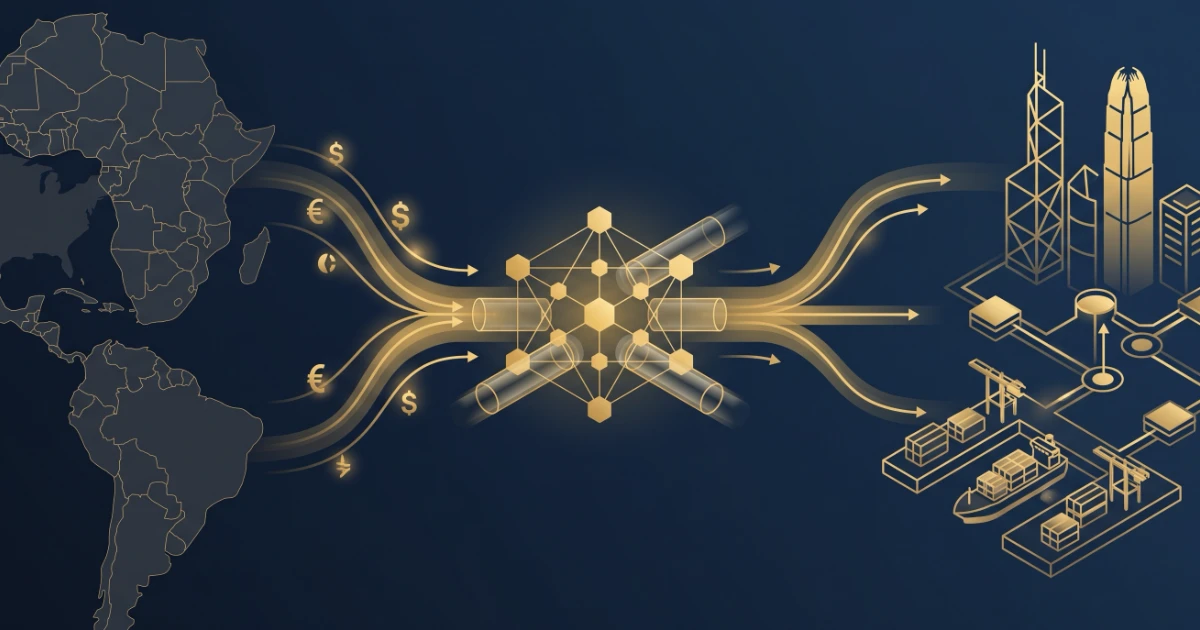
Why stablecoin backhaul, wholesale FX aggregation and local collection may matter more than another crypto wallet
The most important stablecoin opportunity in cross-border payments may also be the least visible.
It is not persuading a Nigerian importer to price solar panels in USDT. It is not convincing a Chinese exporter to hold USDC. It is not putting another crypto wallet in front of a business that already has a bank account.
The larger opportunity is to use stablecoins quietly inside the payment chain: collect local fiat from an importer, move value between regulated providers around the clock, and deliver the currency the exporter actually requested into a bank account in Hong Kong.
The customer may never see the stablecoin. The invoice remains denominated in dollars or Hong Kong dollars. The importer pays in naira, pesos, reais or another local currency. The exporter receives fiat. Stablecoins operate as the settlement backhaul connecting the two ends.
That distinction matters because stablecoins solve only one part of a much larger problem. They can move tokenized dollars quickly, but they do not automatically provide local collection accounts, affordable foreign exchange, customer due diligence, banking access, liquidity, reconciliation or a compliant third-party payout. Those are still the difficult—and potentially valuable—parts of the business.
The real transaction is still fiat to fiat
Consider an importer in an emerging market purchasing machinery, medical equipment or solar panels from a Chinese supplier that receives payments through Hong Kong.
The commercial transaction might look simple:
Local importer → local currency → USD or HKD → supplier’s Hong Kong bank account
But underneath it sits a fragmented chain:
The importer must obtain legitimate access to local collection or banking rails.
Someone must perform the foreign-exchange conversion.
Compliance teams must verify the parties, transaction purpose and supporting trade documents.
Value must move across borders.
A regulated provider must make the final third-party payout.
Every participant must reconcile the payment and demonstrate where the money came from and where it went.
A stablecoin can improve step four. It does not eliminate the other five.
This is why the claim that stablecoins will simply “replace SWIFT” is incomplete. SWIFT is a bank-messaging network, while stablecoins are digital settlement assets. In some payment chains, stablecoins can replace or shorten the cross-border settlement leg. But banks, payment institutions and local rails are still needed at the edges whenever customers pay and receive fiat.
The better question is therefore not whether stablecoins will replace banks. It is:
Which parts of the cross-border payment chain can be rebuilt when tokenized dollars provide the backhaul between local fiat systems?
Stablecoins as payment backhaul
In telecommunications, backhaul carries aggregated traffic between local access networks and the core network. The end user does not care how that traffic is transported; the user cares that the connection works.
Stablecoins can play a similar role in payments.
An originating PSP collects local currency. A settlement provider receives stablecoins or converts the collected funds into stablecoins. Value moves internationally, including during weekends or outside correspondent-banking hours. A destination provider converts or uses the stablecoins to fund a local fiat payout.
The visible customer experience remains conventional:
Fiat in → fiat out
The invisible infrastructure becomes:
Local collection → stablecoin backhaul → local payout
This model is especially relevant where conventional international payments face practical friction:
The sending market has limited dollar liquidity.
Correspondent banks have little appetite for the originating jurisdiction.
A PSP needs to fund payouts after banking hours.
A supplier requires predictable delivery rather than an uncertain chain of intermediaries.
Smaller payment companies cannot maintain prefunded balances in every destination.
The commercial payment must be made over a weekend or holiday.
Research from the Bank for International Settlements supports the underlying demand signal. Its study of cross-border crypto flows across 184 countries found that stablecoin activity has stronger links to transactional needs and traditional remittance costs, particularly in emerging and developing economies. That does not prove that every stablecoin transfer represents trade settlement, but it reinforces the idea that stablecoins are increasingly used where conventional cross-border channels are expensive or difficult. (BIS)
Why Hong Kong is strategically important
Hong Kong is not merely another payout destination. It sits at the intersection of international finance, Chinese manufacturing, regional trade and dollar liquidity.
The 2025 BIS foreign-exchange survey found that the United Kingdom, United States, Singapore and Hong Kong together accounted for 75% of global FX trading handled by sales desks. Hong Kong alone maintained a 7% share, while trading in USD/HKD nearly doubled from the 2022 survey. The Hong Kong dollar’s share of global FX turnover also rose from 2.6% to 3.8%. (BIS)
Hong Kong is also actively modernizing its trade-finance infrastructure. The Hong Kong Monetary Authority’s Project CargoX is connecting cargo, trade and cash-flow data to help banks verify transactions and improve SME trade financing. Its pilot work includes connectivity with Mainland Chinese and ASEAN trade-data platforms. (HKMA)
For a payment company, this creates a focused strategic opportunity: become the easiest and most reliable way for PSPs, fintechs and regional banks to deliver legitimate commercial payments into Hong Kong.
The goal should be category ownership. When a payment provider asks, “Who can terminate this trade payment into Hong Kong?” one company should become the default answer.
The missing wholesale FX layer
The global FX market is enormous—average daily OTC turnover reached $9.6 trillion in April 2025—but access to its best prices is highly unequal. The US dollar appeared on one side of 89.2% of all trades, illustrating how central dollar liquidity remains even when neither end customer is American. (BIS)
Large banks, dealers and institutional counterparties transact at wholesale rates. A smaller PSP processing $2 million or $10 million per month in a particular corridor may receive a materially worse price, especially in a difficult emerging-market currency.
This creates an aggregation opportunity.
Imagine 50 regulated payment companies, each too small to negotiate institutional pricing independently. Their flows could be consolidated into a sufficiently large liquidity book. The aggregator obtains wholesale access and then distributes smaller pieces of that liquidity to its clients.
This is the financial equivalent of buying in bulk and selling in smaller quantities. The provider is not merely converting currency. It is democratizing access to wholesale liquidity.
Its value proposition becomes:
Better pricing than a small PSP can obtain alone.
One integration covering multiple source markets.
Reliable Hong Kong payout capability.
Consistent compliance and transaction documentation.
Predictable settlement and reconciliation.
Volume-based pricing that rewards growth.
The opportunity is particularly strong among small and medium money-transfer operators. Thousands of these businesses have customers, licenses or registrations and local distribution, but lack competitive FX, modern treasury infrastructure and direct access to difficult corridors. Most infrastructure providers chase large banks, venture-backed fintechs or multinational platforms. The fragmented middle remains poorly served.
Why transparent pricing can become a distribution strategy
FX and cross-border payment pricing is often opaque. A provider quotes each customer privately, adds several layers of spread and makes meaningful comparison difficult.
A company seeking to own the Hong Kong category could take the opposite approach: publish indicative rates and clearly explain its qualification criteria.
The model could use monthly volume slabs, for example:
Monthly processed volume | Commercial approach |
|---|---|
$2 million–$25 million | Entry wholesale tier |
$25 million–$100 million | Reduced spread or fee |
$100 million–$250 million | Institutional tier |
Above $250 million | Individually negotiated pricing |
These ranges are illustrative; actual prices must reflect currency, settlement method, compliance cost, liquidity and credit exposure.
The strategic value is not limited to transparency. A regularly updated rate page could become a customer-acquisition engine. PSPs searching for Hong Kong payout pricing, USD/HKD conversion or settlement from a specific emerging market could discover the provider before speaking to a salesperson.
Transparent pricing also forces internal discipline. Treasury, compliance and sales must agree on the cost of serving each corridor and customer category. The provider learns which routes create real margin and which merely create volume.
Volume and profit do not necessarily come from the same transaction
One of the most important commercial distinctions is between volume products and margin products.
A USD-to-USD payment into Hong Kong may generate little or no FX revenue. It can still be attractive if a bank or PSP is currently paying a high fixed fee for each international wire and wants a faster, more predictable alternative.
The provider might offer a flat fee and use stablecoins internally to fund the destination payout. This can create substantial throughput and recurring institutional relationships, but it may not create high profitability by itself.
The margin is usually found earlier in the chain:
Converting local currency into dollars.
Providing scarce dollar liquidity.
Charging for local collection.
Managing treasury and prefunding.
Serving a corridor that banks consider operationally difficult.
Offering a bundled collection, FX, settlement and payout service.
Therefore, a Hong Kong off-ramp may be the correct entry product, but it should not automatically be the final business model.
The strategic prize is controlling the on-ramp
If a PSP in Nigeria converts naira into USDT and hands the stablecoins to a Hong Kong payout provider, the PSP—or its liquidity partner—has already captured the on-ramp FX economics.
The destination provider earns only the settlement or payout fee.
To capture more value, the destination provider must selectively extend into the originating markets. That does not mean obtaining licenses in 50 countries at once. It means identifying the handful of markets responsible for the greatest relevant volume and choosing the appropriate structure in each one.
Possible approaches include:
Partnering with an established local PSP.
Operating under an authorized-delegate or sponsorship arrangement where permitted.
Acquiring a regulated company.
Applying directly for a license.
Establishing local bank collection accounts.
Offering named or virtual accounts through a regulated partner.
Sharing FX revenue with a local liquidity provider.
The product then becomes much stronger:
Pay the supplier locally. We will collect the money in your market and deliver the required currency into Hong Kong.
For the exporter, this removes collection friction. For the importer, it removes the burden of arranging an international wire. For the payment provider, it creates control over more of the value chain.
Sell to PSPs before selling to every importer
There are two possible routes to market.
The first is to acquire individual importers in sectors such as medical supplies, machinery, solar equipment, restaurant supplies or electronics. The second is to serve PSPs and other regulated intermediaries that already have hundreds of such businesses.
The direct-business strategy provides deeper customer knowledge and potentially greater margin, but it is expensive. Every importer requires separate acquisition, onboarding, education, transaction analysis and customer support.
A PSP has already done much of that work. One integration can produce many underlying transactions and considerably more volume.
For an infrastructure company, PSPs should normally be the primary distribution channel. Direct businesses can still be useful in carefully selected verticals where the provider wants to understand the payment problem, validate demand or establish a premium product.
The message to a PSP is straightforward:
Add Hong Kong and China-related commercial payouts to your existing product through one connection, without building the banking, liquidity and settlement network yourself.
Do not push the product before collecting the data
A common strategic mistake is to begin with an existing capability—“We can make Hong Kong payouts”—and search for customers who might want it.
The better process begins with discovery:
Which countries generate the most payments into Hong Kong?
Which commercial sectors drive those flows?
Are customers paying in local currency, dollars or stablecoins?
What are the typical and maximum transaction sizes?
Where are payments delayed or rejected?
Who currently captures the FX margin?
What documentation do banks require?
Which PSPs already control the relevant customers?
Do customers value speed, pricing, certainty, local collection or all four?
Which corridors remain unattractive after compliance and treasury costs are included?
Data should decide the first markets—not enthusiasm, personal familiarity or the apparent size of an economy.
A disciplined sequence for building the network
The opportunity is large enough to create distraction. A company could pursue Hong Kong licensing, US money-transmitter licenses, a European EMI, African collection partnerships, Latin American sales teams, local accounts and a global stablecoin network simultaneously—and execute none of them well.
A more disciplined sequence would be:
Phase One: Own the Hong Kong endpoint
Establish excellent USD and HKD payout coverage.
Make third-party payouts reliable and well documented.
Define eligibility, settlement times and transparent pricing.
Target PSPs already serving importers and exporters.
Become known for one destination before claiming global coverage.
Phase Two: Identify the largest originating markets
Measure actual customer demand.
Rank markets by volume, margin, regulatory feasibility and banking access.
Select no more than a few priority markets.
Set 90-to-120-day commercial and operational targets.
Phase Three: Capture selected on-ramps
Add local collection through partners or regulated entities.
Participate in the FX conversion.
Offer local account details where feasible.
Bundle collection, FX, stablecoin backhaul and Hong Kong payout.
Phase Four: Expand from corridor to network
Repeat the model only after the first corridors work.
Add vertical-specific propositions.
Extend the infrastructure to other Asian payout markets.
Use aggregated volume to negotiate better liquidity and banking terms.
The winners will connect systems, not merely issue tokens
Stablecoins make value programmable and continuously transferable. That is important, but it is no longer sufficient differentiation.
The difficult work lies in connecting regulated fiat systems: obtaining bank accounts, collecting local currency, pricing illiquid FX, understanding trade documentation, satisfying compliance teams, managing prefunding and completing the final payout.
The strongest cross-border payment companies will combine seven capabilities:
Local fiat collection.
Institutional or aggregated FX liquidity.
Compliant stablecoin settlement.
Reliable third-party payouts.
Banking and regulatory coverage.
Treasury and reconciliation infrastructure.
Focused distribution through PSPs and financial institutions.
The stablecoin itself will increasingly disappear into the plumbing.
That is not a weakness. It is evidence that the technology is maturing.
The larger commercial opportunity is not to persuade every importer and exporter to become a crypto user. It is to build the invisible wholesale network that allows them to continue paying and receiving fiat—more quickly, more predictably and through corridors the traditional system still serves poorly.
For payments into Hong Kong and the wider Asian trade economy, that network remains far from complete. Whoever builds it well will not simply operate a stablecoin off-ramp. They may become the wholesale bridge between emerging-market money and Asian commerce.
If you are interested in strategic advisory to help your business identify and enter untapped or underserved markets, please get in touch with us.