


Crypto Removed the Payment Intermediary—but Not the Trust Problem
Bitcoin introduced a revolutionary idea: two people could transfer digital value without relying on a bank or traditional payment intermediary to maintain the ledger.
Since then, thousands of cryptoassets and tokens have emerged. For commerce and payments, however, the most widely used instruments are increasingly dollar-denominated stablecoins—particularly USDT and USDC.
Yet one fundamental problem remains unresolved.
The intermediary may have been removed from the transfer of the digital asset, but trust has not been removed from the broader transaction. This becomes especially problematic when one or both sides of a trade take place outside the blockchain—for example, through domestic bank transfers in different countries.
That is the trust gap.
The Problem: Two Payments That Cannot Occur Simultaneously
Consider a simplified example.
I am in Chicago and want to send the equivalent of $1,000 to someone in Nigeria. You are in Lagos and want to acquire $1,000 in the United States using Nigerian naira.
We agree on the following exchange:
I will send dollars to your cousin’s bank account in New York.
You will send the equivalent amount in naira to my recipient’s bank account in Nigeria.
For this example, set aside the regulatory and legal questions surrounding the transaction. The immediate issue is execution risk.
Who pays first?
If I send the dollars to your cousin and you refuse to send the naira, I lose my money.
If you send the naira first and I refuse to send the dollars, you lose your money.
Even if both parties are honest, operational problems can arise. A bank transfer may be delayed, held for review, sent to the wrong account or incorrectly described as completed. Because the two payments occur on separate banking systems, they cannot be executed atomically—that is, both legs cannot be guaranteed to complete at precisely the same moment.
The blockchain can confirm that a stablecoin moved from one wallet to another. It cannot, by itself, confirm that dollars arrived in a New York bank account or that naira arrived in a Nigerian bank account.
That is the underlying problem: the settlement legs are off-chain, but the parties do not necessarily know or trust one another.
Why a Crypto Exchange Does Not Fully Solve It
The parties could use a centralized exchange or peer-to-peer marketplace. That may reduce some of the risk, but it introduces another intermediary and subjects the trade to the platform’s:
Supported currencies and payment methods
Geographic restrictions
Transaction limits
Account-opening requirements
Compliance policies
Custody arrangements
Dispute-resolution procedures
Pricing and liquidity
There is nothing inherently wrong with using an exchange. However, it does not solve the specific problem of two parties wanting to trade directly while using payment methods or banking relationships outside the exchange.
The real question is therefore:
How can two strangers complete an off-chain exchange without either party being forced to trust the other?
The Proposed Solution: Bilateral Collateral Escrow
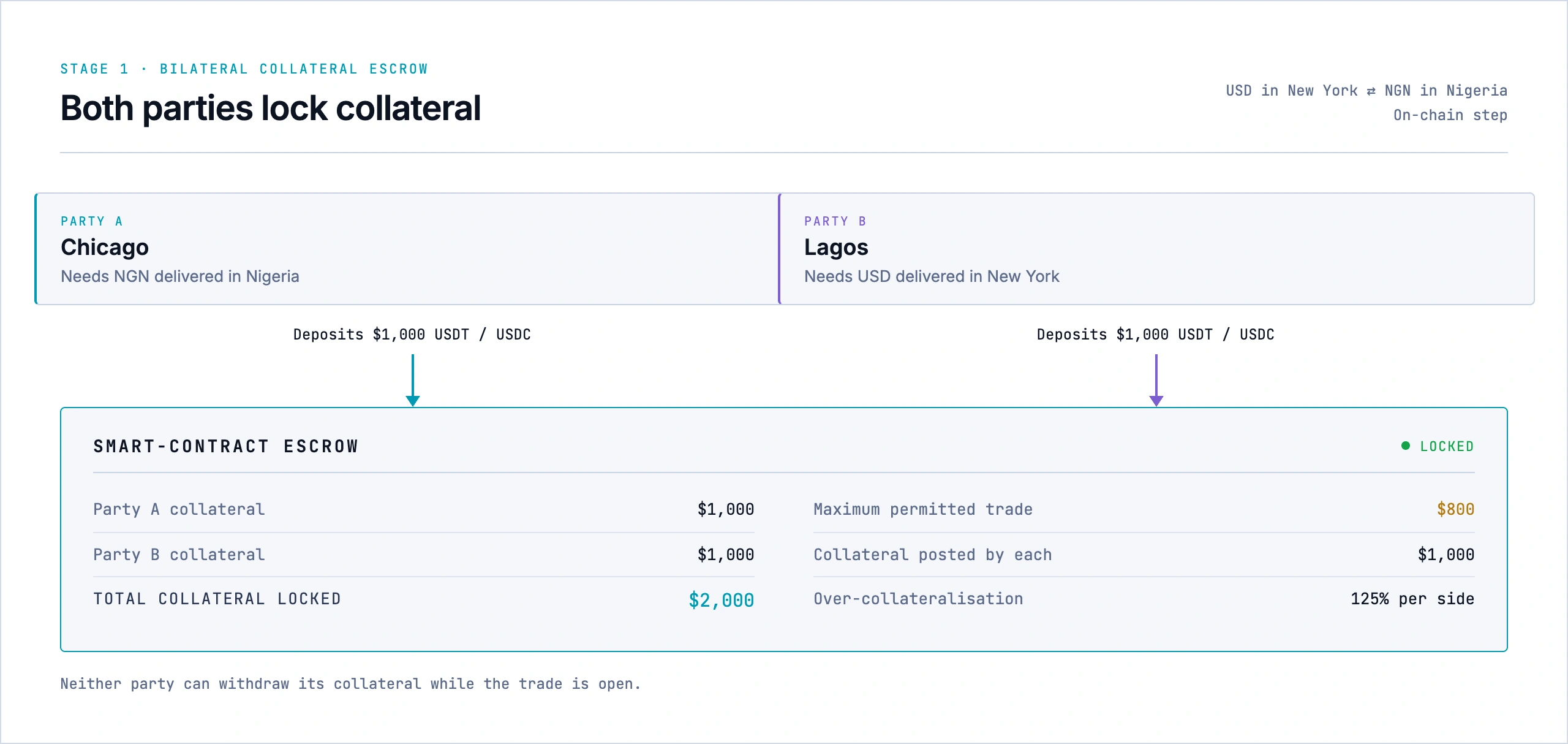
The first stage requires both parties to place collateral into the smart contract before either off-chain payment begins.
One possible answer is a smart-contract-based collateral system.
Instead of escrowing the amount being transferred, both parties post separate collateral before the transaction begins. That collateral remains locked until both sides of the off-chain trade have been completed.
Suppose each party deposits $1,000 in USDT or USDC into a smart contract. The contract now holds $2,000:
$1,000 posted by the dollar-side participant
$1,000 posted by the naira-side participant
The system may allow each party to trade only a percentage of the collateral posted—for example, 80%.
In this case, the maximum trade would be $800.
That produces the following structure:
Component | Amount |
|---|---|
Collateral posted by Party A | $1,000 |
Collateral posted by Party B | $1,000 |
Total collateral locked | $2,000 |
Permitted trade value | $800 |
Collateral-to-trade ratio per party | 125% |
The collateral exceeds the value of the trade. That is important because defaulting becomes economically irrational: a party risks losing more than it could gain by cheating.
How the Transaction Would Work
1. Both parties post collateral
Each participant deposits $1,000 in an approved stablecoin into the smart contract.
The contract confirms that both deposits have been received and locks the funds. Neither party can withdraw its collateral while the transaction is active.
2. The trade is authorized
Once both deposits are locked, the system authorizes an off-chain trade of up to $800.
The parties receive the payment instructions and a deadline for completing their respective obligations.
3. The dollar payment is made
The participant in Chicago sends $800 to the designated bank account in New York.
The recipient confirms that the funds have been received—or the sender submits evidence of payment through the platform.
4. The naira payment is made
The participant in Lagos sends the agreed naira equivalent to the designated bank account in Nigeria.
The Nigerian recipient confirms receipt, and the relevant evidence is submitted.
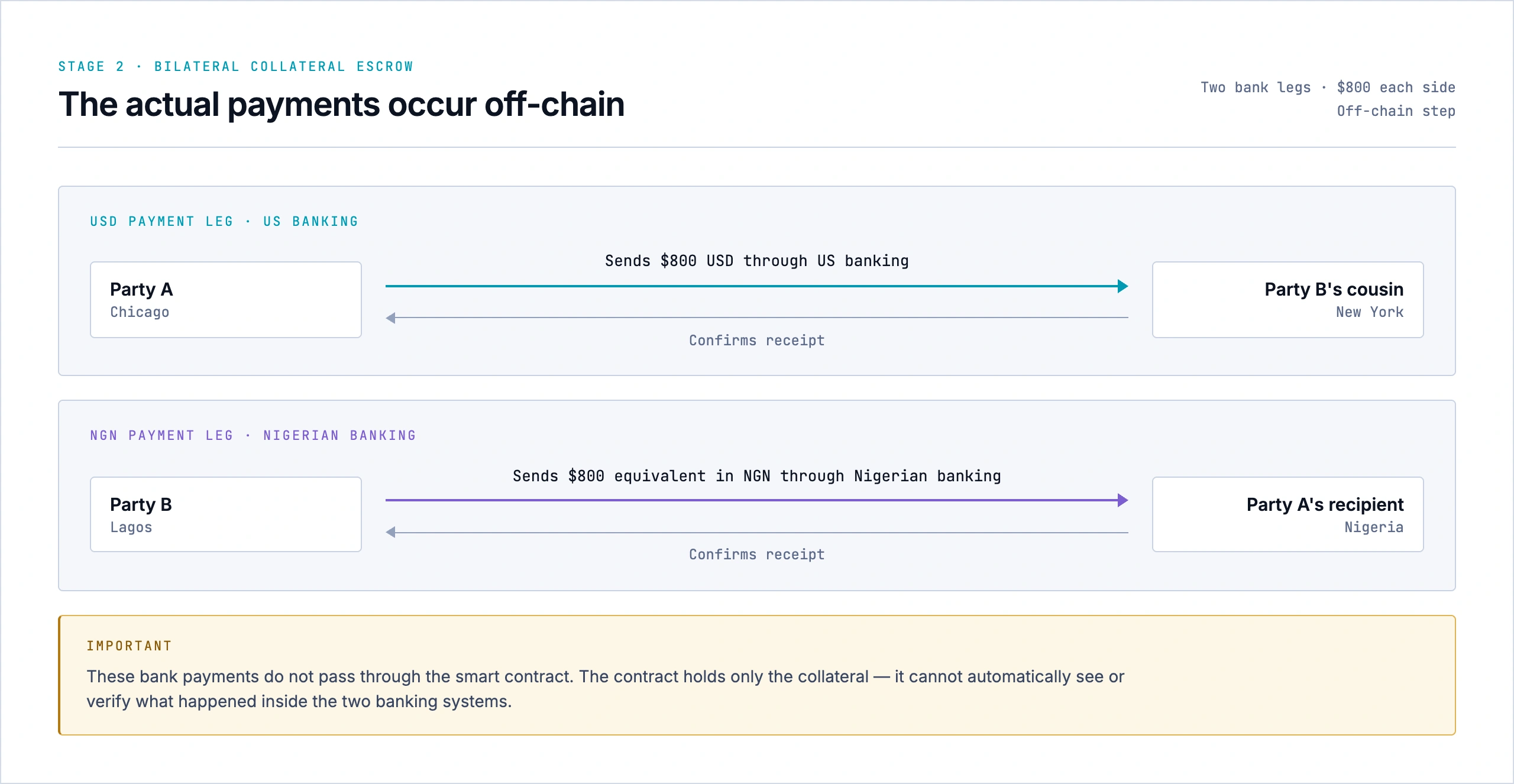
Once the collateral has been confirmed, the parties complete the two payment legs through their respective domestic banking systems.
5. Both parties confirm completion
Each participant confirms through the platform that the other side has fulfilled its obligation.
If both confirmations are received within the specified period and no dispute is raised, the smart contract releases both collateral deposits.
Each party receives its original $1,000 back.
The collateral has not been used to fund the trade. It has served as security for the parties’ performance.
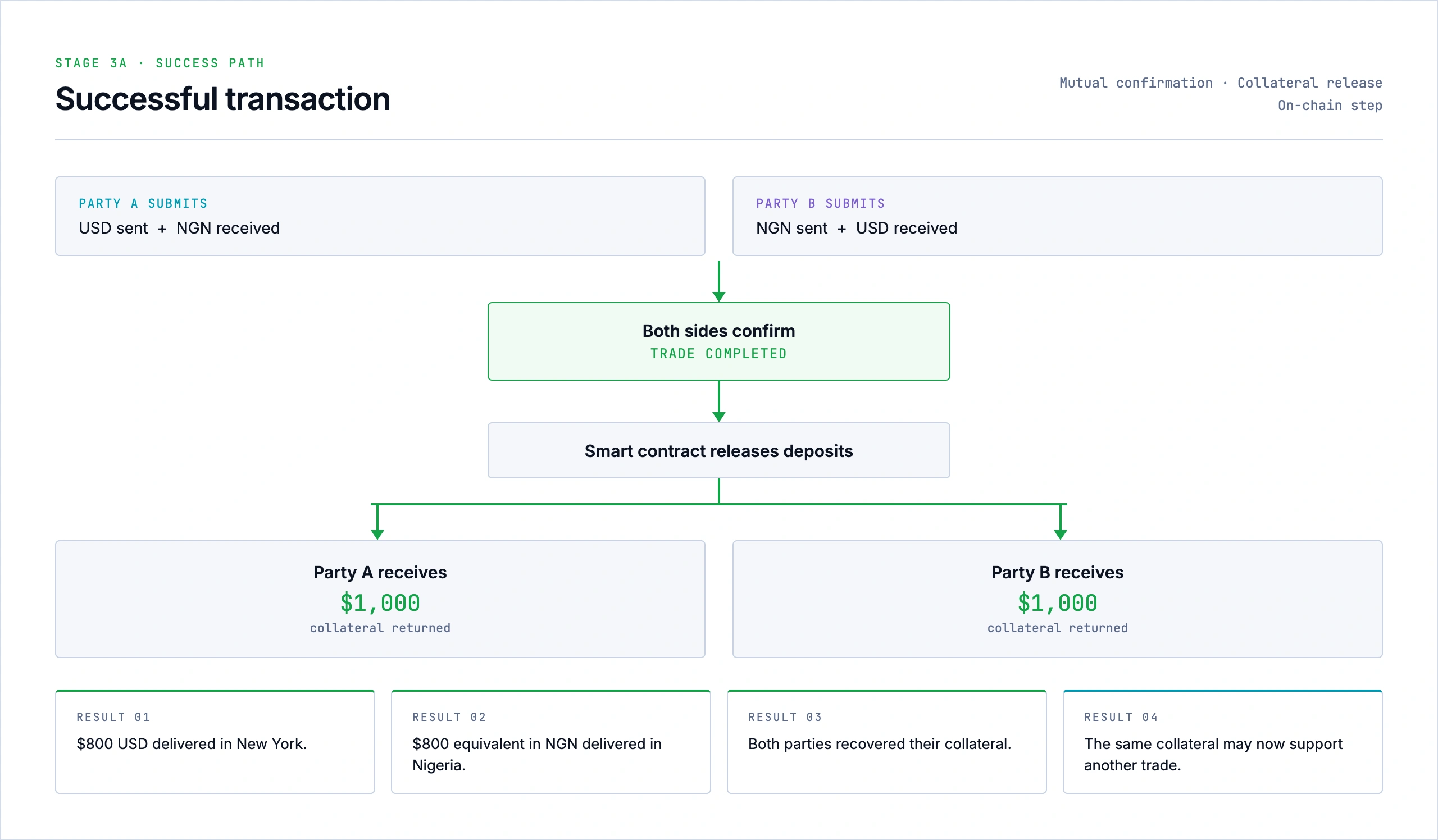
If both payments are completed and confirmed, the transaction follows the successful settlement path below.
What Happens When One Party Defaults?
Suppose the dollar payment is made in New York, but the naira-side participant refuses to complete the corresponding payment in Nigeria.
The dollar-side participant raises a dispute and submits evidence showing that the first leg was completed.
The naira-side participant’s collateral remains locked. If the adjudicator determines that the participant defaulted, some or all of that collateral may be transferred to the injured party according to the rules agreed upon before the trade began.
The same process would apply in reverse if the naira payment were completed but the dollar payment were withheld.
This changes the economics of fraud.
Without collateral, a dishonest party may receive $800 and disappear.
With $1,000 of collateral locked, attempting to steal $800 could cause the dishonest party to lose $1,000. The potential penalty exceeds the potential benefit.
The system does not make fraud technically impossible. It makes fraud economically unattractive and provides a source of compensation when a verified default occurs.
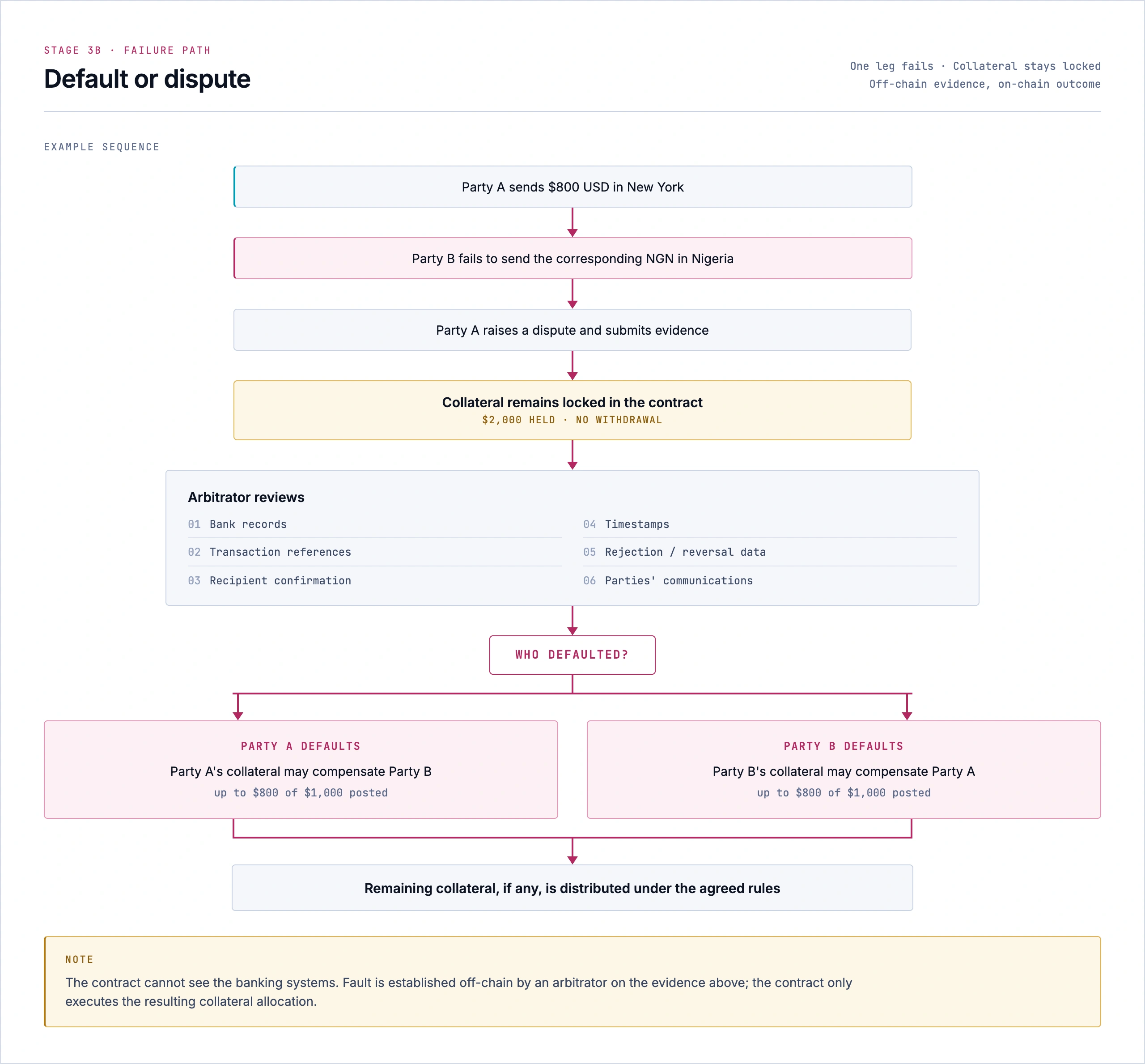
If either party fails to perform or disputes the other party’s claim, the collateral remains locked while the matter is adjudicated.
A Smart Contract Cannot Verify Everything
This distinction is critical: a smart contract cannot independently determine whether an off-chain bank transfer was completed.
It can confirm:
Whether collateral was deposited
How much was deposited
When it was deposited
Whether a deadline expired
Whether the parties submitted confirmations
How the collateral should be released after a valid decision
It cannot ordinarily confirm:
Whether a bank transfer was genuinely received
Whether a screenshot or payment receipt is authentic
Whether a payment was subsequently reversed
Whether the correct beneficiary received the money
Whether a bank froze or rejected the transaction
Which party is telling the truth during a dispute
External information must therefore be introduced into the system. This could happen through banking APIs, approved data providers, cryptographically signed confirmations or human adjudicators.
The system is not completely trustless. Instead, it moves trust away from the trading counterparty and places it in a defined process combining collateral, software, evidence and dispute resolution.
Arbitration, Not Arbitrage
When the parties disagree, someone must examine the evidence and decide what happened.
This function is arbitration or adjudication, not arbitrage.
An arbitrator may need to review:
Bank statements
Transaction references
Beneficiary confirmations
Payment timestamps
Evidence of rejected or reversed payments
Communications between the parties
Data obtained through banking or payment APIs
The smart contract then enforces the decision by releasing or reallocating the collateral.
This introduces an intermediary, but it is a narrowly defined intermediary. The adjudicator does not need to custody the off-chain payment or participate in every successful trade. Its role becomes active only when something goes wrong.
Why Reputation Alone Is Not Enough
A common mistake is assuming that a long trading history eliminates counterparty risk.
It does not.
Confidence fraud often begins with a series of successful transactions. The dishonest party builds credibility over time and then requests a larger transaction outside the normal safeguards:
We have already traded millions together. Surely you can trust me for this one transaction.
That may be precisely the transaction in which the counterparty disappears.
No matter how many successful trades have previously been completed, a party should not rely entirely on reputation when a single failed transaction could create a serious loss.
The better principle is simple:
Trust the structure of the transaction, not the assurances of the counterparty.
Every trade should remain collateralized, even when the parties have worked together many times.
Collateral Can Be Reused
The collateral does not necessarily have to be deposited again for every transaction.
If two parties each maintain $1,000 in the escrow system and the maximum utilization is 80%, they may conduct an $800 trade, complete it and begin another trade using the same collateral.
They could theoretically repeat the process many times in one day, provided each trade is completed or formally closed before the collateral is reused.
This creates a distinction between exposure and throughput.
A participant might process $20,000 during the day through multiple completed transactions while maintaining only $1,000 of locked collateral. At any one time, however, the permitted open exposure would remain limited to $800.
The system’s efficiency would depend on:
How quickly payments can be verified
Whether transactions can run concurrently
How long the dispute window remains open
Whether payments can be reversed later
The volatility and liquidity of the collateral asset
The platform’s risk rules for each participant and payment method
The Model Is More Than an Escrow
This should not be understood as a conventional escrow in which the transaction amount itself is held and released.
It is better described as a bilateral performance-bond system.
Both parties pledge collateral against their obligation to perform an external action. If both perform, the collateral is returned. If one defaults, the collateral can compensate the injured party and impose a penalty on the defaulter.
The model contains five essential components:
Stablecoin collateral to create programmable security.
Overcollateralization so that default costs more than honest performance.
Off-chain payment instructions defining what each party must do.
Evidence and verification mechanisms for determining whether the obligations were completed.
Dispute resolution for cases that software alone cannot decide.
Remove any one of these elements and the protection becomes materially weaker.
Important Design Questions
The concept is simple, but implementing it properly is not.
A real system would need to determine:
Which stablecoins and blockchain networks are accepted?
Who controls the smart contract and its upgrade keys?
Can the collateral issuer freeze or blacklist deposited stablecoins?
What percentage of collateral may be traded?
Who determines the exchange rate?
How long must a recipient wait before confirming final receipt?
What happens when a bank payment is reversed after collateral is released?
What evidence is considered authoritative?
Who appoints and supervises the arbitrators?
Can an arbitration decision be appealed?
Is the full collateral forfeited or only the actual loss plus a penalty?
How are bank holidays, payment delays and compliance holds treated?
How are stolen bank accounts, mule accounts and fraudulent payment proofs handled?
What identity, sanctions and transaction-monitoring controls apply?
In which jurisdictions would the operator require licensing?
These are not minor operational details. They determine whether the system is commercially useful, legally viable and resistant to abuse.
The Regulatory Question Cannot Be Ignored
Although the example above isolates the trust problem, a live platform cannot simply set regulation aside.
Depending on its structure and the jurisdictions involved, the operator may be viewed as providing:
Money transmission
Payment services
Virtual-asset services
Stablecoin transfer or custody
Escrow services
Foreign-exchange services
Marketplace or brokerage services
The classification would depend on who controls the smart contract, who can move the collateral, how fees are earned, whether the operator matches counterparties and how disputes are resolved.
A smart contract does not make an otherwise regulated activity unregulated. The legal analysis must follow the actual movement of money, control of assets and role of each participant.
Reintroducing the Right Kind of Intermediary
The crypto industry often frames intermediaries as something that must be eliminated.
That is too simplistic.
Some intermediaries exist because information is incomplete, real-world events are difficult to verify and disputes require judgment. The objective should not always be to remove every intermediary. It should be to reduce the intermediary’s power, narrow its role and make the outcome enforceable.
In this model:
The blockchain protects the collateral.
The smart contract enforces the agreed rules.
The evidence system records off-chain performance.
The adjudicator intervenes only when the parties disagree.
The intermediary has not disappeared. It has been transformed from a party that must be trusted throughout the transaction into a limited dispute-resolution mechanism.
Conclusion
Cryptocurrency solved the problem of transferring a digital asset without requiring a traditional ledger intermediary. It did not solve the trust problem when a transaction depends on two separate payments occurring through unrelated, off-chain banking systems.
Bilateral collateral provides a pragmatic way to address that gap.
By requiring both parties to lock value exceeding their permitted trading exposure, the system gives each participant equal skin in the game. Honest completion returns the collateral. Verified default exposes the dishonest party to a loss greater than the amount it might have gained.
This is not a completely trustless system. Nor should it pretend to be. It is a structured trust system built from programmable collateral, defined evidence requirements and limited human adjudication.
There are potentially hundreds of thousands of people and businesses that want to transact across disconnected banking systems but cannot safely trust unfamiliar counterparties. A properly designed collateral network could allow them to trade repeatedly while limiting their exposure on every individual transaction.
We are currently exploring how such a system could be built. If you are developing a similar platform, or want to understand its payment flows, collateral mechanics, compliance requirements and dispute-resolution structure, get in touch.