

One question, answered properly: the three ways into Canada’s regulated payments market, with the real numbers attached.
Every operator entering Canada faces the same three doors. You can apply for your own Money Services Business (MSB) registration and build the hponsorship arrangement and move in as a tenant. Or you can acquire a company that is already registered and take the keys to a house that is stanouse yourself. You can operate under someone else’s license through a sding. Each route is legitimate, each has a client profile it genuinely suits, and each carries a price tag that is rarely quoted honestly in one place. What follows is the full answer we give when this question lands in our inbox, which it does almost every week. All figures are indicative, quoted in USD, and current as of August 2026.
The case for applying fresh
Applying is the right route when time is not your constraint. If you are comfortable waiting eight to ten months for the registration to be awarded, and can absorb ten to twelve months in the worst case, the application path gives you the cleanest possible asset: your own company, incorporated the way you want it, named the way you want it, with no prior directors, no prior filings, and no inherited history of any kind. For banking relationships down the road, that cleanliness has real value, because there is nothing in the company’s past for a compliance department to question. You built it; you can evidence every day of its existence.
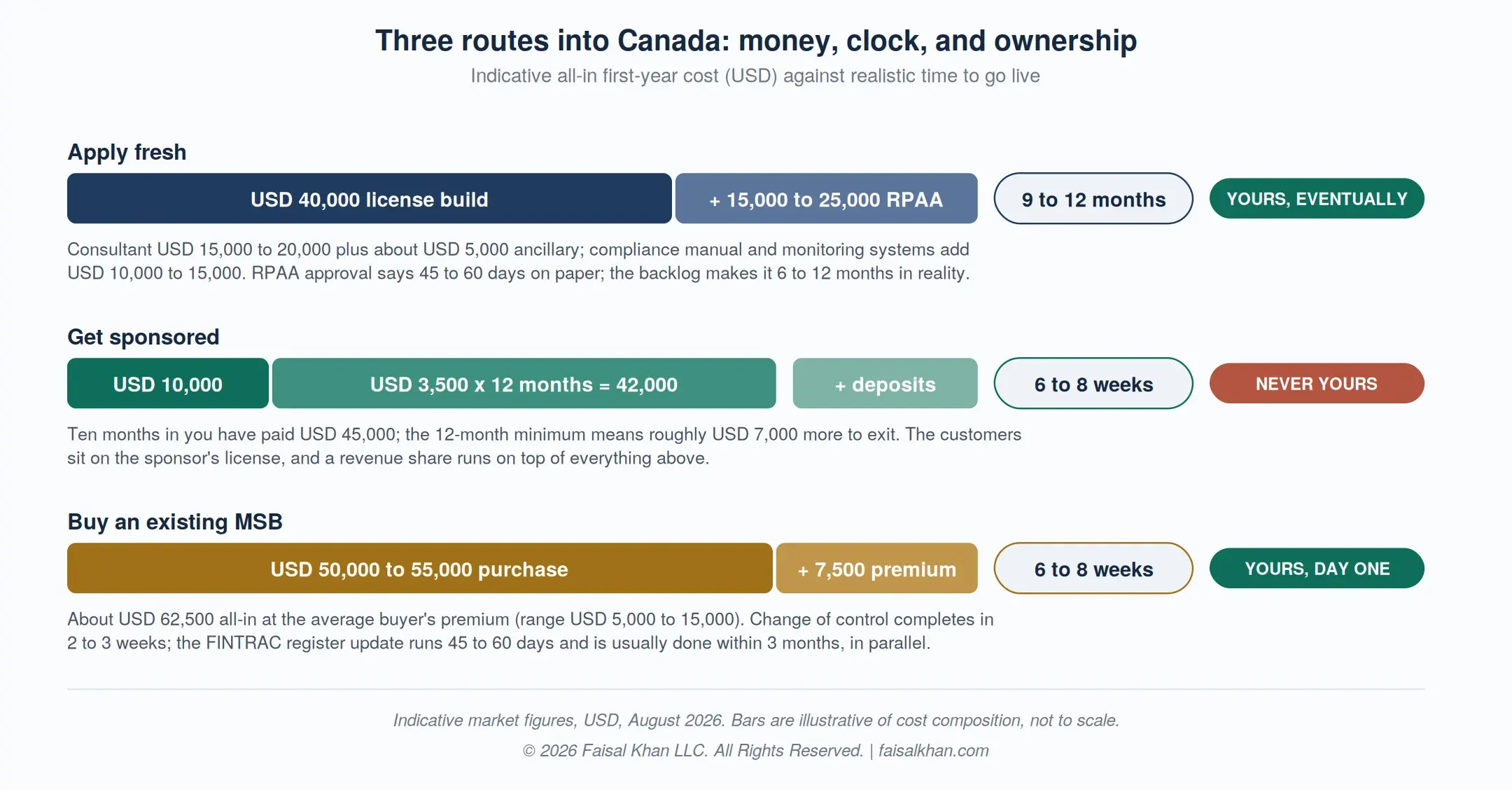
Now budget it realistically, because the sticker price and the true price are different numbers. The license build itself typically runs about USD 20,000 to 25,000. The reason is simple: you will almost certainly engage a consultant to prepare and shepherd the application, and consultants in this market charge USD 15,000 to 20,000, with roughly another USD 5,000 in ancillary charges around them. That gets the registration. It does not get you a business that can operate. If you also need the operating substance, the compliance manual, the control systems, and the transaction monitoring arrangements that a functioning MSB must have, add another USD 10,000 to 15,000. The honest all-in figure for a fresh build is therefore around USD 40,000, and that number still excludes one entire regulatory layer, which deserves its own section.
The RPAA layer, and the queue nobody prices in
The Retail Payment Activities Act sits with the Bank of Canada, and it is entirely separate from your FINTRAC registration. If your model performs retail payment functions, holding funds, initiating transfers, providing clearing or settlement, you register there as well, after your MSB registration is in hand. On paper, the RPAA process takes 45 to 60 days. In reality, because of the application backlog the regulator is working through, you should plan for six months to a year. That gap between the published timeline and the lived one is the single most common surprise for operators who priced their Canada entry off a website.
The RPAA workstream is also not free. Depending on who you engage to prepare and manage the filing, expect USD 15,000 to 25,000 on top of the license build. So stack the fresh-application route honestly: roughly USD 40,000 for the license and operating substance, another USD 15,000 to 25,000 for RPAA where your model requires it, and a best case of about nine months before you are fully in business, with the realistic case running longer. None of that makes the route wrong. It makes the route a planning exercise, and it explains why operators with revenue waiting tend to look at the other two doors.
What sponsorship really costs over a year
Sponsorship looks cheap at the door and reads differently at the till. A typical arrangement runs about USD 10,000 as a one-time fee, plus about USD 3,500 per month to the sponsoring organization. The speed is genuine: three to six weeks to formulate the arrangement, live in about eight. For an operator with a corridor ready and volume waiting, that speed is worth real money, and it is the honest reason sponsorship exists as a product.
But run the arithmetic across a year, because the contract will make you. Ten months in, you have paid USD 45,000: the USD 10,000 entry plus USD 35,000 in monthly fees. The contract runs twelve months at minimum, so leaving means paying out roughly another USD 7,000 before you can exit. Add the security deposits the sponsor will require you to place, and the revenue share running on every transaction you process, and year one of renting someone else’s regulatory perimeter costs somewhere between USD 45,000 and 52,000 before deposits, for an asset you will never own.
And ownership is the structural point that outweighs the arithmetic. The customers are not yours. They sit on the sponsor’s license, under the sponsor’s compliance rules, subject to the sponsor’s decisions about risk appetite, corridors, and counterparties. When the contract ends, the relationships you spent a year building stand on ground you never held. Sponsorship is a fine bridge and a poor destination: right for testing a corridor, right for transacting while a longer play matures, wrong as the place your business permanently lives.
The case for buying: speed with ownership
This is the route we favor, and full disclosure belongs up front: acquisitions are also where we do more of our business. But the reason clients keep choosing this door has nothing to do with our preference and everything to do with the fact that it yields results fast, and what you get is yours. Strictly speaking, you do not go out buying a Canadian license. You acquire 100 percent of the shares of a corporation that already holds a FINTRAC registration, through a change of control. The registration never moves; the company that holds it changes hands, and you own that company from day one.
The clock: the change of control itself takes about two weeks, three in the worst case. The FINTRAC register update reflecting the new ownership runs 45 to 60 days and is usually fully settled within three months, and, critically, it proceeds in parallel while you build your address, your compliance program, and your banking. Practically, you can be up and running in six to eight weeks, which is sponsorship speed with none of sponsorship’s landlord.
The money: a clean, never-operated entity trades at about USD 50,000 to 55,000. On top sits the buyer’s premium, which we have seen range from USD 5,000 through the customary USD 7,500 to as high as USD 15,000 on premium listings. At the average premium, roughly USD 62,500 all-in puts your own license in your hands. That is more than the sticker price of applying and slightly more than a year of sponsorship, and it buys the two things neither of the other routes can deliver together: you transact within weeks, and the asset sits on your balance sheet, available to operate, expand, or one day sell.
The three routes side by side
Apply fresh | Sponsorship | Buy an existing MSB | |
|---|---|---|---|
All-in cost, year one | About USD 40,000, plus USD 15,000 to 25,000 where RPAA applies | About USD 45,000 to 52,000, plus deposits and revenue share | About USD 62,500 at the average buyer’s premium |
Time to go live | 8 to 10 months; worst case 10 to 12. RPAA reality: 6 to 12 months more | 3 to 6 weeks to formulate; live in about 8 | Change of control 2 to 3 weeks; operational in 6 to 8 |
Who owns the asset | You, once awarded | The sponsor, always; customers sit on their license | You, from day one |
Recurring obligations | Your own compliance overhead | USD 3,500 monthly, 12-month minimum, revenue share on volume | Your own compliance overhead |
Exit position | You hold a license you built | Contract ends; the perimeter and customers stay with the sponsor | You hold a company you can operate, expand, or sell |
The catch, and the discipline that answers it
If buying were free of catches, there would be no other routes. The catch is discipline. No regulator approves the sale of the company, which is exactly why the buyer must supply the scrutiny a regulator would otherwise impose. You inherit the entity as it is, so due diligence on dormancy, liabilities, litigation, tax standing, and beneficial ownership is not a formality; it is the entire protection. The handover is complete only when every instrument is executed and physically in your hands: the share transfer, the resolutions, the registers, the certificates. Expect closing documents to arrive as completed templates rather than executed instruments, expect at least one correction-and-reissue loop when a name or an address is wrong, and verify every detail line by line before anything is signed.
Then budget the build that no shell comes with: the Canadian address, the compliance officer, the full AML program, and the RPAA analysis where your model needs it. Resist the urge to rename the company before banking is open, because FINTRAC takes two to four months to reflect a name change and banks notice the mismatch. None of this argues against the route. It argues for doing the route properly, with the same seriousness a regulator would have brought to the table if one had been sitting at it.
Choosing your route
Time-rich and cost-focused: apply fresh. Accept the nine to twelve month runway, keep the total build near USD 40,000, and own the cleanest possible asset at the end of it.
Need to transact immediately, comfortable renting: sponsorship gets you live in about eight weeks. Price the full year honestly, including the exit and the deposits, and treat it as a bridge, not a home.
Want speed and ownership together: buy. Roughly USD 62,500 all-in, live in six to eight weeks, and the asset is yours to grow or to sell.
Playing the long game: combine them. A common structure is an acquisition or a sponsorship now, with a fresh application running in parallel, so volume flows today while the clean build matures behind it.
Deciding between the three?
Faisal Khan LLC advises on, structures, and executes all three routes: fresh applications, sponsorship placements, and MSB acquisitions, including the RPAA workstream.
[cta id="bookbanking"]
[cta id="bookcompliance"]
All figures are indicative market ranges, subject to change, and exclusive of third-party costs paid directly to the providers concerned. Compiled from live transactions with all parties anonymized. This document is general information, not legal, tax, or regulatory advice. Retain qualified Canadian counsel before committing to any route.