


Imagine you have spent the better part of a year inside a game called Gravity. You have fought, traded, collected, built, and accumulated 100,000 Gravity Points. The game sells that amount for roughly $100, and although the points are not technically dollars, they certainly feel valuable. They buy things. Other players want them. You may have spent real money acquiring them, or hundreds of hours earning them.
Then you stop playing Gravity.
You have discovered Second Life, and what you really want now are Linden Dollars. Or perhaps you have moved into Minecraft and want to spend money there instead. You open your Gravity account, look at the 100,000 points sitting in it, and discover something strange about the digital economy: you possess value, but you don't possess portable value.
You cannot walk into the digital equivalent of a foreign-exchange counter and say, "Sell my Gravity Points and give me Linden Dollars."
There is no GRAV/L$ currency pair. No gaming FX desk. No universal market maker willing to give you a bid for the virtual currency you no longer want and an offer for the one you do. In most cases, there isn't even a clean way to leave one economy and enter another without first abandoning some or all of the value you accumulated in the first place.
This is one of the peculiar contradictions sitting in the middle of modern gaming. The industry has built extraordinarily sophisticated virtual worlds, complete with their own currencies, marketplaces, labor, property, creators, speculation, trade, rewards, subscriptions, and status economies. Yet the monetary infrastructure connecting those worlds remains primitive.
The money can get in.
It just has a very difficult time moving sideways.
A player can use a credit card to buy currency in Game A. The same player can use Apple Pay to buy currency in Game B. They can use PayPal to buy something in Game C. Outside the gaming ecosystem, the money is interoperable. Dollars are dollars. Banks communicate with banks. Card networks connect millions of merchants. Payment processors translate between systems.
Then the money crosses the boundary into a game and becomes something else.
It becomes Robux. Minecoins. V-Bucks. Linden Dollars. Gold. Gems. Credits. Points. Tokens. Or one of thousands of currencies issued by smaller games, mobile apps, gaming communities, private servers, and virtual worlds.
And suddenly the interoperability disappears.
This is not a marginal digital economy: Newzoo estimates that the global games market generated more than $200 billion in revenue in 2025. On mobile alone, Sensor Tower estimates that games generated roughly $82 billion in in-app purchase revenue during 2025.
That may turn out to be a very large opportunity.
Gaming Has Built Thousands of Tiny Central Banks
Every game that issues its own currency is, in a peculiar sense, operating a miniature monetary system.
The publisher controls issuance. It decides what one unit can purchase. It decides whether balances expire. It determines whether users can transfer value to one another. It can increase the money supply, change prices, create sinks to remove currency from circulation, introduce new assets, or change the economic rules entirely.
Some game currencies are almost completely closed. Players can buy them but cannot sell them. Some can move between users but cannot leave the platform. Some allow approved creators to convert earnings into real money. A few sit much closer to genuine two-way economies.
Second Life is an obvious example. Linden Dollars can circulate between users and can be exchanged through Linden Lab's own LindeX system. Roblox permits qualifying developers to convert certain Earned Robux into real-world currency through its Developer Exchange program. Minecraft's Minecoins, by contrast, are fundamentally designed to remain within the Minecraft Marketplace ecosystem. Fortnite has its own rules governing V-Bucks and shared wallets across supported platforms.
The walls are also reinforced by distribution platforms: Google Play, for example, generally requires in-app virtual currency purchased through its billing system to remain within the app or game title in which it was purchased. Apple similarly treats in-game currencies and other digital goods as part of its tightly controlled in-app purchasing framework.
These are not simply different implementations of "game money." They are different monetary constitutions.
And this matters, because before we start talking about connecting gaming currencies, we have to acknowledge an uncomfortable truth: just because something costs $100 to buy does not mean it is worth $100 when you want to sell it.
Suppose Gravity sells 100,000 Gravity Points for $100. That establishes a retail purchase price. It does not establish a liquidation price.
Maybe somebody will give you $95 for them.
Maybe $80.
Maybe $40.
Maybe nobody can legally or contractually take them from you at all.
This distinction between purchase price and liquidation value is where things get interesting.
A game currency can have at least three different forms of value. There is the acquisition value: what it costs to obtain. There is its utility value: what it can purchase inside the game. And there is its liquidation value: what somebody else is prepared to pay you for it today.
In a functioning market, these prices would not necessarily be equal. In fact, they almost certainly wouldn't be.
And that difference is where liquidity providers appear.
The Missing Business May Look More Like Foreign Exchange Than Crypto
Suppose you own those 100,000 Gravity Points and decide you are done with the game.
A specialist company offers you $82 for them.
You might object that the game sells the same points for $100. But the company is taking a risk. It does not know how quickly it can resell them. Gravity could change its terms. Demand could collapse. The company could end up holding inventory for weeks. Fraud might be involved. The underlying account could be compromised. The issuer could change the currency's economics overnight.
So the company says: We will give you $82 now.
You accept because $82 of portable value is more useful to you than $100 of theoretical value trapped inside a game you no longer play.
The company now waits for someone entering Gravity.
That person wants 100,000 points. Gravity sells them for $100. The liquidity provider offers them for $94.
The buyer saves $6.
The seller obtained liquidity.
The liquidity provider captured the spread between $82 and $94.
This is not especially exotic. It is market making.
Foreign-exchange dealers do it. Bond dealers do it. Cryptocurrency exchanges do it. Used-car dealers do a version of it. Gift-card markets do it. Whenever somebody wants immediate liquidity in an asset that is not perfectly fungible or perfectly liquid, somebody else can make a business by maintaining inventory and continuously quoting a price.
Gaming currencies could develop the same structure.
A specialist gaming market maker might one day maintain prices across hundreds or thousands of virtual economies. It could know that one game's currency trades close to face value while another routinely clears at a 30 percent discount. It could know that a currency becomes more valuable before a seasonal tournament, or that demand for a particular game's credits spikes after expansion packs are released.
It could know which currencies are easy to source, which are difficult to liquidate, which have high fraud rates, and which come with serious platform risk.
In other words, the real opportunity may not be "crypto for gaming."
It may be the creation of a foreign-exchange market for virtual economies.
Stablecoins Could Become the Invisible Settlement Layer
This is where stablecoins become useful—but perhaps not in the way the crypto industry usually imagines.
The obvious temptation is to say that every game should put its currency on a blockchain.
That is probably unnecessary.
Gravity Points do not need to become tokens. Linden Dollars do not need to become USDC. Minecraft players do not need a crypto wallet. A 13-year-old purchasing a digital sword should not have to understand blockchains, gas fees, seed phrases, bridges, or smart contracts.
The more interesting possibility is that stablecoins sit behind the scenes as a neutral settlement layer between gaming economies.
Imagine that you sell your Gravity Points to a liquidity provider for $82. Instead of wiring money through the banking system, the provider settles the transaction internally using a dollar-denominated stablecoin. Another liquidity provider holds inventory in Linden Dollars. The first provider acquires the required Linden value through that network, and the player simply sees the result.
To the player, the transaction is:
Gravity Points → Linden Dollars.
Behind the scenes, it may actually be:
Gravity Points → liquidity provider → stablecoin settlement → another liquidity provider → Linden Dollars.
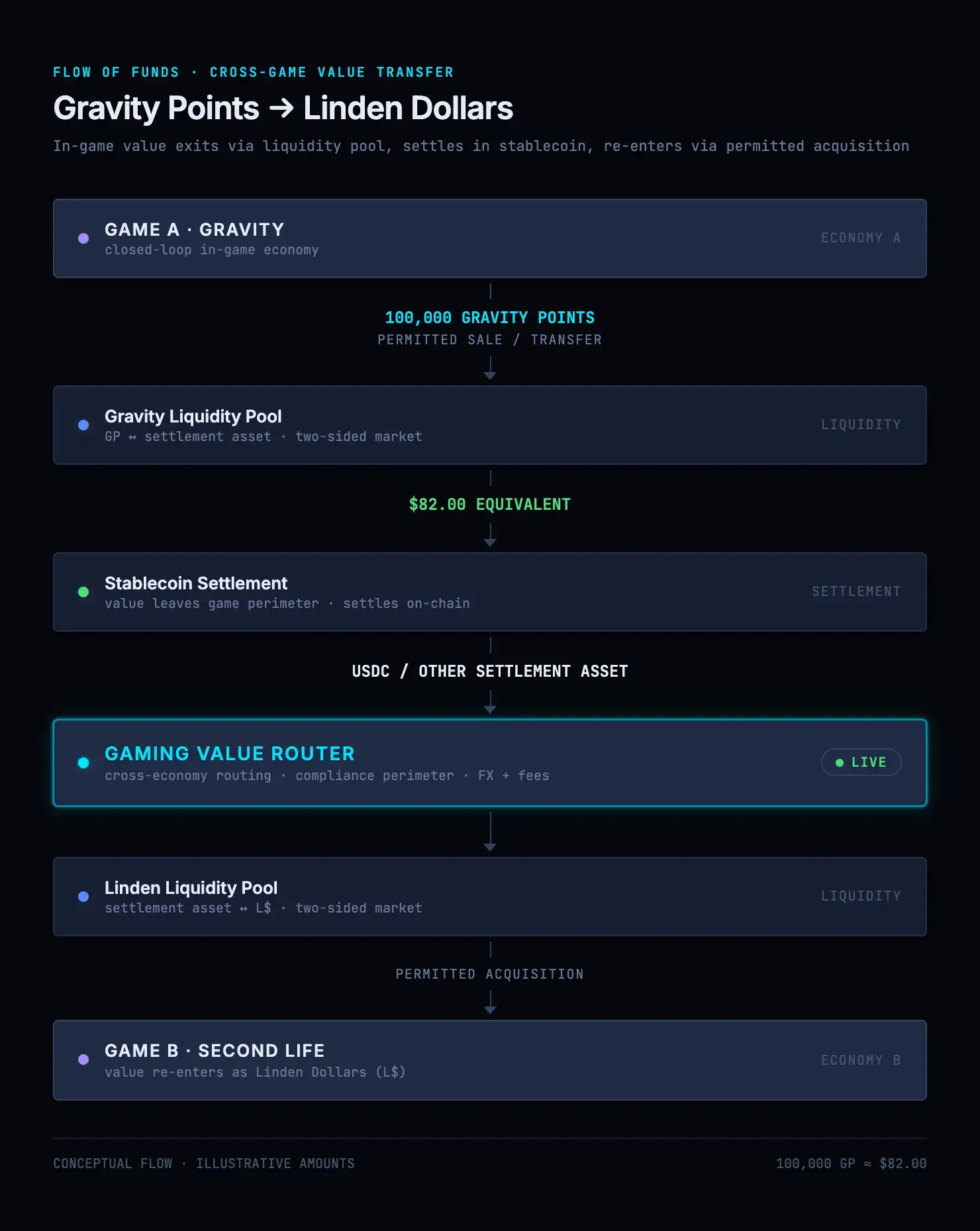
The stablecoin never needs to enter Gravity.
It never needs to enter Second Life.
It lives between the two gardens.
That distinction is important because it allows the internal economies to remain exactly what they are. The publisher does not have to redesign its game around a blockchain. It does not have to surrender control of its currency. It does not have to expose players to cryptocurrency.
The settlement infrastructure simply uses digital dollars to reconcile obligations between participants.
This is much closer to correspondent banking than to the typical crypto pitch.
Banks do not all maintain direct relationships with every other bank in the world. Networks of correspondent institutions, clearing systems, settlement banks, and foreign-exchange providers allow money to move between them.
Gaming could eventually acquire something similar.
The Garden Doesn't Need to Come Down
There is one major constraint to all of this: many gaming currencies are deliberately non-transferable.
That is not a technical problem.
It is a contractual and commercial one.
Stablecoins cannot magically make a non-transferable currency transferable. A smart contract cannot override a publisher's terms of service. If a game does not permit users to sell or transfer its currency, a legitimate payment company cannot simply declare that it has invented interoperability.
This is where the conversation gets more interesting.
The goal may not be to tear down gaming's walled gardens.
It may be to persuade the owners of those gardens to install gates.
Imagine a publisher saying that players can liquidate unused currency, but the publisher receives a 3 percent exit fee. Or that only currency earned through economic activity, rather than purchased currency, can be transferred. Or that users can exchange $100 per month with minimal friction, while higher amounts require additional identity verification.
A publisher might approve several licensed or authorized liquidity providers and expose an API that allows them to quote prices.
Suddenly, interoperability stops being leakage and becomes a revenue stream.
That raises an intriguing economic question. Publishers have traditionally assumed that trapping value increases spending. Once you put $50 into a game, you have an incentive to keep playing because the money cannot easily leave.
But liquidity could have the opposite psychological effect.
People may be more willing to put $200 into a game if they know that $120 of unused value can later be recovered. A secondary market often reduces the perceived risk of purchasing an asset in the first place.
Cars are easier to buy because they can be resold. Securities are more attractive because they are liquid. Collectibles benefit from active secondary markets. Even airline miles become more valuable to consumers when redemption options broaden.
Gaming publishers may eventually have to discover, through experimentation, whether some controlled level of portability increases the total size of their economies.
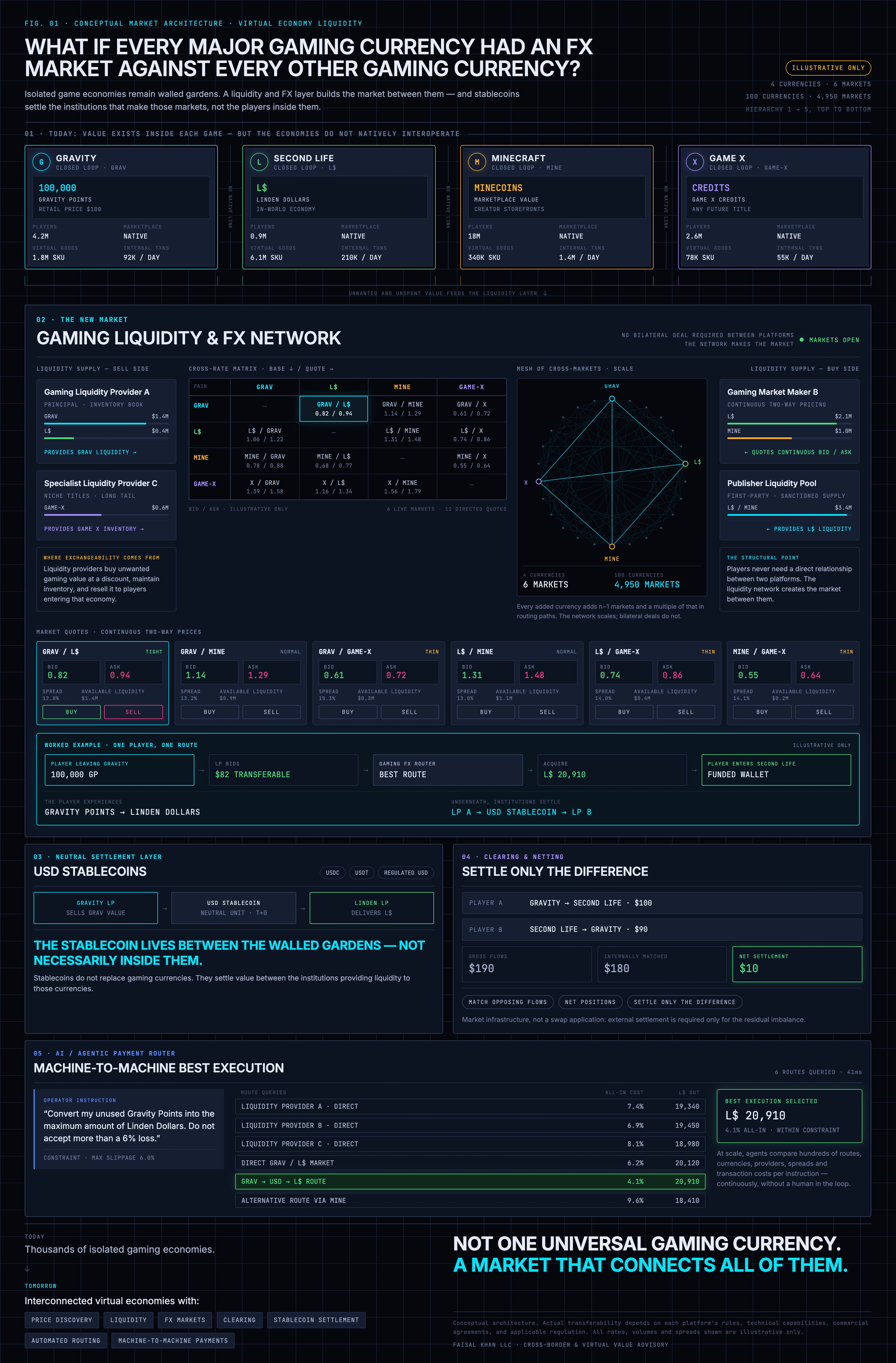
Imagine a Bloomberg Terminal for Game Money
Once enough virtual currencies become tradable, something else happens.
Price discovery becomes a business.
A company could maintain a live database of gaming currencies showing bid prices, offer prices, liquidity depth, transfer rules, redemption requirements, fraud rates, historical volatility, publisher policies, and expected settlement times.
In effect, a Bloomberg terminal for virtual economies.
Perhaps Gravity trades today at:
Bid: $0.81
Ask: $0.93
Another game might trade at:
Bid: $0.97
Ask: $1.01
A very illiquid game's points might clear at:
Bid: $0.42
Ask: $0.78
Those spreads reveal information.
A narrow spread says the asset is liquid and easy to price.
A wide spread tells you something is difficult: inventory is scarce, fraud is high, transferability is complicated, demand is uncertain, or the platform might prohibit the activity tomorrow.
As markets deepen, specialists appear. One company might become particularly good at Roblox-related economic flows. Another might focus on private Minecraft servers. Another might specialize in mobile games across Southeast Asia. Another could provide liquidity to gaming communities in countries where traditional dollar-payment infrastructure is weak but stablecoin access is widespread.
Then larger liquidity providers aggregate the specialists.
At some point, you have created a market structure.
And Then Comes Routing
Once several markets exist, the player should not have to care who provides the liquidity.
Suppose you tell a gaming wallet:
"Convert my Gravity Points into as many Linden Dollars as possible."
The system requests prices from dozens of counterparties.
Maybe one market maker offers a direct Gravity-to-Linden conversion.
Another route is Gravity → stablecoin → Linden.
A third route passes through another highly liquid game currency first because, strangely enough, that produces a better final price.
The software calculates the effective exchange rate, fees, execution probability, settlement time, inventory availability, platform restrictions, and counterparty risk.
Then it routes the transaction.
This starts to resemble payment routing.
Modern payment processors already decide which acquiring bank or payment rail should handle a transaction. Foreign-exchange systems choose liquidity venues. Smart-order routers in financial markets split trades across exchanges.
Gaming value could work the same way.
And then AI agents make the entire thing considerably more interesting.
Your AI Agent Will Probably Care About Your Game Balances More Than You Do
People are terrible at managing small balances.
We leave $4.82 inside one app, $12 worth of loyalty points somewhere else, a forgotten gift-card balance in another account, unused game credits in several games, and subscriptions we barely remember purchasing.
The amounts are too small to justify our attention.
Software does not have that problem.
Imagine telling your personal gaming agent:
"Move unused value out of any game I have not played for 60 days. Never accept more than a 7 percent loss. Keep $25 in a portable dollar balance and allocate the rest to whichever games I am currently playing."
The agent continuously monitors your accounts.
It sees that you stopped playing Gravity six weeks ago.
It asks the market for a price.
The bid is too low.
It waits.
Three days later a new expansion launches and demand for Gravity Points increases.
The bid improves.
Your agent sells.
It moves some of the proceeds into another game's currency and leaves the remainder in portable dollar value.
You might never see the intermediate settlement.
This is where stablecoins become particularly useful. Software can hold them, transfer them, split them, escrow them, and use them programmatically. They are digital money designed to interact with software.
Protocols such as x402 are already experimenting with the idea of allowing software agents to make programmatic stablecoin payments without conventional checkout flows.
That creates the possibility of gaming commerce in which humans specify intentions and agents perform the actual financial operations.
The player says what they want.
The agent figures out how to pay for it.
The Really Weird Part Begins Below One Cent
Today's payment systems have another problem: they are not particularly good at tiny transactions.
You can buy a $9.99 bundle of gems.
But processing a payment of $0.003 every time an autonomous character purchases information from another character is another matter entirely.
Fixed payment costs and operational overhead make extremely small transactions uneconomic.
Stablecoin-based infrastructure changes the arithmetic, particularly when tiny events are accumulated internally and only net obligations are settled externally.
Imagine an AI-controlled player paying another agent $0.002 for a piece of map information.
It rents a digital tool for 45 seconds and pays $0.008.
It pays $0.03 to enter a miniature tournament.
It pays $0.006 for additional computing resources.
It purchases access to a dataset for $0.011.
It compensates the developer of a useful autonomous NPC every time the character's service is used.
No human would authorize these payments individually.
No conventional checkout flow should appear.
And no player wants to enter a credit-card number to pay 0.7 cents.
Machines do not care.
Once software is both the buyer and seller, the economically rational transaction size can become dramatically smaller.
That could give rise to micro-payments, ultra-micro-payments, and eventually what might reasonably be called nano-payments—not because the terminology is important, but because an entirely new category of economic activity emerges once payments become smaller than the threshold of human attention.
Gaming is an unusually natural place for this to happen.
The world is already synthetic.
The goods are digital.
The merchants can be digital.
The consumers can be software.
The services are delivered instantly.
The accounting is programmable.
Money may simply become another callable function in the game.
A Payment Company Built Specifically for Gaming
This raises the entrepreneurial question hiding underneath all of this.
What would a company look like if it decided it was not a general payment processor serving gaming companies, but a payments company designed specifically for virtual economies?
Its most valuable asset probably would not be checkout software.
It would understand the currencies themselves.
It would know which currencies are transferable and which are not. Which can be redeemed. Which can only be spent. Which represent purchased value. Which represent earned value. Which permit creator cash-outs. Which have legitimate secondary markets. Which platforms allow APIs. Which prohibit external exchange entirely.
It would know liquidity.
It would know gaming fraud.
It would know how account takeovers behave inside one game compared with another.
It would understand how stolen payment credentials can become virtual currency and how virtual currency can potentially become portable value again.
It would maintain pricing models for hundreds of digital economies.
It could provide wallets, stablecoin treasury infrastructure, settlement, compliance, creator payouts, cross-game promotions, tournament payments, guild treasury services, marketplace settlement, and programmatic payment APIs for agents.
Eventually, the company might be able to tell a developer:
"Integrate with us once, and your game's economy can interact with 300 other approved virtual economies."
That starts looking like infrastructure rather than a feature.
The moat would not be the code.
It would be the network.
The integrations. The licenses. The publisher relationships. The liquidity. The transaction data. The risk models. The pricing history. The banking relationships. The market makers. The fraud intelligence.
The ability to provide an executable price for a virtual currency that almost nobody else knows how to price could itself become extraordinarily valuable.
The More Useful Game Money Becomes, the More It Starts Looking Like Money
There is, of course, a regulatory catch.
A point that can only purchase a digital hat inside a single game does not behave very much like money.
A point that can be transferred to another person, sold for a dollar stablecoin, moved across borders, and exchanged into another virtual currency starts to look considerably more financial.
That transformation has consequences.
Payment regulation, money-transmission rules, stored-value regulation, AML requirements, sanctions screening, consumer protection, custody rules, age restrictions, and gambling law may enter the picture depending on exactly how the system is structured and where it operates.
And gaming presents some particularly unusual problems because large numbers of users are minors.
Then there is fraud.
Liquidity makes assets more useful.
It also makes stealing them more profitable.
If 100,000 stolen Gravity Points are basically trapped inside Gravity, their attractiveness to criminals is limited.
If they can be transformed into portable dollars in 15 seconds, the economics change immediately.
Account takeovers become more valuable. Bot farming becomes more attractive. Stolen cards can potentially be converted into game currency and then into other forms of value. Fraud rings can exploit pricing differences between platforms. Artificial markets can be manufactured.
A serious gaming payments network would therefore need to know far more than payment processing.
It would need device intelligence, behavioral analysis, provenance data, velocity controls, identity systems, transaction monitoring, delayed settlement, risk-adjusted pricing, and platform-specific fraud models.
A liquidity provider buying virtual currencies is not merely exchanging value.
It is underwriting the probability that the value is genuine.
That is why a 2 percent spread may sometimes be enough and a 30 percent spread may sometimes be entirely rational.
The Consumer Exchange Might Not Even Be the Biggest Business
The obvious use case is a gamer converting $50 from one game into another.
But consumer conversion may eventually be the least interesting part of the system.
Game publishers themselves have treasury problems.
Creators need to be paid.
Marketplaces need settlement.
Tournament winnings need distribution.
Guilds accumulate funds.
Gaming companies operate across countries.
Advertising networks distribute rewards.
Publishers run multiple games whose economies cannot necessarily communicate.
Digital assets are increasingly rented, subscribed to, shared, or licensed rather than merely purchased.
AI agents will consume digital services.
Once a settlement network exists, all of these activities can potentially run over the same infrastructure.
A large publisher with ten different games might begin by making currency interoperable only across its own titles.
Then perhaps with a strategic partner.
Then with five publishers.
Then with fifty.
This is how payment networks tend to grow: not through philosophical agreement about openness, but because connecting to the network becomes commercially useful.
Eventually a developer launching a new game may face a decision that does not exist today:
Do you want your virtual economy connected to the gaming liquidity network?
The Internet Connected Information. Games Still Haven't Connected Value.
Gaming has spent decades pushing aggressively toward interoperability in almost every technical dimension.
Multiplayer infrastructure became global.
Game engines became reusable.
Identity systems improved.
Cloud gaming emerged.
Voice communications connected communities.
Creators began building assets for enormous digital audiences.
Games became platforms rather than products.
Yet their monetary systems still resemble thousands of islands, each issuing its own currency and maintaining its own borders.
Billions of dollars flow into those islands.
The economic value becomes fragmented once it gets there.
That does not feel like an endpoint.
It feels like a temporary architectural condition.
The most interesting company in gaming payments may therefore not be the one that invents another currency.
It may be the company that learns how to connect the currencies that already exist.
The games can keep their walls.
The publishers can retain control.
The currencies can remain proprietary.
The players do not need to become crypto users.
Somewhere beneath the surface, however, market makers could provide liquidity, stablecoins could provide settlement, payment companies could provide regulatory infrastructure, and AI agents could search for the best possible routes between economies.
What emerges is not one universal metaverse currency.
It is something potentially more realistic:
a financial network connecting many different virtual currencies without requiring them to become the same currency.
The gaming industry built virtual worlds first.
Perhaps now it needs correspondent banks.
Perhaps it needs FX dealers.
Perhaps it needs clearing houses.
Perhaps it needs a Bloomberg terminal.
And perhaps the opportunity is not merely to process the hundreds of billions of dollars already flowing into gaming.
It is to create a market around all the value that, once it gets inside, currently has nowhere else to go.
Five Questions That Become Hard to Ignore
If players knew that unused gaming value could be recovered, would they actually spend more? The assumption behind most walled gardens is that making currencies difficult to exit protects revenue. But liquidity can also make an asset easier to purchase because the buyer knows that the decision is partially reversible. If publishers could charge for controlled exits while increasing users' willingness to fund their accounts, would interoperability become a revenue generator rather than a threat?
Who owns the price of gaming money? If hundreds of currencies eventually trade against one another, somebody will have to determine their market value. The company that collects real-time bids, offers, liquidity, fraud statistics, transfer restrictions, and historical prices could become considerably more important than the company operating the consumer-facing wallet. Is the larger opportunity the exchange—or the information infrastructure underneath the exchange?
Can virtual currencies be deliberately designed with different levels of monetary freedom? Instead of asking whether a gaming currency is transferable or non-transferable, publishers could create multiple economic layers. Purchased credits might remain locked. Creator earnings might be redeemable. Marketplace revenue might be transferable. Promotional currency might expire. Could a payments company provide publishers with a programmable regulatory and economic framework allowing them to choose precisely how open each category of value should be?
What markets appear when the minimum rational payment falls below one cent? Humans will not negotiate thousands of payments worth fractions of a cent. Agents will. What happens when autonomous software can purchase information, computation, access, temporary digital assets, services from other agents, or even strategic assistance inside a game continuously? The interesting question is not whether today's purchases become cheaper. It is which economic activities become possible for the first time.
And finally: who becomes the financial infrastructure company for virtual worlds? There are several potentially enormous businesses hidden inside this problem: market making, custody, payments, gaming FX, compliance, fraud, treasury management, stablecoin settlement, agentic routing, publisher APIs, and pricing data. Perhaps one company combines them. Perhaps an ecosystem develops. But if trillions of tiny economic interactions eventually occur across virtual environments, one question becomes difficult to avoid: who sits in the middle when the money moves?