

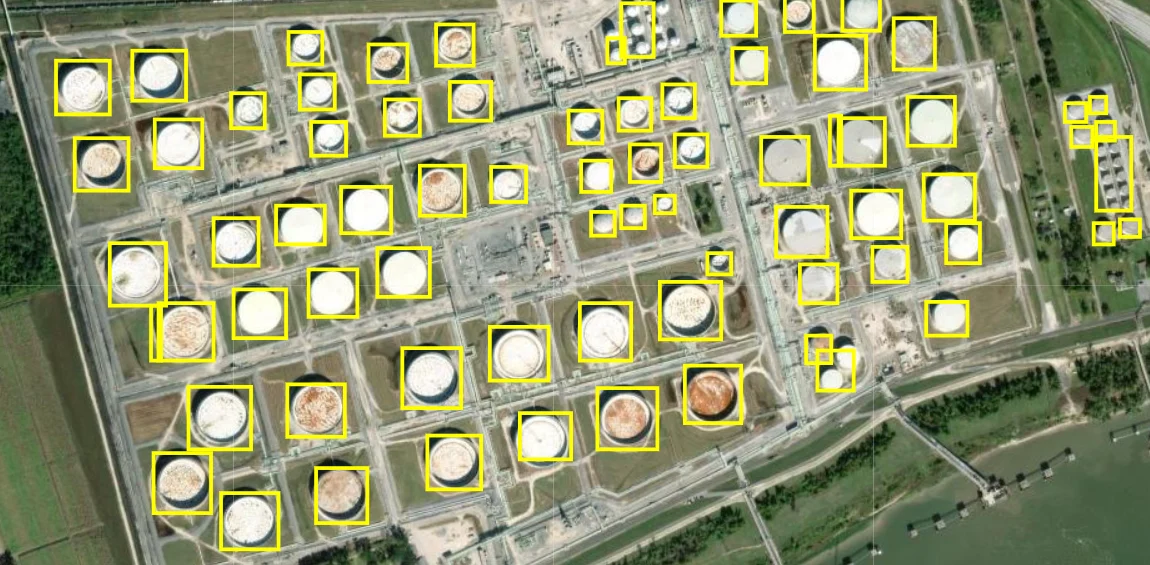
Here is something that stuck with me. There is a shadow inside an oil tank, and traders pay real money to have it measured.
Let me explain how a shadow becomes a number.
The tank is a sundial
Big crude oil tanks do not have a fixed lid. The roof floats on top of the oil. Pump more oil in, the roof rises. Take oil out, the roof sinks. And when it sinks, the wall of the tank starts casting a shadow across the roof.
Think of a sundial. The sun does the same thing every day, but the shadow tells you the hour. Here the shadow tells you the barrels.
Let's say (just to make maths simple) a tank holds 500,000 barrels when full, and the wall is 50 feet tall. If the roof has sunk 25 feet, the tank is half full, so 250,000 barrels. The more the roof sinks, the bigger the shadow. Measure the shadow, work back to the drop, and you have your barrels. Of course the real thing has to account for the angle of the sun and so on, but the idea really is that simple.
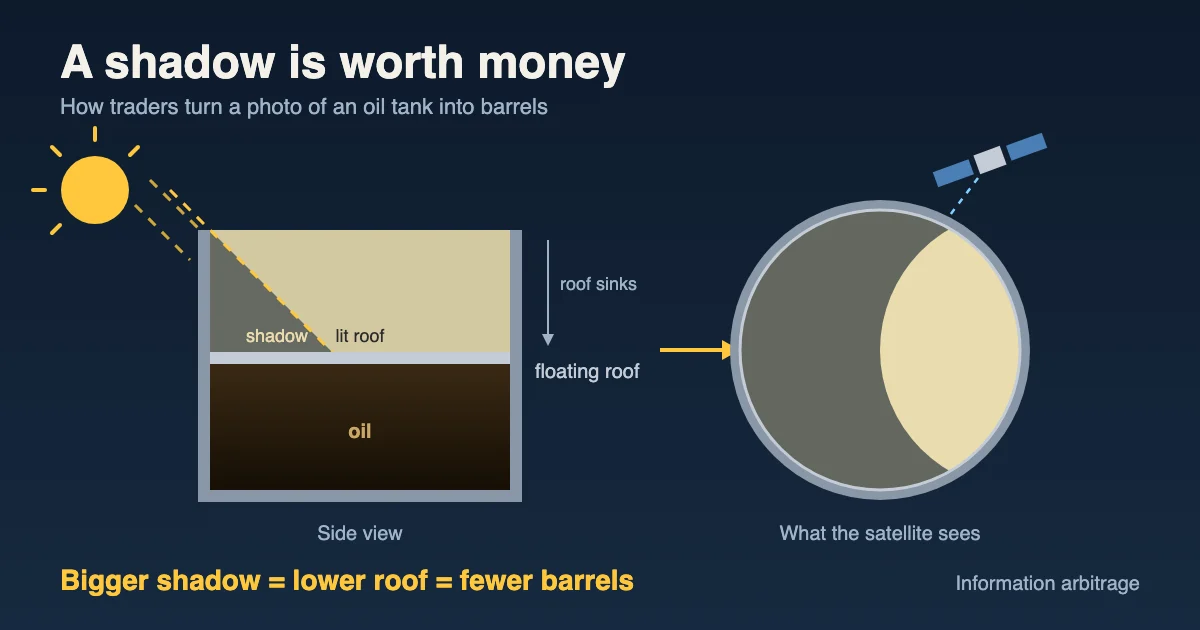
A photograph becomes a number.
According to the video I saw, one company says it reads more than 20,000 tanks a week, and when there is cloud cover or it is night, they switch to radar.
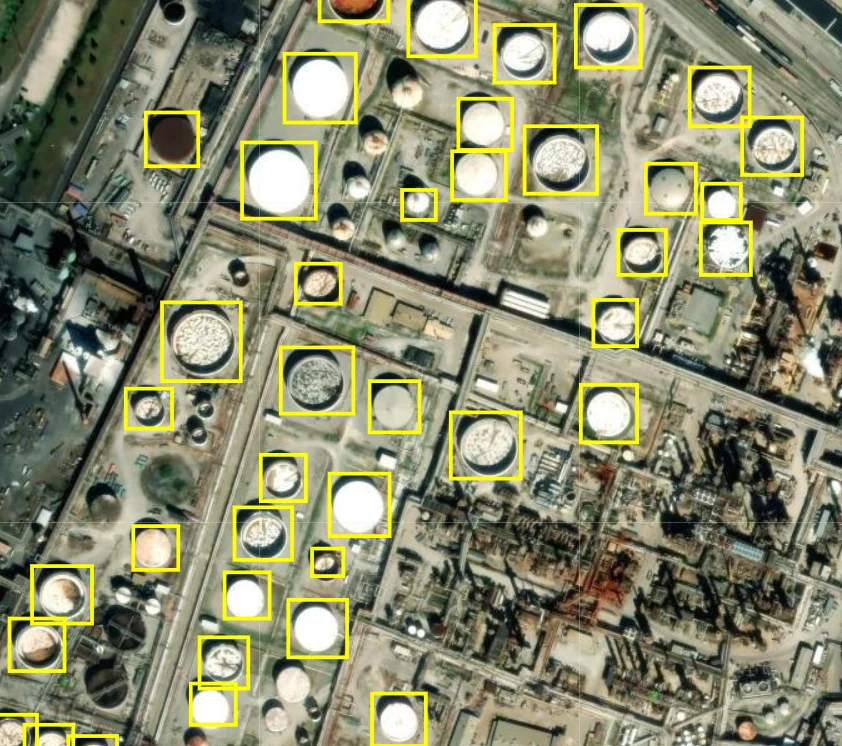
Why bother? Because the official number is late
The official US storage numbers come out once a week. The shadows change every day.
Why does that matter? Because oil prices move on inventories. When tanks fill up, prices tend to fall. When tanks drain, prices tend to rise. So if I know on Tuesday what the rest of the market will only know next week, I am sitting on a head start. And a head start is something you can trade.
Allow me to digress: the helicopter
What I liked most is that this did not start with satellites. According to the video, in 2009 one firm flew a helicopter over Cushing, Oklahoma, every Friday, photographing the tanks.
Why Cushing? Because that is where US oil futures end. What is a futures contract? It is an agreement to buy or sell something at a set price on a set date. With oil, the contract ends in real barrels delivered to real tanks in Cushing. Somebody has to take the oil. Somebody has to have a place to put it.
Now you see why the tanks matter.
In April 2020 the tanks were filling fast, and the traders who held contracts had nowhere to put the oil. So they paid people to take it off their hands. The price went to minus $37 a barrel.
Full tanks, no room, negative price. Anyone watching the shadows would have seen it coming a lot earlier than the weekly number would tell them.
This is information arbitrage
What is arbitrage? In the classic version you buy something cheap in one place and sell it dear in another. Same thing, two prices.
Information arbitrage is the same idea, except the two "places" are two moments in time. Today, a few people know how much oil is in the tanks. Next week, everybody knows. The gap between those two moments is the profit. You could call it time arbitrage, if you will.
This is what a hedge fund or a commodity trader is really paying for. They are not paying for a pretty satellite picture. They are paying for a few days of head start, and then they position themselves in the futures market before the rest of the market catches up.
IMHO this is the cleanest example of out-of-the-box thinking I have seen in a while. Nobody asked "how do we get the official number faster?" They asked "what does the oil leave behind that we can see from the sky?" And the answer was a shadow.
Needless to say, there are probably thousands, if not hundreds of thousands, of ideas like this out there. I have heard of people counting cars in shopping mall parking lots from above to guess a retailer's sales before it reports. Same trick, different object. If you can see it, count it, and the market does not know it yet, there is money in it.
A word of caution, and one of honesty
The edge does not last. The day everybody buys the same pictures, the shadow is priced in and the head start is gone. Then the clever people go looking for the next shadow. That is how this game works.
And nobody leaked anything here. No insider, no phone call, no brown envelope. Just the sun, a floating roof and a shadow. That, IMHO, is what separates this from insider trading. The information was there for anyone to see. They were simply the ones who thought to look.
If I have understood any of this wrongly, please comment and tell me. I would be curious to hear it from someone who works with this data.
Interesting times we live in.
Related resources (Money Wiki):