
x402 Architecture Decision Tree
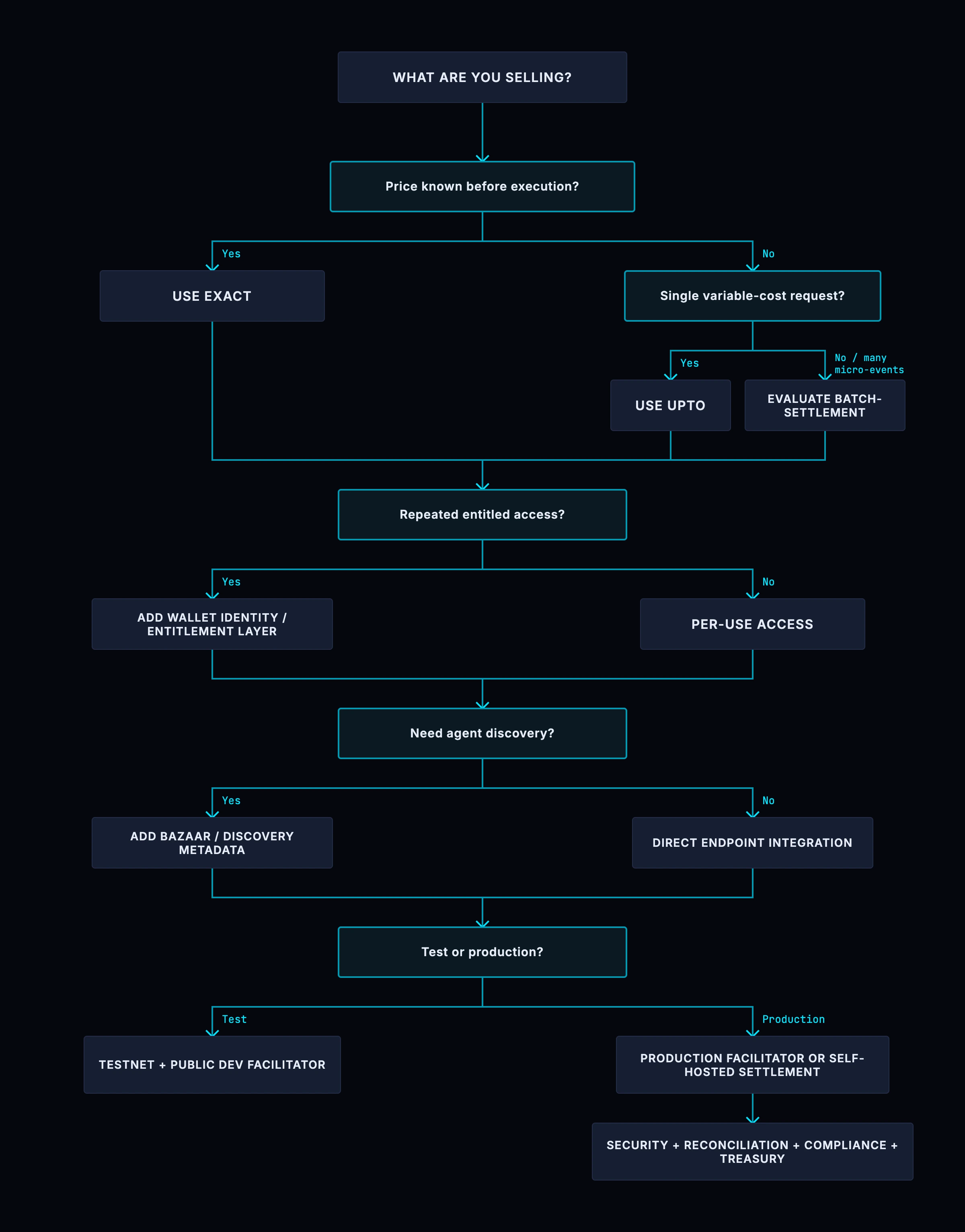
A second practical decision tree:
Need one simple demonstration?
    → exact + Base Sepolia

Need AI tool monetization?
    → MCP + exact

Need variable model/compute charge?
    → upto

Need thousands of sub-cent calls?
    → batch-settlement

Need repeat access after one purchase?
    → identity/entitlement extension

Need autonomous discovery?
    → Bazaar metadata

Need mainnet?
    → production facilitator + controls

Need multiple payment rails?
    → payment abstraction; consider x402 + MPP
Suggested 30/60/90-Day Program
Days 1–30 — Learn and prove
Week 1
Build:
one test server
one protected endpoint
one test wallet
one buyer script
Success:
402 → payment → 200Week 2
Add:
failure tests;
spend controls;
transaction evidence;
dashboard.
Week 3
Create a real paid resource.
Recommended:
payments/regulatory intelligence APIWeek 4
Expose the same resource as:
HTTP API
+
MCP tool
Deliverable at Day 30:
Internal x402 Laboratory v1Days 31–60 — Validate externally
Add:
Bazaar/discovery experiment;
second seller;
second buyer;
uptotest;mainnet controlled wallet;
production facilitator comparison.
Recruit:
3–5 external design partnersAsk them to make real low-value purchases.
Measure:
implementation time;
failure rate;
wallet friction;
payment latency;
economics;
support burden.
Deliverable:
External x402 Beta ReportDays 61–90 — Package commercially
Choose one product:
Option A
x402 API Monetization Gateway
Option B
Paid MCP Gateway
Option C
Agent Spending-Control Service
Option D
x402 Readiness & Compliance Assessment
Option E
Machine-Commerce Integration Advisory
Then publish:
live demo;
implementation note;
benchmark;
security model;
buyer documentation;
commercial pricing.
Deliverable:
A product/service someone outside the company can buy.A Specific Demo I Would Build First
For a payments, banking, or licensing consultancy, the first demo should not be weather data.
Weather is technically convenient but commercially irrelevant.
Build:
Payment & Licensing Intelligence API
Example endpoint:
POST /api/regulatory-snapshotInput:
{
  "origin": "US",
  "destination": "Mexico",
  "activity": "cross-border-remittance",
  "customerType": "business"
}
Output:
{
  "summary": "...",
  "possibleRegulatoryTouchpoints": [...],
  "questionsToResolve": [...],
  "paymentRails": [...],
  "confidence": "...",
  "sourceTimestamp": "..."
}
Pricing ladder:
Basic structured lookup       $0.05
Enhanced lookup               $0.25
Primary-source bundle         $1.00
AI-generated deep brief       $2.00–$5.00
Human review                  conventional engagement
These prices are examples for experimentation, not recommended final commercial rates.
Why this is a strong test
It combines:
domain expertise
+
structured data
+
AI
+
API monetization
+
agent purchase
+
payments
It also creates a sales funnel.
An agent might buy US$0.25 of data.
Its company may later need a:
US$2,500 assessment
US$25,000 engagement
larger licensing/banking project
The x402 endpoint can therefore be:
revenue product
+
lead-generation mechanism
+
technical demonstration
at the same time.
MCP version
Tool:
regulatory_snapshotThe agent can first call a free tool:
list_supported_jurisdictionsThen a paid tool:
get_regulatory_snapshotThen the result can include:
human_consultation_recommended: truewhen the problem exceeds what should be answered automatically.
That is a commercially coherent bridge between machine transactions and high-value advisory work.
Related x402 Explainers
If You Are Building This Commercially
For a fintech-focused implementation, the roadmap should include the financial infrastructure behind the demo. Stablecoin settlement may need a stablecoin payment structure; regulated money movement may need a licensing pathway; fiat treasury may need multi-currency accounts.
Key Takeaway
The objective of the first 90 days is not maximum scope. It is to prove technical control, real buyer behavior, unit economics, and the surrounding operating model cheaply enough that the company can decide what deserves to scale.
This page is part of x402 Protocol Explained, the full guide to how machine-to-machine payments work.