
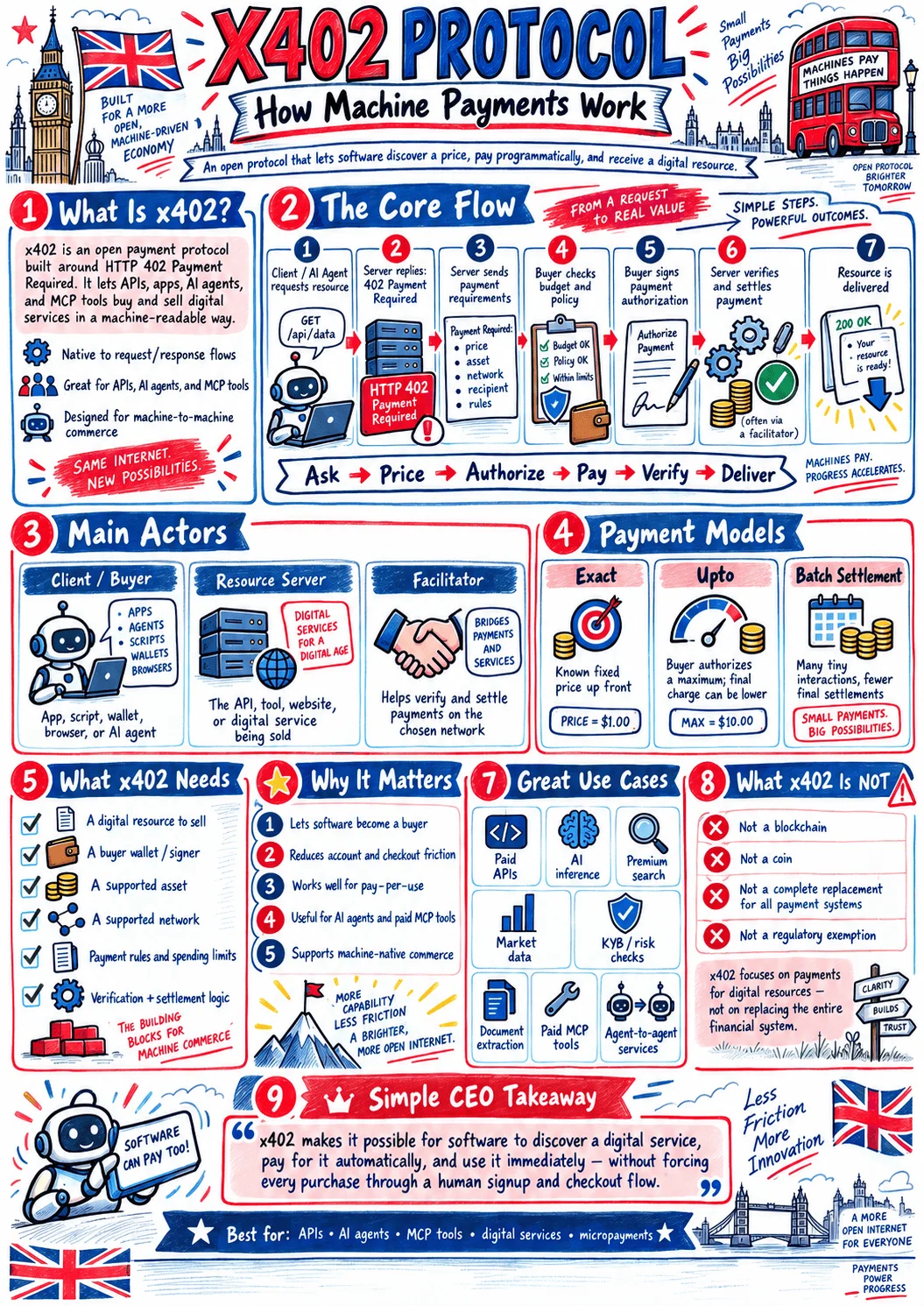
Executive Summary
x402 turns payment into a native part of a machine-to-machine request.
Today, a normal paid API usually requires something like:
Find vendor
   ↓
Create account
   ↓
Enter company/user information
   ↓
Add credit card / bank method
   ↓
Choose plan
   ↓
Receive API key
   ↓
Store credentials
   ↓
Call API
   ↓
Vendor meters usage
   ↓
Monthly invoice / prepaid credits / card charge
An x402-enabled service can instead behave like this:
Software asks for resource
   ↓
Server says:
"Payment required.
Price = $0.01.
I accept this payment method."
   ↓
Software signs an approved payment
   ↓
Software retries request with payment proof
   ↓
Server verifies payment
   ↓
Server delivers resource
   ↓
Payment settles
The important innovation is not merely “crypto payments.”
The larger idea is:
A piece of software can discover the price of a digital service, authorize payment, pay, and receive the service without a human opening an account, entering card details, buying credits, or manually exchanging API keys.
That is particularly relevant to:
AI agents;
paid MCP tools;
data APIs;
inference APIs;
compute;
search;
content;
machine-to-machine services;
usage-based services;
API marketplaces;
microtransactions;
autonomous software procurement.
As of September 19, 2026, x402 is no longer simply a Coinbase experiment. Protocol stewardship is under the x402 Foundation within the Linux Foundation, with 40 organizations participating at operational launch in July 2026, including major companies across cards, acquiring, cloud, stablecoins, blockchains, and commerce.
The x402 site currently reports, for its latest 30-day window:
Metric | Reported value |
|---|---|
Transactions | 75.41 million |
Volume | US$24.24 million |
Buyers | 94.06 thousand |
Sellers | 22 thousand |
These figures are official ecosystem figures, not an independent audit.
A rough calculation from those numbers produces an average reported payment of only about US$0.32 per transaction, which illustrates why the protocol is closely associated with API calls, agents, and granular digital services rather than traditional checkout.
The strategic conclusion
For a company evaluating x402 in 2026:
Do learn it now.
Do build controlled proofs of concept.
Do make selected APIs and MCP tools x402-ready.
Do test real mainnet payments at tiny values after testnet validation.
Do not redesign an entire payment business around x402 yet.
Do not assume x402 eliminates compliance, accounting, treasury, fraud, or customer-service requirements.
Do not assume x402 will be the only HTTP payment standard.
The right stance is:
Treat x402 as a potentially important internet payment primitive and an inexpensive strategic option to acquire now—not as a reason to throw away the conventional payment stack.
What the x402 Protocol Is
x402 is an open internet payment protocol centered on the concept behind the HTTP status code:
402 Payment RequiredHTTP already has familiar response codes:
200 = OK
301 = Moved
400 = Bad Request
401 = Unauthorized
403 = Forbidden
404 = Not Found
500 = Server Error
HTTP 402 Payment Required was reserved for payment-related use but historically never developed into a widely used web payment mechanism.
x402 gives that idea an actual payment workflow.
A server can effectively communicate:
You requested this resource.

It costs X.

These are the payment methods/networks/assets I accept.

Here is where payment is to be sent.

Here are the rules and time limits.
The client can then construct a cryptographically signed payment authorization and retry the request.
The x402 v2 specification separates the protocol into three conceptual layers:
Types
Standard objects such as payment requirements, payment payloads, and settlement responses.
Logic
How a particular payment scheme and payment network create, verify, and settle value.
Representation
How that payment information is carried through HTTP, MCP, A2A, or another request/response transport.
That separation is important.
x402 is therefore not merely:
"Pay USDC on Base."The architecture is closer to:
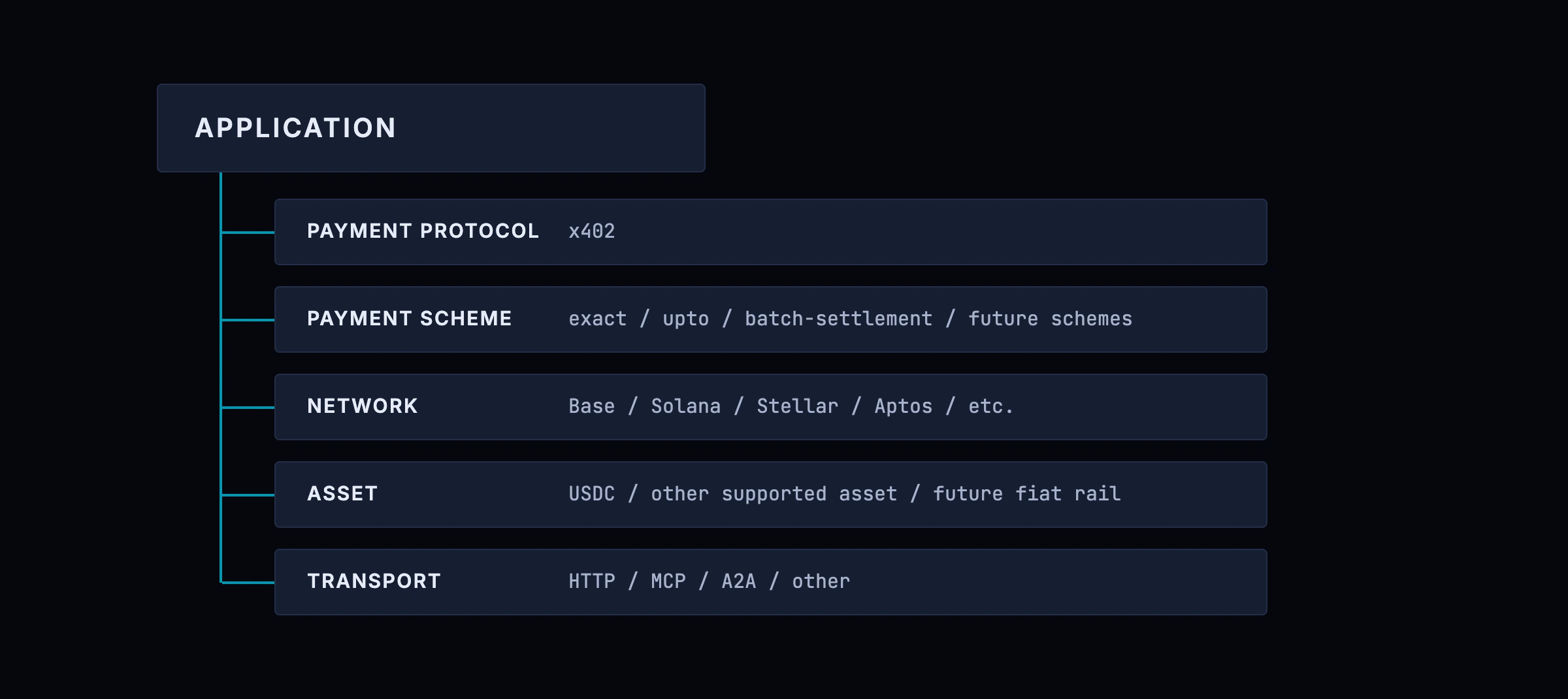
The protocol is intended to be payment-method and network extensible. The current reference implementations, however, are still most mature around on-chain assets and stablecoin-style payments.
That distinction matters:
The protocol ambition is broader than the current production implementation footprint.
What x402 Is Not
Understanding what x402 is not prevents most conceptual mistakes.
x402 is not a blockchain.
It can use blockchains as settlement networks, but x402 itself is a protocol.
x402 is not a cryptocurrency.
There is no requirement that “x402 coin” exist.
x402 is not USDC.
USDC is a common settlement asset, but the protocol is not identical to USDC.
x402 is not Coinbase.
Coinbase originated the protocol, but governance has moved to the x402 Foundation under the Linux Foundation.
x402 is not a wallet.
The payer still needs some mechanism capable of signing a valid payment authorization.
x402 is not a merchant acquirer.
It standardizes the payment interaction; it does not automatically provide all acquiring functions.
x402 is not Stripe replacement software.
It does not automatically provide everything Stripe provides: cards, dispute management, merchant onboarding, conventional subscriptions, billing portals, tax products, fraud tooling, local payment methods, etc.
x402 is not a compliance exemption.
A protocol cannot exempt a company from:
money-transmission rules;
sanctions controls;
AML obligations;
consumer-protection laws;
tax obligations;
licensing;
privacy requirements;
accounting rules.
The exact regulatory perimeter depends on what a company actually does.
x402 is not automatically anonymous.
Protocol-level payment may not require a conventional user account, but blockchain activity can be public, a facilitator may apply compliance controls, and an application may require identity separately.
x402 is not necessarily a micropayment-only system.
Micropayments are a natural fit, but technically a seller can quote larger amounts if appropriate.
x402 is not limited to humans.
Its most interesting design characteristic is that the payer can be software.
Why HTTP 402 Matters
The internet is excellent at moving information.
It is much worse at moving money as part of the same machine-native interaction.
A software program can request a web page with a single instruction.
It can call an API with a single instruction.
But historically, if payment is required, the process often exits the machine-native flow and enters a human/business workflow:
Register
Verify email
Add payment method
Accept contract
Buy package
Receive key
Manage subscription
Receive invoice
Reconcile invoice
That is manageable when the buyer is a person or procurement department.
It becomes awkward when the buyer is an autonomous agent that discovers a service for the first time at 3:17 a.m., needs one answer worth three cents, and may never use the service again.
The economic problem is not simply payment settlement.
It is commercial onboarding friction.
x402 attempts to collapse:
Discovery → Pricing → Authorization → Payment → Deliveryinto the native request/response interaction.
This is why x402 matters more in an agentic-computing world than it did when HTTP 402 was originally reserved.
ELI5
Imagine the internet has a vending machine.
You ask:
Can I have a picture?
The vending machine answers:
Yes. It costs one penny.
Your little robot has a digital wallet.
The robot says:
Okay, I am allowed to spend one penny.
It puts the digital penny into the machine.
The machine checks that the penny is real.
Then it gives your robot the picture.
Nobody had to:
make an account;
type a password;
enter a credit card;
choose a monthly subscription.
That “ask → price → pay → receive” rule is basically what x402 is trying to standardize for the internet.
ELI15
Suppose you are building a computer program.
Your program asks another website:
Give me today's premium exchange-rate dataset.The website responds:
Payment Required.
Price: $0.02
Accepted payment: USDC
Network: Base
Your software has a wallet.
It checks:
Am I allowed to spend $0.02?
Yes.
It digitally signs permission to make the payment.
It sends the request again with the signed payment information attached.
The website verifies it and sends back the dataset.
The important part is that the software itself can complete the purchase.
That makes it possible for an AI agent to become a customer.
ELI20
At a more technical level, x402 standardizes the payment handshake between a client and a resource server.
The normal interaction is approximately:
1. Client → GET /premium-data

2. Server → HTTP 402 Payment Required
            PAYMENT-REQUIRED: <encoded payment requirements>

3. Client reads:
   - scheme
   - network
   - amount
   - asset
   - recipient
   - expiry/rules

4. Client chooses an acceptable option.

5. Client signs the appropriate authorization.

6. Client retries:
   GET /premium-data
   PAYMENT-SIGNATURE: <encoded signed payment payload>

7. Server verifies authorization.

8. Server executes the request.

9. Payment is settled.

10. Server returns:
    HTTP 200
    data
    PAYMENT-RESPONSE: <settlement information>
The client can be:
a browser;
a backend;
an AI agent;
a script;
an MCP client;
another machine.
The server can be:
an API;
an MCP server;
a website;
a data service;
an AI model endpoint;
a compute service.
A facilitator may be used to abstract payment verification and blockchain settlement so the merchant does not have to operate blockchain infrastructure directly.
ELI30
x402 is an extensible payment negotiation and authorization protocol for request/response systems.
The core abstraction separates:
WHAT IS BEING BOUGHT
resource

HOW MUCH / ACCEPTED CONDITIONS
PaymentRequirements

HOW PAYMENT IS AUTHORIZED
scheme + signed PaymentPayload

WHERE VALUE MOVES
network

WHAT VALUE MOVES
asset

WHO RECEIVES IT
payTo

WHO MAY VERIFY / BROADCAST SETTLEMENT
facilitator

HOW PAYMENT DATA IS CARRIED
HTTP / MCP / A2A / another transport
In x402 v2, network identifiers use the CAIP-2 format, allowing chain/network identity to be expressed without coupling the entire protocol to a single chain.
The most important current schemes are:
exact: known fixed amount;upto: maximum preauthorization, final amount determined after usage;batch-settlement: high-frequency interactions represented by signed cumulative vouchers and settled in aggregate.
The protocol therefore provides a common commercial vocabulary that an automated buyer and seller can interpret without prior bilateral integration.
The deeper significance is this:
x402 attempts to make economic negotiation machine-readable at the protocol layer, rather than leaving it entirely inside merchant-specific accounts, plans, invoices, prepaid balances, and checkout flows.
x402 Explained to a Nontechnical CEO
Forget blockchains for a moment.
Assume your company owns something valuable online:
data;
software functionality;
research;
computation;
verification;
an AI model;
a database;
a document;
a search capability;
a compliance check.
Today, if another company wants to buy US$0.05 worth of that capability, you may need to turn that company into a “customer” first.
That may require:
Account
Contract
API key
Billing account
Minimum commitment
Invoice
Credit card
Prepaid balance
Sales process
The transaction cost of becoming a customer can be thousands of times greater than the actual service being purchased.
x402 says:
What if software could simply ask what the resource costs, pay that amount under pre-approved rules, and receive it?
That changes the definition of a customer.
Your future customer may not be:
John Smith
ABC Corporation
[email protected]
It may be:
ABC Corporation's procurement agent
running automatically
with a US$50/day spending authority
that discovers your service
uses it twice
pays US$0.34
and never returns.
That sounds small.
At machine scale, it may not be small.
A human might make 20 buying decisions in a day.
Software could make thousands or millions.
The CEO-level question is therefore not:
Will everyone pay using x402?
It is:
If software becomes an economically active customer class, do we have a way to sell to software without requiring human onboarding?
x402 is one credible answer to that question.
How Important Is x402?
The correct answer is not:
"Revolutionary, replace everything."Nor is it:
"Just another crypto protocol."Its importance depends on the use case.
Use case | Current strategic relevance |
|---|---|
AI agent buying APIs | High |
Paid MCP tools | High |
Machine-to-machine services | High |
Usage-priced digital services | High |
API long-tail monetization | Medium–High |
Micropayment-heavy agent loops | Medium–High, with batch settlement |
Human pay-per-article | Medium |
Ordinary SaaS subscription | Low–Medium |
Retail card checkout | Low today |
Local payment-method e-commerce | Low today |
Regulated third-party money movement | Technically relevant but regulation dominates |
Why it could become important
Three trends reinforce one another:
AI agents
      +
machine-discoverable tools
      +
programmable money
      =
software capable of becoming an economic actor
If software routinely chooses suppliers dynamically, the existing model of:
account first
commercial relationship first
payment credentials first
becomes a bottleneck.
x402 addresses exactly that bottleneck.
Why it may not dominate
Standards competition exists.
Cloudflare's Machine Payments Protocol (MPP), for example, also formalizes machine payments around HTTP 402, supports multiple payment methods including cards via Stripe, defines charge/session/subscription intents, and is designed to interoperate with x402 services.
Therefore the strategic objective should be:
Become HTTP-machine-payment capable, with x402 support as a first-class implementation—not x402-exclusive.
That preserves optionality.
Bottom Line
The most important mental model is:
HTTP made information callable.

MCP is making capabilities callable.

x402 is trying to make payment callable.
That is why x402 deserves serious attention.
Its potential is not that people will suddenly prefer a stablecoin transaction over a credit card.
Its potential is that software itself may become a buyer, and today's account/checkout/subscription architecture was largely designed for humans and long-lived commercial relationships.
x402 creates a different pattern:
discover
→ quote
→ authorize
→ pay
→ consume
→ settle
all in machine-readable form.
For a company deciding what to do next, the disciplined approach is:
1. Learn the protocol.
2. Build a testnet seller.
3. Build a controlled buyer.
4. Add spending policy.
5. Prove failure behavior.
6. Add one commercially real API.
7. Expose it through MCP.
8. Test discovery.
9. Run tiny mainnet transactions.
10. Reconcile every transaction.
11. Recruit an external buyer.
12. Compare exact, upto, and batch economics.
13. Evaluate production facilitators.
14. Keep an abstraction layer so x402, MPP, and future methods can coexist.
15. Package what you learn into a product or advisory offering.
If the experiments fail, the downside is limited.
If machine-to-machine commerce becomes a significant payment category, you will already understand the operating model before most businesses have moved beyond the phrase “AI payments.”
That is the correct reason to work on x402 now.
Related x402 Explainers
If You Are Building This Commercially
x402 may be the machine-facing payment layer, while the business behind it still needs ordinary regulated infrastructure. If the model involves third-party money movement, review payments and fintech licensing. If stablecoin revenue must connect to fiat operations, see multi-currency account infrastructure. If customer funds are pooled or administered, an FBO account structure may become relevant.
Describe your x402 payment model if you want to map the flow of funds before deciding which infrastructure is actually required.
Key Takeaway
x402 is best understood as an attempt to make payment a native capability of software. The practical next step is not to redesign an entire payment stack around it; it is to prove one controlled paid resource, understand the operating model, and expand only where the economics and risk controls make sense.