
What an x402 Facilitator Does
The facilitator is one of the most commercially important concepts to understand.
Without a facilitator, the merchant may need to understand:
RPC endpoints;
network rules;
gas;
token behavior;
transaction broadcasting;
confirmation;
nonce handling;
replay protection;
network-specific settlement;
retries;
chain errors.
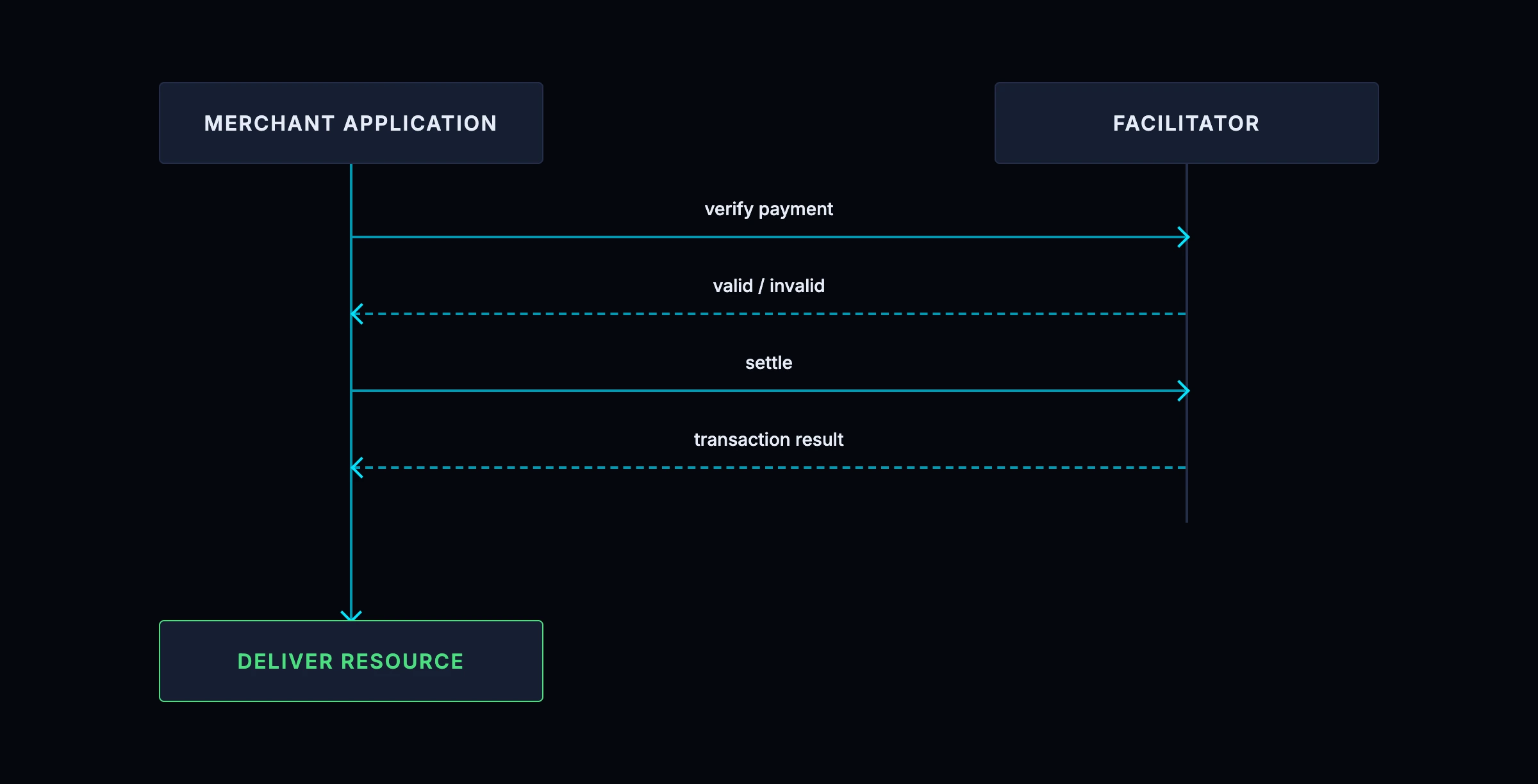
With a facilitator, the resource server can ask a standardized service to perform the payment-specific operations.
Typical interface:
POST /verify
POST /settle
GET  /supported
Conceptually:
Production choices
You generally have three choices:
A. Managed facilitator
Advantages:
fastest implementation;
no node infrastructure;
less chain-specific engineering;
external operations/support;
may include compliance tooling.
Disadvantages:
provider dependency;
pricing;
service-level dependency;
supported-network constraints;
compliance policy may differ from yours.
B. Self-host facilitator
Advantages:
control;
customization;
own risk rules;
broader infrastructure ownership;
potentially better economics at scale.
Disadvantages:
engineering;
key management;
RPC operations;
uptime burden;
security responsibility.
C. Direct/self settlement in application
Possible in some architectures, but increases application complexity.
Critical distinction
The public x402.org facilitator is for development/testnet use, not something to assume is your production mainnet settlement path.
For production, choose an appropriate managed facilitator, self-host, or implement a controlled settlement architecture.
Key Questions to Ask Vendors and Facilitators
Before selecting a production facilitator, ask:
Coverage
Which x402 protocol versions are supported?
Which schemes are supported?
Which networks are production-supported?
Which assets are supported?
Is Permit2 supported?
Is EIP-3009 supported?
Is batch settlement supported?
Is MCP supported directly or only HTTP?
Economics
What is the facilitator fee?
Who pays gas?
Is there a minimum transaction value?
Are there monthly minimums?
Are there volume tiers?
Are failed verifications charged?
Are failed settlements charged?
Compliance
Is KYT performed?
Which sanctions lists/policies are applied?
Are jurisdictions blocked?
Can the merchant configure its own rules?
Is wallet-risk scoring exposed?
Is screening synchronous?
What information is logged?
Settlement
When is settlement considered final?
How is
settlement_pendinghandled?What are retry semantics?
How are duplicate settlements prevented?
What is the confirmation policy?
What happens during chain congestion?
Security
Who holds facilitator signing keys?
Is HSM/KMS used?
Are independent security audits available?
Is there an incident-response policy?
Is there a bug bounty?
How are contracts upgraded?
Reliability
SLA?
P50/P95/P99 verify latency?
P50/P95/P99 settle latency?
Historical availability?
Regional infrastructure?
Rate limits?
Operations
Dashboard?
Webhooks?
Exports?
Payment IDs?
Reconciliation API?
Support response times?
Sandbox?
Testnet parity with production?
Vendor risk
Can we switch facilitators?
Are payloads standards-compliant?
Is there proprietary lock-in?
Can we self-host later?
What data can be exported?
A facilitator should be treated as payment infrastructure, not as a random SDK dependency.
Related x402 Explainers
If You Are Building This Commercially
If a facilitator or platform moves beyond software verification into custody, exchange, transmission, or third-party value movement, map the actual activity against the relevant payments and fintech licensing pathways rather than classifying it from the word “facilitator.”
Key Takeaway
A production facilitator should be assessed like payment infrastructure: protocol compatibility matters, but so do security, uptime, custody/control, fees, reconciliation, compliance controls, and exit portability.
This page is part of x402 Protocol Explained, the full guide to how machine-to-machine payments work.