
Need a U.S. FBO account to collect customer funds, hold balances, or manage payouts? Faisal Khan LLC helps fintechs, money transfer operators, and payment platforms identify suitable banking and solution-provider relationships for their business model.
Whether you are launching a payment service, expanding into the United States, or replacing an existing provider, start with the transactions your business needs to support. We review your requirements, help identify the appropriate account structure, and facilitate introductions where there is a suitable provider fit.
Tell us what your business does, where your customers are, and how funds move. Your initial inquiry starts a suitability review; the selected provider handles formal onboarding and account approval.
Find an FBO Account That Fits Your Payment Business
An account is useful only if the provider supports the customers, payment methods, and settlement arrangements behind it. A fintech wallet, a remittance company, and a B2B payments platform may each need a different program.
Our role is to help connect those requirements:
Business and provider fit: Identify the customer types, countries, transaction volumes, and activities a prospective provider needs to evaluate.
Account structure: Clarify whether you need pooled customer funds, individually titled accounts, collection and settlement facilities, or a combination.
Banking and licensing: Identify whether the opportunity requires a banking introduction alone or a separate licensing or sponsorship workstream.
A clearer provider introduction: Present your flow of funds and operational requirements so prospective providers can assess the actual business.
You can approach us with an existing operation or a defined launch plan. If your licensing or account structure is still being developed, explain your current position so we can identify the questions that need to be resolved.
What Is an FBO Account?
FBO stands for “For Benefit Of.” In U.S. banking, an FBO account generally describes a deposit account maintained by one party for the benefit of another party or multiple parties. In a fintech arrangement, a company may administer the account while the underlying customers retain beneficial ownership of their funds.
A simplified account title might read:
ABC Payments LLC FBO Customers
The company named on the account and the people whose money it holds are not necessarily the same. The account agreement, legal relationship, and ownership records establish their respective rights. An FBO designation alone does not create every protection a business or customer might expect.
An FBO account may hold funds for one beneficiary or pool funds for many customers. The FDIC describes these arrangements in its guidance on pass-through deposit insurance.
This page focuses on U.S. banking arrangements. Similar customer-money structures exist internationally, but their terminology and legal treatment vary.
How Does an FBO Account Work?
In a typical pooled arrangement, customer money enters an account at a bank. A ledger identifies each customer’s share of that money. Approved payment instructions then determine when funds move to recipients, merchants, or back to customers.
FBO Account: Example Flow of Funds
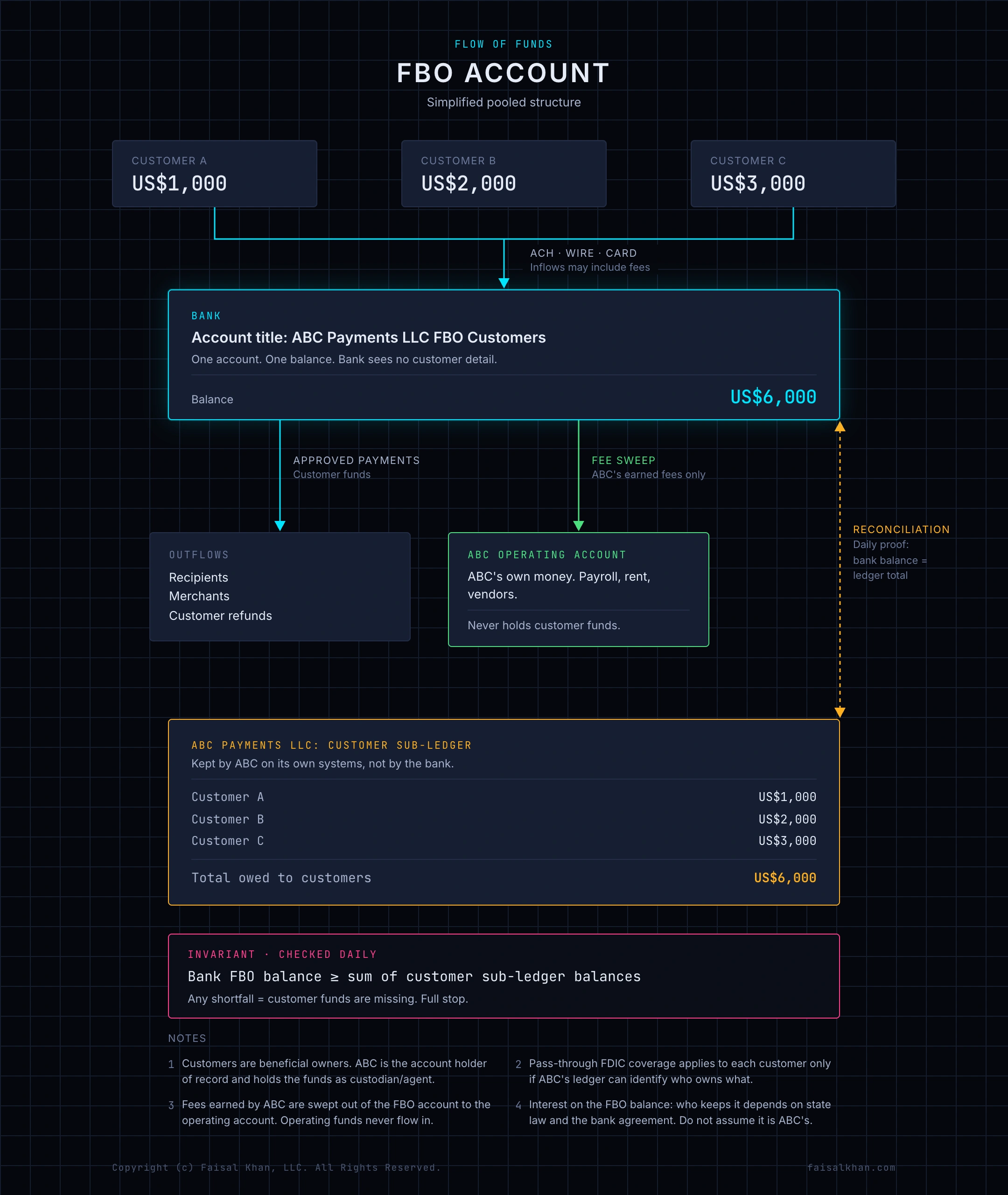
The ledger is a record of ownership, not another account through which money passes. This illustration shows balances before payouts and assumes no pending transactions or fees.
In practice, the bank balance and customer records must reconcile, with settlement timing, returns, reserves, and exceptions accounted for. Earned fees should move to the company’s operating account only as permitted by the agreements and applicable rules.
Depending on the program, the bank, fintech, or a service provider may maintain the ledger. Responsibilities and bank access to records must be clearly established. Federal banking agencies identify recordkeeping, reconciliation, and third-party dependencies as significant considerations in bank–fintech deposit arrangements.
Who Might Need an FBO Account?
An FBO account may suit businesses that receive or administer money belonging to customers or other beneficiaries.
Business or use case | Potential role of the account | Key issue to resolve |
|---|---|---|
Money transfer operators | Hold customer funds awaiting approved transfer or payout | Licensing, settlement timing, and permitted corridors |
Fintech wallets | Hold pooled customer balances with individual ledger records | Ownership, withdrawals, and reconciliation |
B2B payment platforms | Organize collections and payments to approved business recipients | Underlying transaction purpose and control of funds |
Marketplaces | Hold seller proceeds pending settlement | Seller rights, refunds, and payment-processing structure |
Payroll and contractor platforms | Hold funds designated for worker payments | Funding finality and applicable payroll or transmission rules |
Embedded finance programs | Support approved customer deposit and payment features | Bank responsibilities, disclosures, and program oversight |
Provider eligibility depends on the complete business model. If your use case is listed above, tell us which collections, balances, or payouts you need to support.
What Can an FBO Account Provide?
Within an approved banking program, an FBO account can support:
Separation of customer money from the company’s operating funds.
Tracking of individual interests within a pooled balance.
Customer collections, settlement, refunds, and disbursements.
A defined framework for account administration and reporting.
ACH, wire transfers, instant payments, virtual account numbers, cards, and APIs depend on the provider and program approval. They are not automatically included because an account carries an FBO designation.
The practical question is therefore: Can this banking arrangement support your specific transactions, customers, and regulatory structure?
Does an FBO Account Give You a Money Transmitter License?
No. An FBO account is a banking arrangement, not a money transmitter license. Opening one does not automatically authorize your company to accept and transmit money, operate nationwide, or act as an authorized delegate.
Your regulatory position depends on your activities and the jurisdictions involved. Depending on the model, the path may involve your own state licenses, a properly established authorized delegate arrangement, or a bank-led structure supported by applicable law. The bank relationship alone does not extend the bank’s exemptions to your company. See FinCEN’s money transmission guidance and New York DFS’s licensing and agent reporting framework.
What About FinCEN Registration?
FinCEN MSB registration is a separate federal obligation where applicable. It does not provide state money transmitter licenses or account approval. Certain payment-processing models qualify for a federal exclusion, but using an FBO account is not itself a qualifying condition. See FinCEN’s MSB registration guidance and payment processor ruling.
Need both banking access and a licensing or sponsorship route? Include that in your inquiry. We can help identify the separate provider discussions your proposed model requires; qualified legal counsel should confirm the regulatory position.
Switzerland draws the same line at a different threshold: Swiss licensing for pooled customer funds explains when holding client money crosses from SRO affiliation into FinTech or banking authorization.
FBO Account vs. Other Account Structures
These terms describe different aspects of an arrangement and can overlap.
Structure | Primary purpose | How it differs |
|---|---|---|
Business operating account | Hold the company’s own revenue and working capital | Generally used for business expenses, rather than holding beneficially owned customer balances |
FBO account | Hold deposits for identified beneficiaries | Separates the account administrator’s role from underlying ownership |
Escrow account | Hold funds subject to agreed release conditions | Focuses on conditional release; an FBO designation alone does not create escrow terms |
Individually titled customer account | Establish a separate bank account for each customer | Differs from tracking multiple customers within one pooled account |
Virtual account number | Identify or route transactions to an underlying account | May be a routing identifier rather than a separate deposit account |
An omnibus account simply pools funds. Whether it is also an FBO arrangement depends on its ownership structure and documentation.
For a Swiss entity the equivalent analysis is set out in Swiss SRO customer-fund and omnibus account structures.
What Are the Requirements for an FBO Account?
There is no single application checklist that every bank uses. Expect a program review rather than a standard business checking application.
Typical diligence materials may include corporate formation records, ownership information, management backgrounds, financial statements, funding sources, and expected balances. You should also be ready to explain your customers, transaction volumes, average payment sizes, currencies, and countries served.
A useful application package includes:
A flow-of-funds diagram: Every funding source, account, intermediary, and payout destination.
A regulatory position: Relevant licenses, registrations, delegate agreements, or legal analysis supporting the model.
Compliance controls: Applicable customer verification, sanctions screening, monitoring, escalation, and reporting responsibilities.
Account operations: Ledger ownership, reconciliation processes, payment approvals, returns, disputes, and access controls.
Commercial requirements: Required payment rails, integration needs, launch timing, and expected economics.
Banks may request additional information, reserves, minimum balances, or changes to the proposed structure. Requirements depend on the institution and program.
Before approaching providers, resolve one question clearly: Whose money is in each account, and who has authority to move it?
Is an FBO Account FDIC Insured?
Eligible deposits may receive pass-through FDIC insurance when the relevant requirements are met. This generally requires genuine beneficial ownership, account records disclosing the custodial relationship, and records identifying each owner’s interest.
Coverage is generally limited to US$250,000 per depositor, per insured bank, per ownership category. Other deposits held by the same owner at that bank in the same category are aggregated. An FBO account does not create a separate additional insurance allowance merely because it uses a different platform. See the FDIC’s pass-through coverage guidance.
FDIC insurance covers insured bank failure. It does not insure the fintech itself against failure, fraud, or operational problems, and it does not guarantee uninterrupted access during an intermediary’s collapse. See FDIC guidance on banking through third-party apps.
Common Questions About FBO Accounts
Can a startup inquire before it has launched?
Yes. Send a defined business model, target customers, projected volumes, funding position, and launch plan. Provider eligibility varies; an inquiry helps establish what needs to be in place before a formal application can proceed.
Do I need an FBO account or a full banking-as-a-service program?
An FBO arrangement addresses how customer deposits are held and recorded. A broader banking-as-a-service program may also include customer onboarding, cards, APIs, and other features. Describe the functions you need so the proposed scope matches your product.
Can you help if our existing provider no longer supports us?
We can review replacement-provider requirements and explore potential introductions. Explain why the relationship is ending, the transition deadline, current balances, and any unresolved compliance or reconciliation matters. Replacement approval and continuity cannot be assumed.
Can a foreign-owned company obtain an FBO account?
Potentially, subject to provider eligibility and due diligence. A foreign-owned U.S. entity and a company incorporated outside the United States present different onboarding questions. Ownership, management location, customer geography, regulatory status, and business substance all matter.
Can an FBO account support international money transfers?
It may support the U.S. collection or settlement portion of an approved arrangement. It does not independently authorize foreign exchange, cross-border transmission, or overseas payouts. Providers must approve the complete transaction model and counterparties.
Does an FBO account protect customer funds from company bankruptcy?
The designation alone does not establish bankruptcy protection. Ownership, agreements, segregation, records, and applicable insolvency law determine the treatment of funds. This should be addressed in the program’s legal structure before launch.
What does an FBO account cost, and how long does approval take?
Pricing and timing are provider-specific. Potential charges include setup, monthly program fees, transactions, compliance services, and technical integration. Minimum balances or reserves may also apply. A meaningful quote and implementation estimate require review of your business model and supporting documents.
How to Start Your FBO Account Inquiry
1. Tell Us About Your Business
Submit your company name and website, incorporation jurisdiction, customer types, countries served, expected monthly volume, and required payment methods. Include your current licensing status and whether you are launching, expanding, or replacing an account.
A concise description is enough to begin the conversation. A flow-of-funds diagram helps us understand the proposal; corporate and compliance documents will be needed as the review progresses.
2. Establish the Account and Provider Fit
We review the proposed structure and discuss material gaps, required capabilities, and potential banking or solution-provider routes. Where a suitable option is identified, we facilitate the introduction. Any engagement scope and applicable fees should be agreed before work proceeds.
3. Proceed to Provider Due Diligence
The selected provider evaluates your business, confirms eligibility and commercial terms, and determines the required documentation. Approval, payment capabilities, limits, and implementation timing are established through that process.
Discuss Your FBO Account Requirements
Give us the business model. We will help identify the banking conversations it requires.
If your fintech or money transfer business needs to collect customer funds, maintain balances, or arrange payouts through a U.S. FBO account, send us your requirements. We can help you assess the account structure and explore introductions through our banking and solution-provider relationships.
Initial suitability inquiry. Formal account applications and approvals are handled by the selected provider.
For related account needs, explore our banking solutions.
Faisal Khan LLC facilitates business introductions and provider relationships; it is not a bank and does not hold customer funds. Account availability is subject to provider approval and terms. Licensing and account structures require assessment of the specific business model.