
Unsure whether the business needs SRO, FinTech, or banking authorization? Contact Faisal Khan with the customer-fund and custody flow.
High-Level Comparison
Feature | SRO/VQF | FINMA FinTech License | Swiss Bank License |
|---|---|---|---|
Direct FINMA prudential authorization | No; member supervised by SRO for AMLA | Yes | Yes |
AML supervision | Through SRO | Direct/within FINMA regime | Direct/within FINMA regime |
Public deposits | Not a general authorization | Up to CHF 100m under current regime, subject to conditions | Bank regime |
Interest on accepted deposits | Not SRO authority | No, under current FinTech license conditions | Potentially within banking business |
Invest accepted deposits | Not SRO authority | No, under current FinTech license conditions | Bank regime |
Collective crypto custody | Can trigger more than SRO | FinTech license can apply | Bank/custody structures may apply |
Individual-address crypto custody | Can be treated differently | May not require FinTech solely on that fact | Depends on model |
Customer bank accounts | Not inherent | Not identical to bank accounts | Banking capability subject to authorization |
Regulatory intensity | Lower prudential layer | Intermediate | Highest among these three |
Swiss SRO / VQF
The SRO model is suited to eligible professional financial intermediaries subject to AMLA but not otherwise directly supervised by FINMA under a prudential financial-market license.
This can be highly effective for:
exchange;
money/value transmission;
FX;
certain payment models;
certain crypto/VASP services.
It is not designed to turn the company into a deposit-taking bank.
FINMA FinTech License
FINMA's current FinTech license permits an institution to accept public deposits up to CHF 100 million or accept cryptobased assets, provided the deposits are not invested and no interest is paid.
FINMA also indicates that collective custody of cryptobased assets can fall within the FinTech license, while accepting cryptoassets stored for each client on individual blockchain addresses is treated differently in its public perimeter guidance.
A FinTech institution must meet FINMA requirements and conduct its business from Switzerland.
This license can therefore become relevant when a product evolves from simple transaction execution into client-value holding.
Banking License
A banking license sits at a higher prudential level and is relevant when the business carries on regulated deposit-taking or other banking business beyond available exceptions/lower-tier frameworks.
A bank faces materially higher expectations around:
capital;
liquidity;
governance;
risk management;
audit;
prudential supervision;
organization;
recovery/resolution;
deposit protection where applicable.
A startup wanting an IBAN feature should not jump directly to “we need a bank.” Often an EMI, FinTech institution, bank partnership, or other structure can solve the actual problem more efficiently.
The Client-Money Trigger
The most important design question is often:
Does the business hold repayable customer money as a balance, or does it merely receive funds as part of an immediate transaction?
Examples requiring closer analysis include:
fiat wallet balance held for weeks;
customer treasury account;
prepaid balance;
pooled reserve;
omnibus customer fiat;
stablecoin reserve held by issuer;
settlement account retaining customer money.
The FBO account and customer-fund structure should therefore be mapped alongside the licensing question.
The Crypto-Custody Trigger
Another key question is whether cryptoassets are held individually or collectively.
Example:
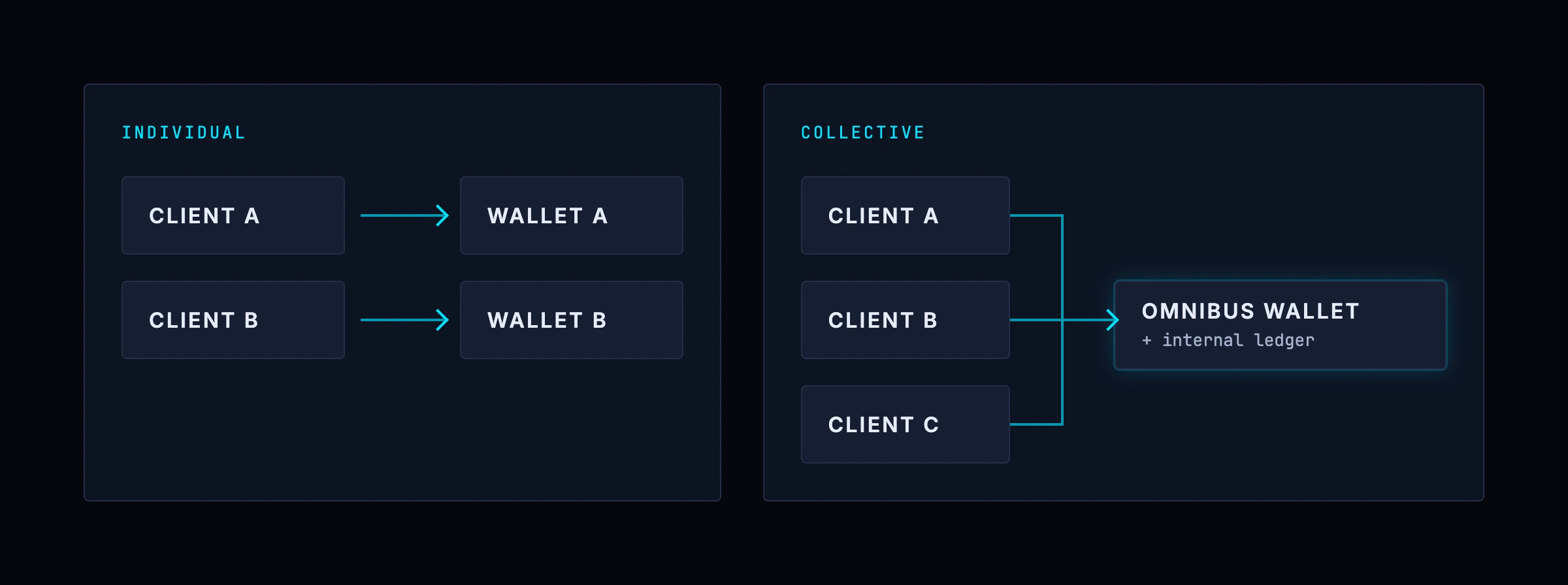
The second structure can have materially different licensing consequences.
What About Customer IBANs?
None of the labels should be used casually.
An SRO does not issue IBANs. A FinTech license is not automatically a bank charter. A customer IBAN program may instead be provided through a bank, EMI, payment institution, or other authorized partner.
The actual named account arrangement should be reviewed separately.
Proposed Reform: FinTech License May Be Replaced
Switzerland's Federal Council proposed a new Payment Instrument Institution category in 2025 that would replace the current FinTech license. The proposal was designed to create a more tailored framework for payment instruments and certain stablecoin business models.
A separate Crypto-Institution category was also proposed.
As of September 2026, these remain part of an ongoing legislative reform process. Buyers should therefore distinguish current law from proposed future regimes.
Which Structure Fits Which Product?
SRO/VQF may fit when:
company exchanges value;
transmits money/crypto;
carries out FX;
performs eligible VASP activity;
does not cross into prudential deposit/custody licensing.
FinTech license may fit when:
company accepts client deposits within the current statutory limit;
company takes collective custody of cryptoassets;
it satisfies the no-investment/no-interest conditions and other requirements.
Bank license may fit when:
business is genuinely deposit-taking/banking at a scale or structure outside lower-tier options;
the strategy justifies bank-level capital and supervision.
For many fintech groups, global banking infrastructure through partners is more practical than seeking a bank charter solely for distribution of accounts.
Related Swiss SRO Guides
Related reading: Swiss SRO crypto custody, Swiss SRO IBAN and customer accounts, and Swiss SRO companies for sale.
Frequently Asked Questions
Is VQF a light banking license?
No. It is an SRO/AML supervisory relationship for qualifying financial intermediaries.
What is the current FinTech deposit limit?
FINMA states that the current FinTech license permits public deposits up to CHF 100 million subject to the statutory conditions.
Can a FinTech institution pay interest?
The current FinTech license requires that the accepted deposits are not invested and no interest is paid.
Does collective crypto custody require a FinTech license?
FINMA's public guidance identifies collective custody of cryptobased assets as a situation where the FinTech license can apply. The exact model should be analyzed.
Will the FinTech license disappear?
The Federal Council has proposed replacing it with a Payment Instrument Institution regime, but the reform must complete the legislative process and enter into force before it becomes current law.
Regulatory References
Start With the Money Flow
The right Swiss authorization becomes clearer once the model shows who holds customer fiat and crypto, for how long, under whose legal claim, and for what purpose.
Contact Faisal Khan to review the Swiss regulatory perimeter for your product.