
The important distinction is regulatory. A Swiss company affiliated with VQF or another FINMA-recognized self-regulatory organization is not the same as a FINMA-licensed bank, an electronic money institution, or an EU MiCA-authorized CASP. The SRO supervises the member's compliance with the Swiss Anti-Money Laundering Act. The actual services the company can offer depend on its business model and whether additional Swiss or foreign authorization is required.
Looking to acquire a Swiss SRO/VQF company? Use the Faisal Khan contact form and provide the proposed activities, target customer countries, expected monthly volume, custody model, fiat requirements, and whether banking or existing technology must be included.
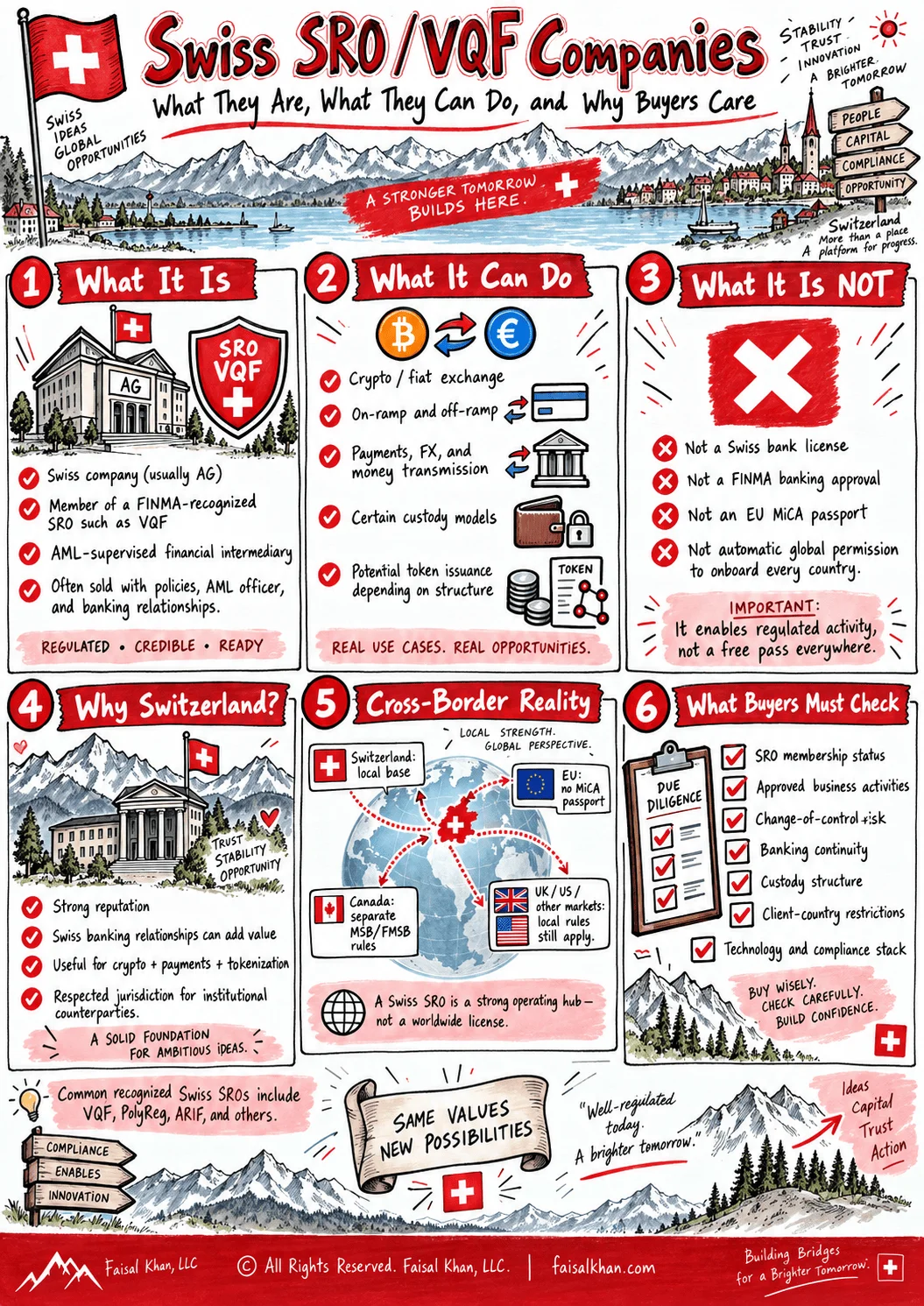
Swiss SRO Companies for Sale: What Is Actually Being Sold?
A good Swiss SRO acquisition is not simply a company certificate. Buyers should separate the transaction into distinct assets and verify each one independently.
Component | What it can add | What must be verified |
|---|---|---|
Swiss AG | Established Swiss legal entity | Corporate history, liabilities, tax, capital, shareholders |
Active SRO affiliation | AMLA-supervised financial-intermediary status | Current status, business description, audit history, continuity after ownership change |
AML framework | Policies, risk model, KYC/EDD procedures | Whether the documents fit the buyer's new products and countries |
AML Officer | Existing compliance function | Contract continuity, qualifications, independence, capacity |
Banking | Corporate or operating account relationships | Permitted activity, crypto acceptance, client-fund permissions, change-of-control re-KYC |
Crypto infrastructure | Wallet, custody, KYC, Travel Rule or exchange stack | Ownership, contract transferability, production status, regulatory architecture |
Customer-account infrastructure | Virtual accounts, named accounts or IBAN programs | Actual provider contract and whether client funds may be received |
Operating history | Existing regulatory and banking track record | Clients, volumes, complaints, suspicious-activity history, outstanding remediation |
A company with a VQF membership and no bank account is materially different from a company with VQF, production banking, custody infrastructure, and signed customer-account contracts. The acquisition price should reflect the assets that can actually survive the transaction.
For buyers evaluating several jurisdictions, our broader licensing solutions explain how regulatory structures can be combined rather than treated as interchangeable licenses.
What Is a Swiss SRO?
Under the Swiss Anti-Money Laundering Act, certain professional financial intermediaries that are not directly supervised by FINMA must affiliate with a FINMA-recognized self-regulatory organization, or SRO. The SRO establishes AML rules, monitors members, conducts or oversees audits, and can impose supervisory measures or sanctions.
For this reason, expressions such as Swiss SRO license, Swiss VASP license, and VQF license are widely used commercially but are shorthand. The legally accurate description is generally a Swiss financial intermediary affiliated with a FINMA-recognized SRO for AML supervision.
VQF is particularly common in crypto and fintech transactions. VQF states that its active members can include payment service providers, foreign-exchange dealers, lenders, and cryptocurrency or VASP businesses, depending on the business model.
There is no numbered Swiss SRO ladder such as Class 1, Class 2, or Class 3. The regulatory analysis follows the activity being performed.
Why Buy an Existing Swiss SRO Company?
The strongest reason to acquire an existing company is execution advantage, not the nominal cost of SRO membership.
A buyer may seek to avoid rebuilding every component from zero. An established target may already have:
a Swiss AG with the required local representation;
an active SRO relationship;
completed AML policies and operating procedures;
an experienced AML Officer;
previous SRO audits;
an operating Swiss corporate bank account;
bank or payment-provider integrations;
KYC/KYB and transaction-monitoring tooling;
Travel Rule infrastructure;
wallet or custody technology;
a domain, platform, customer portal, or back office;
agreements that would otherwise take months to negotiate.
The acquisition case becomes much weaker if those items are non-transferable or if banks, compliance officers, and critical partners will terminate or re-underwrite the relationship after a change of ownership.
What Can a Swiss SRO Company Potentially Do?
The following matrix is a regulatory-perimeter starting point, not a blanket permission list. The specific structure must be reviewed before launch.
Proposed activity | Can SRO affiliation be relevant? | Main issue to examine |
|---|---|---|
Fiat foreign exchange | Yes | AMLA obligations and operating model |
Money/value transmission | Yes | Client-money flow and cross-border law |
Crypto-to-crypto exchange | Yes | VASP activity, AML/KYC, Travel Rule |
Fiat-to-crypto exchange | Yes | Banking, AML, source of funds, settlement |
Crypto-to-fiat off-ramp | Yes | Banking and payment flows |
OTC digital-asset desk | Yes | Principal/agency model, custody, counterparties |
Brokerage | Potentially | Instruments traded and whether securities rules apply |
Custodial wallet | Potentially | Individual vs collective custody and Banking Act analysis |
Non-custodial wallet software | Often different | Whether the company controls assets or merely supplies technology |
Payment-token issuance | Potentially | AMLA and token structure |
Utility-token issuance | Potentially | Whether token is genuinely functional or investment-like |
Asset/RWA token issuance | Additional analysis | Securities, prospectus and other financial-market rules |
Stablecoin issuance | Additional analysis | Banking, guarantee, reserve and AML structure |
Customer fiat accounts/IBANs | Not created by SRO status | Bank/BaaS/EMI partner and client-money permissions |
Acceptance of public deposits | Generally no | FinTech or banking authorization may be required |
Securities trading venue | No | Separate FINMA authorization can be required |
If the commercial objective is primarily conversion between bank money and digital assets, the related crypto-fiat on/off-ramp infrastructure is often just as important as the regulatory entity itself.
VQF Is Not a Banking License
This is one of the most important acquisition points.
A Swiss AG may be a VQF member and also have a PostFinance, Relio, BCB, or other banking relationship. Those are two separate assets.
An ordinary corporate PostFinance account means the Swiss company has a bank account. It does not automatically mean the company can:
issue Swiss IBANs to customers;
maintain customer payment accounts;
accept public deposits;
pool customer fiat indefinitely;
issue e-money;
operate as a bank.
Where client money is accepted, held, pooled, invested, or made repayable, Swiss banking or FinTech licensing questions can arise. Customer accounts and virtual IBAN arrangements normally depend on the actual contractual structure with a bank or payment provider.
Buyers seeking account infrastructure should separately evaluate named accounts and the contractual rights underlying any customer-account product included with the company.
Crypto Custody: A Major Due-Diligence Point
Two targets can both advertise “crypto custody” while having very different regulatory risk.
FINMA distinguishes structures where cryptoassets are attributable to individual clients from structures involving collective custody. A business that accepts client deposits or takes collective custody of cryptoassets can fall within the FinTech license regime, subject to the applicable conditions and limits. A plain SRO affiliation therefore cannot be treated as universal custody authority.
For every acquisition that mentions Fireblocks, Copper, BitGo, MPC wallets, omnibus wallets, segregated addresses, or qualified custody, the buyer should document:
who controls the private keys;
whether the client has an individual address or a claim against a pooled wallet;
whether the company can transfer assets without the client's direct action;
whether client assets appear on the company's balance sheet;
how insolvency segregation works;
whether the model requires a FinTech or another FINMA authorization;
whether the technology agreement survives a change of control.
Technology does not determine the legal outcome by itself. The legal and operational custody model does.
Can a Swiss SRO Company Issue Tokens?
Potentially, but “token issuance” is not one permission.
FINMA traditionally distinguishes among payment tokens, utility tokens, and asset tokens, with hybrid forms possible. Payment-token projects commonly engage AML requirements. A genuine utility token can be treated differently when it provides functional access to a service. Asset tokens can be treated as securities and therefore bring securities and prospectus considerations into the analysis.
For a business focused on tokenized securities or real-world assets, Switzerland can be attractive because of its DLT legal framework, but an SRO membership should not be presented as a securities or exchange license.
Can a Swiss SRO Company Issue a Stablecoin?
A Swiss structure may be used in a stablecoin project, but VQF affiliation alone is not a general stablecoin authorization.
FINMA's stablecoin guidance analyzes the rights of the holder, reserve structure, redemption, guarantees, deposit-taking implications, AML risks, and other features. Swiss stablecoin models using bank default guarantees have existed, but the regulatory conclusion depends on the legal design.
Switzerland is also developing a new regulatory framework that proposes dedicated Payment Instrument Institution and Crypto-Institution categories. Buyers acquiring an SRO company for a multi-year crypto strategy should therefore consider regulatory migration risk rather than assuming today's perimeter will remain unchanged.
For broader settlement architecture, see our stablecoin and crypto-fiat rails resources.
Can the Company Onboard Clients Worldwide?
Not simply because it is Swiss.
Swiss law determines whether the company can carry out the activity from Switzerland. The customer's country determines whether the company can actively solicit and service that customer locally.
Customer location | Practical position |
|---|---|
Switzerland | Swiss regulatory perimeter applies; SRO may cover AML supervision for eligible intermediary activities |
EU/EEA | Swiss SRO provides no MiCA passport; active EU crypto solicitation can require EU authorization |
United Kingdom | Swiss status does not replace UK requirements; UK financial-promotion and crypto rules can apply |
Canada | A foreign entity directing MSB services to Canada can fall under FINTRAC FMSB requirements |
United States | Swiss status does not replace federal MSB or applicable state money-transmission analysis |
Other countries | Country-by-country review required; rules vary widely by activity, client type, solicitation and local presence |
Under MiCA, a third-country firm can have a narrow exception where an EU client approaches it on the client's own exclusive initiative. That reverse-solicitation concept is not a substitute for a European go-to-market strategy and cannot be created by a contractual disclaimer when the foreign firm has solicited the client.
This is why a global group may hold Switzerland alongside Canada, the United Kingdom, and the European Union rather than expecting one Swiss entity to cover every market.
Swiss SRO vs Canada MSB vs UK/EU EMI vs MiCA
Structure | Primary commercial role | What it does not automatically provide |
|---|---|---|
Swiss AG + SRO | Swiss financial-intermediary and VASP/AML platform | EU passport, banking license, customer IBAN authority |
Canada MSB/FMSB | Canadian/foreign Canadian MSB registration perimeter | EU/UK/Swiss market authorization |
UK EMI | UK e-money and payment-services permissions within its authorization | Swiss SRO status or automatic crypto authorization |
EU EMI | EU payment/e-money capability and applicable passporting | Crypto authorization unless separately in scope and authorized |
MiCA CASP | EU crypto-asset service authorization and passporting | Swiss, Canadian, US or UK authorization |
For an acquisition-led global strategy, our Canada MSB companies for sale and Electronic Money Institution licensing pages provide the corresponding frameworks.
Swiss AG Capital and Local Presence
Many SRO companies offered for acquisition are Swiss AGs.
A Swiss AG requires minimum share capital of CHF 100,000. At incorporation, at least 20% of the capital must be paid, subject to an absolute minimum of CHF 50,000. This is why some sale advertisements show CHF 50,000 paid and CHF 50,000 still callable.
That unpaid capital is not a bonus for the buyer. It is an outstanding capital commitment that must be understood in the purchase economics.
A Swiss AG must also be represented by at least one person resident in Switzerland. The ultimate shareholder can be foreign, but the entity cannot simply eliminate the Swiss representation requirement after acquisition.
What Does a Fresh VQF Application Involve?
VQF's published process includes:
preparing and submitting the application and supporting documentation;
paying the processing fee;
preliminary completeness review;
requests for missing information where required;
substantive Legal & Compliance review;
additional evidence depending on the business model;
an admission interview;
VQF's admission decision.
VQF does not publish a guaranteed number of weeks for admission. Complexity and completeness matter.
For a company applicant, current VQF materials include forms dealing with the company application, planned/current business activities, ownership/shareholding, branches and participations, AML function, responsible persons, risk/customer profiles, and other AMLA documentation.
This is one reason acquisition can be attractive: the buyer starts with an operating regulatory history rather than a blank application. It does not remove the need to report material changes.
Change of Ownership Is Not a Rubber Stamp
Buying the shares of an existing SRO company is not equivalent to buying a transferable certificate.
An acquisition can change:
shareholders and beneficial owners;
directors and management;
persons responsible for proper business conduct;
AML personnel;
business model;
customer geography;
transaction volume;
products;
banking profile;
outsourcing and technology relationships.
VQF maintains formal processes for reporting changes, including ownership and business-activity adjustments. Banks and other partners can also re-underwrite the entity.
A purchase agreement should therefore distinguish between share completion and regulatory/banking continuity. Where commercially appropriate, conditions precedent, holdbacks, staged payments, seller cooperation, or termination rights can be tied to critical approvals and account continuity.
How Much Does a Swiss SRO Company Cost?
There are three different numbers to consider.
1. Regulatory and application fees
The SRO's own admission and annual supervisory fees are generally small relative to six-figure acquisition prices. VQF publishes its current fee regulation, which should be checked immediately before an application or transaction.
2. Annual operating and substance cost
A functioning company can require:
Swiss resident representation;
AML Officer and compliance resources;
accounting and tax;
SRO supervision and AML audits;
legal support;
office/substance arrangements;
KYC/KYB and monitoring tools;
Travel Rule tooling;
banking fees;
custody and wallet technology;
insurance or security controls where relevant.
A dormant low-activity shell can be materially cheaper to maintain than a high-volume operating VASP.
3. Acquisition premium
The seller is usually charging for time saved and infrastructure already assembled. A premium can be justified when difficult banking, compliant operating history, technology, contracts, and experienced personnel survive the acquisition. A high price is difficult to justify when the only asset is an SRO affiliation that must effectively be rebuilt after completion.
Our Swiss SRO Acquisition Process
A disciplined transaction should normally proceed as follows:
Step 1 — Buyer profile
We establish the proposed product, jurisdictions, client types, assets, custody model, fiat flows, projected monthly volume, and technology requirements.
Step 2 — Target screening
We identify targets whose existing business description and infrastructure are reasonably aligned with the buyer's proposed activity.
Step 3 — Initial information package
Subject to confidentiality and seller process, the buyer reviews corporate status, SRO status, key infrastructure, banking overview, operating history, capital position, and headline commercial terms.
Step 4 — Regulatory fit analysis
Before treating the company as suitable, the proposed post-acquisition model should be mapped against SRO, FINMA, banking, securities, custody, client-money, and cross-border requirements.
Step 5 — Due diligence
The buyer verifies corporate, financial, tax, regulatory, AML, banking, technology, contractual, litigation, and operational matters. Our buyer and seller due-diligence framework explains the broader transaction approach.
Step 6 — Change-of-control and partner continuity
Required notifications are prepared and critical banks/vendors are addressed. The exact sequence depends on the target and transaction structure.
Step 7 — Completion and controlled transition
Shares, governance, banking access, compliance responsibility, operational credentials, vendor contracts, source code, domains, and records are transferred under a documented closing plan.
What We Need From a Buyer
Before sourcing a Swiss SRO company, it is useful to have:
buyer/group name and ownership structure;
buyer jurisdiction;
exact proposed services;
B2B, B2C, institutional or mixed customer profile;
intended customer countries;
expected monthly transaction count and value;
expected average ticket;
fiat currencies;
digital assets;
custody/non-custody model;
stablecoin requirements;
banking requirements;
need for customer IBANs or named accounts;
card requirements, if any;
required technology stack;
preferred acquisition timeline;
acquisition and operating budget.
This information prevents the common mistake of buying the cheapest available Swiss company and discovering later that its business model, bank, custody arrangement, or customer geography does not fit the intended product.
Swiss SRO Acquisition Due-Diligence Checklist
At minimum, serious buyers should verify:
current commercial-register extract;
current SRO membership and status;
current business-activity description on file with the SRO;
ownership and control records;
paid and unpaid share capital;
SRO audit reports;
remediation, sanctions, warnings, or open findings;
AML Officer arrangements;
historic customers and transaction volumes;
suspicious-activity/reporting history to the extent lawfully disclosable;
bank account agreements and recent statements;
banking permissions for crypto and client-money flows;
customer-account/IBAN contracts;
wallet/custody architecture;
KYC/KYB, monitoring, sanctions, blockchain analytics and Travel Rule contracts;
tax and accounting records;
creditor and litigation status;
IP, platform, domain and software ownership;
vendor change-of-control clauses;
required regulatory notifications;
migration requirements under forthcoming Swiss regulatory reforms.
Who Is a Swiss SRO Acquisition Best Suited For?
A Swiss SRO company can make sense for:
established crypto exchanges seeking a Swiss operating entity;
fintech groups building multi-jurisdiction regulatory coverage;
OTC and institutional digital-asset desks;
companies building fiat/crypto on-ramp and off-ramp services;
payment and foreign-exchange businesses;
tokenization and RWA groups needing a Swiss operating base;
global businesses that value Swiss banking and institutional counterparties;
acquirers who value time-to-market more than the lowest possible setup cost.
It is less compelling when the buyer only wants a badge saying “Swiss VASP” but has no Swiss operating reason, no banking strategy, and no plan for the jurisdictions where customers actually live.
Related Swiss SRO Guides
This pillar is supported by dedicated pages covering:
Frequently Asked Questions
Is a Swiss VQF company a FINMA-licensed VASP?
Not in the sense of a direct prudential license issued by FINMA. VQF is a FINMA-recognized SRO. Eligible financial intermediaries are affiliated with and supervised by the SRO for AMLA compliance.
Can a Swiss SRO company serve EU customers under MiCA?
A Swiss SRO does not receive a MiCA passport. Active provision and marketing of crypto-asset services into the EU should be analyzed under MiCA and relevant EU rules. The third-country reverse-solicitation exception is narrow and client-initiated.
Can the company have PostFinance?
Some targets have PostFinance or other Swiss banking relationships. The bank account must be verified, including its permitted use and whether the relationship is expected to continue after the ownership and business model change.
Does PostFinance mean the company can issue IBANs to clients?
No. A corporate bank account and a customer-account/virtual-IBAN program are separate things. Customer-account capability requires specific contractual and regulatory analysis.
Can a Swiss SRO company provide crypto custody?
Potentially, but the custody structure matters. Collective custody, acceptance of deposits, or other structures can require additional FINMA authorization.
Can it issue a stablecoin?
Potentially under a properly structured model, but VQF membership alone is not a blanket stablecoin license. The reserve, redemption, guarantee, deposit, AML, and token characteristics require separate analysis.
Does the buyer have to live in Switzerland?
The ultimate shareholder does not have to be Swiss solely because the company is an AG, but a Swiss AG must be represented by at least one person resident in Switzerland. SRO and operational requirements must also be maintained.
Is the CHF 100,000 share capital part of the purchase price?
It depends on the target. An AG has a CHF 100,000 minimum nominal share capital, but it may have been only partially paid. The acquisition documentation should clearly distinguish paid-in capital, cash actually remaining in the company, and any unpaid capital commitment.
How long does a new VQF application take?
VQF does not publish a guaranteed number of weeks. Processing depends on completeness, complexity, follow-up questions, the business model, and the admission process.
Is buying an existing SRO company faster than applying from scratch?
It can be, particularly when the company has useful banking, compliance, audits, personnel, and technology. It is not automatically faster if the buyer changes the company so substantially that major regulatory and banking re-underwriting is required.
Regulatory References
Discuss a Swiss SRO Company Acquisition
Availability, infrastructure and pricing vary materially between targets. A useful first step is to define the post-acquisition activity and the countries in which customers will be onboarded, then screen companies against that model rather than buying purely on headline price.