
Looking for a Swiss crypto exchange or on/off-ramp company? Contact Faisal Khan with currencies, assets, corridors, volumes, and target customer countries.
Typical Swiss Exchange Models
Crypto-to-crypto exchange
The customer exchanges one cryptoasset for another.
Key issues:
custody;
source of crypto;
sanctions/blockchain analytics;
exchange execution;
customer jurisdiction.
Fiat-to-crypto on-ramp
The customer sends bank money and receives crypto.
Key issues:
who receives fiat;
whether money is customer property while pending execution;
bank acceptance of crypto activity;
execution timing;
wallet destination;
customer-country rules.
Crypto-to-fiat off-ramp
The customer sends crypto and receives fiat to a bank/payment account.
This adds beneficiary verification, bank-settlement, blockchain source-of-funds, and payment-screening issues.
OTC desk
The Swiss company executes larger bilateral trades as principal, agent, or broker. The principal/agency structure should be clear in both customer agreements and flow of funds.
Example On-Ramp Flow
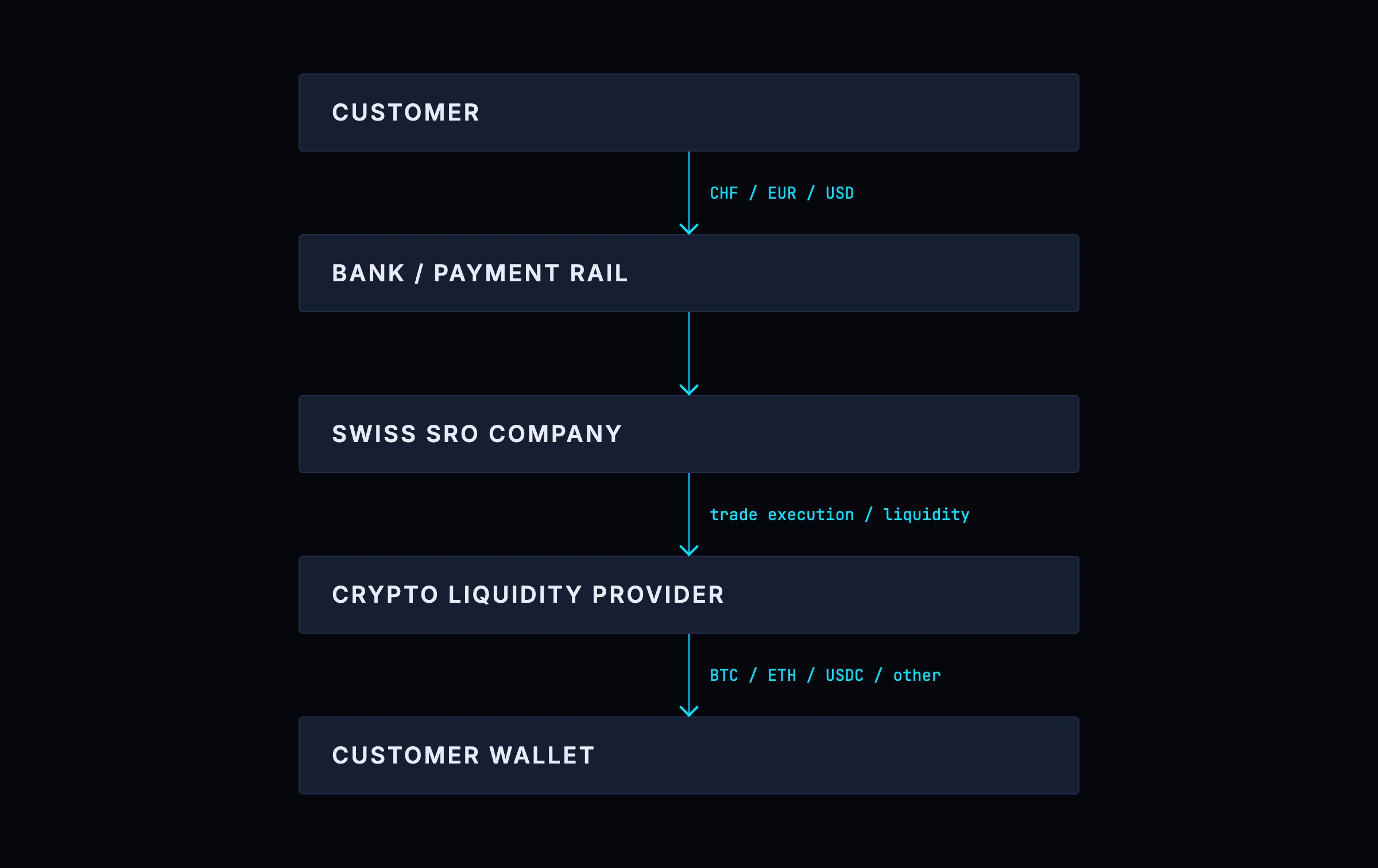
The legal analysis changes if fiat is held as a persistent balance before execution or crypto is retained in custody after execution.
Example Off-Ramp Flow
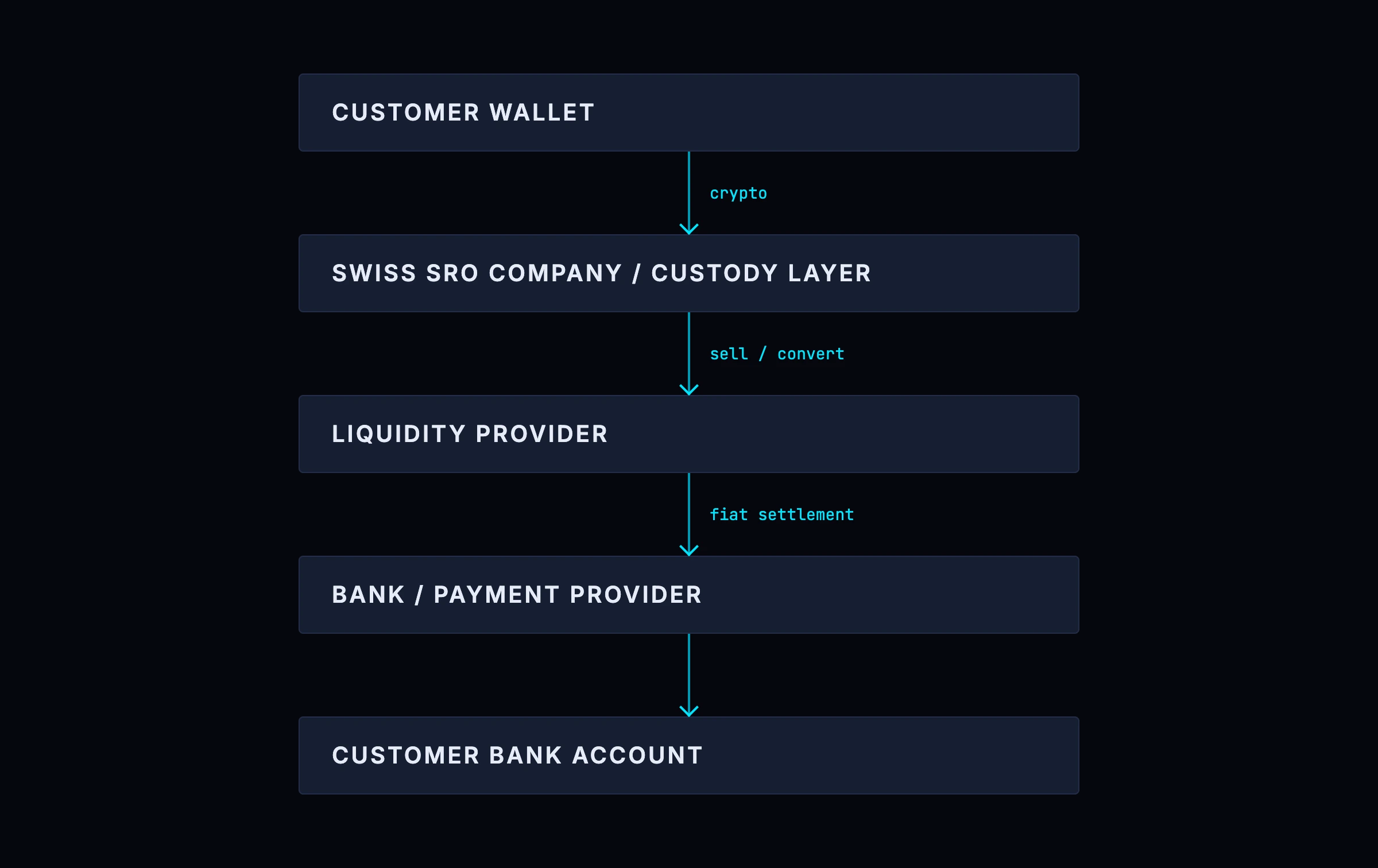
The company should document exactly when title to the crypto and fiat changes and who bears settlement risk.
SRO Status Is Only One Layer
An operating exchange also needs:
banking;
liquidity;
KYC/KYB;
sanctions/PEP screening;
blockchain analytics;
Travel Rule solution;
wallet infrastructure;
reconciliation;
treasury management;
customer terms;
pricing and execution policy;
security and incident response.
Our crypto-fiat on/off-ramp solutions focus on the banking and settlement layer that must work alongside the Swiss entity.
Bank Acceptance Is Critical
A company with VQF status but no bank willing to process crypto-related flows may have limited commercial value.
The bank should understand:
exchange activity;
fiat currencies;
supported cryptoassets;
customer jurisdictions;
average and maximum ticket;
transaction volume;
liquidity counterparties;
custody design;
AML controls.
The buyer should verify that the bank was not opened under a materially different business description.
Liquidity and Execution
A production exchange or OTC business needs price and settlement infrastructure. A buyer should determine whether the target includes:
exchange accounts;
institutional liquidity providers;
OTC counterparties;
prime-brokerage relationships;
market-making agreements;
stablecoin settlement partners;
prefunding requirements;
trading limits.
“Legacy Binance broker-dealer access” or similar historical claims should be verified for current legal ownership, current status, and transferability.
Travel Rule and Blockchain Analytics
Swiss VASPs are expected to address AML risks associated with crypto transfers. A credible operating stack should document:
originator/beneficiary information handling;
counterparty VASP identification;
self-hosted wallet procedures;
high-risk address detection;
mixer/tumbler exposure;
sanctions screening;
darknet/scam/ransomware typologies;
escalation thresholds.
Cross-Border Customer Acquisition
A Swiss exchange cannot assume that SRO affiliation allows active marketing into every foreign country.
The EU, UK, Canada, U.S., and other markets have separate requirements. A Swiss entity is best treated as one contracting node in a global architecture, not as a universal passport.
Where European expansion is material, compare the Swiss structure with crypto exchange licensing and the relevant local authorization route.
Buying an Existing Exchange SRO vs Starting Fresh
An acquisition is most attractive when it includes difficult-to-recreate infrastructure:
clean active SRO standing;
crypto-aware bank account;
AML Officer;
exchange/on-ramp business description already on file;
completed audits;
wallet and compliance tools;
liquidity relationships;
production software;
domain and customer portal.
It is less attractive when the only asset is a shell with no bank, no live tools, and no post-acquisition continuity plan.
Related Swiss SRO Guides
Related reading: Swiss SRO crypto custody, Swiss SRO client countries, and Swiss SRO companies for sale.
Frequently Asked Questions
Can a Swiss SRO operate a crypto exchange?
Potentially, yes, where the business model fits the AML/SRO perimeter and does not trigger additional authorization.
Can it accept EUR and USD?
That depends on the banking/payment infrastructure and provider acceptance, not merely SRO status.
Can it provide custody after exchange?
Potentially, but custody structure must be separately reviewed.
Can it serve EU retail customers?
Swiss SRO status does not provide MiCA passporting. EU market access requires a separate analysis.
Is an existing bank account enough to launch?
No. The bank must permit the actual crypto flow and the company still needs liquidity, AML, wallet, security, reconciliation, and cross-border controls.
Regulatory References
Acquire the Operating Stack, Not Just the Shell
For exchange and on/off-ramp businesses, the transaction value often lies in the bank, compliance, custody, and liquidity connections around the SRO entity.
Contact Faisal Khan about Swiss crypto exchange and on/off-ramp companies.