
The distinction becomes critical when a buyer says, “I want crypto, IBANs, customer balances, SEPA, and cards.” One regulatory status rarely covers the entire stack.
Building a Swiss + UK/EU regulatory structure? Contact Faisal Khan with the required currencies, customer countries, payment rails, crypto services, and account model.
Swiss SRO vs EMI: Core Comparison
Issue | Swiss SRO/VQF | UK/EU EMI |
|---|---|---|
Core purpose | AML supervision of qualifying financial intermediary | E-money issuance and payment services |
Customer e-money balances | Not inherent | Core EMI capability within authorization |
Payment accounts | Not inherent | Can be within authorized services |
IBANs | Requires bank/payment infrastructure | Often delivered directly/through banking infrastructure depending on setup |
Not an EMI safeguarding regime | Core regulatory requirement for relevant customer funds | |
Crypto exchange | Can fit SRO/VASP model | Not automatically authorized by EMI permission |
EU passport | No | EU EMI can use applicable passporting framework within EEA; UK EMI does not post-Brexit |
MiCA | No | Separate crypto authorization may be required |
Switzerland | Domestic Swiss structure | Foreign EMI does not automatically provide Swiss authorization |
Why Buyers Confuse These Structures
Many fintech products combine:
payment accounts;
card settlement;
foreign exchange;
bank transfers;
crypto exchange;
stablecoins;
wallets;
cross-border payouts.
The user experiences these features in one app. Regulators do not necessarily treat them as one activity.
A platform may therefore need an EMI or banking partner for fiat account functionality and a separate crypto authorization or entity for digital-asset services.
What an EMI Is Designed to Do
An EMI can be authorized to issue electronic money and provide payment services. Depending on the jurisdiction and permissions, this can support products such as:
stored e-money balances;
payment accounts;
transfers;
card-related services;
SEPA connectivity through appropriate infrastructure;
business and consumer payment products.
Our Electronic Money Institution overview covers the EMI model in more detail.
An EMI is not a bank and does not automatically have permission to engage in every crypto activity.
What a Swiss SRO Is Designed to Address
A Swiss SRO structure addresses AML supervision for eligible financial intermediaries. It can be relevant where the Swiss entity professionally exchanges, transfers, accepts, or holds third-party value within the permitted perimeter.
This can fit:
crypto exchange;
on/off-ramp;
OTC trading;
payment intermediation;
remittance/value transfer;
foreign exchange.
But it does not itself create the e-money and safeguarding framework associated with an EMI.
Customer IBANs
A recurring sales mistake is to describe a Swiss SRO company with a corporate bank account as if it automatically has an IBAN product.
A corporate bank account means the company can bank itself. A customer-account product requires an infrastructure provider and legal structure supporting customer funds.
Depending on the product, the actual IBAN may be issued or sponsored by:
a bank;
an EMI;
a payment institution;
a Banking-as-a-Service provider;
another appropriately regulated institution.
The Swiss SRO company's role can sit around that infrastructure, but the contracts must support the advertised product.
For businesses requiring end-customer account identity, our named accounts page explains the operational concept.
EU EMI vs UK EMI
Following Brexit, UK and EU EMI permissions are distinct.
A UK EMI is relevant to UK regulated payment/e-money business. An EU EMI can provide access to the EU/EEA payment market subject to its authorization and passporting framework.
Neither should be marketed as an automatic Swiss or global authorization.
For UK-specific buyers, see UK EMI licensing.
What About Crypto?
An EMI permission does not automatically cover crypto exchange, custody, brokerage or other cryptoasset services.
In the EU, MiCA authorization must be considered for crypto-asset services. In the UK, the regulatory regime is separate and is moving to a new FSMA authorization framework in 2027.
That means a group can need:
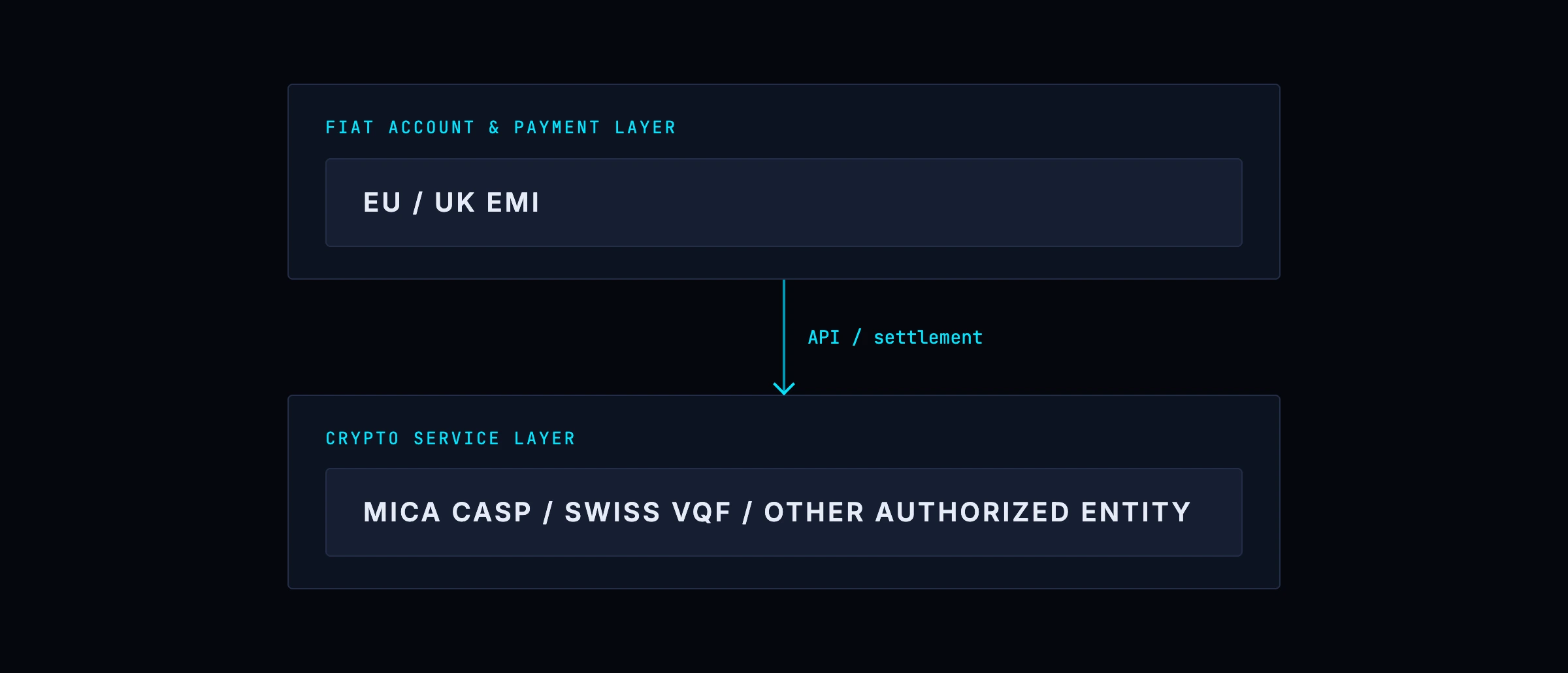
The exact legal arrangement depends on who contracts with the customer, who holds fiat, and who executes the crypto transaction.
When Switzerland Complements an EMI
A Swiss SRO can be strategically useful alongside an EMI when:
the group wants a Swiss crypto/FX operating entity;
Swiss banking or institutional counterparties are useful;
tokenization/RWA work is centered in Switzerland;
the EMI is focused on fiat accounts and payment rails;
different jurisdictions are routed to different group entities.
The Swiss entity should add a distinct capability rather than duplicate an EMI simply for marketing.
Related Swiss SRO Guides
Related reading: Swiss VQF vs MiCA, Swiss SRO IBAN and customer accounts, and Swiss SRO companies for sale.
Frequently Asked Questions
Is a Swiss SRO an EMI?
No.
Can VQF issue e-money?
VQF affiliation does not itself create EMI authorization.
Does an EMI automatically allow crypto exchange?
No. Crypto services require separate analysis and, in many jurisdictions, separate authorization.
Can an EMI provide customer IBANs?
EMIs commonly support payment-account and e-money products, but the exact IBAN issuance and banking infrastructure depends on the institution's permissions and partners.
Is a Swiss SRO useful if I already own an EMI?
Potentially, if Switzerland adds a crypto, FX, tokenization, banking, or group-structuring function not served by the EMI.
Regulatory References
Design the Regulatory Stack Around the Product
Start with the customer experience and flow of funds, then assign each activity to the correct regulated entity.
Contact Faisal Khan about Swiss SRO and EMI acquisition structures.