
This is one of the most important distinctions when evaluating Swiss VASP companies advertised with “banking” or “IBAN capability.”
Evaluating a Swiss company advertised with customer IBANs? Contact Faisal Khan and provide the bank/provider agreement, customer flow, and countries to be supported.
The Four Different Things Sellers Often Call an “IBAN”
1. The company's own corporate IBAN
The Swiss AG has an ordinary bank account in its own legal name. This is not a customer-account product.
2. A reference or collection IBAN
Customers send money to an account controlled by the company or its provider and are identified through payment references or reconciliation data.
3. A virtual IBAN
The provider assigns unique IBAN-like identifiers to customers or sub-accounts while settlement may occur through one or more master accounts.
4. A genuinely named customer account
The account infrastructure identifies the end customer by name at the banking/payment-provider level, subject to the provider's legal and operational design.
These products have different legal, banking, reconciliation, and insolvency characteristics.
For businesses specifically seeking end-customer naming, see our named account solutions.
Does VQF Issue IBANs?
No. VQF is an SRO. It does not issue bank accounts or IBANs.
A VQF-affiliated company may contract with a bank or payment institution that provides account infrastructure. The value resides in that contract and the regulatory architecture supporting it.
The due-diligence question is therefore:
Who is the regulated account provider, and what exactly has that provider contractually agreed to offer through the Swiss company?
Can the Swiss Company Hold Customer Fiat?
Possibly in certain transaction structures, but persistent customer balances can raise Swiss deposit-taking and FinTech licensing issues.
FINMA explains that accepting public deposits on a professional basis is generally a regulated banking activity unless an exemption or another regime applies. The FinTech license can allow eligible institutions to accept public deposits up to CHF 100 million or collectively hold cryptoassets, subject to conditions including no investment or interest payment on those deposits.
That means a product resembling a bank account or stored-value wallet must be analyzed beyond the SRO layer.
Customer Accounts Through a Banking Partner
A partner-based arrangement can look like:
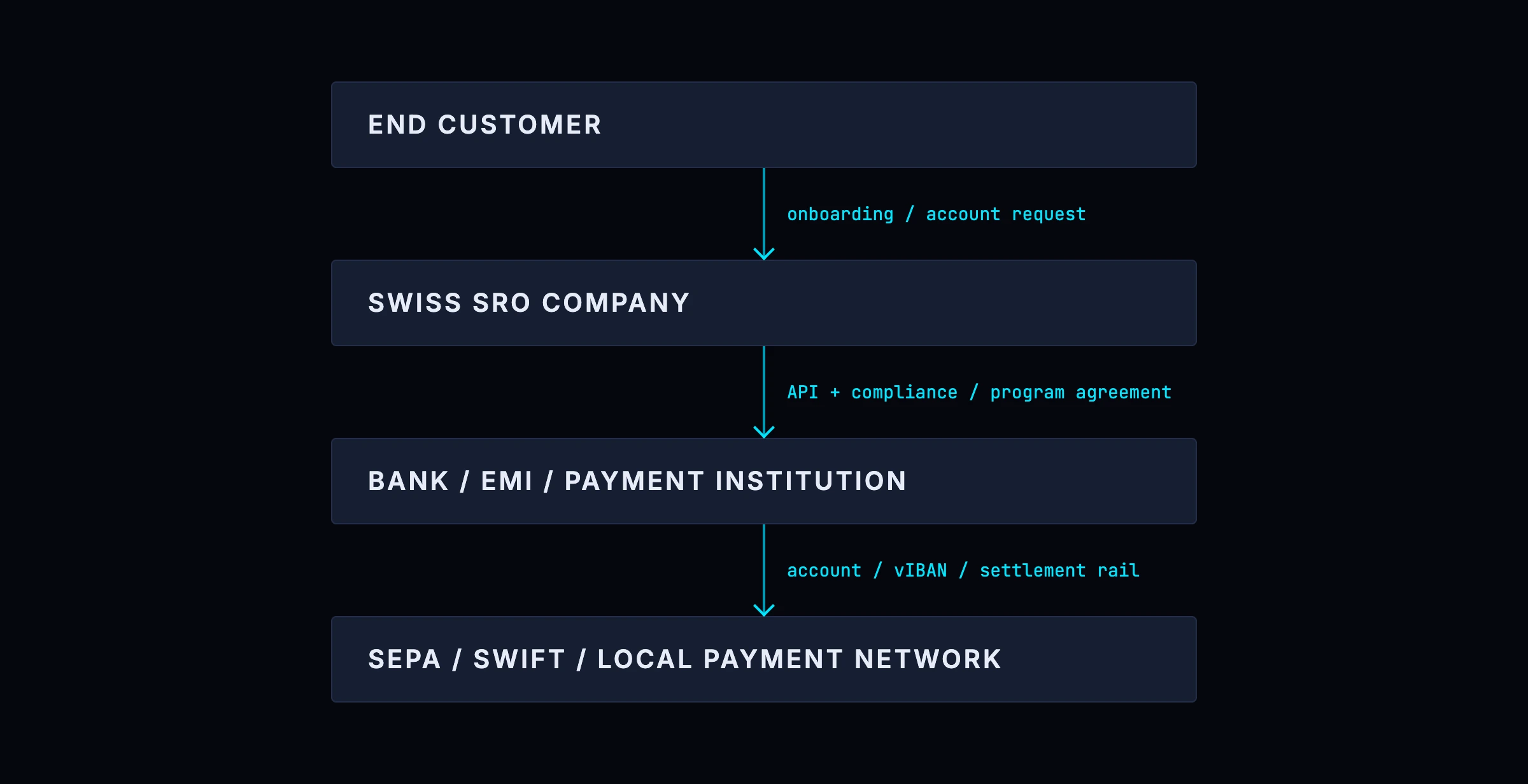
The Swiss company may provide the front-end, exchange, payment orchestration, or crypto service while the bank/payment institution provides the regulated account layer.
The precise allocation of KYC, safeguarding, transaction monitoring, liability, complaints, and customer disclosures must be documented.
What About FBO or Omnibus Accounts?
An omnibus or FBO-style account can allow one regulated or contracted entity to hold funds operationally for multiple underlying customers while maintaining a sub-ledger.
This can be useful for fintechs, but it creates several questions:
Who legally owns the account?
Are underlying customers recognized by the bank?
Is the account segregated from operating funds?
How are beneficial owners identified?
Who carries AML responsibility?
Are funds protected in insolvency?
Can the company commingle funds?
Can money remain there indefinitely?
Our FBO account overview explains the operational concept; the Swiss legal treatment must still be confirmed for the actual structure.
Can a Swiss SRO Company Offer Multi-Currency Accounts?
It can potentially distribute or integrate multi-currency account services provided by an appropriate partner. SRO membership itself does not manufacture the account permissions.
If the provider supports CHF, EUR, USD, GBP, or other currencies, the buyer should verify:
which currencies are production-live;
whether IBANs are local, virtual, or correspondent-based;
incoming and outgoing rail coverage;
customer eligibility;
business vs individual accounts;
restricted industries;
crypto compatibility;
settlement speed;
transaction limits;
FX pricing.
How to Verify an Advertised IBAN Program
Request:
executed master services/program agreement;
name and regulatory status of account provider;
product schedule;
countries permitted;
customer types permitted;
account/IBAN structure;
KYC responsibility matrix;
safeguarding/segregation description;
crypto acceptance language;
settlement currencies;
pricing;
reserves/minimum commitments;
API production credentials evidence;
current customer program status;
change-of-control clause;
termination rights;
bank/provider approval required for new UBOs;
whether the agreement can be assigned or remains with the target entity.
“Potential Swiss IBAN Infrastructure” Should Be Valued Conservatively
The word potential is not an asset.
A seller may have a relationship, integration discussion, sandbox account, term sheet, or reseller opportunity. None of those should be valued like a signed live program.
A buyer paying a premium for customer-account capability should make closing or part of the purchase price conditional on evidence that the program survives the acquisition.
Related Swiss SRO Guides
Related reading: Swiss SRO banking and PostFinance, Swiss SRO vs FinTech license, and Swiss SRO companies for sale.
Frequently Asked Questions
Does a VQF company automatically receive Swiss IBANs for clients?
No.
Does a PostFinance corporate account mean customer accounts are available?
No. It shows that the company itself has banking. Customer-account functionality is a separate product and agreement.
Can a Swiss SRO maintain fiat wallet balances?
The legal structure must be reviewed. Persistent repayable balances can trigger FinTech/banking-law analysis.
Can the customer have a named account?
Potentially through a provider that supports named or dedicated account structures. The provider contract—not the SRO membership—creates that capability.
Can IBANs be combined with crypto exchange?
Yes in properly structured models, but the bank/payment provider must permit the crypto activity and the division of regulated responsibilities must be clear.
Regulatory References
Verify the Account Product Before Buying
A customer-account program can be one of the most valuable components of a Swiss acquisition, but only when the legal and commercial rights actually exist.
Contact Faisal Khan to review Swiss SRO IBAN and account infrastructure.