
For a group building internationally, the question is usually not “Which one is better?” It is “Which customers, products, and flows should sit in each entity?”
Considering Switzerland and an EU MiCA structure? Contact Faisal Khan with your target markets and product set.
VQF vs MiCA: Side-by-Side Comparison
Issue | Swiss VQF/SRO | EU MiCA CASP |
|---|---|---|
Jurisdiction | Switzerland | European Union |
Core framework | AMLA/SRO supervision | MiCA crypto-asset regulation |
Supervisor | SRO supervises member for AMLA; FINMA supervises SRO | National competent authority under MiCA |
EU passport | No | Yes, subject to MiCA notification/passporting framework |
Switzerland passport | Swiss domestic structure | No automatic Swiss authorization |
Crypto services | Depends on Swiss model and other laws | Authorized MiCA service categories |
Prudential requirements | SRO is primarily AML supervision; other Swiss licenses may apply | MiCA capital/governance/organizational rules apply |
Client asset/custody rules | Swiss custody/banking analysis | MiCA custody and client-asset rules for authorized service |
Stablecoins | Swiss-specific analysis; SRO alone not blanket authority | ART/EMT regime under MiCA, separate from ordinary CASP authorization |
Securities/RWA | Swiss securities law separate | MiCA excludes many financial instruments; EU securities law may apply |
Cross-border EU retail growth | Not a passport | Core strength |
The Biggest Misconception: “Switzerland Is in Europe, So VQF Covers Europe”
Switzerland is geographically in Europe but is not an EU member state. VQF membership does not create MiCA authorization.
A Swiss company that actively markets crypto-asset services to EU clients cannot simply rely on Swiss SRO status as the legal basis for its European expansion.
If EU customers are central to the business plan, an EU licensing strategy should be developed separately.
MiCA Reverse Solicitation Is Narrow
Article 61 of MiCA contains an exception where an EU client initiates a crypto-asset service at the client's own exclusive initiative with a third-country firm.
The same article states that where the third-country firm—or a person acting on its behalf—solicits clients in the Union, the service is not treated as client-initiated merely because a contract says otherwise.
This has several practical consequences:
reverse solicitation is not an EU marketing strategy;
an EU-targeted website or advertising can undermine the argument;
affiliates and agents can matter;
the exception does not create a general passport;
firms should not build projected EU customer acquisition around it.
Where Swiss VQF Can Be Stronger
VQF may be attractive when the commercial objective is to establish a Swiss financial-intermediary operation with access to Swiss counterparties and a business model that fits the SRO perimeter.
Potential reasons include:
Swiss corporate presence;
Swiss banking relationships;
crypto/fiat exchange or money/value transfer;
OTC and institutional activity;
Swiss tokenization/RWA strategy;
non-EU global contracting;
regulatory diversification within a multinational group.
The value often comes from the package—entity, compliance, banking, technology and operating history—not merely the SRO affiliation.
Where MiCA Is Stronger
MiCA's key strategic advantage is EU crypto market access under a harmonized framework.
For a business expecting to actively market to customers in France, Germany, Italy, Spain, the Netherlands and other EU markets, MiCA authorization is the appropriate foundation for in-scope crypto-asset services.
The EU entity can become the group's contracting entity for EU crypto business, while Switzerland serves a different function.
What About Payments and IBANs?
Neither “VQF” nor “MiCA CASP” should automatically be equated with an EMI.
A crypto group may need separate payment/e-money infrastructure for:
customer EUR balances;
payment accounts;
virtual IBANs;
SEPA transfers;
safeguarding customer fiat;
issuing e-money.
That is why some groups pair MiCA authorization with an Electronic Money Institution structure or third-party banking/payment partners.
Similarly, a Swiss SRO company with a bank account does not thereby become a customer-account issuer.
Custody Comparison
Custody is regulated differently under the two frameworks.
Under MiCA, custody and administration of cryptoassets on behalf of clients is one of the crypto-asset services that can be authorized.
In Switzerland, the custody architecture can determine whether SRO affiliation is sufficient or whether FinTech/banking rules become relevant. Collective custody can be particularly important in the analysis.
A buyer comparing two acquisition targets should therefore review the exact custody architecture rather than compare labels.
Token Issuance and Stablecoins
MiCA and Switzerland also diverge on issuance.
MiCA has dedicated regimes for asset-referenced tokens and e-money tokens. A CASP authorization does not by itself authorize every stablecoin issuance model.
Switzerland analyzes tokens under its own financial-market laws. Payment, utility and asset-token characteristics can lead to different outcomes. FINMA also has specific stablecoin guidance.
The choice of jurisdiction should therefore reflect the intended token, reserve, redemption, target market, and distribution model.
Can a Group Hold Both?
Yes, and for a sufficiently large global business that can be the rational architecture.
Example:
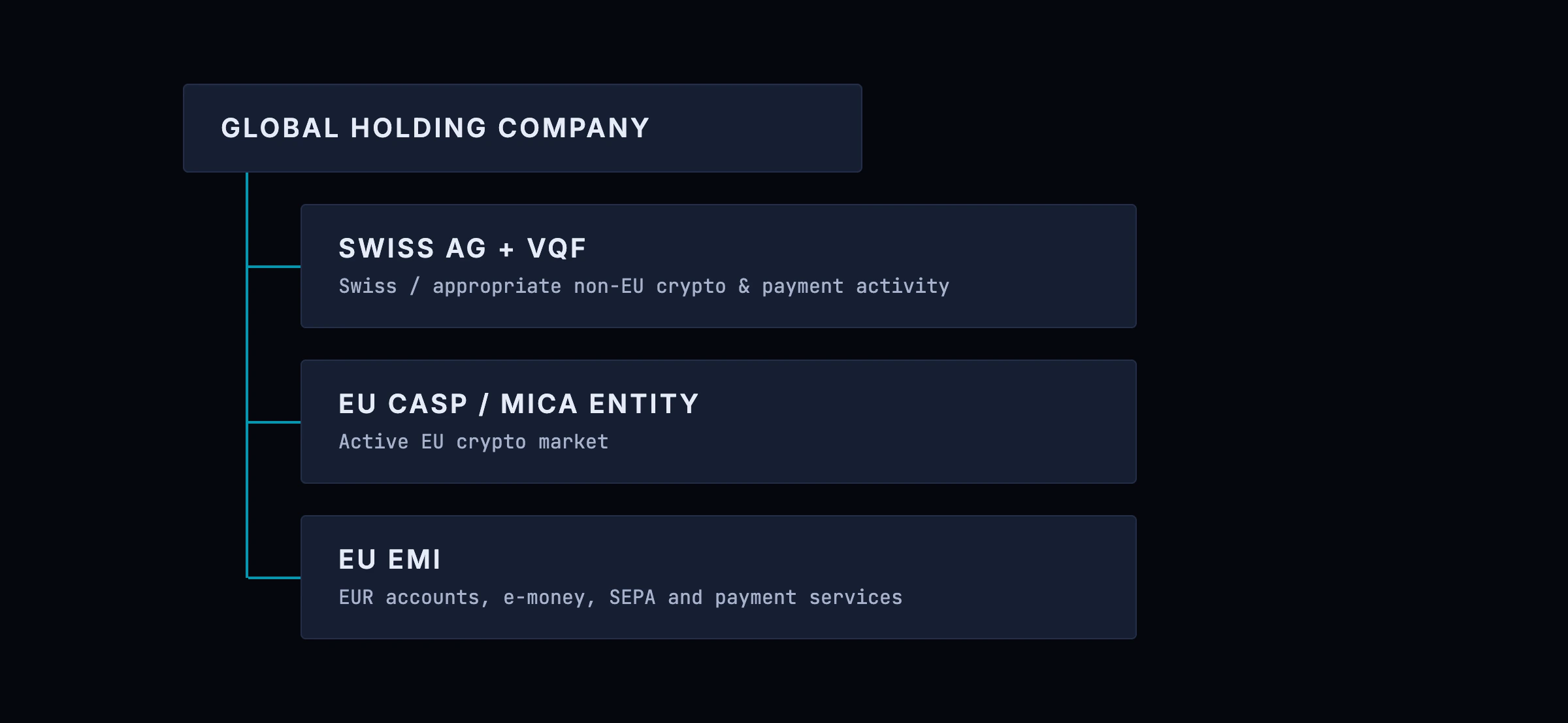
The important part is routing customers and funds to the entity whose permissions match the activity.
Which One Should Be Acquired First?
That depends on the commercial launch sequence.
If the immediate customer base is the EU and active crypto marketing is planned, MiCA has direct market-access relevance.
If the business already has global regulatory coverage but wants a Swiss operating hub, banking, tokenization capability, or jurisdictional diversification, VQF may be strategically useful.
A Swiss acquisition should not be justified by pretending it replaces MiCA.
Related Swiss SRO Guides
Related reading: Swiss SRO client countries, Swiss SRO vs UK and EU EMI, and Swiss SRO companies for sale.
Frequently Asked Questions
Does Swiss VQF passport into the EU?
No.
Can a MiCA company operate freely in Switzerland?
MiCA passporting is an EU framework. Swiss regulatory requirements must be analyzed separately.
Can a Swiss company use reverse solicitation for EU clients?
Article 61 provides a narrow client-initiated exception for third-country firms, but active solicitation defeats the premise. It should not be used as a substitute for an EU go-to-market authorization.
Does MiCA provide an EMI license?
No. Payment/e-money activities may require separate authorization or partner infrastructure.
Would a global crypto group ever need both?
Yes. They can serve different geographic, banking, product, and risk-management purposes.
Regulatory References
Structure Switzerland and the EU Correctly
The strongest architecture treats Switzerland and MiCA as complementary regulatory nodes rather than competing badges.
Contact Faisal Khan to discuss Swiss SRO and EU MiCA acquisition options.