
Considering a Swiss stablecoin structure or acquisition? Contact Faisal Khan with the proposed reserve, redemption, currency, customer countries, and banking model.
Why “Stablecoin License” Is an Oversimplification
A stablecoin can be structured in different ways:
fiat-backed token redeemable at par;
token supported by a bank guarantee;
token backed by short-term securities;
token backed by commodities;
overcollateralized crypto token;
algorithmic stabilization mechanism;
token representing a claim on an issuer or reserve vehicle.
These structures do not necessarily receive the same regulatory treatment.
FINMA's Stablecoin Focus
FINMA's 2024 guidance emphasizes the financial-market and AML risks of stablecoin issuance. It notes that Swiss issuers have used bank default guarantees in structures intended to avoid requiring a banking license, subject to FINMA's requirements for such guarantees.
This means the regulatory analysis can involve:
Banking Act;
AMLA;
deposit protection questions;
guarantee terms;
sanctions;
reserve management;
redemption rights.
Where VQF Can Fit
If the issuer or operating company performs financial-intermediary activities subject to AMLA, SRO affiliation may be relevant.
However, VQF membership alone does not answer whether the reserve structure constitutes public deposits or whether another FINMA authorization is required.
A stablecoin business may therefore combine:
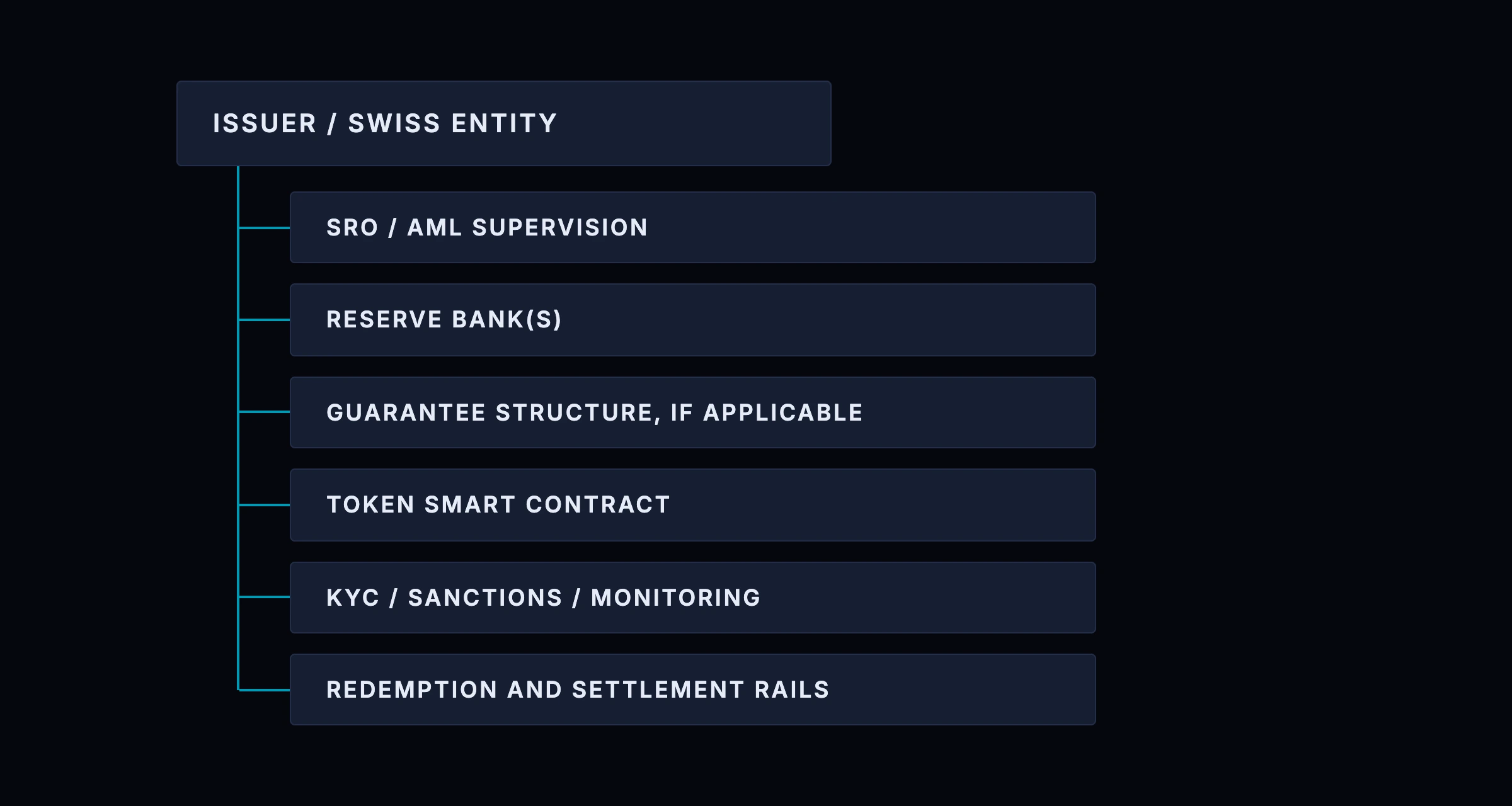
The entire architecture must be assessed together.
Reserve Structure
A fiat-backed stablecoin should have a clearly documented reserve policy.
Questions include:
Where are reserves held?
Who owns the reserve accounts?
Are reserves segregated?
Are they bankruptcy remote?
What assets can be held?
Is reserve value matched 1:1?
Who reconciles supply and reserves?
Is there independent attestation or audit?
Can reserves be invested?
Who earns reserve income?
A stablecoin with opaque reserves may face both regulatory and banking obstacles regardless of SRO status.
Redemption
Redemption design is central.
The legal documents should state:
who may redeem;
minimum redemption amount;
permitted countries;
KYC requirements;
fees;
timing;
whether redemption is at par;
circumstances allowing suspension;
treatment of frozen/sanctioned addresses;
what claim the holder has against the issuer.
These rights help determine the product's legal character.
AML and Sanctions
FINMA specifically highlights heightened money-laundering, terrorist-financing, sanctions-evasion, and reputational risks in stablecoin projects.
A Swiss stablecoin platform should plan for:
identity verification;
wallet screening;
transfer monitoring;
sanctions controls;
mint/redeem controls;
Travel Rule obligations where relevant;
self-hosted wallet policy;
high-risk jurisdiction controls;
freeze/burn functionality where legally and technically appropriate.
If the stablecoin is used for cross-border settlement, our stablecoin and crypto-fiat rails material explains the operational infrastructure that sits beside the issuance vehicle.
Stablecoin + IBAN / Payment Account
Some projects want a unified product:
customer IBAN;
fiat balance;
instant conversion to stablecoin;
stablecoin transfer;
redemption to bank money.
That is not one regulatory permission. The account layer can involve banks, EMIs, payment institutions, or FinTech authorization. The stablecoin layer has its own Swiss analysis.
For fiat connectivity, the fiat banking bridge should be mapped separately.
Switzerland's Proposed New Payment Instrument Regime
Switzerland is actively reforming this area.
The Federal Council's 2025 consultation proposed a new Payment Instrument Institution authorization intended to replace the existing FinTech license and provide a framework that includes certain payment instruments and stablecoin models. It also proposed a separate Crypto-Institution category.
The consultation ended on February 6, 2026. As of September 2026, these proposals should be treated as forthcoming legislative reform rather than current operating authorization.
A company purchased today for stablecoin issuance should therefore be assessed for regulatory migration risk.
Buying a Swiss SRO for Stablecoin Launch
An existing Swiss company can still be useful if it provides:
clean AG;
active SRO affiliation;
AML Officer;
established bank relationship;
stablecoin/payment-token business description;
KYC and blockchain analytics;
wallet infrastructure;
prior legal analysis;
platform/IP.
But do not pay a premium for “stablecoin enabled” without reviewing the issuer structure, bank agreement, reserve architecture, and FINMA analysis.
Stablecoin Due-Diligence Checklist
Request:
token legal opinion;
FINMA/SRO correspondence;
bank/reserve agreements;
default guarantee, if used;
token terms;
redemption agreement;
reserve policy;
attestation/audit reports;
smart-contract audit;
mint/burn controls;
sanctions/freezing controls;
historical supply and reserves;
customer countries;
marketing materials;
complaints/incidents;
accounting/tax treatment;
regulatory migration analysis.
Related Swiss SRO Guides
Related reading: Swiss token issuance and RWA, Swiss crypto regulation 2026, and Swiss SRO companies for sale.
Frequently Asked Questions
Does VQF provide a stablecoin license?
No. SRO affiliation can address AML supervision but does not itself resolve banking, reserve, guarantee, or other financial-market requirements.
Can reserves be held at a Swiss bank?
Potentially, subject to bank acceptance and the legal structure.
Can a Swiss stablecoin be offered in the EU?
EU distribution can trigger MiCA and other EU requirements. Swiss issuance does not create EU authorization.
Is a bank guarantee always required?
No universal rule says every stablecoin must use one. FINMA has addressed guaranteed structures, but the appropriate model depends on the stablecoin design.
Will the Swiss stablecoin rules change?
Switzerland has proposed new Payment Instrument Institution and Crypto-Institution regimes. Buyers should plan for possible migration once legislation is finalized and brought into force.
Regulatory References
Design Stablecoin, Banking and Regulation Together
A stablecoin is not simply a token smart contract. The reserve, redemption, AML, banking, jurisdiction, and customer-account layers determine whether the business is launchable.
Contact Faisal Khan to discuss a Swiss stablecoin/SRO structure.