
Planning token issuance or acquiring a Swiss tokenization company? Contact Faisal Khan with the token terms, underlying asset, distribution countries, and platform flow.
FINMA's Token Categories
FINMA's established framework distinguishes three main categories, with hybrid forms possible.
Payment tokens
These are cryptoassets intended to function as a means of payment or money/value transfer.
Payment-token issuance and related activities can trigger AML obligations.
Utility tokens
These provide digital access to an application or service. A genuinely functional utility token can be treated differently where its sole purpose is access and it is already usable as such when issued.
If a “utility” token also has an investment function, the securities analysis can change.
Asset tokens
These represent assets or economic claims such as participation in a company, debt, earnings streams, dividends, interest, or rights linked to physical assets.
FINMA treats asset tokens as securities in relevant circumstances.
What Is an RWA Token?
“Real-world asset” is a commercial label rather than a single legal category.
An RWA token might represent:
equity in a company;
a bond or loan claim;
revenue share;
real estate exposure;
gold or commodities;
fund interests;
invoices or receivables;
carbon credits;
intellectual-property revenue;
another contractual or property-linked claim.
The underlying legal right determines much of the regulatory treatment.
Where SRO Affiliation Fits
VQF/SRO status can be relevant where the Swiss entity is a financial intermediary handling payments, crypto transfers, exchange, or other AML-sensitive activity around the issuance.
It does not by itself establish that:
the token is not a security;
no prospectus is required;
the platform may operate a trading venue;
the product is not a collective investment scheme;
the token can be marketed worldwide;
custody is permitted under any structure.
For a broader crypto operating layer, the stablecoin and crypto-fiat rails may support settlement around tokenized assets without replacing the securities analysis.
Example RWA Structure
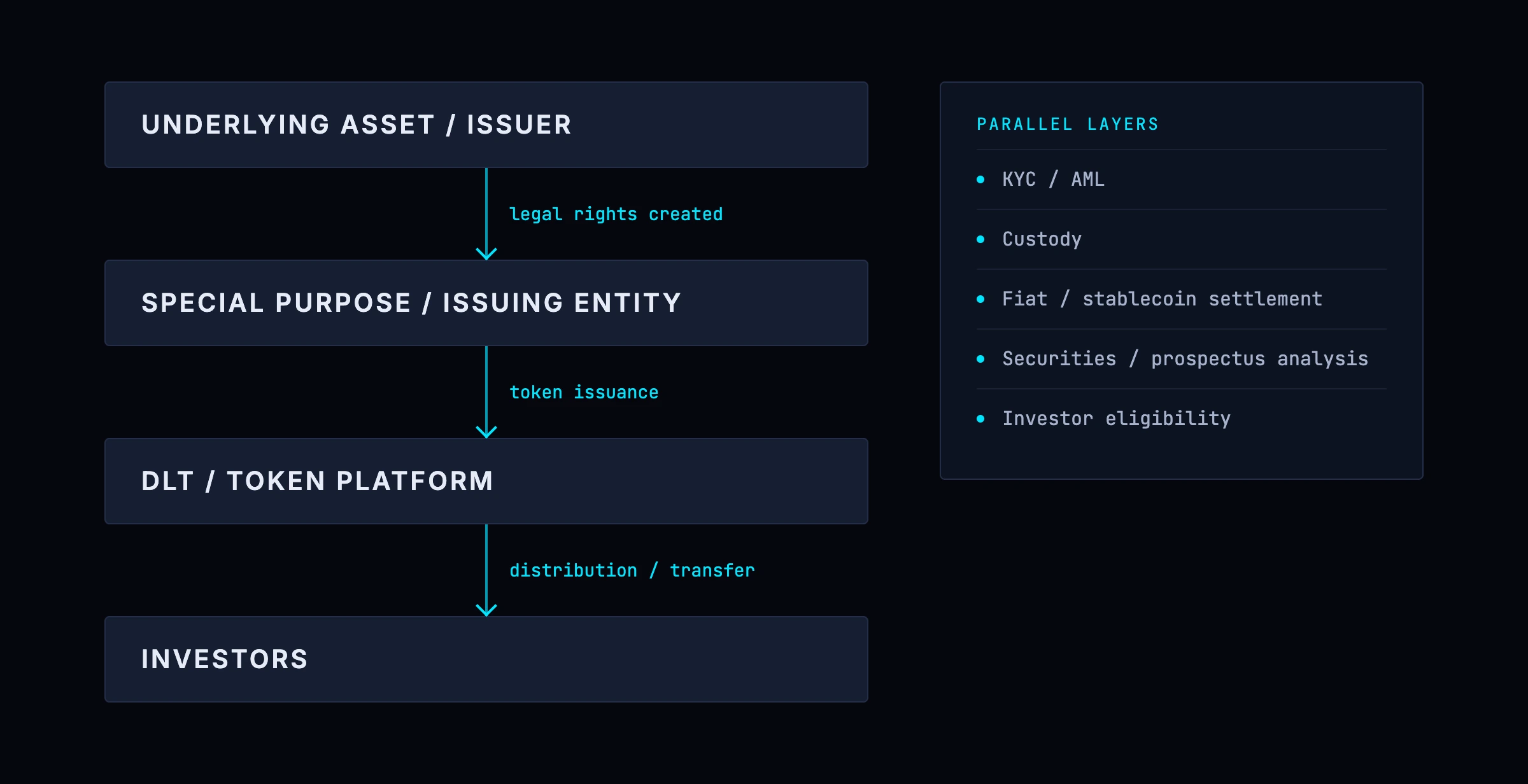
The legal documentation linking the token to the underlying asset is as important as the blockchain code.
DLT Securities and Trading Venues
Switzerland's DLT legislation provides legal infrastructure for ledger-based securities and DLT trading systems. This is a significant advantage for sophisticated tokenization models.
However, operating a venue where multiple parties trade DLT securities can require separate FINMA authorization as a DLT trading facility or another financial-market infrastructure.
An SRO-affiliated exchange company should not expand into multilateral securities trading simply because it already trades payment tokens.
Token Issuance Due Diligence
For an acquisition advertised as including “token issuance,” request:
token legal memorandum;
token terms and conditions;
white paper/prospectus;
FINMA correspondence or regulatory assessment;
smart-contract audit;
token contract addresses;
issuer entity;
holder rights;
reserve or underlying-asset evidence;
distribution countries;
investor restrictions;
KYC/AML process;
secondary-market arrangements;
custody setup;
redemption process;
historical issuance and holders;
complaints or disputes;
tax/accounting treatment.
A token project with clean legal analysis and production infrastructure can be materially more valuable than a shell merely authorized for a broad corporate purpose.
Distribution Outside Switzerland
A Swiss token can still trigger foreign law where investors are located.
For example:
EU financial-instrument or MiCA rules may apply depending on token classification;
U.S. securities law can apply to offers involving U.S. persons;
UK financial-promotion and securities rules can apply;
local private-placement or prospectus requirements can apply elsewhere.
Swiss issuance is not a passport for global distribution.
Banking and Settlement
Tokenization projects need a settlement layer. Depending on design, investors may subscribe using:
CHF;
EUR;
USD;
stablecoins;
other cryptoassets.
The banking infrastructure must be comfortable with the investor type, source of funds, token product, and redemption flows.
For fiat settlement, global banking infrastructure can be as critical as the blockchain infrastructure.
When a Swiss Acquisition Can Be Attractive
A Swiss SRO/tokenization company can have strategic value if it includes:
existing Swiss legal entity;
SRO standing;
accepted tokenization business description;
bank account;
AML Officer;
KYC/KYB stack;
wallet/custody tools;
smart-contract platform;
legal templates;
prior regulatory analysis;
clean token issuance history.
But the buyer must confirm that the new RWA product is sufficiently similar to the prior model or obtain fresh analysis.
Related Swiss SRO Guides
Related reading: Swiss stablecoin issuance, Swiss crypto regulation 2026, and Swiss SRO companies for sale.
Frequently Asked Questions
Does VQF authorize security-token issuance?
VQF membership addresses AML supervision for relevant financial intermediary activity. Security/asset-token treatment is governed by additional Swiss laws and must be analyzed separately.
Can Switzerland tokenize real estate?
Potentially, yes, but the legal structure must define what the token actually represents and comply with securities, property, corporate, investment, and offering rules as applicable.
Are all RWA tokens securities?
No blanket answer. Many RWA structures create investment or securities characteristics, but classification depends on the legal and economic rights.
Can a Swiss SRO operate an RWA exchange?
Not merely because it is an SRO member. Operating a trading venue for securities or DLT securities can require separate FINMA authorization.
Regulatory References
Build the Legal Right Before Marketing the Token
RWA tokenization is strongest when the legal claim, custody, settlement, distribution, and blockchain layers are designed together.
Contact Faisal Khan about Swiss tokenization and SRO acquisition opportunities.