
Bring Banking, Treasury and Payment Connectivity Into One Operating Stack
Cross-border payment businesses often outgrow the infrastructure they started with. The constraint is usually not customer demand; it is the number of banking, treasury, settlement and payout relationships required to support that demand.
As corridors and products expand, institutions can find themselves managing separate relationships for accounts, collections, foreign exchange, domestic and international transfers, card programs, virtual accounts, digital-asset settlement and compliance technology. Each relationship adds its own onboarding, API work, operational procedures, reporting and reconciliation burden.
We help qualified clients assemble these capabilities through specialist banking and payment infrastructure providers in our network, with the objective of creating a more coherent operating architecture rather than a patchwork of disconnected vendors.
Depending on your business model, jurisdiction, licensing position and transaction profile, the infrastructure can support:
- Accounts and balances in multiple supported currencies
- Named and virtual accounts
- ACH, Fedwire and SWIFT
- SEPA and local payment rails
- Cross-border disbursement capabilities
- Foreign exchange
- Card issuing and card-related capabilities
- Stablecoin collection and settlement
- Treasury management
- API-based payment orchestration
- Embedded or branded customer interfaces
- Compliance, screening and transaction monitoring integrations
Important: Infrastructure availability is subject to compliance approval, jurisdiction, licensing, business model, transaction profile and the underlying banking or regulated service provider.
Where the Friction Appears
Growth Creates Infrastructure Complexity
A financial institution can have a strong product, good customers and significant transaction volume while still being constrained by fragmented banking infrastructure.
Provider Fragmentation
Expanding into additional markets can require separate:
- Banking relationships
- Payment providers
- FX counterparties
- Payout partners
- Contracts
- APIs
- SLAs
- Reconciliation processes
The cumulative effect is slower implementation, more operational handoffs and a larger control surface for the internal team.
Repeated Due Diligence
Every counterparty may ask for a different version of the same underlying compliance package, including:
- KYB requirements
- AML questionnaires
- Transaction monitoring expectations
- Flow-of-funds reviews
- Source-of-funds requirements
- Periodic compliance reviews
As the provider count increases, the same compliance team can spend disproportionate time maintaining third-party relationships instead of managing the underlying risk program.
Liquidity Spread Across the Network
Working balances can end up dispersed among banks, settlement accounts, wallets and payout partners.
This can create:
- Excess prefunding
- Idle balances
- Liquidity fragmentation
- Delayed settlement
- Additional treasury overhead
Operational Breaks and Reconciliation
Exceptions, returns and delayed transfers often have to be traced across more than one system. Once volumes increase, the cost is not just bookkeeping; it becomes a daily operations and controls issue.
A More Coherent Architecture
Connect the Required Capabilities Through a Coordinated Infrastructure Stack
Rather than sourcing every account, rail and settlement relationship independently, an approved institution may be able to connect several required capabilities through a coordinated provider stack.
A typical configuration can look like this:
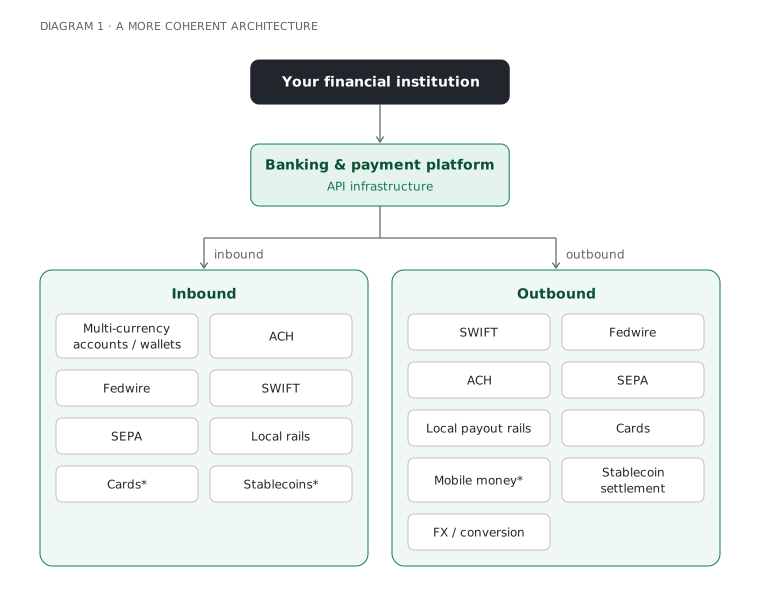
* Availability varies by program, country, use case and approval.
Inbound Payment Capabilities
Depending on the approved program, infrastructure may include the ability to receive funds through several mechanisms.
| Capability | Typical Use |
|---|---|
| Multi-Currency Accounts | Receive and hold USD, EUR, GBP and other supported currencies |
| Named Accounts | Receive funds into an account displaying the business or approved customer name |
| Virtual Accounts | Assign unique account identifiers for customer-level reconciliation |
| ACH | Receive U.S. domestic bank transfers |
| Fedwire | Receive U.S. wire payments |
| SWIFT | Receive international bank wires |
| SEPA | Receive qualifying euro payments |
| Local Payment Rails | Receive domestic payments in supported jurisdictions |
| Cards | Card acceptance capabilities where available |
| Stablecoins | Receive supported digital assets and settle into fiat, where permitted |
Outbound Payment Capabilities
The same infrastructure can potentially be used for disbursement and settlement.
| Capability | Typical Use |
|---|---|
| SWIFT Payments | International bank-to-bank payments |
| Fedwire | U.S. domestic wire transfers |
| ACH | U.S. domestic electronic payments |
| SEPA | Euro-denominated payments |
| Local Payouts | Domestic bank or alternative payout rails in supported markets |
| Cards | Business or end-user spending programs, subject to approval |
| Mobile Money | Payouts into supported mobile-money networks |
| Stablecoin Settlement | 24/7 digital-asset settlement where supported |
| FX Conversion | Convert between supported currencies before settlement |
Treasury and Multi-Currency Operations
For an international payments business, the account itself is only one component of the operating model.
The treasury layer may allow an approved customer to:
- Hold balances in multiple currencies
- Convert currencies
- Move funds between supported accounts
- Receive customer payments
- Send supplier or beneficiary payments
- Manage liquidity centrally
- Create payment workflows using APIs
- Reconcile incoming funds using virtual account structures
The objective is to centralize more of the treasury workflow and reduce unnecessary operational movement between separate systems.
Embedded and White-Label Delivery
Present Approved Financial Capabilities Inside Your Own Customer Experience
For eligible programs, customer-facing functionality can potentially be embedded into a branded portal or application.
Your users may interact with your brand and interface while regulated banking, payment or treasury services remain with the approved underlying provider.
Potential modules may include:
- Dashboard
- Accounts and wallets
- Named or virtual accounts
- Cards
- Payments
- Beneficiary management
- Approvals
- Transaction history
- FX
- API connectivity
- Reconciliation
- User and permission management
Example Structure
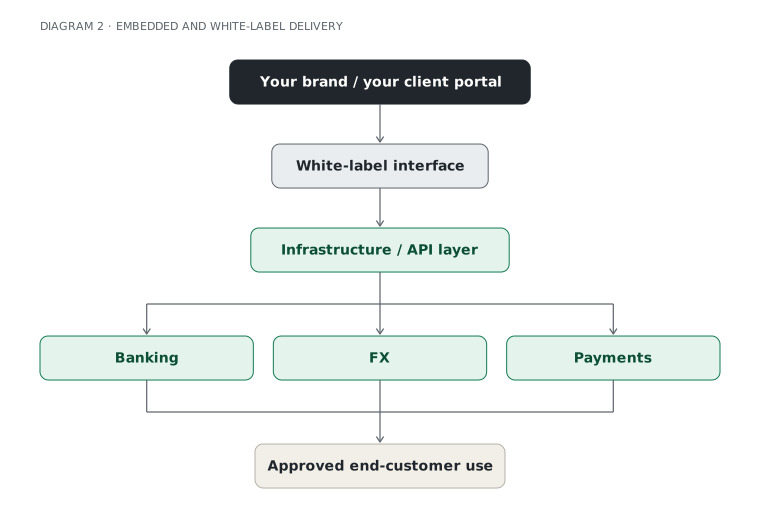
The precise commercial and regulatory structure depends on whether your company acts as the regulated entity, program manager, distributor, agent, authorized delegate, technology provider or another approved participant.
Compliance and Regulatory Infrastructure
Payments infrastructure must be designed around the regulatory model rather than added after the fact.
Depending on the program, the underlying solution may integrate or support:
- AML controls
- KYC and KYB
- UBO verification
- OFAC and sanctions screening
- PEP screening
- Transaction monitoring
- Adverse media screening
- Case management
- Payment monitoring
- Customer risk scoring
- Compliance audit trails
Third-party compliance platforms may also be integrated into the infrastructure stack.
Licensing Still Matters
Access to infrastructure does not eliminate licensing requirements.
The appropriate structure depends on:
- Where your company is incorporated
- Where your customers are located
- Where funds originate
- Where funds are delivered
- Whether you control customer funds
- Whether you transmit money
- Whether you provide stored value
- Whether you perform FX
- Whether you onboard consumers, businesses or both
- Whether you operate under your own license or another regulated entity
Where required, we can separately assess licensing, sponsorship, authorized delegate, agency or regulated-entity acquisition options.
Where the regulated entity is Swiss, banking for Swiss SRO and VASP companies covers what a corporate account there actually permits and what a change of ownership does to it.
Suitable Business Profiles
Remittance and Cross-Border Transfer Businesses
Useful for businesses that need to manage:
- Customer collections
- FX conversion
- Settlement
- Cross-border disbursement
- Local payouts
- Treasury
- Reconciliation
MSBs and Money Transmitters
Suitable for appropriately licensed or sponsored businesses that need access to additional banking or payout infrastructure.
Payment Service Providers and PayFac Platforms
Useful for payment companies seeking to reduce the number of separate banking, FX, payout and settlement integrations.
Foreign Exchange and Treasury Firms
Can support firms that need to:
- Hold multiple currencies
- Convert funds
- Receive client money
- Settle counterparties
- Move funds internationally
Fintech Platforms and Regulated Financial Businesses
Useful where the business already has a regulated or compliant operating model but lacks the necessary banking infrastructure.
Investment, Treasury and Capital-Movement Businesses
Potentially useful for approved businesses that need to move capital internationally while maintaining stronger visibility and treasury control.
Payroll, Contractor and Workforce Payment Platforms
Can support centralized funding and cross-border payouts into approved beneficiary markets.
Example Use Cases
1. U.S. MSB Requiring International Payouts
A U.S. money services business collects customer funds domestically and needs access to international payout corridors.
The infrastructure provider may supply:
- Settlement accounts
- FX
- SWIFT
- Local payout connectivity
- Reconciliation
- API access
2. International PSP Requiring USD Collection
A non-U.S. payment company needs the ability to receive USD from approved business customers.
Subject to eligibility, it may be possible to provide:
- USD collection accounts
- Named or virtual account structures
- ACH
- Fedwire
- SWIFT
- FX and onward settlement
3. Remittance Company With Multiple Corridors
A remittance company currently maintains separate payout providers across several countries.
A consolidated infrastructure layer can potentially reduce the number of direct integrations while centralizing treasury and reconciliation.
4. Fintech Requiring White-Label Accounts
A fintech wants to give approved business customers access to accounts, wallets, payments and cards through its own interface.
A white-label infrastructure model may be considered, subject to the fintech's regulatory and program structure.
5. Stablecoin-to-Fiat Settlement
An approved financial institution receives or uses supported stablecoins and requires conversion into fiat for banking or payout purposes.
The infrastructure may connect stablecoin settlement with traditional payment rails, subject to jurisdiction and compliance approval.
Why Use Us
We are not attempting to replace banks, regulated payment institutions or infrastructure providers.
Our role is to identify the appropriate structure and introduce qualified clients to solution providers capable of supporting the required flow of funds.
That means we begin with the transaction model.
We look at:
- Originating countries
- Destination countries
- Customer type
- Licensing status
- Monthly transaction volume
- Average transaction size
- Payment purpose
- Collection rails
- Settlement method
- Beneficiary type
- FX requirements
- Banking requirements
- Compliance responsibilities
- Technical requirements
From there, we determine which infrastructure model is commercially and operationally realistic.
What We Need From You
Before we approach a provider, we want the transaction model: who pays, who receives, where the funds travel, which entity controls them, and which regulated activities happen along the way. Around that we need your licensing position, corridors, currencies, rails, volumes and ticket sizes, and the account structures the flow depends on.
There is nothing to prepare in advance. The assessment form asks for it a section at a time, it takes about ten minutes, and you can leave anything you do not yet know.
If you already have a flow-of-funds diagram, attach it. If you do not, describe the transaction in plain English and we can convert it into one.
Typical Infrastructure Architecture
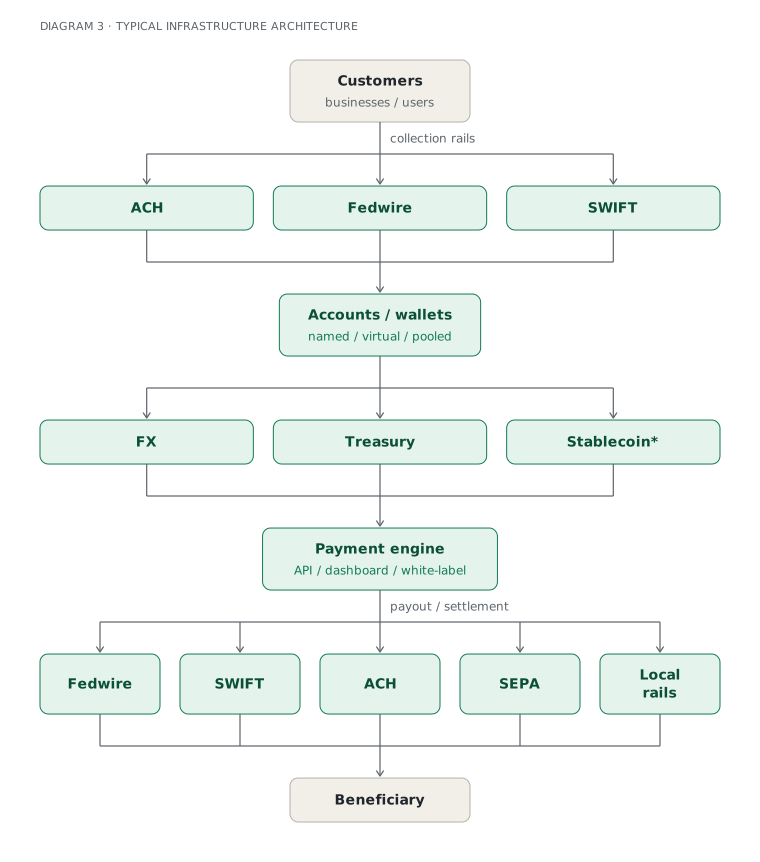
* Where permitted and supported.
The Intended Outcome
The objective is to simplify the operating model: fewer disconnected relationships between collection, account holding, conversion, settlement, payout and reconciliation.
For a suitable financial institution, that can translate into a more manageable treasury and payments architecture.
It does not remove compliance or regulatory obligations.
It can, however, make the infrastructure supporting those obligations considerably easier to operate.
Geographic and Currency Coverage
Coverage depends on the specific program.
Infrastructure partners may support:
- Major global currencies
- USD, EUR and GBP payment rails
- SWIFT connectivity
- U.S. ACH and Fedwire
- European SEPA
- Local payout networks
- Selected emerging-market currencies
- Cross-border settlement across multiple regions
Not every currency, country or payment rail is available to every customer.
We confirm coverage after reviewing the proposed flow of funds.
Our Role
Faisal Khan works with banking and payment infrastructure providers as part of a broader solution-provider network.
Where appropriate, we may introduce your company to a third-party provider capable of supplying some or all of the infrastructure described on this page.
The regulated service, banking relationship, account, payment service, FX service, card program or other financial product is provided by the relevant approved provider — not by Faisal Khan LLC unless specifically stated otherwise in writing.
Our role may include:
- Initial transaction assessment
- Structuring the flow of funds
- Identifying suitable providers
- Coordinating introductions
- Helping prepare the onboarding package
- Commercial coordination
- Supporting the implementation process
Frequently Asked Questions
Can you provide one account that does everything?
Usually, no.
What can often be provided is a consolidated infrastructure layer that connects several banking and payment capabilities behind one commercial or technical relationship.
The actual structure depends on the business model and jurisdiction.
Can an unlicensed company use this?
Possibly for certain non-regulated use cases, but not where the activity itself requires licensing.
If your business is transmitting money, holding customer funds, providing payment services or performing another regulated activity, the licensing structure must be assessed first.
Can this work for an MSB?
Yes, subject to the MSB's licensing, compliance program, transaction profile and provider approval.
Do you support named accounts?
Named and virtual account structures may be available for approved programs.
Do you support FBO or pooled accounts?
Potentially. FBO and pooled-account structures require materially more compliance and banking review than ordinary operating accounts.
Can customers get individual virtual accounts?
Potentially, depending on the program and customer type.
Can the platform be white-labeled?
White-label or embedded treasury capabilities may be available for suitable financial institutions and fintech programs.
Is API access available?
Yes, API connectivity may be available for collections, payments, treasury, account management and reconciliation.
Can stablecoins be included?
Potentially, where the jurisdiction, provider and customer profile permit it.
Stablecoin activity is assessed separately from ordinary fiat payment flows.
Which countries are supported?
Coverage varies. Send us your originating countries, destination countries and currencies and we can assess the relevant program.
Global Banking Infrastructure: Detailed Guides
Each page below covers one part of the stack in detail — a set of accounts, a family of rails, a settlement model or a delivery model. The assessment form is listed alongside them.
- API Payment Infrastructure for Fintechs
- Banking Infrastructure for MSBs and Money Transmitters
- Banking and Payment Infrastructure for PSPs and PayFacs
- Global Payment Rails for Financial Institutions
- Multi-Currency Accounts for Financial Institutions
- Named and Virtual Accounts for Financial Institutions
- Payment Infrastructure for Remittance Companies
- Request an Assessment
- Stablecoin-to-Fiat Settlement Infrastructure
- Treasury Infrastructure for Fintechs and Financial Institutions
- White-Label Banking and Treasury Infrastructure
Related Solutions
Infrastructure sits on top of a regulatory position. These pages cover the account structures and licensing routes the architecture above depends on.
- MSB Bank Account
- Named Accounts
- FBO Accounts
- Money Transmitter License Coverage
- Authorized Delegate Solutions
- FinCEN Registration
- Foreign MSB Registration
Start With Your Transaction Model
When evaluating banking or payment infrastructure, the useful starting point is not a bank name. It is the transaction model: who pays, who receives, where funds travel, which entity controls them and which regulated activities are performed along the way.
Send us that, with your licensing position, corridors, currencies, rails and volumes, and we can then determine which structure is worth pursuing.