
Comparing a Swiss SRO with a Canadian MSB acquisition? Contact Faisal Khan with your customer countries and required activities.
Swiss VQF vs Canada MSB: Core Comparison
Issue | Swiss AG + VQF | Canadian MSB / FMSB |
|---|---|---|
Core regime | Swiss AMLA + SRO supervision | FINTRAC registration under Canadian AML law |
Main supervisor | VQF or another recognized SRO | FINTRAC |
Typical activities | Payments, FX, money/value transfer, crypto/VASP depending on model | FX, remittance, money transfer, virtual currency and other covered MSB services |
Domestic market | Switzerland | Canada |
Foreign-customer reach | Country-by-country | Country-by-country |
Banking license | No | No |
EMI/e-money license | No | No |
EU MiCA passport | No | No |
Client-account authority | Not inherent | Not inherent |
Regulatory character | Active SRO affiliation and supervision | Registration; FINTRAC expressly says registration is not an endorsement/license |
What a Swiss VQF Company Adds
A Swiss VQF acquisition can add:
Swiss corporate presence;
SRO-supervised AML framework;
established Swiss operating history;
Swiss banking relationships where included;
crypto/FX/payment intermediation capability subject to model;
access to the Swiss digital-asset ecosystem;
tokenization/RWA optionality;
group regulatory diversification.
The regulatory status is only one part of the acquisition value. Banking and infrastructure can be especially important.
What a Canadian MSB Adds
A Canadian MSB structure can be directly relevant where the business operates in Canada or directs covered MSB services to Canadian clients.
FINTRAC's covered MSB activities include foreign exchange, remitting/transmitting funds, and dealing in virtual currencies. Foreign entities without a Canadian place of business can fall within the FMSB regime when they direct and provide covered services to clients in Canada.
For buyers actively pursuing Canada, the Canada MSB guide explains the domestic and foreign registration framework.
Is Canada “Easier” Than Switzerland?
This is the wrong comparison if the objective is market access.
The better question is:
Where are the customers and what will the entity actually do?
A relatively inexpensive Canadian registration does not create Swiss permissions. An established Swiss company does not provide Canadian market authorization when the Canadian regime applies.
The jurisdictions can therefore be complementary.
Crypto Business Models
Both jurisdictions can be relevant to virtual-currency businesses, but buyers should avoid assuming that either status authorizes every crypto service.
Areas that require separate analysis include:
custody;
lending;
derivatives;
securities/tokenized assets;
stablecoins;
customer fiat balances;
card programs;
investment products;
customer accounts.
In Switzerland, the distinction between individually attributable custody and collective custody can affect whether a FinTech license is required. In Canada, securities and provincial requirements can arise separately from FINTRAC MSB registration.
Banking
Neither status guarantees banking.
A Swiss acquisition may sometimes include PostFinance, Relio, or another bank relationship. A Canadian MSB may have an operating bank account or payment institution relationship.
In both cases, the buyer should verify:
bank knowledge of the regulated activity;
permitted customer countries;
crypto acceptance;
transaction limits;
client-money treatment;
settlement currencies;
change-of-control terms;
whether the bank will re-underwrite the buyer.
The difference between a regulatory entity and its global banking infrastructure should be made explicit during valuation.
Acquisition Economics
Canadian MSB companies can often be acquired or established at materially lower headline cost than Swiss VQF companies. But comparing only purchase price can be misleading.
Swiss asking prices can include:
paid share capital;
existing bank account;
local personnel;
AML Officer;
audit history;
platform or wallet technology;
vendor integrations.
Canadian MSB inventory can also vary substantially depending on age, province, RPAA status, banking, transaction history, and infrastructure.
A buyer should price the actual asset package.
Can One Group Use Both?
Yes.
A multinational structure might use:
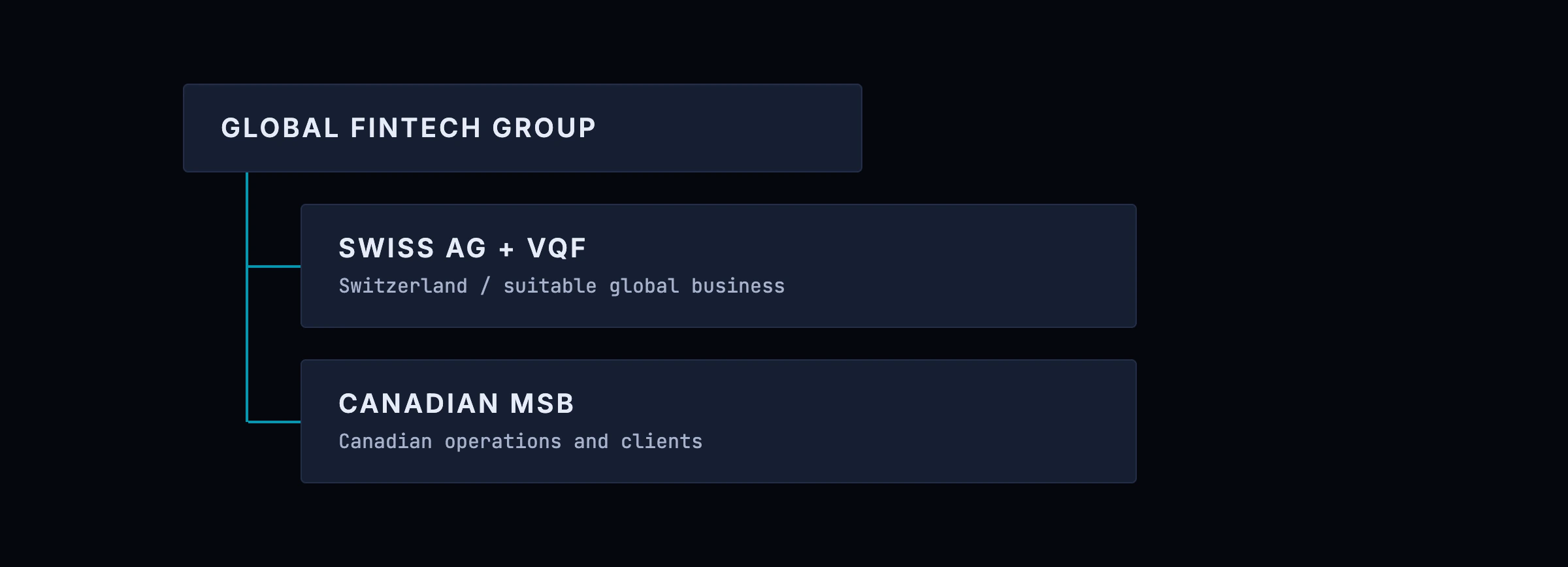
If the group is buying rather than applying, Canada MSB companies for sale can be evaluated alongside Swiss targets.
Which Structure Fits Which Objective?
Choose Canada when the primary objective is:
Canadian customers;
Canadian virtual-currency dealing;
Canadian remittance/FX activity;
building Canadian regulatory footprint.
Consider Switzerland when the objective is:
Swiss operating presence;
a Swiss SRO-supervised VASP/payment intermediary;
Swiss banking relationships;
digital-asset/tokenization infrastructure;
an additional non-EU global regulatory node.
Consider both when:
the company has global ambitions;
customer routing can be separated by jurisdiction;
Canada is commercially important;
Switzerland adds infrastructure or strategic value beyond “another registration.”
Related Swiss SRO Guides
Related reading: Swiss SRO client countries and Swiss SRO companies for sale.
Frequently Asked Questions
Is a Canadian MSB a prudential financial license?
FINTRAC registration is an AML registration and FINTRAC specifically warns that registration is not an endorsement or licensing of the business. Separate provincial or activity-specific rules can also apply.
Is VQF “stronger” than FINTRAC?
They are different frameworks and should not be ranked as substitutes. The relevant issue is which jurisdiction and activity the company needs.
Can a Swiss SRO serve Canadians without FINTRAC?
If the foreign business directs and provides covered MSB services to clients in Canada, FMSB registration can apply.
Can a Canadian MSB serve Switzerland?
Canadian registration does not replace Swiss regulatory requirements.
Regulatory References
Build a Multi-Jurisdiction Structure
The best acquisition is the one that matches the customer map and flow of funds, not the one with the most impressive jurisdiction name.
Contact Faisal Khan to compare Swiss SRO and Canadian MSB opportunities.