
You tap “send” once. Behind that one action, banks, payment companies, compliance systems, FX providers, messaging networks, correspondent banks, and local payout rails may all have a role before the recipient sees the money.
Explainer · Infographic #1 of 52 · Updated September 28, 2026
The infographic below is built around a simple question:
When you send $100 internationally, who actually touches the payment?
The answer is not simply, “one company sends it to another country.”
A cross-border payment is usually a coordinated chain of instructions, controls, accounts, liquidity, and ledger entries.
The core idea: A cross-border payment is closer to a synchronized accounting process than a parcel being shipped overseas.
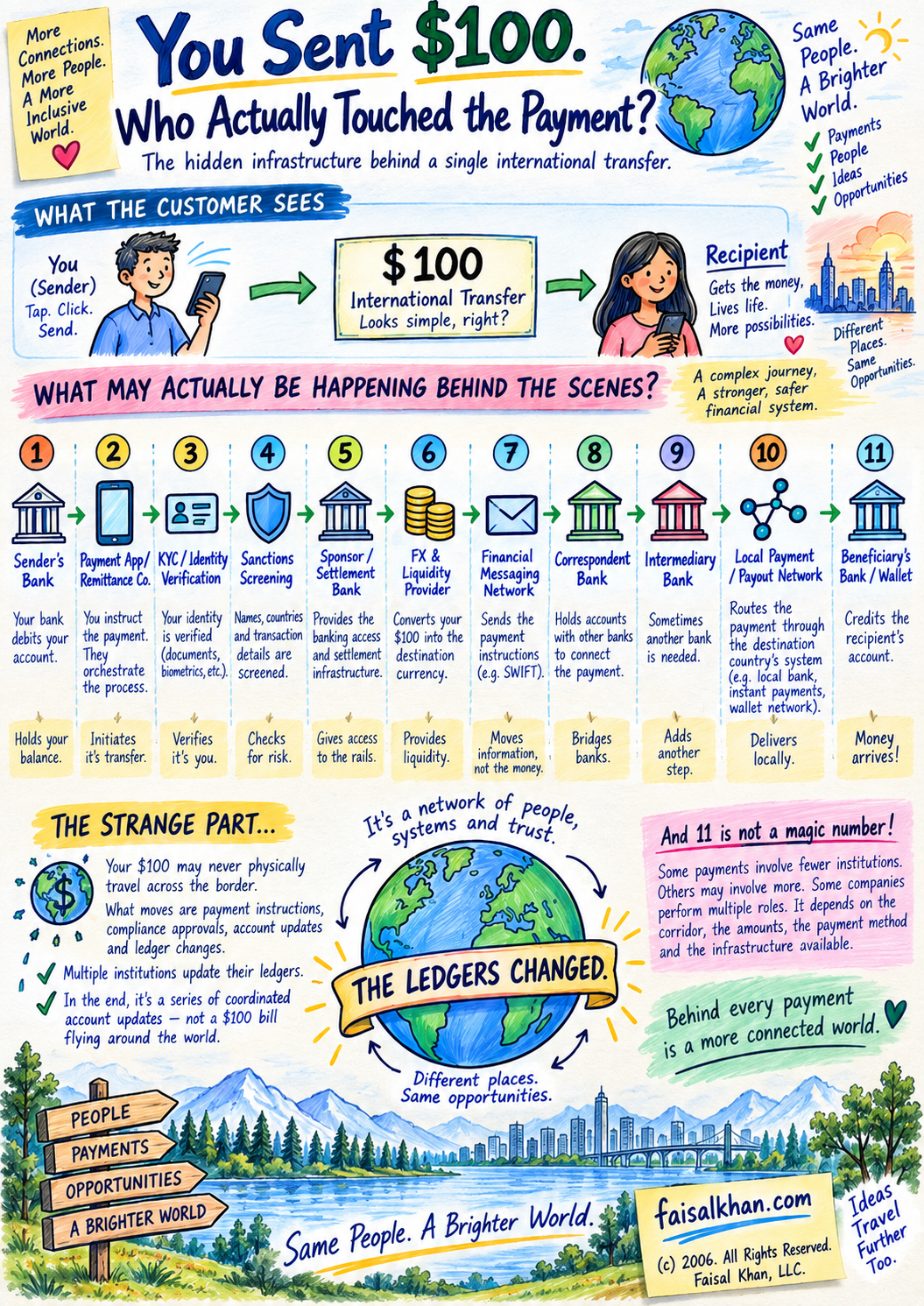
What the Customer Sees
From the customer's perspective, the transaction is almost absurdly simple:
You → $100 international transfer → Recipient
You open an app or banking interface.
You enter an amount.
You choose a recipient.
You press Send.
Eventually, the recipient sees money in an account or wallet.
The product has done its job if virtually everything between those two moments is invisible.
But the simplicity of the interface hides the complexity of the financial infrastructure underneath it.
What May Actually Be Happening Behind the Scenes
A cross-border payment can involve several distinct functional layers.
Some participants handle customer funds.
Some provide banking infrastructure.
Some supply foreign exchange or liquidity.
Some transmit payment instructions.
Others perform identity verification, sanctions screening, fraud controls, or transaction monitoring.
That distinction matters.
“Touches the payment” does not mean that every participant takes possession of the customer's $100.
Some participants may only see information. Others make risk decisions. Others maintain accounts or provide settlement infrastructure.
The payment is therefore better understood as a coordinated system than as a chain in which the same $100 is repeatedly handed from one company to another.
The 11 Touchpoints in the Infographic
The sequence is deliberately simplified so the underlying roles can be understood without requiring a banking operations manual.
A real transaction may contain fewer participants, more participants, or combine several of these functions inside one institution.
1. Sender's Bank
The process begins with the sender's account or funding source.
The bank may debit the customer's balance, authorize the transfer, or release funds into the payment flow.
This is where the customer's visible money usually begins.
2. Payment App or Remittance Company
This is usually the customer-facing orchestrator.
It captures the payment instruction, identifies the beneficiary, calculates fees and foreign exchange, determines the route, and coordinates the institutions required to complete the transaction.
From the customer's perspective, this company may appear to be “sending the money.”
Operationally, it may be orchestrating several other parties.
3. KYC and Identity Verification
The sender—and sometimes the recipient—must be identified according to the requirements of the relevant provider and jurisdiction.
Identity systems may verify:
Identity documents
Addresses
Databases
Biometrics
Devices
Customer information
Other risk signals
The identity provider may never hold one cent of the customer's money.
But without successful verification, the payment may never proceed.
4. Sanctions and Compliance Screening
Names, countries, counterparties, transaction information, and other data may be screened before or during execution.
This can include sanctions checks and other compliance controls.
A compliance system can therefore participate directly in determining whether the transaction proceeds while never touching the underlying funds.
5. Sponsor or Settlement Bank
Many non-bank payment companies do not independently maintain direct access to every payment rail they use.
A regulated bank may provide the accounts and settlement infrastructure beneath the product.
Depending on the arrangement, the bank may:
Hold program funds
Provide settlement accounts
Access domestic payment rails
Execute transfers
Support regulatory or operational requirements
This is one reason the company visible to the customer is not always the institution actually holding or settling the money.
6. FX and Liquidity Provider
If the sender pays in one currency and the recipient receives another, somebody must convert the value.
But foreign exchange is only part of the problem.
The payment provider must also have sufficient liquidity available in the right currency, account, institution, and jurisdiction to complete the payout.
For example:
USD → MXN
The conversion may look instantaneous to the customer, but underneath it are pricing, liquidity, treasury, and settlement arrangements.
7. Financial Messaging Network
Banks need standardized instructions telling them things such as:
Who is paying
Who is receiving
How much is being transferred
Which currency is involved
Which accounts should be used
How the payment should be routed
Financial messaging infrastructure transmits those instructions between institutions.
A network such as SWIFT is therefore often involved in communicating the payment instruction.
But this leads to one of the most important distinctions in international banking:
The payment message is not the money itself.
Messaging communicates what institutions are supposed to do.
Settlement takes place through accounts and payment systems.
8. Correspondent Bank
The originating institution may not have a direct account relationship with the institution required at the destination.
A correspondent bank can provide that missing connection.
For example, one bank may maintain an account with another bank capable of clearing or settling the required currency.
This account-to-account relationship forms an important part of many traditional international payment flows.
For a deeper explanation, see correspondent banking relationships.
9. Intermediary Bank
Sometimes even one correspondent relationship is not enough.
Another institution may sit between the sending and receiving sides because of:
Currency clearing requirements
Account relationships
Geography
Routing constraints
Settlement arrangements
A payment can therefore involve something resembling:
Originating Bank → Correspondent Bank → Intermediary Bank → Receiving Bank
Every additional institution may introduce another ledger, another operational process, another compliance environment, and potentially another fee.
10. Local Payment or Payout Network
Reaching the destination country does not necessarily mean the beneficiary has been paid.
The international leg may still need to connect to a domestic payment mechanism.
That could include:
A domestic bank transfer system
An instant-payment network
A mobile wallet network
A local clearing system
A cash payout network
Another local payout partner
The cross-border payment has therefore become a domestic payment for its final leg.
This local delivery layer is an important part of broader cross-border payment infrastructure.
11. Beneficiary's Bank or Wallet
Finally, the recipient's institution records the customer-facing credit.
The beneficiary opens an app or banking interface and sees the balance.
From that person's perspective:
The money arrived.
Operationally, that balance is the visible result of everything that happened upstream.
The Strange Part: The $100 May Never “Travel” Across the Border
People naturally imagine an international payment as if a digital $100 object travels from one country to another.
That mental model is often wrong.
In an account-based financial system, what changes are balances and claims recorded on different ledgers.
One institution debits an account.
Another institution's settlement balance changes.
Correspondent accounts may be credited or debited.
Foreign exchange positions may change.
Liquidity may be consumed in one location and replenished elsewhere.
A local payout account may be used.
Finally, the recipient's institution records a credit.
The payment is not a $100 bill flying around the world. It is a coordinated sequence of instructions and ledger changes.
That is why the central message of the infographic is:
THE LEDGERS CHANGED.
The customer thinks in terms of money traveling.
Financial infrastructure works in terms of accounts, obligations, balances, liquidity, settlement, and finality.
Three Different Things Are Happening at the Same Time
A useful way to understand the infographic is to separate the process into three layers.
1. Information
Information moves between companies and systems.
This can include:
Customer identity
Account details
Beneficiary details
Payment instructions
Currency information
Transaction references
Reconciliation data
Information can move internationally even when money has not yet settled.
2. Risk Decisions
Various systems determine whether the payment should be allowed to continue.
These may include:
KYC
Sanctions screening
Transaction monitoring
Fraud controls
Other compliance checks
A risk system may approve or stop the payment without moving the funds itself.
3. Value and Settlement
Meanwhile, the financial side of the transaction must be coordinated.
This can involve:
Customer balances
Settlement accounts
Correspondent balances
FX positions
Liquidity
Domestic payout funds
Beneficiary credit
These layers interact constantly.
But they are not the same thing.
A payment instruction can move without final settlement.
A compliance system can approve a payment without possessing money.
An FX provider may provide liquidity without being the company that sold the transfer to the customer.
A useful mental model: think of a cross-border payment as orchestration.
The system must make several independent participants agree on identity, permission, amount, currency, routing, liquidity, settlement, and beneficiary credit.
The Send button simply initiates that orchestration.
Why 11 Is Not a Magic Number
The infographic uses 11 touchpoints because it exposes many of the functions that can exist behind an international transfer.
It is not a claim that every $100 international payment passes through exactly 11 companies.
One transaction might involve four principal institutions.
Another might involve seven.
Another might involve ten or more.
A bank with direct international relationships may eliminate several intermediaries.
A remittance company that pre-funds its destination markets may pay the beneficiary locally and settle its treasury position separately.
One payment provider may perform KYC, sanctions screening, FX, and orchestration itself.
Another may outsource each function to a specialist.
Some institutions may therefore perform several roles simultaneously.
The exact architecture depends on factors such as:
The sending country
The receiving country
Currency
Payment rail
Banking relationships
Liquidity model
Regulatory structure
Transaction type
Payout method
So the better question is not:
“How many companies touched my $100?”
It is:
Which systems had to agree before the beneficiary could spend it?
That question gets much closer to how cross-border payments actually work.
Frequently Asked Questions
Does every cross-border payment use correspondent banks?
No.
Correspondent banking remains an important architecture for international bank payments, but other models also exist.
These can include direct clearing access, regional payment systems, card networks, prefunded payout arrangements, and digital-asset or stablecoin-based settlement structures.
Does SWIFT move the money?
Not in the sense most people imagine.
SWIFT is primarily a financial messaging network.
It carries standardized instructions between financial institutions.
Settlement occurs through accounts and payment systems.
The message and the settlement are connected, but they are not the same thing.
Why would a payment need an intermediary bank?
Because the sending and receiving institutions may not have the direct account or currency-clearing relationships necessary to settle with one another.
An intermediary institution can bridge that gap.
Why can a $100 transfer require so much infrastructure?
Because the dollar amount is not what creates most of the complexity.
A cross-border payment may still need to coordinate:
Multiple institutions
Different jurisdictions
Multiple currencies
Compliance obligations
Liquidity
Payment instructions
Routing
Clearing
Settlement
Final payout
A relatively small transaction can therefore require much of the same infrastructure as a substantially larger one.
Can one company perform several of the 11 roles?
Yes.
That is common.
A single bank or payment company may combine customer onboarding, compliance, FX, routing, settlement, and other functions.
The infographic separates the roles because the objective is to explain the architecture, not imply that every function must be performed by a separate company.
The Real Machinery Behind the Payment
The simplicity of an international transfer is largely an illusion created by good product design.
What appears to be one action on a phone may actually be the customer-facing interface to a network of financial institutions, compliance systems, liquidity providers, messaging infrastructure, correspondent relationships, settlement accounts, and domestic payment rails.
The customer sees:
Send → Receive
The financial system sees:
Identity → Permission → Instruction → Routing → Liquidity → Settlement → Ledger Update → Recipient Credit
That hidden coordination is the real machinery behind the $100 transfer.