
You click Send in seconds.
But a wire transfer is not one single event. It is a sequence of checks, approvals, messages, routing decisions, and settlement actions that unfold behind the scenes before the beneficiary actually receives the money.
The infographic below is built around a simple question: What really happens after you initiate a wire transfer?
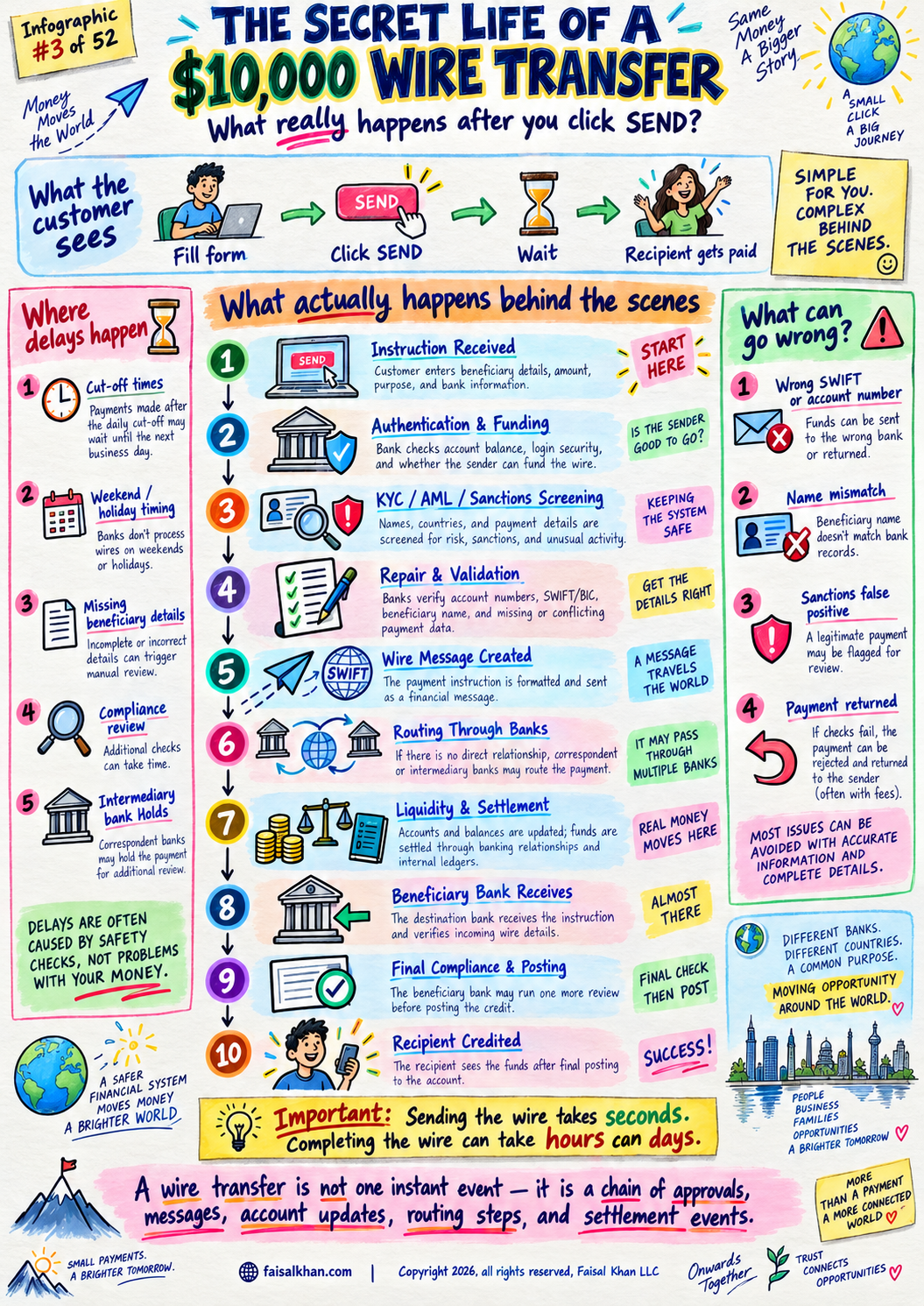
The infographic follows one wire transfer from customer instruction to recipient credit, while also showing where delays happen and what can go wrong along the way.
Most people imagine a wire as an immediate movement of money from one bank to another. In reality, the process is operationally more complex. A wire can be initiated quickly, but completion may depend on cut-off times, compliance checks, account validation, correspondent relationships, liquidity, settlement mechanics, and the final posting by the receiving bank.
Core idea: Sending a wire takes seconds. Completing a wire can take hours—or sometimes days.
What the Customer Sees
From the sender’s perspective, the process is simple:
Fill form → Click Send → Wait → Recipient gets paid
That is the entire customer experience.
The sender enters beneficiary information, the amount, and perhaps a short purpose-of-payment note. After pressing Send, there is little visible activity other than a status indicator or confirmation message.
From the recipient’s perspective, the process is equally simple. At some point, the receiving account is credited and the funds appear available.
The infographic exists because a large amount of hidden infrastructure sits between those two moments.
What Actually Happens Behind the Scenes
The center of the infographic breaks the wire transfer into ten operational stages. This is not meant to suggest that every wire always follows exactly the same path. Rather, it shows the major functions that commonly exist behind a bank wire.
A bank may perform several of these functions internally, while other transactions may involve additional participants such as correspondent banks or intermediary institutions.
Step 1: Instruction Received
The wire begins when the customer submits the transfer request.
At this point, the bank receives key transaction data, which may include:
Beneficiary name
Beneficiary bank
Account number or IBAN
SWIFT/BIC details
Amount
Currency
Purpose of payment
Sender information
This is the formal start of the operational process.
If the original instruction is incomplete or inaccurate, problems later in the chain become much more likely.
Step 2: Authentication and Funding
Before the bank proceeds, it needs to confirm that the sender is authorized and that the account can support the transaction.
This stage may include:
Login or identity authentication
Account balance review
Funding confirmation
Fraud-prevention checks
Security verification
The bank is effectively asking two questions:
Is this really the customer?
Can this customer fund this wire?
This is one reason a wire transfer should not be thought of as an automatic money push. The bank must first validate the sender’s authority and the transaction’s operational viability.
Step 3: KYC, AML, and Sanctions Screening
The bank then evaluates whether the transaction raises regulatory or compliance concerns.
This stage can include screening of:
Names
Countries
Banks
Counterparties
Payment details
Transaction patterns
Risk signals
The objective is not simply to catch illegal activity. It is also to ensure that the institution satisfies its obligations relating to sanctions, anti-money-laundering controls, and transaction monitoring.
That is why a legitimate payment can still be delayed if a name resembles a sanctions-listed party or if something about the transaction requires manual review.
These controls fit within broader AML/BSA program documentation.
Step 4: Repair and Validation
This is one of the least visible but most important stages.
Banks validate the payment instruction for operational accuracy. They may review:
Account numbers
IBAN formatting
SWIFT/BIC information
Beneficiary names
Required fields
Missing or conflicting payment data
This is often called “repair” because some wires require human review or correction before they can move forward.
A wire may be paused here if something is incomplete, inconsistent, or unclear.
This stage matters because a bank cannot route a payment properly if the destination information is wrong.
Step 5: Wire Message Created
Once the transaction is validated, the payment instruction is formatted as a wire message.
In international contexts, this often means a standardized financial message sent through established banking rails.
A critical distinction is:
The message is not the money.
The message tells another bank what to do, for whom, in what amount, and under what routing instructions.
The actual financial effect of the wire still depends on the institutions and settlement infrastructure behind the message.
Step 6: Routing Through Banks
If the sender’s bank has a direct relationship with the receiving bank, the route may be relatively straightforward.
If not, the payment may pass through one or more other institutions, such as a correspondent banking relationship.
That can create a chain like this:
Originating Bank → Correspondent Bank → Intermediary Bank → Beneficiary Bank
Every additional institution can add time, controls, operational complexity, and sometimes fees.
This is why the same customer action—clicking Send—can produce different outcomes depending on corridor, currency, bank relationships, and transaction details.
Step 7: Liquidity and Settlement
This is where the wire becomes financially meaningful inside the banking system.
Balances and accounts need to be updated across the relevant institutions. Depending on the structure, this can involve:
Internal bank ledgers
Settlement balances
Nostro/vostro relationships
Correspondent accounts
Treasury or liquidity management
This stage is closely connected to broader cross-border payment flows.
It is also where people often misunderstand what a wire is. They imagine one digital object moving from one bank to another. In reality, the process is usually a coordinated set of ledger and account updates across institutions.
Step 8: Beneficiary Bank Receives the Instruction
At this point, the destination bank receives the incoming payment instruction and begins its own review.
That bank will assess the incoming transaction based on its own:
Operational requirements
Compliance rules
Account structures
Posting procedures
Risk controls
Receiving a wire instruction does not automatically mean the recipient sees the money immediately.
The destination bank still has work to do.
Step 9: Final Compliance Review and Posting
The beneficiary bank may run another internal review before posting the funds.
This can include:
Beneficiary-name checks
Account validation
Internal risk review
Screening and monitoring controls
Credit-posting logic
Only after this stage is completed can the credit be posted to the beneficiary account.
That is why a payment may have arrived operationally at the destination bank but still not yet appear in the recipient’s balance.
Step 10: Recipient Credited
Finally, the beneficiary sees the funds.
From the recipient’s perspective, the transfer is complete.
From the banking system’s perspective, that visible credit is the end result of all the earlier checks, validations, routing actions, and settlement events that happened upstream.
This is the point at which the wire becomes real to the customer.
Where Delays Happen
The infographic highlights five common sources of delay.
1. Cut-Off Times
Banks often process wires according to daily cut-off schedules.
A transfer sent after the relevant cut-off may not move until the next business day.
2. Weekends and Holidays
Many wire-related processes do not run on weekends or local banking holidays.
Even if the customer sends the wire instantly, the banking system may not fully process it until the next business window.
3. Missing Beneficiary Details
Incomplete or incorrect beneficiary information can trigger manual review, repair work, or outright rejection.
4. Compliance Review
Some transactions require additional screening or human review, especially if a name match, country concern, or unusual transaction pattern is detected.
5. Intermediary Bank Holds
Correspondent or intermediary banks may also pause a transaction if additional review is needed.
Important: Delays are often caused by control and safety mechanisms, not by the money being “lost.”
What Can Go Wrong
The infographic also highlights four common failure points.
1. Wrong SWIFT or Account Number
A bad routing detail can cause the wire to be misrouted, delayed, or returned.
2. Name Mismatch
If the beneficiary name does not match the receiving bank’s records closely enough, the transaction may require manual intervention or rejection.
3. Sanctions False Positive
A legitimate transaction may be flagged because a name or detail resembles something on a watchlist.
4. Payment Returned
If a wire cannot be completed, it may be rejected and returned to the sender—sometimes after fees have been deducted.
The underlying lesson is simple:
Most wire-transfer problems are information problems before they become money problems.
The Main Message of the Infographic
The single most important sentence in the infographic is this:
A wire transfer is not one instant event—it is a chain of approvals, messages, account updates, routing steps, and settlement events.
That sentence captures the real educational point.
A wire transfer feels instantaneous at the front end because modern user interfaces are fast.
The financial and operational process behind it is not always instantaneous. Banks still need to authenticate the sender, check the payment, create the message, route it properly, settle the transaction, and post the funds correctly.
That is why the wire can be initiated in seconds but completed only after multiple systems and institutions have done their work.
Frequently Asked Questions
Is a wire transfer the same as money instantly moving from one bank to another?
Not necessarily.
The customer initiates the wire quickly, but the actual completion depends on messaging, routing, internal reviews, settlement, and final posting by the receiving bank.
Why can a wire be delayed even when the sender entered everything correctly?
Because the transaction may still be affected by bank cut-off times, weekends, holidays, intermediary-bank reviews, liquidity processes, or compliance controls.
Does SWIFT move the money?
Not in the way most people think.
SWIFT is primarily a messaging framework for financial institutions. The message instructs the payment flow, but settlement happens through accounts and balances maintained across banking relationships.
Can the receiving bank still review the wire after it arrives?
Yes.
The receiving bank may conduct its own final checks before crediting the beneficiary account.
Why is a $10,000 wire useful as an educational example?
Because it is large enough to feel important to the sender, but normal enough to illustrate how standard bank-wire operations actually work.
Why This Matters
People often assume that wire transfers are simple because the user interface is simple.
That assumption is wrong.
Behind one customer action is a structured banking workflow involving instruction capture, authentication, screening, validation, message creation, routing, settlement, and final posting.
Understanding that process makes several things easier to understand:
why some wires are delayed;
why banks ask for precise beneficiary details;
why compliance reviews exist;
why international transfers can involve other banks; and
why “sent” does not always mean “received.”
A better mental model is this:
Clicking Send starts the process. It does not finish it.