
Founders frequently search for the cheapest MSB license in the United States and discover Montana. The attraction is obvious: Montana does not currently regulate money transmitters under a state money transmitter licensing regime.
That can reduce one layer of state licensing cost for a business whose relevant activity is genuinely within Montana. It does not create a cheap nationwide money transmitter license.
The useful way to price the structure is therefore to separate the components.
The Cost Components
Component | Government Cost | Professional / Operating Cost |
|---|---|---|
Montana company formation | Montana filing fee applies | Formation/provider fee may apply |
Montana registered agent | N/A as a federal fee | Annual commercial agent fee if used |
EIN | US$0 from the IRS | Assistance fee may apply if outsourced |
FinCEN Form 107 registration | US$0 government filing fee | Preparation/compliance support fee may apply |
AML/BSA program | No FinCEN filing fee | Depends on business model and complexity |
Risk assessment | No government filing fee | Professional preparation/review cost |
No registration fee | Internal salary or outsourced cost | |
No registration fee | Periodic independent-review cost | |
State licensing | Varies by state | Application, bond, legal, compliance and operating costs |
MSB banking | Bank/provider dependent | Onboarding, monthly, transaction and advisory costs may apply |
The IRS states that an EIN can be obtained free directly from the IRS. FinCEN registration itself also has no government registration fee.
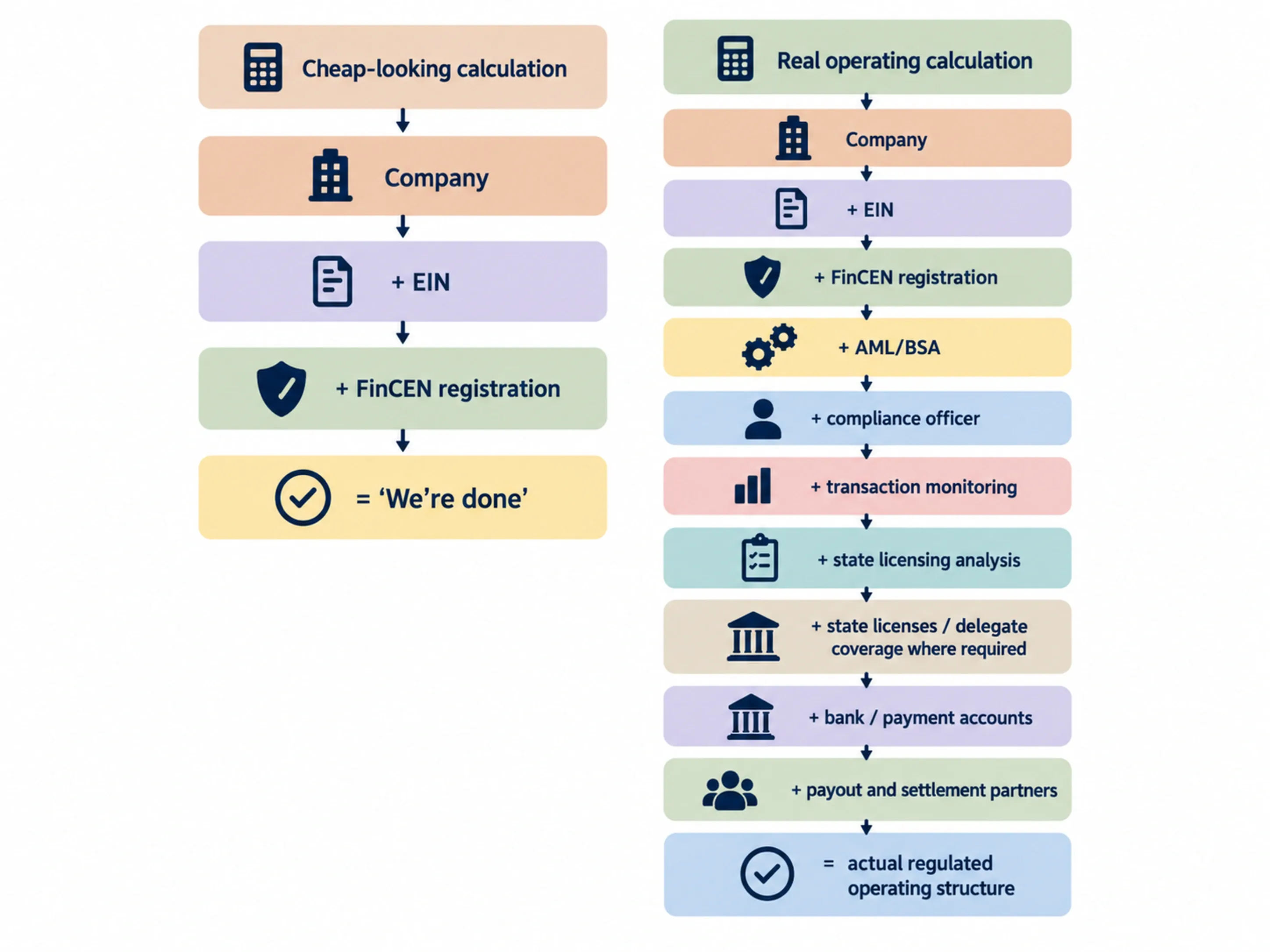
The expensive part of a serious MSB is not typing information into Form 107. It is building a structure that survives bank, regulator, partner, and counterparty scrutiny.
Why “Cheapest MSB License” Is the Wrong Comparison
There is no single federal U.S. money transmitter license.
A qualifying business may need federal FinCEN registration, while state money transmitter licenses are determined separately. The U.S. money transmitter licensing framework can therefore become materially more expensive as the geographic footprint expands.
A startup that only compares the price of entity formation and FinCEN registration can badly underestimate its real cost of market entry.
For example:
Why Montana Can Still Be Economically Attractive
Montana can be a rational starting jurisdiction when the proposed footprint makes its lack of a state MTL genuinely relevant.
The economic advantage is not that Montana somehow grants nationwide permissions for free. The advantage is that a qualifying business may establish a U.S. corporate and federal MSB framework without adding a Montana MTL application that Montana does not issue.
That can be useful for:
Founders testing a narrow payment model;
International entrepreneurs establishing a U.S. MSB presence;
Companies preparing for bank or PSP diligence;
Businesses that will later add state licenses;
Businesses that expect to operate through a licensed principal in additional states;
Cross-border models where U.S. state exposure has been carefully mapped.
Is Montana the Fastest or Easiest U.S. MSB Setup?
It can be faster and simpler than pursuing a portfolio of state money transmitter licenses because there is no Montana MTL application to obtain.
But “fastest” must be defined carefully.
Company formation, EIN administration, and FinCEN registration can be comparatively straightforward. Building a usable payment business can still take longer because the company may need:
A tailored AML/BSA program;
Banking;
Payment rails;
Foreign payout partners;
State licenses;
Authorized-delegate coverage;
Compliance staffing;
Vendor onboarding.
So Montana can simplify the starting structure without eliminating the work required to become operational.
The Compliance Cost Is Part of the Product
A newly registered MSB still needs a written AML program designed around its actual risk.
That typically means work around:
Customer identification;
KYB and beneficial ownership;
Sanctions screening;
Suspicious activity reporting;
Transaction monitoring;
Recordkeeping;
Escalation;
Compliance governance;
Training;
Independent testing.
The existing AML/BSA Programs resource explains why this work is more than a document-purchase exercise.
State Licensing Can Change the Economics Completely
Suppose the Montana company intends to serve customers in California, Texas, New York, and Florida.
The relevant question is not:
What did my Montana setup cost?
It is:
What regulatory structure is required for each state in which the business is conducting regulated money transmission?
Possible answers may include:
Direct state licensing;
An applicable exemption;
An authorized-delegate relationship;
A licensed-principal model;
Restructuring so the company is not itself the money transmitter.
The cost difference between those models is substantial.
Banking Costs Are Separate
A FinCEN registration does not include a bank account.
Banks and financial institutions can review the company's:
FinCEN registration;
State licensing;
Ownership;
Business model;
AML/BSA program;
Countries and corridors;
Transaction volumes;
Cash or crypto exposure;
Source of funds;
Expected account activity.
A founder budgeting for launch should therefore include banking and payment infrastructure rather than treating it as an automatic consequence of registration. The MSB-friendly banking process is a separate underwriting exercise.
What to Compare When Evaluating Providers
Do not compare providers solely on a headline “Montana MSB” price.
Ask exactly what the package contains:
Question | Why It Matters |
|---|---|
Is company formation included? | Establishes the legal entity |
Is the EIN included or supported? | Required for tax and banking administration |
Is Form 107 support included? | Establishes the federal MSB registration where required |
Is the activity classification reviewed first? | Prevents inappropriate or inaccurate registration |
Is a flow-of-funds review included? | Determines licensing exposure |
Is an AML/BSA program included? | Core federal compliance requirement |
Is a risk assessment included? | Should drive the AML program |
Is state licensing analyzed? | Montana does not solve other states |
Is bank/counterparty readiness included? | Registration alone may not satisfy underwriting |
Is ongoing compliance addressed? | MSB obligations continue after registration |
Frequently Asked Questions
Is FinCEN registration free?
There is no FinCEN government filing fee for MSB registration. A professional may charge for assessment, preparation, compliance, or administrative support.
Is an EIN free?
Yes. The IRS issues EINs without a government fee when obtained directly from the IRS.
Is Montana the cheapest money transmitter license?
Montana does not issue a money transmitter license, so describing it as the cheapest MTL is misleading. It may be a lower-cost starting jurisdiction for a particular structure because there is no Montana MTL application.
Will I avoid all state licensing costs with a Montana company?
No. Other states can impose their own licensing requirements based on the business activity and transaction footprint.
Is a cheap FinCEN-only setup enough for bank onboarding?
Sometimes a bank may consider the structure, but FinCEN registration alone does not guarantee approval. Banks commonly review applicable state licensing and the broader compliance and transaction profile.
Assess the Total Cost Before You Buy the Setup
The correct commercial comparison is not “Who will sell me the cheapest Montana MSB?”
It is the total cost of getting from a startup idea to a structure that can be accurately presented to banks, counterparties, regulators, payment providers, and customers.
Request a Montana MSB Cost Assessment
Send us the proposed activity, customer states, countries, expected volume, and whether you need banking or sponsor coverage. We can map the setup cost separately from the cost of becoming operational.