
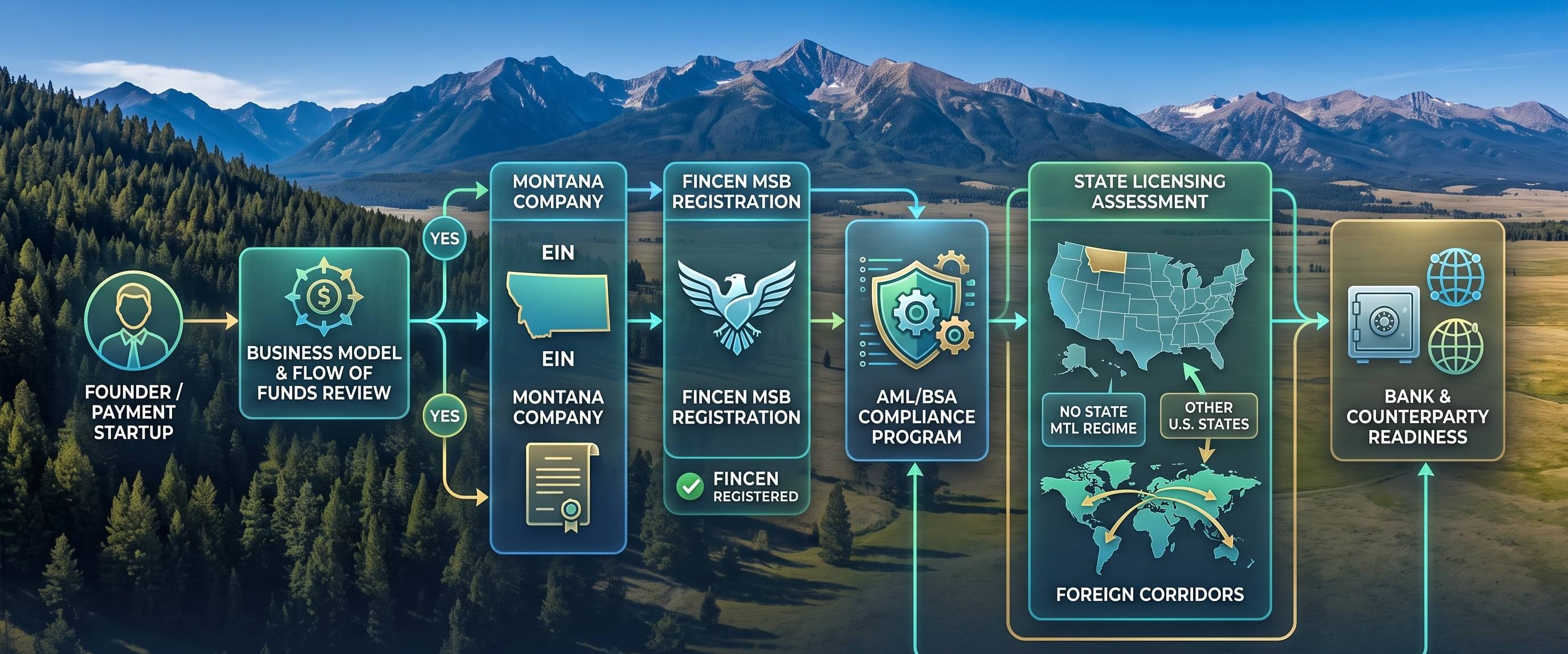
A Montana-based U.S. Money Services Business can be a practical starting structure for certain payment, remittance, foreign exchange, fintech, and cross-border payment businesses. The structure is attractive because Montana does not currently operate a state money transmitter licensing regime, while qualifying U.S. money services businesses generally register federally with the Financial Crimes Enforcement Network, or FinCEN.
The important point is what this structure is — and what it is not.
A Montana company plus an EIN plus FinCEN MSB registration can create a real U.S. business entity with a real federal MSB registration and real Bank Secrecy Act compliance obligations. It does not create a “Montana MSB license,” a federal money transmitter license, or automatic authority to transmit money throughout the United States.
That distinction is the foundation of the service we help structure.
What We Mean by a Montana MSB Setup
The commercial objective is not to manufacture a certificate that can be presented as a license. It is to establish a properly documented U.S. business structure for an entrepreneur whose actual activities fall within the federal definition of a Money Services Business.
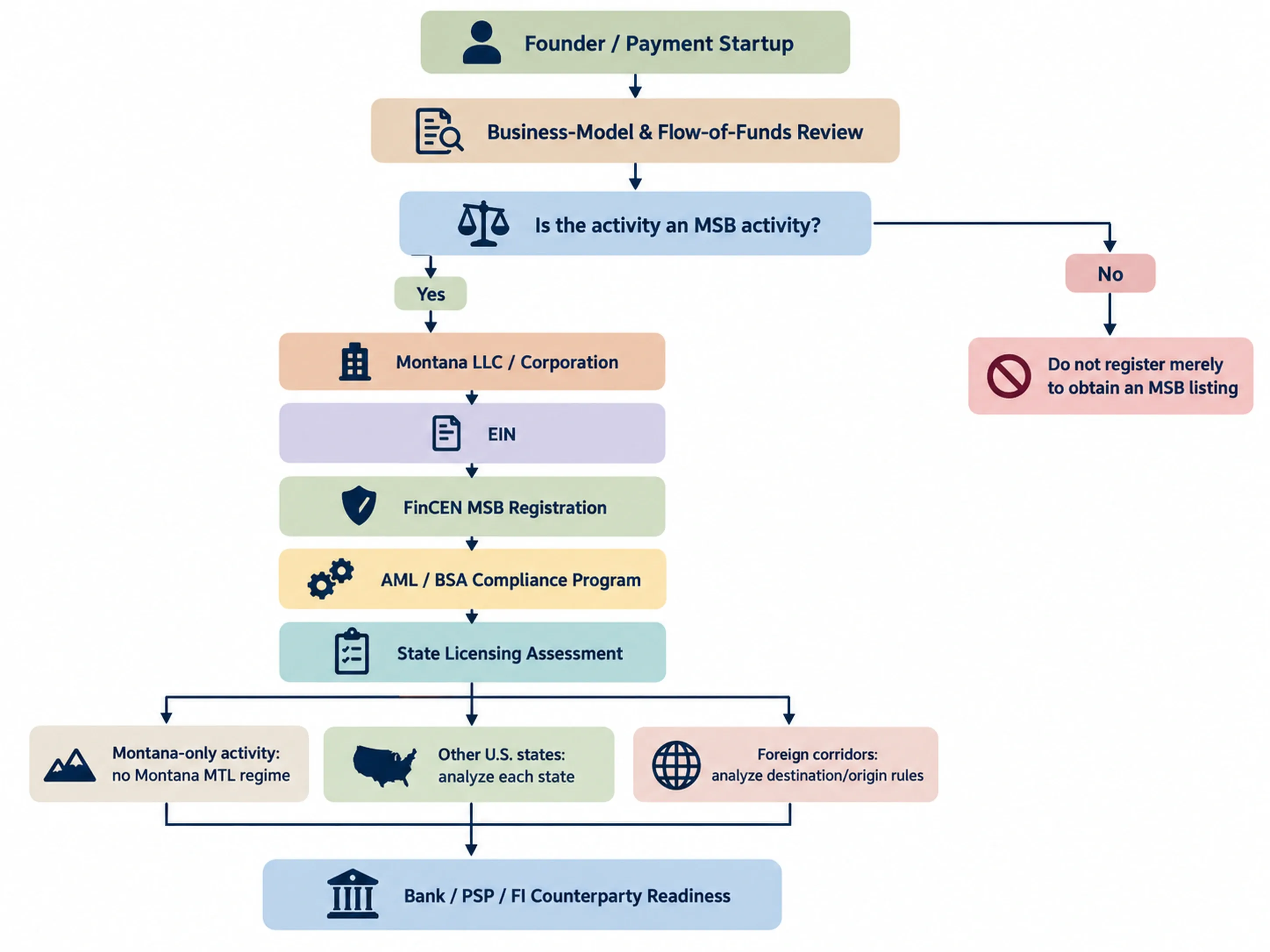
A typical setup may involve:
Formation of a Montana LLC or corporation through an appropriate corporate services provider.
Appointment of a Montana registered agent.
Employer Identification Number, or EIN, application support.
Review of the proposed business model and flow of funds.
Determination of the relevant federal MSB activity categories.
FinCEN Form 107 registration support where registration is required.
A written AML/BSA compliance framework appropriate to the activity.
Compliance officer and operating-control planning.
State-by-state money transmission licensing assessment.
Banking and counterparty readiness documentation.
This work sits underneath the broader U.S. Money Services Business registration and licensing framework. The purpose is to give the founder a defensible starting point, not to imply permissions the company does not possess.
The Structure in One Diagram
Why Montana Is Different
Montana's Division of Banking and Financial Institutions states that it does not regulate money transmitters. That is unusual in the United States and creates a genuine state-level distinction.
But the absence of a Montana MTL does not transform FinCEN registration into a license.
There are two separate regulatory layers to keep straight:
Layer | What It Does | What It Does Not Do |
|---|---|---|
FinCEN MSB registration | Registers a qualifying MSB federally under the BSA framework | Does not issue a federal money transmitter license |
State money transmitter licensing | Authorizes regulated money transmission where a state's law requires a license | Is not replaced by FinCEN registration |
Montana | Currently does not regulate money transmitters under a Montana MTL regime | Does not issue a “Montana MSB license” |
For founders who need to understand the state licensing layer in detail, our U.S. money transmitter license guide explains how federal registration and state authorization interact.
What You Can Accurately Say to a Bank or Counterparty
After a legitimate setup, the company may be able to say:
We are a U.S. company registered with FinCEN as a Money Services Business. Our corporate base is Montana, which does not currently issue a money transmitter license. Our permitted operating footprint is assessed separately based on the states and jurisdictions involved in our transactions.
That is materially different from saying:
We hold a Montana MSB license.
The second statement is inaccurate because there is no Montana money transmitter license to produce.
This difference matters when a bank, Canadian MSB, U.K. payment institution, European EMI, correspondent, sponsor bank, payout company, or other financial institution performs due diligence. A sophisticated counterparty may ask for both federal registration and evidence of state licensing or a documented basis for why a state license is not required.
Who This Structure May Be Suitable For
A Montana MSB setup may be worth evaluating for founders building businesses such as:
cross-border payment platforms;
remittance and money transfer businesses;
B2B payment companies;
foreign exchange services;
payment facilitators whose activities may constitute money transmission;
digital wallet or stored-value businesses;
crypto-fiat or stablecoin payment businesses;
payment aggregators;
merchant settlement businesses;
international founders entering the U.S. payments market.
The business label does not determine the regulatory result. A “PSP,” “fintech,” “software platform,” or “marketplace” can still fall inside money transmission rules if it accepts or controls funds for transmission.
The analysis begins with the flow of funds.
What the Setup Does Not Give You
A Montana MSB setup does not automatically provide:
nationwide U.S. money transmission authority;
licenses in California, New York, Texas, Florida, or other states;
regulatory approval by FinCEN;
bank-account approval;
correspondent banking approval;
Canadian, U.K., E.U., or other foreign regulatory authorization;
permission to describe FinCEN registration as a government license;
exemption from AML/BSA obligations;
an automatic right to operate merely because the company appears in FinCEN's public MSB search.
FinCEN itself warns that MSB registration should not be portrayed as government approval, certification, endorsement, or authorization to operate.
FinCEN Registration Is Real — But It Is Registration
FinCEN generally requires a qualifying MSB to file Form 107 within 180 days after the business is established. Registration is renewed every two years, and certain supporting documentation must be retained in the United States for five years.
FinCEN's public MSB search can show the registrant, its MSB activities, registration number, and the states in which the registrant reports engaging in MSB activities. Listing states on Form 107 does not issue state licenses.
The practical consequence is simple:
Federal registration tells FinCEN what the MSB is and what it says it does. State law determines whether separate state authorization is required.
The AML/BSA Layer Is Not Optional
Registering with FinCEN is not the end of the compliance work.
A qualifying MSB must maintain a written, risk-based anti-money laundering program. FinCEN's rules require, at a minimum, policies and internal controls, a person responsible for day-to-day compliance, employee training where appropriate, and independent review.
For a startup, this means the compliance package should reflect the actual business:
customer types;
business customers versus consumers;
domestic and international corridors;
expected transaction size and volume;
products and payment methods;
cash exposure;
stablecoin or crypto exposure;
sanctions risk;
use of agents, correspondents, processors, or payout partners;
suspicious activity reporting processes;
recordkeeping responsibilities.
A generic policy manual that does not match the actual flow of funds is weak documentation. Our existing AML/BSA Programs page explains the compliance framework in more detail.
The State Licensing Assessment Is the Critical Step
The biggest mistake is assuming the company's state of incorporation controls where it may provide money transmission.
It does not.
If a Montana company solicits, receives, or transmits money involving customers in another U.S. state, the other state's law may apply. Federal law also separately addresses businesses operating without a state money transmitter license where state law requires one.
That is why the deliverable should include a state licensing map based on the actual transaction set.
For example:
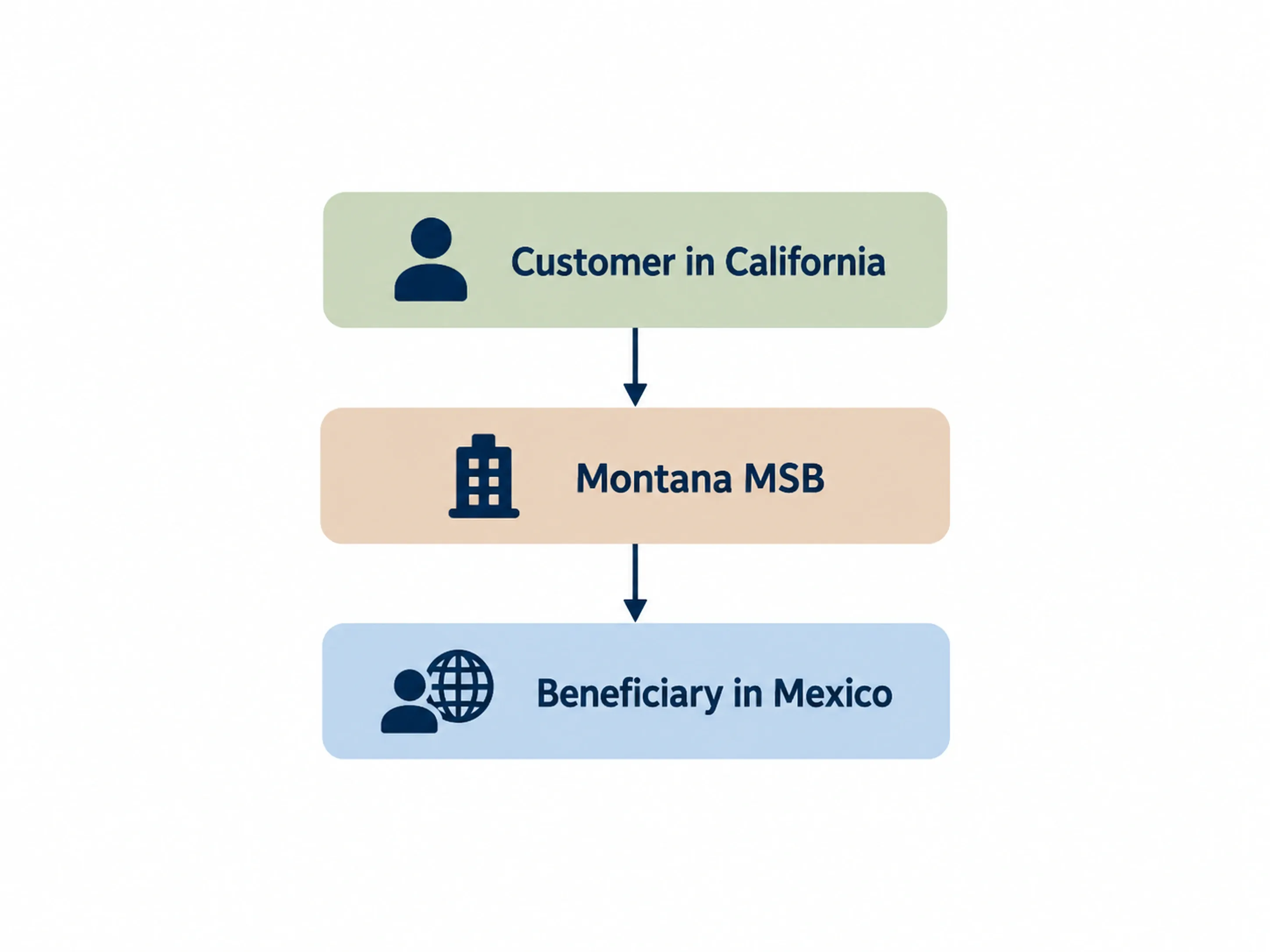
The fact that the company is incorporated in Montana does not answer the California licensing question.
Likewise:
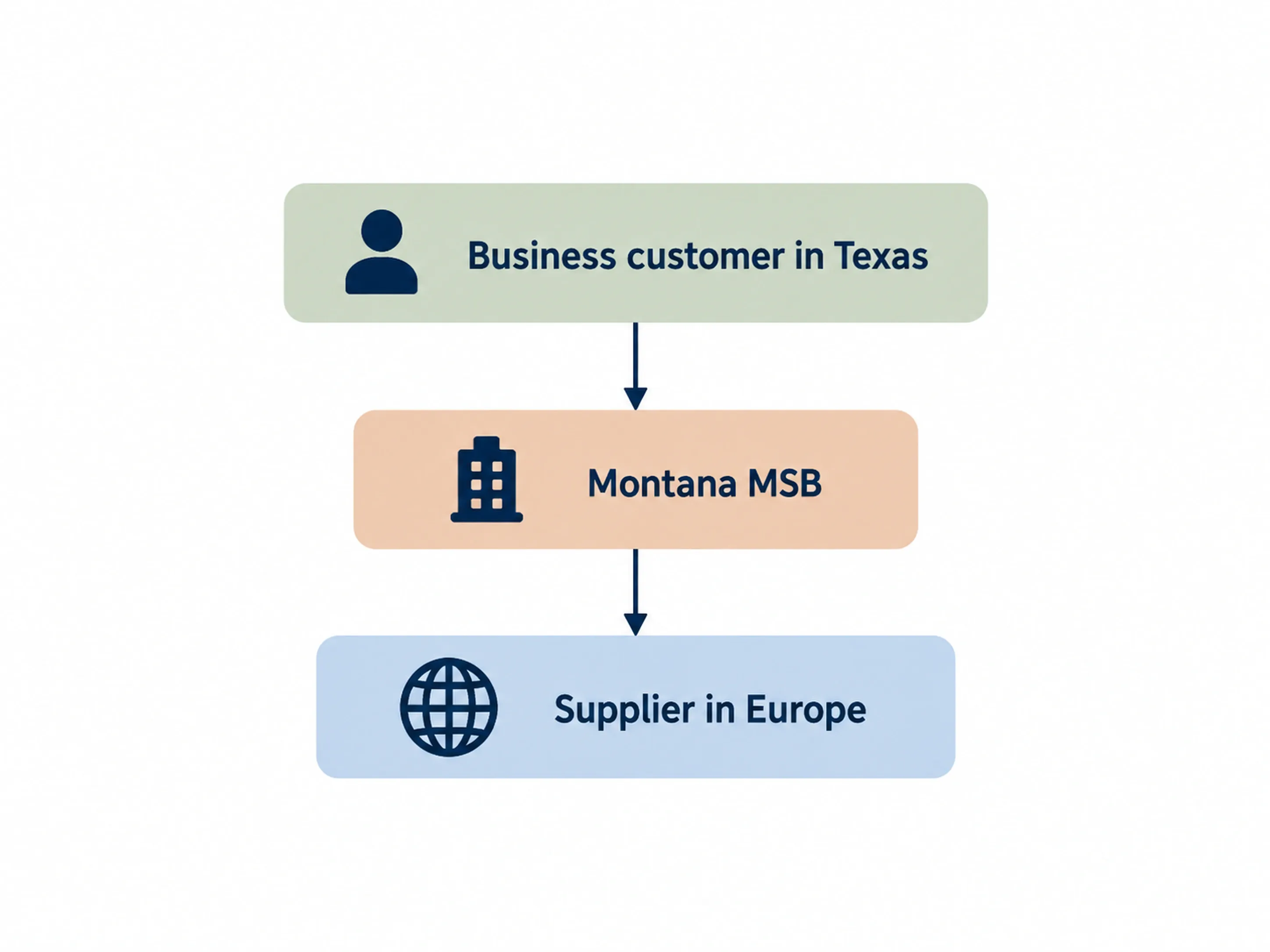
Texas must be analyzed separately from Montana and separately from the European destination jurisdiction.
Where direct state licensing is not commercially sensible, an authorized delegate or properly structured licensed-principal arrangement may be an alternative.
A Montana Company Is Not Required for FinCEN Registration
FinCEN registration is based on the activity of the business, not the marketing label placed on the company and not solely on its state of incorporation.
A Delaware, Wyoming, Texas, Florida, or other U.S. entity can also become a FinCEN-registered MSB if its activities meet the definition. A foreign-located business conducting qualifying MSB activity in substantial part within the United States may also fall within FinCEN's rules.
The reason to consider Montana is therefore not “FinCEN requires Montana.” It does not.
Montana is considered because its state treatment of money transmission is different. Corporate, tax, banking, operational, and licensing considerations should still determine whether Montana is the appropriate entity jurisdiction.
What We Build Around the Registration
The strongest setup is not simply:
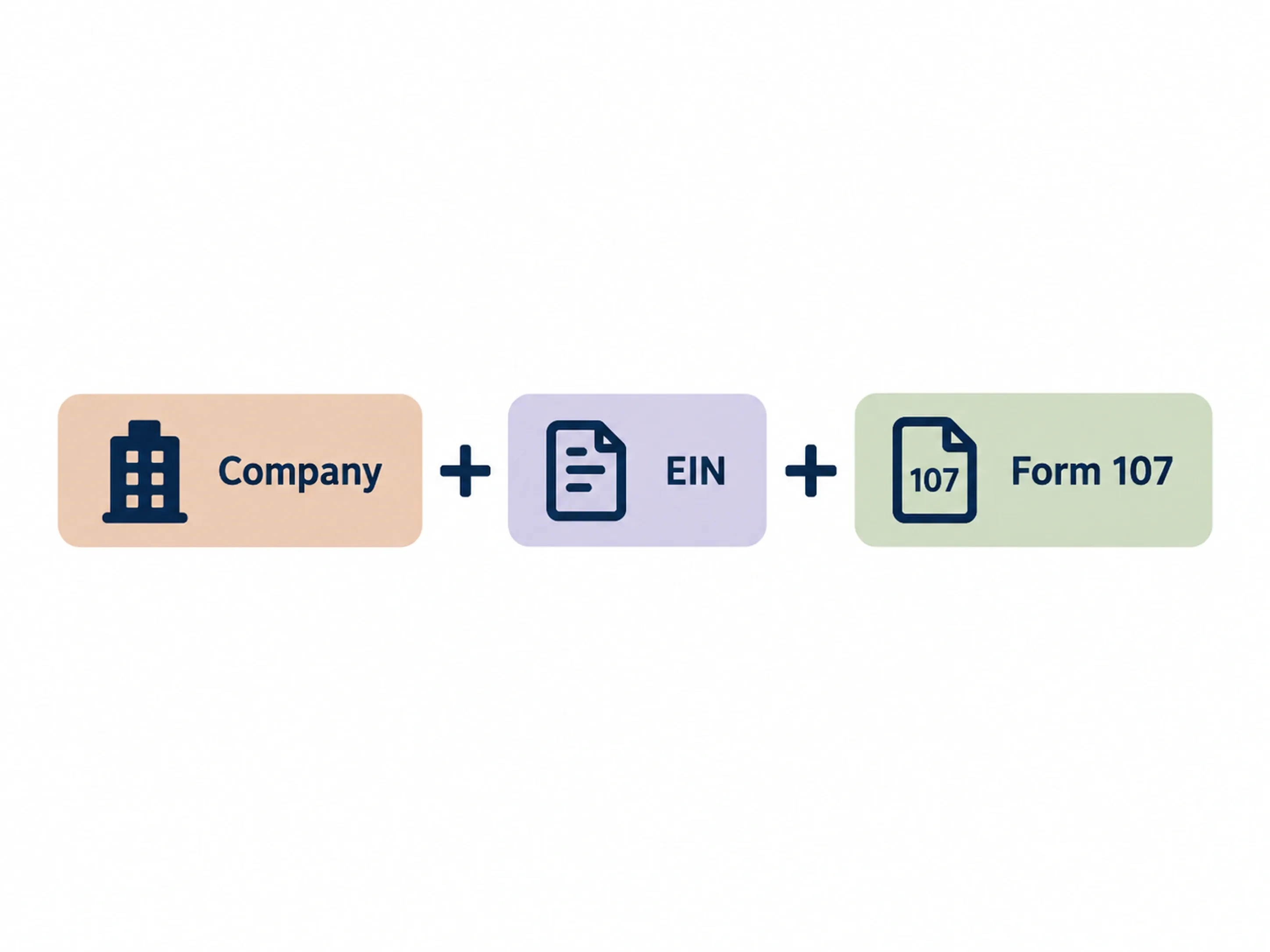
It is:
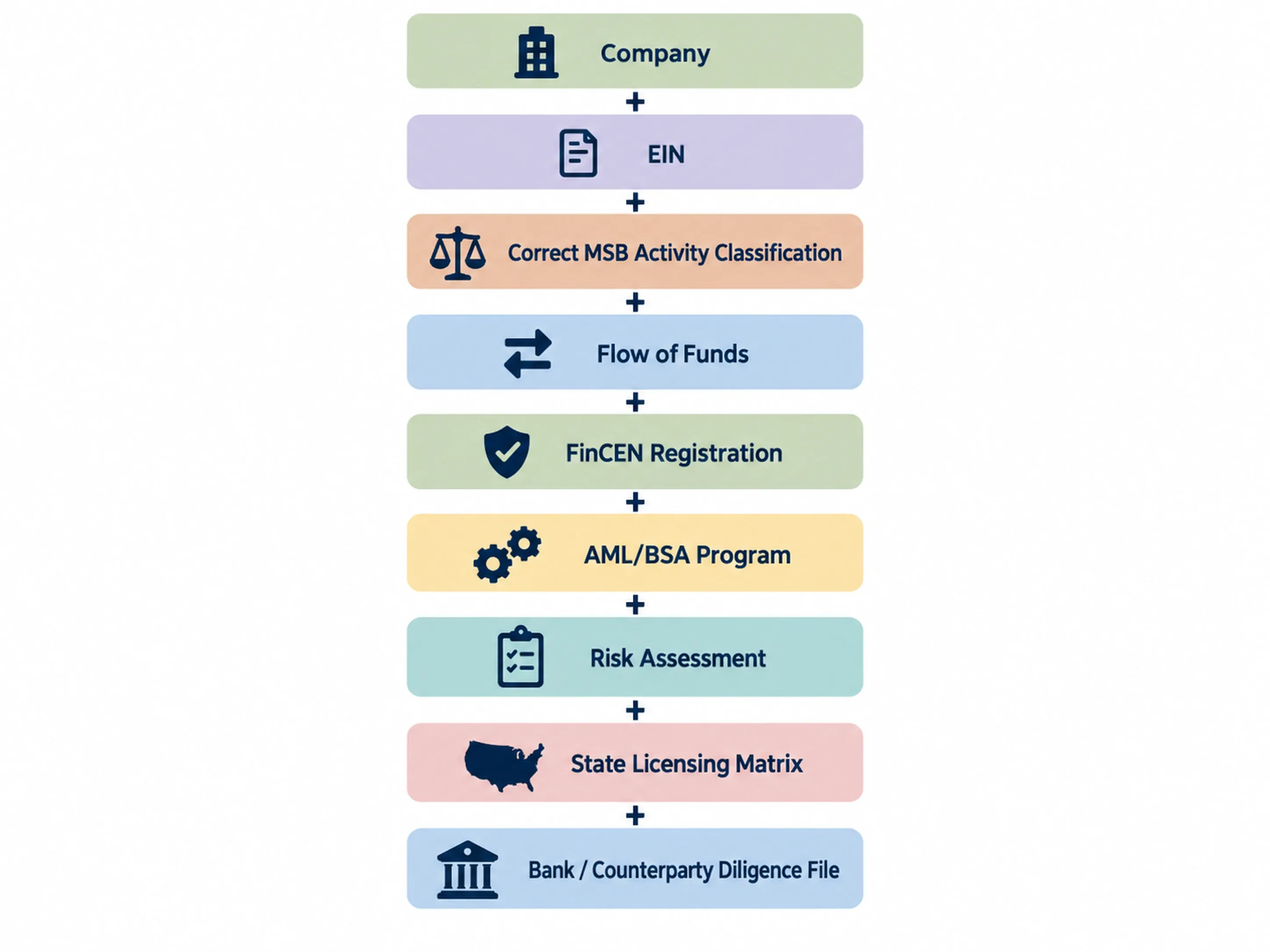
That package is substantially more useful when the founder approaches a bank or financial institution.
Banks are expected to confirm FinCEN registration where required, confirm applicable state licensing, understand agent status where relevant, and perform risk-based due diligence. A FinCEN listing alone will rarely answer every underwriting question.
If banking is part of the requirement, the structure should be designed with MSB-friendly banking diligence in mind from the beginning rather than after the entity has already been formed.
What a Counterparty Readiness File Should Contain
A serious onboarding package may include:
certificate or articles of formation;
operating agreement or corporate documents;
EIN evidence;
ownership and beneficial ownership information;
organization chart;
FinCEN MSB registration status;
business description;
products and services description;
flow-of-funds diagram;
transaction set;
customer categories;
countries and states served;
AML/BSA policy;
risk assessment;
sanctions policy;
KYC/KYB framework;
compliance officer information;
transaction monitoring approach;
state licensing matrix;
licenses, exemptions, or authorized-delegate relationships where applicable;
expected monthly volume;
average and maximum transaction sizes;
banking and payment-rail requirements.
The purpose is not to make the company look more regulated than it is. The purpose is to make its actual regulatory position easy for an FI or NBFI to understand.
When This Structure Makes Commercial Sense
A Montana-based setup is most compelling when all of the following are true:
the entrepreneur genuinely conducts or is preparing to conduct an activity that qualifies as an MSB;
the proposed U.S. footprint is understood;
the founder wants a U.S. entity and federal MSB registration;
the founder understands that Montana is not a nationwide licensing shortcut;
the compliance program will be built around real operations;
banks and counterparties will be told accurately what the company holds;
additional state licensing or sponsorship will be added when the business model requires it.
It is especially useful as an entry point for an international founder who needs to establish a credible U.S. regulatory and corporate framework before moving into more expensive licensing, banking, or sponsorship work.
When a Montana MSB Setup Is Not Enough
This structure is not sufficient if the business needs direct money transmission authority in states that require a license and has no applicable exemption or licensed-principal arrangement.
It may also be inadequate if a specific bank, PSP, EMI, payment institution, correspondent, or other counterparty has a policy requiring a state-issued MTL or another formal regulatory license.
The correct question to ask the counterparty is therefore not simply:
Do you accept a Montana MSB?
A better question is:
Will you onboard a U.S. FinCEN-registered MSB whose corporate base is Montana, where no state MTL is issued, given this specific transaction model and geographic footprint?
That forces the counterparty to evaluate the actual structure rather than an ambiguous label.
The Montana MSB Setup Process
1. Business-Model Review
We start with what the company will actually do.
We examine who pays, who receives, who controls the money, where it sits, which accounts are used, who instructs the payment, which currencies are involved, and which jurisdictions the transaction touches.
2. Entity Structure
If Montana is suitable, company formation is coordinated with the required Montana registered-agent arrangement and corporate documentation.
3. EIN
The company obtains its Employer Identification Number. The IRS offers different application routes depending on whether the principal place of business and responsible party are in or outside the United States.
4. MSB Classification
The activities are mapped to the relevant FinCEN categories. A company should not register merely because it wants to appear in the MSB database. The registration must correspond to genuine qualifying activity.
5. FinCEN Registration
Form 107 is prepared based on the actual ownership, activities, states, branches, agents, and required supporting documentation.
6. Compliance Program
The AML/BSA program and related controls are aligned to the actual business rather than copied from an unrelated operator.
7. State Licensing Matrix
Each material U.S. state touched by the proposed business is assessed separately.
8. Counterparty and Banking Readiness
The corporate, compliance, registration, state-licensing, and transaction documentation is assembled into a coherent diligence package.
Detailed Montana MSB Guides
The following supporting pages address the questions founders usually ask before proceeding:
Frequently Asked Questions
Is there a Montana MSB license?
No. Montana does not currently issue a money transmitter license. A qualifying business may register federally with FinCEN as an MSB, but that federal registration is not a Montana license.
Can I show my FinCEN registration to a bank?
Yes. FinCEN registration is a legitimate part of an MSB diligence file. The bank may also ask for applicable state licenses, exemptions, authorized-delegate evidence, compliance documentation, ownership information, and transaction details.
Can I tell a Canadian, U.K., or European counterparty that I am licensed?
Not merely because of a Montana company and FinCEN registration. The accurate description is that the company is registered with FinCEN as a U.S. MSB and is based in Montana, where a state money transmitter license is not issued.
Does selecting “All States” on FinCEN Form 107 make me licensed nationwide?
No. It reports the geographic scope of the MSB activities stated in the federal registration. It does not issue state money transmitter licenses.
Do I need to be a U.S. citizen to own the Montana company?
Foreign ownership of U.S. companies is possible, but tax, EIN, banking, sanctions, source-of-funds, and counterparty requirements must be addressed separately.
Can I open an MSB bank account after registration?
Possibly, but registration does not guarantee banking. Banks perform their own risk assessment and commonly review state licensing, AML/BSA controls, ownership, countries, transaction flows, expected volume, and source of funds.
Can I register first and decide what the business will do later?
That is not a sound approach. FinCEN registration should reflect the actual MSB activity. The business model and flow of funds should be defined before the registration and compliance program are prepared.
Request a Montana MSB Setup Assessment
If you are building a payment, remittance, cross-border, FX, wallet, settlement, or crypto-fiat business and are considering a U.S. MSB structure, send us the proposed business model, customer types, countries, U.S. states, expected transaction volume, and flow of funds.
We will determine whether a Montana-based setup is a sensible starting structure and identify the additional registration, compliance, banking, sponsorship, or state licensing work that may be required.