
A non-U.S. entrepreneur can establish a U.S. company and may be able to use that company as the basis for a U.S. Money Services Business structure when the actual business activity falls within FinCEN's MSB rules.
Montana is frequently considered because the state does not currently regulate money transmitters through a state money transmitter licensing regime.
The opportunity is real. The common misunderstanding is assuming that foreign ownership plus a Montana company plus FinCEN registration creates a U.S. payment license. It does not.
The Basic Structure
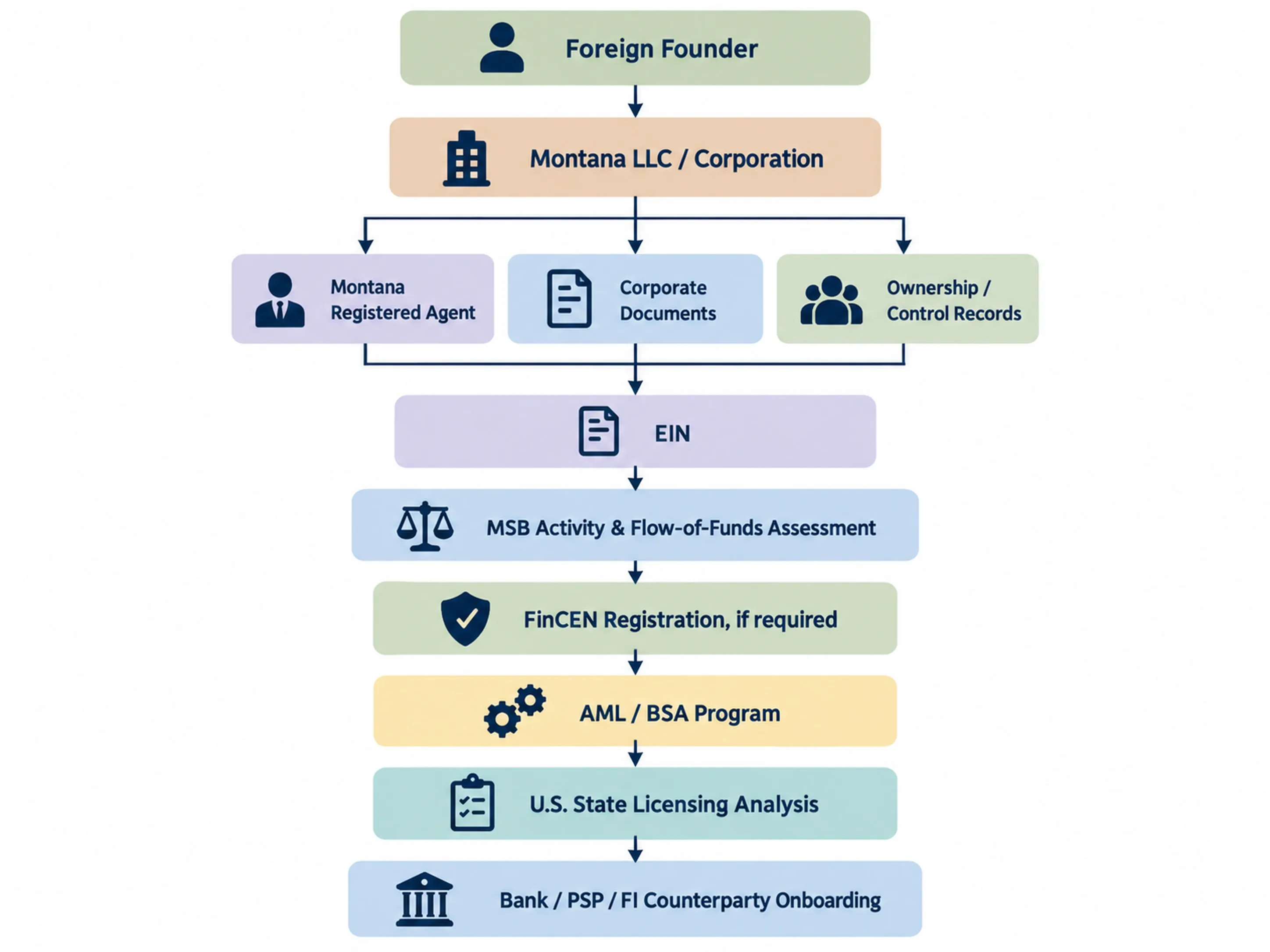
The founder's nationality does not replace the need to determine what the company actually does.
A U.S. Company Is Only the Corporate Layer
Formation of a Montana company gives the founder a U.S. legal entity.
It does not itself create:
MSB status;
A bank account;
Nationwide state authorization;
Acceptance by a Canadian, U.K., or E.U. counterparty.
MSB status arises from the activity. FinCEN registration is a separate federal compliance step.
The broader Money Services Business framework should therefore be reviewed before the entity is presented as a regulated payment business.
Montana Registered Agent Requirement
Montana requires LLCs and corporations to maintain a registered agent with a physical Montana address.
A foreign founder without a Montana presence can use an appropriate commercial registered-agent service.
The registered agent is a corporate requirement. It is not a substitute for an operating office, compliance function, tax presence analysis, bank onboarding address, or FinCEN supporting-document arrangement.
EIN for a Foreign Founder
The IRS provides different EIN application routes depending on the applicant's circumstances.
International applicants whose principal place of business is outside the United States cannot use the standard online EIN process in the same way as eligible domestic applicants. The IRS provides telephone, fax, and mail routes for international applicants.
This means the founder should decide early:
Who the responsible party is;
Where the principal place of business is;
What address will be used;
Which EIN process applies;
Who is authorized to assist.
The EIN is an identifier. It is not evidence that the company is licensed to transmit money.
FinCEN Registration for the Actual Activity
A company should register with FinCEN only when the business falls within the applicable MSB definition and registration requirement.
The registration may identify activities such as money transmission, currency exchange, check cashing, and other covered MSB services.
For an international founder, the file should clearly explain:
Why the company is an MSB;
What it does in or through the United States;
Which states it serves;
Which countries it serves;
Whether it uses agents or payout partners;
Where supporting documentation is maintained;
How its AML/BSA compliance function operates.
U.S. Supporting Documentation
FinCEN requires specified supporting documentation for the registration to be retained at a location in the United States for five years.
That requirement can matter to a foreign-owned business that intends to run the entire organization from abroad.
The setup should therefore plan document custody and record availability rather than treating the U.S. entity as a shell.
State Licensing Still Depends on the Transaction Footprint
A foreign founder may be particularly attracted to Montana because there is no Montana money transmitter license.
But the regulatory analysis changes as soon as the business reaches customers in other states.
If a customer in California sends money through the Montana company to a beneficiary in another country, the fact that the owner lives in Dubai, London, Istanbul, Lagos, Singapore, or elsewhere does not answer the California licensing question.
The U.S. money transmitter license framework must be applied to the actual state footprint.
Foreign Ownership and Banking
Foreign ownership is one of the factors banks and payment institutions may review during onboarding.
Expect questions around:
Beneficial owners;
Nationality and residence;
Source of wealth;
Source of capital;
Related companies;
Countries served;
Customer locations;
Expected volume;
Sanctions exposure;
U.S. operating presence;
Compliance personnel;
State licensing;
Payout partners;
Prior financial-services experience.
None of these factors automatically disqualifies the business. They increase the importance of having a coherent diligence package.
Presenting the Company to Foreign Counterparties
Suppose the founder approaches a Canadian payment company, U.K. EMI, or E.U. payment institution.
If the counterparty asks:
Are you licensed?
The company should not answer:
Yes, we have a Montana MSB license.
A more accurate description is:
We are a U.S. company registered with FinCEN as a Money Services Business. Our U.S. corporate base is Montana, which does not issue a state money transmitter license. We can provide our FinCEN registration and the documentation for the regulatory footprint relevant to this program.
The counterparty can then decide whether that status satisfies its onboarding policy.
Why Foreign Founders Need a Stronger Documentation Package
An international founder often has more cross-border elements in the business from day one.
That can mean more diligence around:
Correspondent relationships;
Foreign payout partners;
Sanctions;
Local licensing;
FX;
Stablecoins;
Beneficiary countries;
Source of funds;
Group-company transactions.
For that reason, the AML/BSA and risk framework should be built around the actual international model rather than a domestic template. See AML/BSA Programs for the core compliance components.
Frequently Asked Questions
Can a non-U.S. citizen own a Montana LLC?
U.S. companies can have foreign owners. The founder should separately review U.S. tax, reporting, banking, sanctions, and corporate requirements applicable to the ownership structure.
Do I need an SSN to get an EIN?
The IRS has procedures for international applicants and foreign responsible parties. The correct process depends on the facts and application method.
Does a Montana registered agent make me U.S.-resident?
No. A registered agent is the state's recipient for legal and official notices. It does not by itself establish personal residency or solve all operational-presence questions.
Can I run the MSB entirely from outside the United States?
The structure requires careful review of federal, state, tax, banking, record-retention, and foreign-jurisdiction obligations. FinCEN also has rules for certain foreign-located MSBs.
Will a U.S. bank open an account for a foreign-owned MSB?
Some institutions consider foreign-owned MSBs, but approval depends on the institution's risk appetite and the applicant's licensing, compliance, ownership, transaction profile, countries, and operating model.
Build the Structure Around the Real Business
A foreign founder should use the Montana setup to establish a transparent U.S. corporate and federal compliance framework — not to create the appearance of holding a license that does not exist.
Request a Foreign-Founder MSB Assessment
Send your country of residence, ownership structure, proposed U.S. entity, payment activity, customer states, corridors, and banking requirements. We can determine whether a Montana-based MSB structure is a sensible starting point.