
Founders frequently ask whether they should establish their U.S. payment company in Montana, Wyoming, or Delaware before registering with FinCEN as a Money Services Business.
The first point to understand is that FinCEN registration is not limited to Montana.
A qualifying U.S. company formed in Montana, Wyoming, Delaware, or another state can have federal MSB registration obligations based on what it actually does.
The state of incorporation and the states in which money transmitter licensing is required are related but different questions.
The Core Comparison
Question | Montana | Wyoming | Delaware |
|---|---|---|---|
Can an entity be formed there? | Yes | Yes | Yes |
Can a qualifying entity register with FinCEN? | Yes | Yes | Yes |
Does formation itself create MSB status? | No | No | No |
Does FinCEN registration create nationwide MTL authority? | No | No | No |
State money transmitter regime | Montana does not currently regulate money transmitters | State licensing rules apply | State licensing rules apply |
Does incorporation eliminate other-state licensing? | No | No | No |
Montana's distinguishing feature is its treatment of money transmission at the state level, not a special FinCEN registration category.
FinCEN Does Not Require a Montana Entity
FinCEN's MSB registration rule applies based on the business and its activities.
There is no “Montana version” of Form 107 that grants greater federal authority.
A founder should therefore not choose Montana because someone says:
FinCEN gives Montana MSBs special nationwide status.
That is not how the federal/state framework works.
See the existing FinCEN Registration vs. Money Transmitter License explanation for the federal/state distinction.
Why Choose Montana?
Montana may be attractive when:
The company wants a U.S. entity;
The actual operating model makes Montana's lack of a state MTL relevant;
The business understands that other states remain separate;
Banking and counterparties can accept the documented structure;
The company is willing to build full AML/BSA controls.
It can be a practical starting point, but the entity should not be selected solely for a marketing phrase such as “Montana MSB license.”
Why Choose Wyoming or Delaware?
A founder may still choose another state for reasons unrelated to MSB licensing.
Those reasons can include:
Existing corporate structure;
Investors;
Counsel preference;
Governance;
Tax planning;
Group-company consistency;
Commercial contracts;
Banking;
Administrative familiarity.
If a Wyoming or Delaware company wants to conduct business in Montana, separate corporate foreign-qualification questions may arise.
The key principle is:
The state with the most convenient incorporation process is not automatically the state that determines every regulatory obligation of the payment business.
Do You Need a Montana Entity to Benefit From Montana's Regulatory Position?
Not necessarily.
Montana's decision not to regulate money transmitters is a rule about regulated activity in Montana; it is not a special federal status reserved only for Montana-incorporated companies.
A company formed elsewhere may be able to conduct business in Montana after satisfying the applicable corporate qualification requirements. That is a separate corporate-law question from money transmitter licensing.
This is another reason not to confuse:
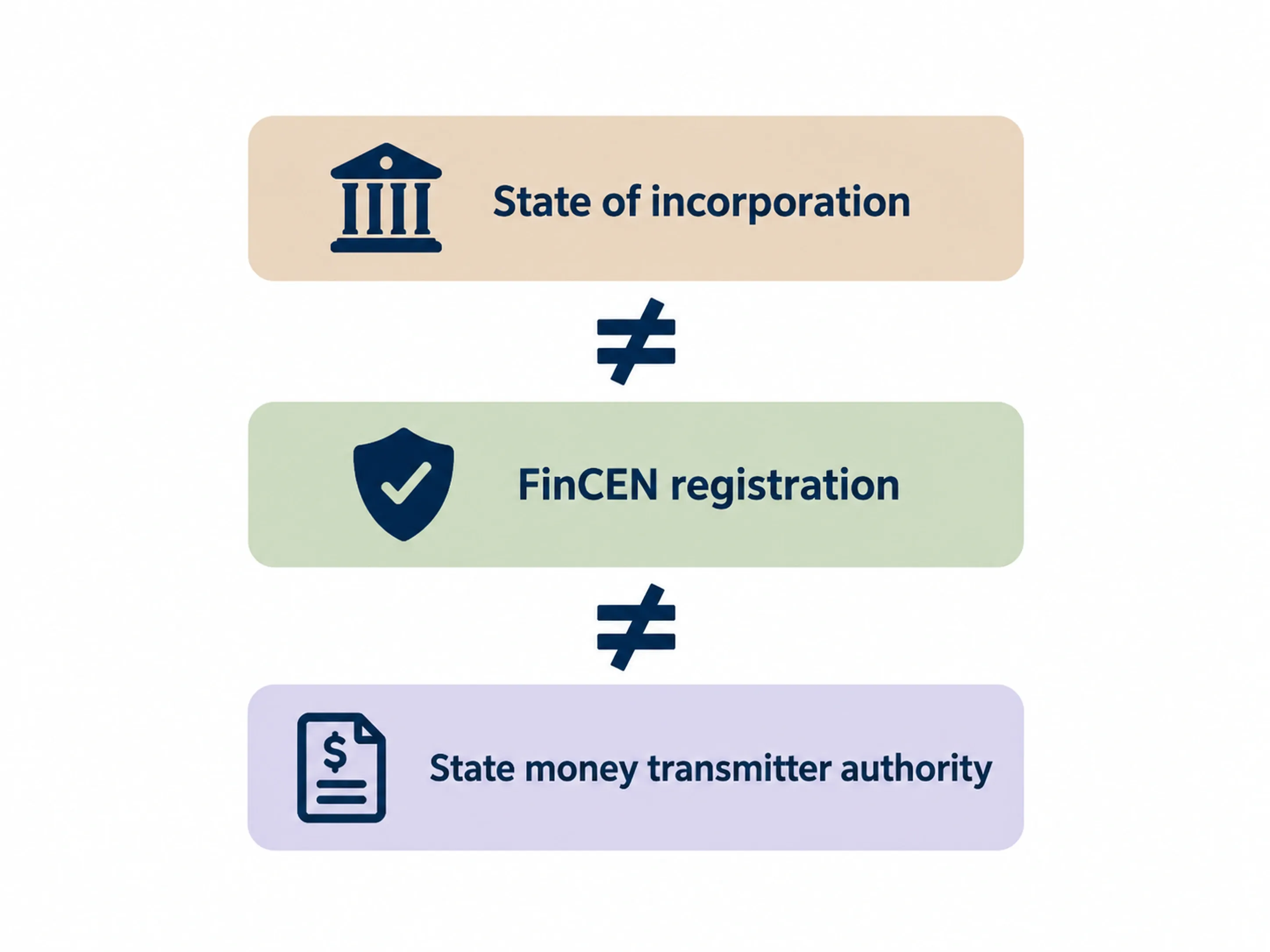
A Montana entity can still be operationally convenient, especially when the business wants its U.S. corporate base there. But the founder should not assume that forming in Montana is the only way to have money-transmission activity connected to Montana, or that a Montana charter creates broader permissions outside the state.
Example: Delaware Company Serving Montana
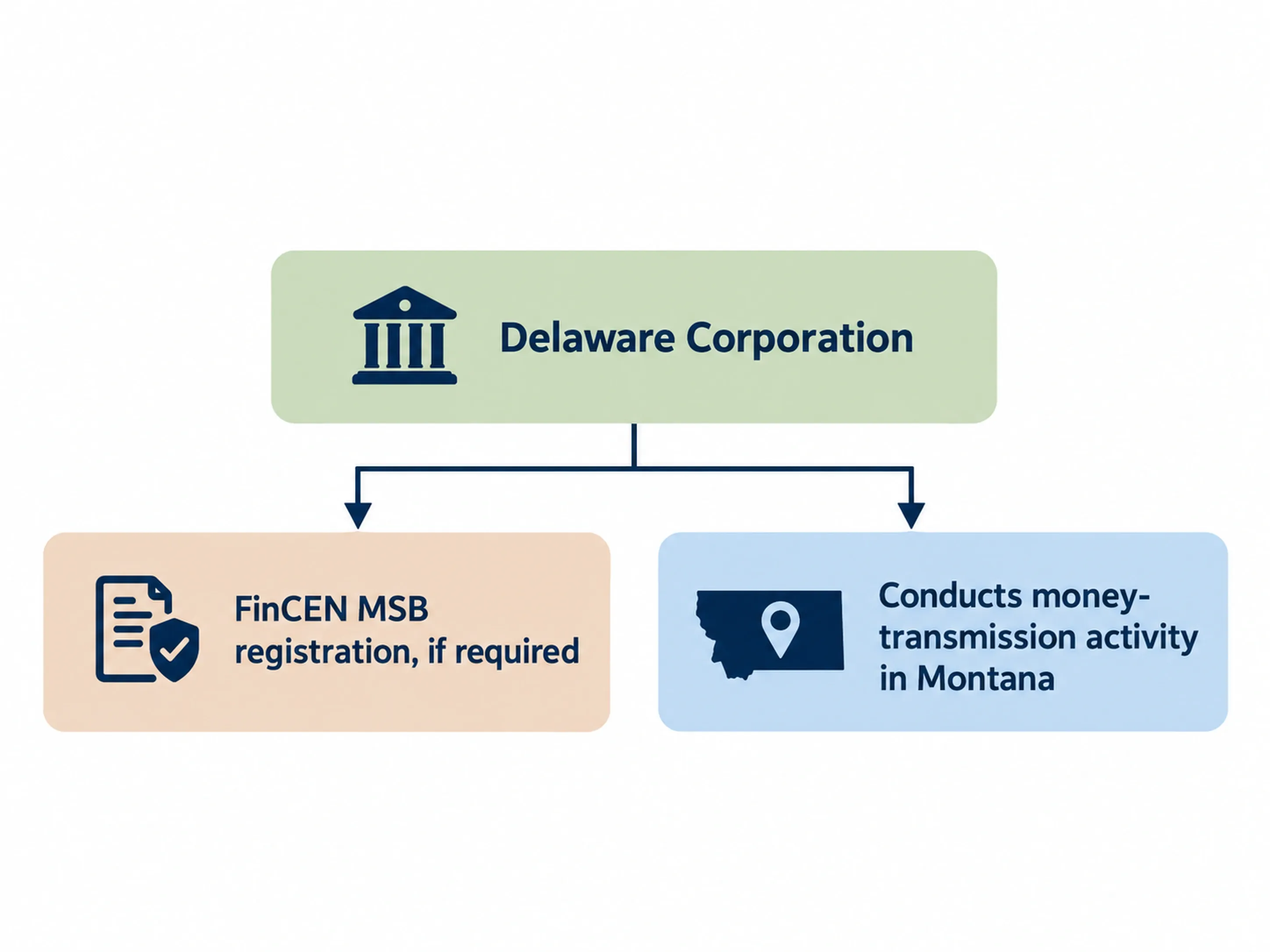
The company may need to address corporate authority to do business in Montana, but Montana does not become a money transmitter licensing jurisdiction merely because the company is foreign-qualified there.
Example: Montana Company Serving New York
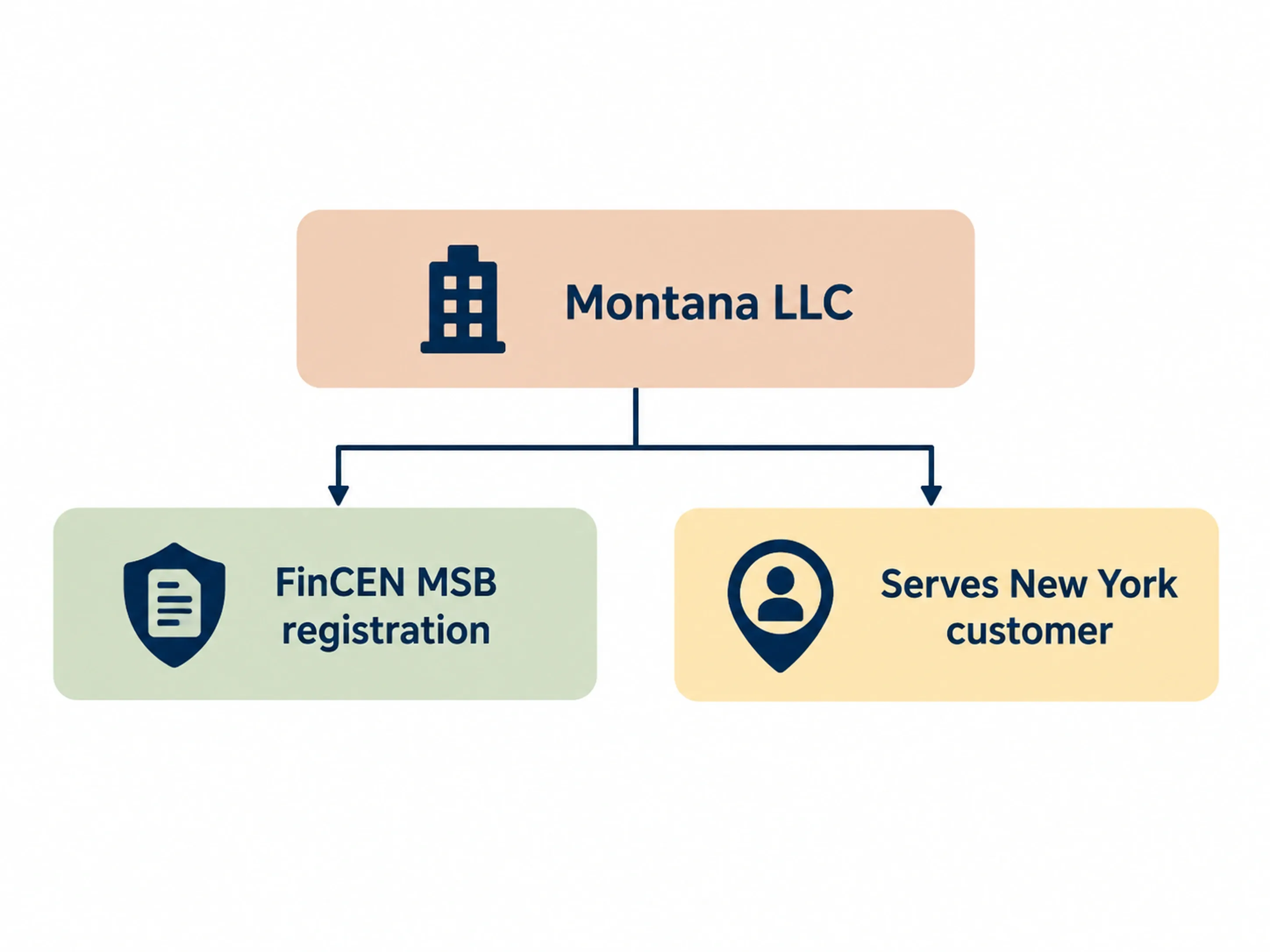
The Montana incorporation does not answer the New York regulatory question.
The company's state footprint must be analyzed under the broader U.S. money transmitter licensing framework.
Choose the Entity After the Flow Is Known
A sensible entity-jurisdiction decision should consider:
Founders and ownership;
Investor requirements;
Operating location;
Customer states;
Countries and corridors;
Banking;
Tax advice;
Licensing footprint;
Compliance staffing;
Corporate administration.
For some founders, Montana will be the appropriate starting point. For others, a Delaware or Wyoming company with a different licensing strategy will be cleaner.
Frequently Asked Questions
Is a Montana FinCEN registration stronger than a Delaware FinCEN registration?
No special federal authority arises merely from the Montana incorporation. FinCEN registration is federal.
Can I incorporate in Wyoming and register with FinCEN?
A qualifying Wyoming company can be subject to FinCEN MSB registration.
Is Montana always cheaper?
Not necessarily. The total cost depends on company administration, compliance, banking, and the state licensing footprint.
Does Delaware have a federal MSB license?
No. There is no general federal money transmitter license created by Form 107.
Why does Montana appear so often in “cheap MSB license” offers?
Because Montana's lack of a state money transmitter licensing regime makes it easy to market a Montana entity plus FinCEN registration as if it were a license. The structure can be legitimate, but that description is inaccurate.
Choose the Jurisdiction for the Business You Actually Plan to Run
Montana's regulatory distinction is useful, but the company should be selected as part of a complete corporate, compliance, licensing, banking, and transaction strategy.
Request a U.S. MSB Structure Assessment
Send your founders' locations, customer states, corridors, investor requirements, banking needs, and flow of funds. We can compare the practical role of Montana, Wyoming, Delaware, or another entity jurisdiction within the wider licensing strategy.