
A Montana company registered with FinCEN as a Money Services Business does not automatically receive the right to conduct money transmission in every U.S. state.
This is the most important limitation of the Montana MSB structure.
Montana currently does not regulate money transmitters under a state money transmitter licensing regime. Other states can impose their own licensing requirements.
Incorporation State and Operating Authority Are Different Questions
A founder may say:
My company is incorporated in Montana, so Montana law applies.
That is incomplete.
The company may be incorporated in Montana, but a transaction can create regulatory exposure in another state because of where the customer, sender, beneficiary, merchant, account, or regulated activity is located.
This is why U.S. money transmission is generally analyzed state by state.
The existing Money Transmitter License — United States guide covers the wider licensing structure.
Example: California Customer
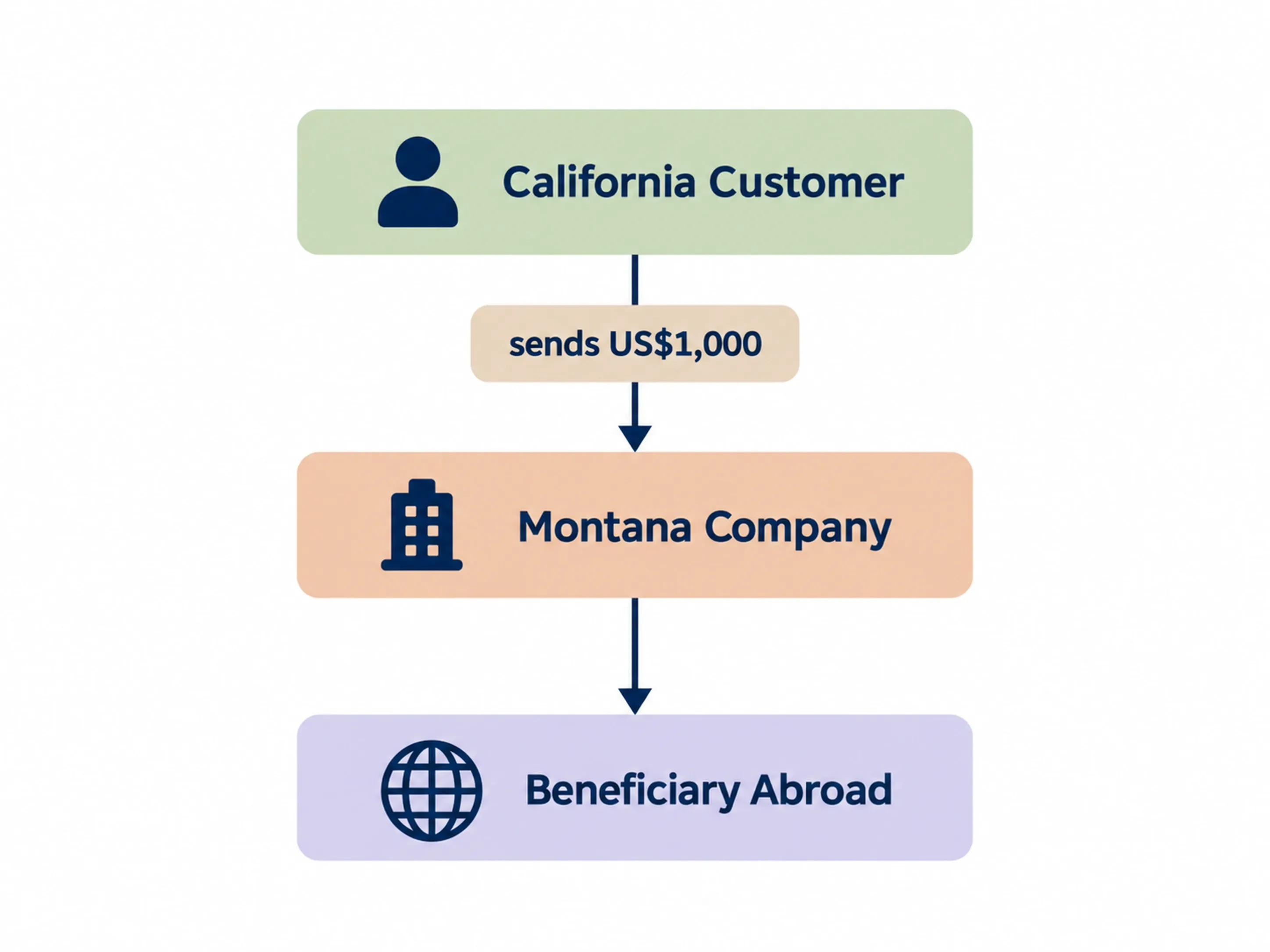
The relevant question is not simply whether Montana requires an MTL.
You must analyze whether the company's activity involving the California customer triggers California money transmission law and, if so, whether the company has the required license, exemption, or licensed-principal structure.
Example: B2B Payment From Texas
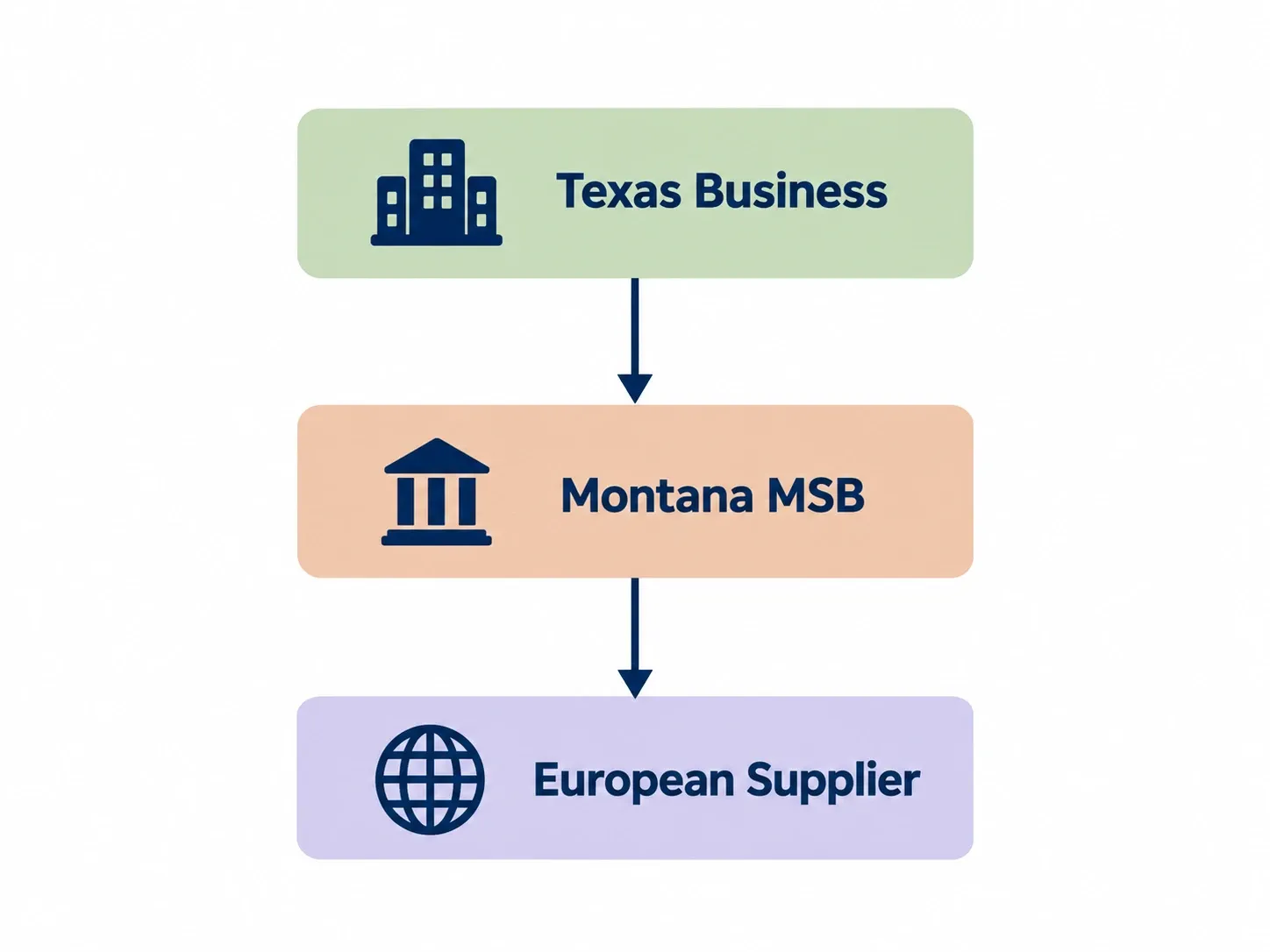
Again, the Montana incorporation does not eliminate the Texas analysis.
The fact that the payment is B2B rather than B2C may affect the facts and risk profile, but it does not create a universal exemption from money transmission law.
What FinCEN “All States” Means
FinCEN Form 107 can report the states in which the registrant says it engages in MSB activities. FinCEN's public registration system also explains how “All States” or “All States & Territories” selections appear.
That is a federal registration disclosure.
It is not a mechanism for FinCEN to issue state licenses.
The same distinction is explained in the existing FinCEN Registration vs. Money Transmitter License resource.
Federal Law Does Not Erase State Licensing
31 U.S.C. § 5330 expressly states that the federal money transmitting business registration requirement does not supersede state-law requirements.
18 U.S.C. § 1960 separately defines an unlicensed money transmitting business to include a business operating without an appropriate state money transmitting license where the applicable state law makes that conduct punishable.
The consequence is straightforward:
FinCEN registration and state authorization are separate compliance questions.
The Four Practical Paths
When another state's law applies, the business usually needs to analyze one of four paths.
1. Obtain the State License
The company applies for its own money transmitter license.
This creates greater independence but can involve:
Application fees;
Surety bonds;
Minimum net worth;
Permissible investment requirements;
Background checks;
Business plans;
Financial statements;
Compliance documentation;
Ongoing reporting;
Examinations.
2. Use an Applicable Exemption
Some business models or transaction structures may fall within a statutory or regulatory exemption.
The exemption must be real and documented. It should not be inferred merely because another company uses a similar label.
3. Operate Under a Licensed Principal
A licensed money transmitter may appoint another business as an authorized delegate or agent where the applicable state framework permits it.
The Authorized Delegate model can provide a faster route to coverage, but the delegate operates within the principal's licensed footprint and compliance framework.
4. Restructure the Flow
In some businesses, the regulated money movement can be performed by a bank, licensed MTO, payment institution, or other principal while the startup remains a software, marketing, marketplace, referral, or technology layer.
Whether that works depends on the actual contract and flow of funds, not the label.
The State Licensing Matrix
A Montana MSB planning a U.S. rollout should maintain a state matrix showing at least:
State | Customers? | Money Flow? | Direct MTL? | Exemption? | Delegate Coverage? | Launch Status |
|---|---|---|---|---|---|---|
Montana | Yes/No | Yes/No | N/A for money transmission regime | N/A | If relevant | Approved / Hold |
California | Yes/No | Yes/No | Review | Review | Review | Approved / Hold |
Texas | Yes/No | Yes/No | Review | Review | Review | Approved / Hold |
Florida | Yes/No | Yes/No | Review | Review | Review | Approved / Hold |
New York | Yes/No | Yes/No | Review | Review | Review | Approved / Hold |
Do not activate a state simply because it has been selected on FinCEN Form 107.
Banks Will Ask About This
Bank examination guidance specifically contemplates banks confirming FinCEN registration and confirming state licensing where applicable.
That means the state matrix is not an academic exercise. It can become part of bank onboarding.
A sophisticated bank may ask:
Which states do you serve?
Which licenses do you hold?
Why do you believe a license is not required in a particular state?
Are you an authorized delegate?
Which licensed principal covers you?
What activities take place in Montana?
Where are customers located?
Where are funds accepted?
The strongest answer is documented, not improvised.
Frequently Asked Questions
Can I serve all 50 states after registering with FinCEN?
No. FinCEN registration is not 50-state money transmitter licensing.
Does having a Montana company exempt me in other states?
No. Each relevant state's law must be analyzed.
If the beneficiary is outside the United States, do state laws still matter?
They can. The U.S. sender/customer side of the transaction may still create state licensing obligations.
Can an authorized delegate solve the problem?
Potentially, in states where the principal is licensed and the structure is permitted. The exact coverage must be documented.
What if I only serve businesses?
B2B status alone should not be assumed to eliminate money transmission licensing. The actual state law, contracts, and flow of funds must be reviewed.
Launch by Approved Footprint, Not by Assumption
A Montana MSB can be a useful starting structure, but its expansion plan should be controlled by a state-by-state licensing matrix rather than the state of incorporation.
Request a State-Coverage Assessment
Send the states in which customers will originate transactions, the proposed flow of funds, and the business model. We can map where direct licensing, an exemption, or licensed-principal coverage may need to be evaluated.