
A Montana-based FinCEN-registered Money Services Business can form one part of a cross-border payment structure. It is not, by itself, a global payment license.
The correct structure depends on where the payer is, where the beneficiary is, who receives or controls the funds, which entity performs FX, which payment institutions are involved, and where regulated money transmission occurs.
Start With the Corridor
A cross-border payment business should be analyzed transaction by transaction.
For example:
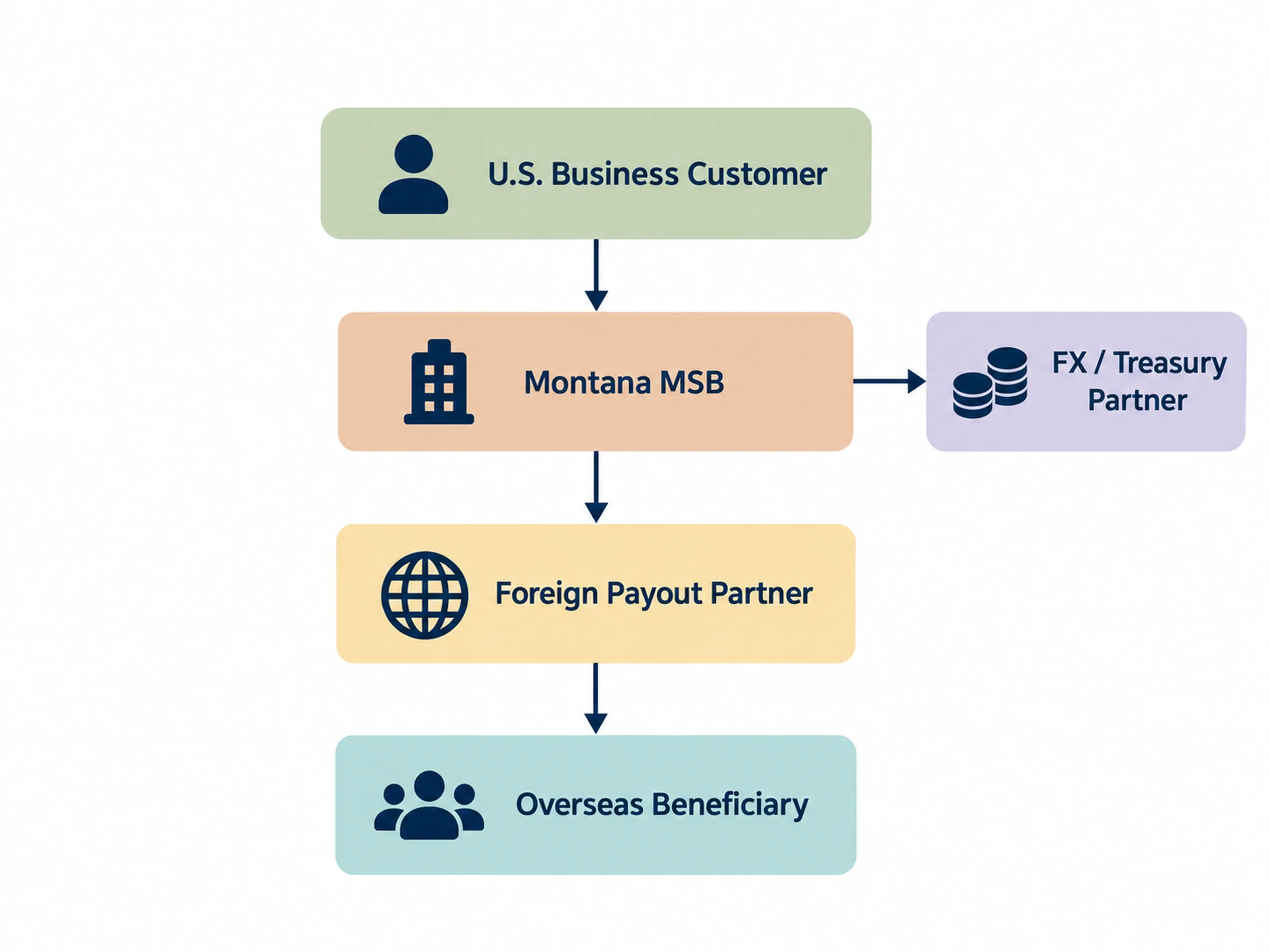
That flow creates at least four separate questions:
Is the Montana company a money transmitter under U.S. federal rules?
Which U.S. state laws apply on the originating side?
What licensing or regulatory status does the foreign payout side require?
Will the banks and counterparties accept the structure?
The Montana answer solves only part of that map.
What Montana Contributes
Montana does not currently operate a state money transmitter licensing regime.
That means a qualifying business whose relevant U.S. activity is properly situated in Montana does not have a Montana MTL application to complete.
The company may still have federal FinCEN registration and BSA/AML obligations.
This distinction between federal MSB status and state licensing is explained in the broader Money Services Business registration and licensing framework.
What Montana Does Not Contribute
A Montana company does not automatically provide:
California, Texas, Florida, New York, or other state authority;
Canadian MSB or RPAA status;
U.K. payment institution or EMI permissions;
E.U. payment institution or EMI authorization;
Money transfer permissions in the beneficiary country;
Correspondent bank approval;
Access to SWIFT, ACH, Fedwire, SEPA, or local payment rails;
A foreign exchange license where one is separately required.
Those are separate parts of the operating model.
U.S.-Originating Cross-Border Payments
Consider:
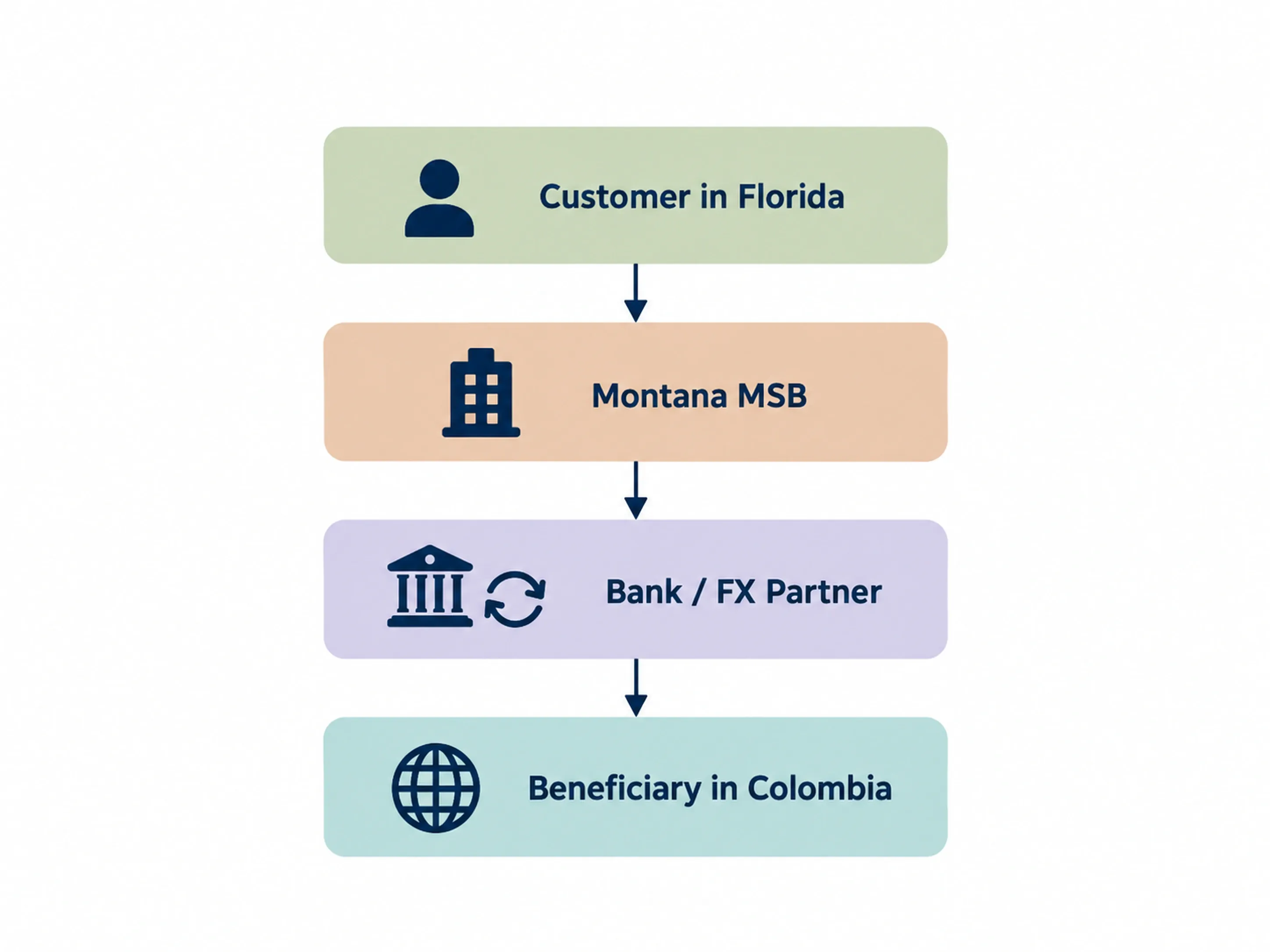
The foreign destination does not make the U.S. state question disappear.
The company must determine whether its interaction with the Florida customer constitutes regulated money transmission under Florida law and what authorization is required.
That is why the state footprint should be mapped before launch.
Foreign-to-Foreign Payments Using a U.S. Entity
Another model may look like:
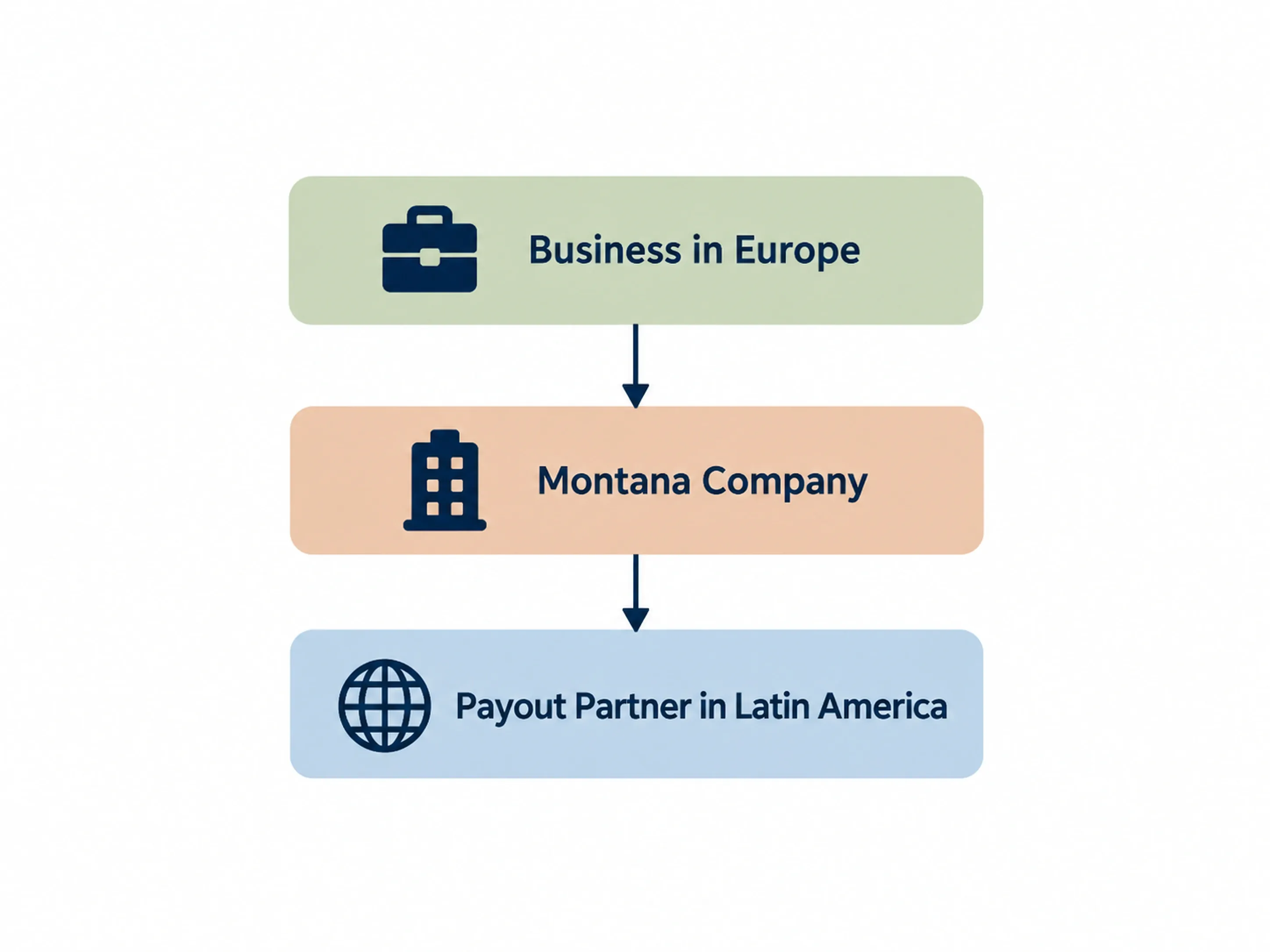
This should not automatically be described as “safe because no U.S. customer is involved.”
The facts can still create U.S. federal, banking, sanctions, tax, contractual, or state-law questions depending on where the business is conducted, which accounts are used, and how the company is connected to the United States.
The foreign jurisdictions also need their own analysis.
Banking and Settlement
A cross-border MSB frequently needs more than an ordinary operating account.
Depending on the business, it may need:
Collection accounts;
Customer-funds accounts;
Settlement accounts;
Named accounts;
FBO structures;
ACH;
Domestic wires;
SWIFT;
FX;
Virtual accounts;
Payout accounts;
Stablecoin settlement;
Local payment rails.
Banks will review the relationship between those accounts and the company's licensing footprint.
The MSB-friendly banking process should therefore be considered at the design stage, not after the payment flow has been fixed.
Foreign Counterparties Will Ask What You Are
A Canadian MSB, U.K. EMI, European PI, payout institution, bank, or NBFI may ask for the company's regulatory status.
The correct diligence description is factual:
U.S. company;
FinCEN-registered MSB, if registered;
Based in Montana;
No Montana MTL because Montana does not issue one;
State permissions mapped separately;
AML/BSA program maintained;
Foreign corridor permissions handled separately.
Do not substitute “Montana MSB license” for that explanation.
Build the Flow of Funds Before the Compliance File
A useful cross-border flow should show:
Legal entities;
Bank accounts;
Payer;
Beneficiary;
Currencies;
FX point;
Payment rail;
Settlement timing;
Fees;
Correspondent or payout partners;
Who has title/control over funds;
Where customer money is held;
Whether funds are pooled;
Whether stablecoins are used;
Who performs customer due diligence.
That diagram is often more useful to a bank or regulator than several pages of marketing language.
Cross-Border AML/BSA Issues
International payments can increase exposure to:
Sanctions;
High-risk jurisdictions;
Nested relationships;
Third-party payments;
Agent risk;
Source-of-funds concerns;
Beneficiary opacity;
Fraud;
Trade-based money laundering;
Crypto wallet risk;
Unusual FX patterns.
The MSB's AML/BSA program should therefore be tailored to the corridors and counterparties actually used.
Frequently Asked Questions
Can a Montana MSB send money internationally?
A FinCEN-registered Montana-based MSB can be part of an international payment model, but the specific U.S. state and foreign-jurisdiction requirements must be analyzed.
Does Montana replace the payout-country license?
No.
What if all customers are outside the United States?
That changes the analysis but does not automatically eliminate U.S. obligations or foreign licensing requirements.
Can I use stablecoins for settlement?
Potentially, but the use of stablecoins can create additional money transmission, sanctions, blockchain-monitoring, custody, and counterparty questions.
Will a foreign bank accept my FinCEN registration?
Some counterparties may accept a FinCEN-registered MSB structure for a particular relationship; others may require a state-issued license or another regulatory status. It is an underwriting decision.
Build the Corridor as a Regulatory Chain
For cross-border payments, the correct model is not “one license covers the world.” It is a chain of legally and operationally compatible entities, accounts, permissions, controls, and counterparties.
Request a Cross-Border MSB Assessment
Send one representative transaction set showing the payer, beneficiary, currencies, U.S. state, destination country, payment rails, accounts, and counterparties. We can map the regulatory and banking chain around it.