

Alternative payments are payment methods other than traditional card (Visa, Mastercard, Amex) and standard bank wire. They include everything from local bank transfer schemes like iDEAL in the Netherlands and Pix in Brazil, to cash-based voucher systems like Boleto in Brazil and OXXO in Mexico, to buy now pay later solutions, to mobile money across Africa and South Asia, to QR code payment apps across Southeast Asia. In most markets, alternative payments are not actually alternative at all: they are the primary payment method for significant portions of the customer base. For businesses operating internationally, understanding and accepting alternative payments is the difference between serving a market and missing most of it. Faisal Khan LLC advises businesses on alternative payment strategy, connects them to local payment method acceptance infrastructure, and helps structure the commercial and technical integration of alternative payment methods across international markets.
Why Alternative Payments Are Non-Optional for International Businesses
The framing of "alternative" payments as a secondary consideration is a Western card-centric bias that costs international businesses real revenue.
Consider: In the Netherlands, iDEAL (a bank transfer-based online payment system) accounts for over 60% of all online transactions. A Dutch e-commerce customer who lands on a checkout page with only Visa and Mastercard is likely to abandon the purchase. In Brazil, Boleto Bancario (a cash payment voucher) is used by tens of millions of Brazilians who are unbanked or simply prefer the payment method. Pix, Brazil's real-time payment system, has become the dominant payment method for all transaction sizes since its 2020 launch. In Germany, SOFORT and Giropay enable direct bank transfer payments that a significant portion of online shoppers prefer to card payments.
The pattern repeats in market after market: local payment methods reflect real customer preferences, not just the absence of cards. Accepting them is not optional for businesses that want to compete in these markets.
Major Alternative Payment Methods by Region
Latin America: Pix (Brazil): Real-time bank transfer system operated by Brazil's central bank. Free, instant, 24/7. Now the dominant payment method in Brazil across all demographics and business sizes.
Boleto Bancario (Brazil): Cash payment voucher printable at any bank or lottery house. Widely used by unbanked customers and those who prefer not to use cards online.
OXXO (Mexico): Cash payment at OXXO convenience stores. Allows customers to pay online and then settle cash at any of 20,000+ OXXO locations across Mexico.
Mercado Pago (Latin America): The dominant digital wallet and payment platform across Argentina, Brazil, Mexico, and other Latin American markets.
Europe: iDEAL (Netherlands): Bank transfer-based online payment. Dominant in the Netherlands. Requires integration with Dutch banking infrastructure.
SOFORT / Klarna Pay Now (Germany, Austria, Switzerland): Bank transfer payment with real-time confirmation. Widely used in German-speaking markets.
Bancontact (Belgium): National debit card and bank transfer scheme. Dominant for Belgian domestic payments.
Swish (Sweden): Mobile payment app linked to Swedish bank accounts. Dominant for peer-to-peer and many merchant payments in Sweden.
Southeast Asia: GrabPay (Singapore, Malaysia, Philippines, Vietnam): Regional super-app wallet with significant payment market share.
GCash (Philippines): The dominant mobile wallet in the Philippines with over 60 million users.
OVO and GoPay (Indonesia): Competing mobile wallets with significant market share in Indonesia's rapidly growing digital payment market.
PromptPay (Thailand): Central bank-operated real-time payment system. Dominant for domestic payments.
Middle East: STC Pay (Saudi Arabia): Telco-operated mobile wallet with significant market share.
Mada (Saudi Arabia): Saudi Arabia's national debit card and payment network.
Fawry (Egypt): Multi-channel payment platform with widespread cash payment acceptance network.
Buy Now Pay Later: The Global Alternative Payment Trend
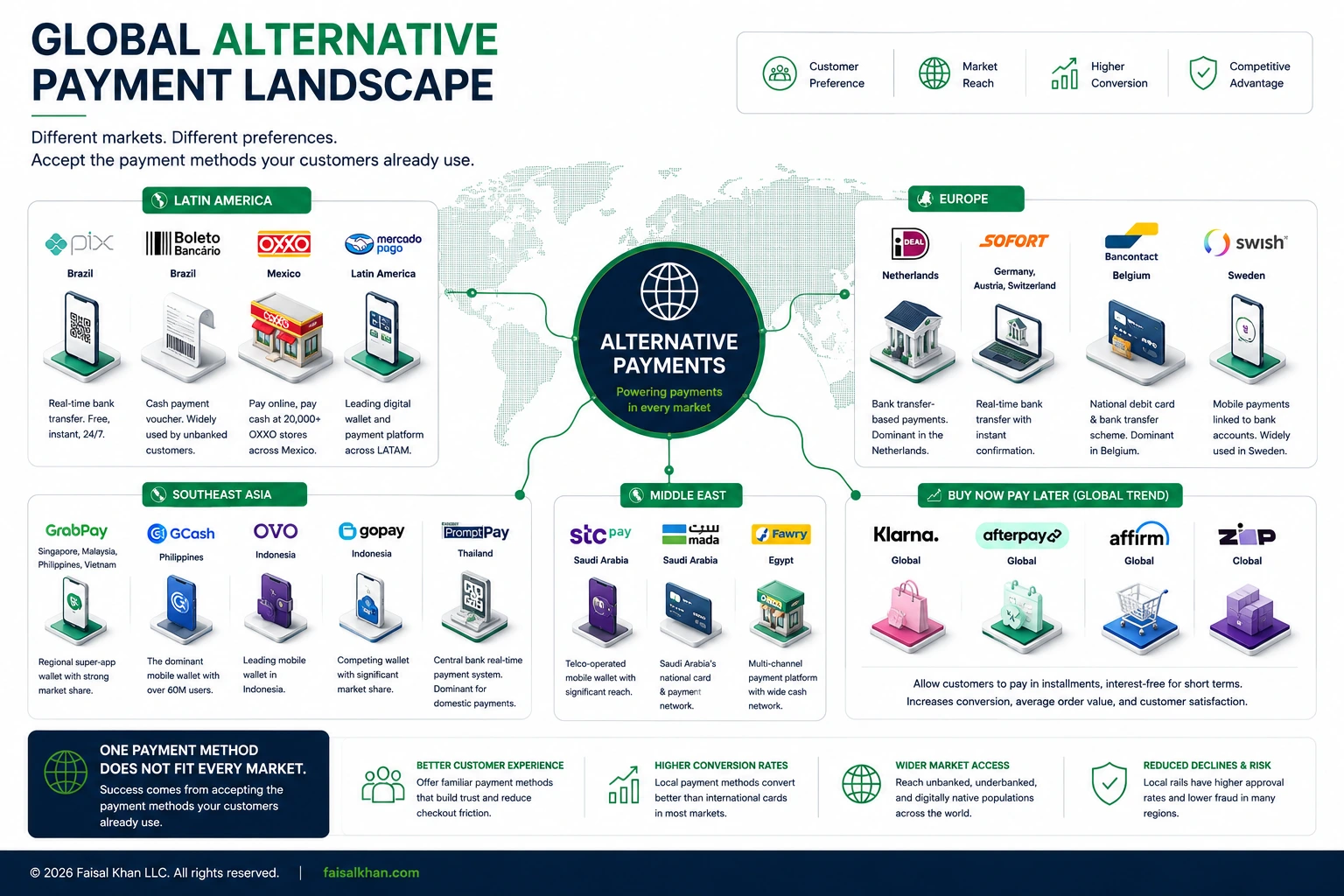
Buy Now Pay Later (BNPL) has become one of the most significant alternative payment trends globally. BNPL allows consumers to split purchases into installments, typically interest-free for short terms. Major providers include Klarna, Afterpay (Block), Affirm, Zip, and dozens of regional alternatives.
For merchants, offering BNPL increases average order values, improves conversion rates (particularly for higher-ticket items), and reaches customers who prefer to spread payments without using a credit card. The BNPL provider typically pays the merchant upfront (minus a merchant fee of 2% to 8%) and takes on the installment collection from the customer.
For international merchants, BNPL provider coverage is patchy. Klarna is strongest in Europe and increasingly the US and Australia. Afterpay is strong in Australia, the US, UK, and Canada. Regional BNPL providers dominate in Southeast Asia, Latin America, and the Middle East.
Regulatory scrutiny of BNPL has increased globally as consumer advocates raise concerns about debt accumulation. Several jurisdictions (UK, Australia, EU) are moving toward formal BNPL regulation. Businesses accepting BNPL should monitor the regulatory trajectory in markets where they rely on it significantly.
Integrating Alternative Payments: Technical and Commercial Considerations
Payment orchestration platforms: Rather than integrating with each alternative payment method individually, payment orchestration platforms (Checkout.com, Rapyd, Nuvei, and others) aggregate multiple payment methods behind a single API. This significantly reduces integration complexity for merchants wanting broad alternative payment coverage.
Local payment method aggregators: Specialist providers focus on aggregating local payment methods in specific regions (for example, dLocal for Latin America and Africa, 2C2P for Southeast Asia). These are often more cost-effective and have better local coverage than global orchestration platforms for specific regions.
Compliance and regulatory considerations: Each alternative payment method operates within a specific regulatory framework in its home market. Cash voucher systems have anti-money laundering obligations. BNPL is subject to consumer credit regulation in some jurisdictions. Mobile money is regulated as payment services. Understanding the compliance implications of each payment method is part of the integration picture.
Settlement in local currency: Alternative payment method acceptance often settles in local currency. For businesses that primarily operate in USD or EUR, managing multi-currency settlement adds treasury complexity. Payment orchestration platforms typically offer currency conversion and settlement consolidation services.
We advise businesses on alternative payment strategy, connect them to payment orchestration platforms and regional payment aggregators appropriate for their geographic footprint, and help them understand the compliance implications of specific alternative payment methods.
Frequently Asked Questions
How do I know which alternative payment methods I need to accept?
Start with your traffic data. Where are your customers located? Then research the dominant payment methods in each of those markets. The payment methods that are non-negotiable (iDEAL in the Netherlands, Pix in Brazil, GCash in the Philippines) will be clear. Prioritize by the revenue at stake in each market. We advise on payment method strategy for specific geographic and demographic customer profiles.
Is accepting alternative payments more expensive than card acceptance?
It depends on the method. Many alternative payment methods (Pix in Brazil, Faster Payments in the UK, SEPA in Europe) carry flat fees that are significantly cheaper than card interchange, especially at higher transaction values. BNPL is generally more expensive than card acceptance (2% to 8% merchant fee versus 1.5% to 3% for cards). The right comparison is not just cost but also the conversion and average order value benefit of offering the method.
Can I accept alternative payments without a local entity in each country?
Yes, in most cases. Payment orchestration platforms and regional aggregators handle the local banking and licensing requirements on your behalf. You integrate with their API and they handle the local payment method infrastructure. For some payment methods (especially bank transfer-based ones in regulated markets), the aggregator's local presence is essential for the integration to work.
What is a closed-loop versus open-loop payment method?
A closed-loop payment method is one that only works within a specific network or ecosystem (Starbucks points, store gift cards, some e-wallet systems). An open-loop method can be used anywhere the network is accepted (Visa, Mastercard, most bank transfer systems). Most alternative payments that matter for international commerce are open-loop, but closed-loop methods are relevant for specific loyalty and marketplace applications.
Accept the Payment Methods Your Customers Actually Use
Alternative payments are where significant portions of your international customer base want to pay. Businesses that accept only cards serve only the card-paying segment, which in many markets is a minority. Faisal Khan LLC advises on alternative payment strategy, connects businesses to payment orchestration and regional payment aggregation infrastructure, and helps them navigate the technical and compliance requirements of adding local payment methods across international markets. Your customers have already chosen how they want to pay. The question is whether your checkout is ready to accept it.