

B2B payments are the financial backbone of global commerce. Every purchase order settled between businesses, every cross-border invoice paid, every supplier relationship funded through a payment transfer is a B2B payment. And yet for many businesses, especially those operating internationally, B2B payments remain slow, expensive, opaque, and frustratingly difficult to get right. The correspondent banking system that powers most international B2B payments was built for a different era. Banks add fees, intermediaries deduct charges, exchange rates carry hidden markups, and the status of a payment can be unclear for days. Faisal Khan LLC advises businesses on how to build better B2B payment infrastructure, connects them to the payment rails, banking partners, and technology providers that make cross-border business payments faster and more cost-effective, and helps companies navigate the licensing and compliance requirements that come with operating international payment flows at scale.
What Makes B2B Payments Different From Consumer Payments
B2B payments differ from consumer payments in ways that fundamentally change the infrastructure, compliance requirements, and commercial dynamics involved.
Transaction size: B2B transactions are typically much larger than consumer transactions. A single B2B payment might be USD 50,000, USD 500,000, or more. At these values, basis point differences in FX rates represent real money, and payment delays have material cash flow consequences.
Counterparty verification: B2B payments involve verified legal entities on both sides. Paying the wrong entity, missing a payment due to incorrect bank details, or having a payment returned creates commercial and legal consequences that go far beyond the inconvenience of a failed consumer transaction.
Payment terms and timing: B2B payments operate on negotiated payment terms (net 30, net 60, letters of credit, advance payment). The payment infrastructure must support scheduled payment execution, partial payments against invoices, and reconciliation against purchase orders and invoices.
Compliance requirements: Large B2B payments, particularly international ones, trigger enhanced due diligence requirements. Banks subject large international business transfers to OFAC screening, correspondent bank compliance review, and in some cases, source of funds documentation. These requirements are manageable but must be planned for.
Multi-currency and multi-jurisdictional complexity: B2B trade between international counterparties involves multiple currencies, multiple banking systems, multiple regulatory frameworks, and often multiple correspondent banks in the payment chain.
The Main Channels for International B2B Payments
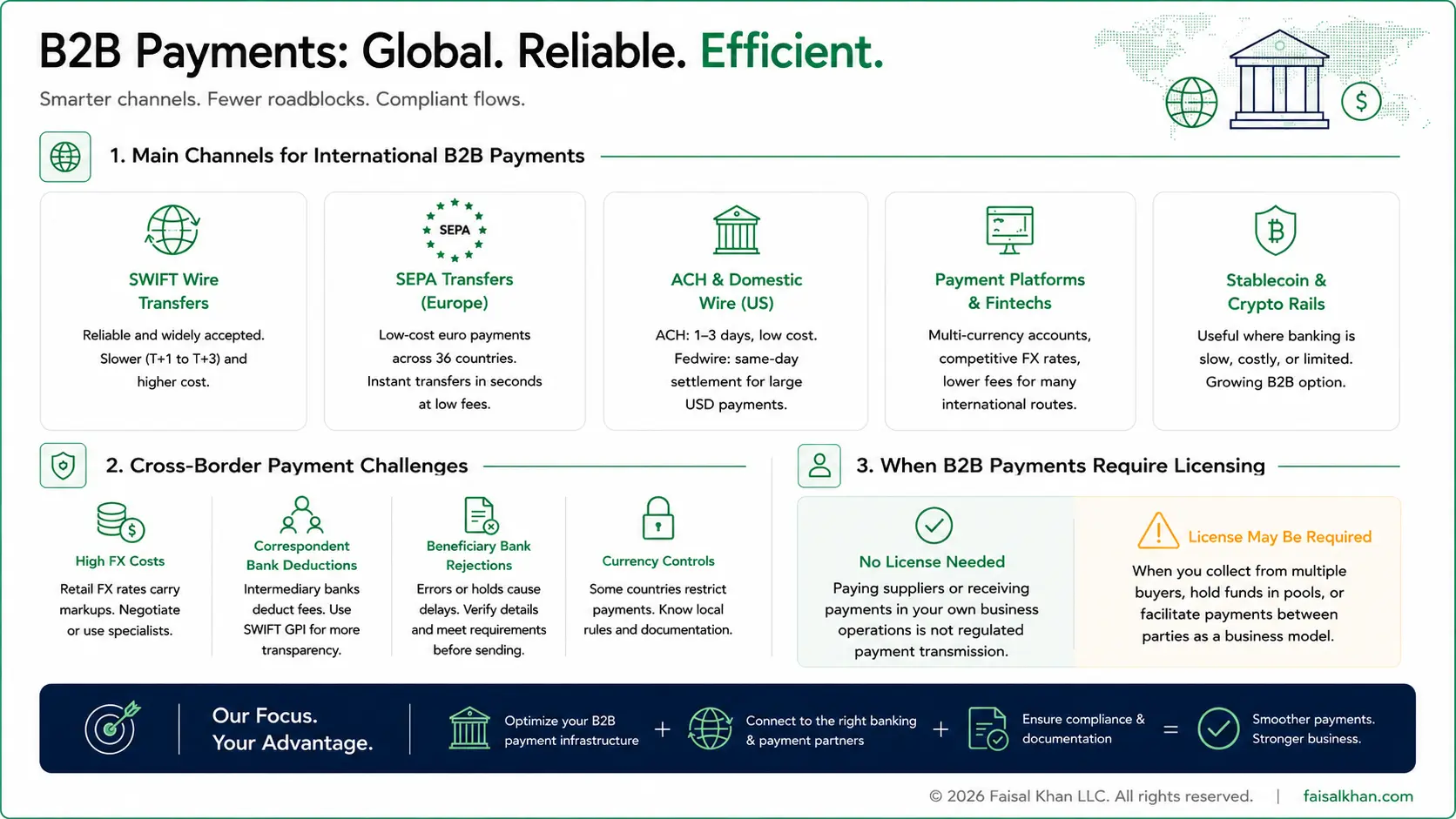
SWIFT wire transfers: The dominant channel for large international B2B payments. Reliable, widely accepted, with established settlement finality. But slow (T+1 to T+3 typical, longer if correspondent complications arise), expensive (USD 15 to USD 45 or more in bank fees per wire, plus potential intermediary deductions), and opaque without SWIFT GPI tracking.
SEPA transfers (Europe): For B2B payments within the EU/EEA, SEPA Credit Transfer and SEPA Instant Credit Transfer provide low-cost, euro-denominated payments across 36 countries. SEPA Instant can settle in seconds at flat fees of a few cents. For businesses with significant European counterparties, SEPA access is a material cost advantage.
ACH and domestic wire (US): For USD B2B payments within the United States, ACH (automated clearing house) transfers are the standard for routine payments (1 to 3 day settlement, very low cost). Fedwire provides same-day, real-time settlement for large-value payments. Businesses sending or receiving large USD amounts internationally often settle the final domestic leg via Fedwire.
Payment platforms and fintechs: Wise Business, Airwallex, Payoneer, and similar platforms have built multi-currency business payment infrastructure on top of licensed banking relationships globally. They offer businesses competitive FX rates and lower fees than traditional bank wire for many international payment routes. These are not replacements for banking relationships at high volumes, but they serve many mid-market B2B payment needs effectively.
Stablecoin and crypto rails: For specific corridors where traditional correspondent banking is slow, expensive, or unavailable, stablecoin settlement (USDT, USDC) is increasingly used for B2B settlement. We cover this in detail across our crypto and stablecoin infrastructure pages.
Cross-Border B2B Payment Challenges and How to Address Them
High FX costs: Banks typically offer B2B clients retail FX rates with significant markups. Businesses with regular large international payments should negotiate FX pricing directly with their bank or use a specialist FX provider. The difference between retail and wholesale FX pricing on a USD 1 million monthly payment flow can be tens of thousands of dollars per year.
Correspondent bank deductions: International SWIFT wires often travel through one or more correspondent banks before reaching the recipient. Each correspondent may deduct its own fee from the payment amount, meaning the recipient receives less than the sender instructed. SWIFT GPI (Global Payment Innovation) has improved transparency and, to some extent, reduced deductions, but the problem has not been fully solved by the banking system.
Beneficiary bank rejections: Banks in receiving countries reject international wires for various reasons: incomplete beneficiary details, AML holds, compliance review triggers, or technical formatting errors in the SWIFT message. Each rejection delays payment and may incur return fees. Building a library of verified beneficiary account details, using a payment platform that validates beneficiary details before sending, and understanding the documentation requirements for large transfers in specific countries all reduce rejection rates.
Currency controls: Some countries impose restrictions on cross-border payments: mandatory central bank approval for large transfers, requirements to use specific correspondent banks, or restrictions on the currencies in which payments can be made. Businesses with significant payment flows to controlled currency markets need specific expertise in navigating these requirements.
We advise businesses on how to optimize their B2B payment infrastructure, connect them to banking and payment platform partners appropriate for their payment volumes and corridors, and help them understand the compliance and documentation requirements for large international transfers.
When B2B Payments Require Licensing
Most businesses making or receiving B2B payments as part of ordinary commercial operations do not need payment licensing. You pay your supplier; they receive the funds. This is commercial trade, not regulated payment transmission.
Licensing becomes relevant when your business is in the flow of funds on behalf of others: when you collect payments from multiple buyers and remit to multiple sellers, when you hold funds in a pool account before disbursing, or when you facilitate payment flows between parties as a business model rather than as an operational necessity.
If your B2B business model involves payment facilitation, marketplace payment handling, or intermediary positions in the payment flow, licensing obligations very likely apply. We advise on where these lines fall and connect businesses to the licensing and compliance infrastructure they need.
Frequently Asked Questions
What is the cheapest way to make a large international B2B payment?
For most large international B2B payments, the combination of competitive FX pricing (negotiated directly with a bank or via a specialist FX provider) and SWIFT GPI-enabled wire transfer is the most practical and cost-effective approach. For specific corridors where stablecoin settlement is available and the counterparty accepts it, blockchain-based settlement can offer further cost reduction. The right answer depends on the specific corridor, the counterparty's banking infrastructure, and your transaction frequency and volume.
How long does an international B2B wire transfer take?
Standard international SWIFT wire: typically T+1 to T+3 working days from initiation to credit in the recipient's account. SWIFT GPI has reduced this to same-day for many major currency pairs between correspondent-connected banks. Payments to less-served markets or involving multiple correspondents can take longer. Some fintech payment platforms offer faster settlement on specific routes by using local clearing rather than SWIFT.
Do I need to declare large B2B wire transfers to regulators?
In the US, businesses (not just banks) have reporting obligations for certain cross-border transactions. Financial institutions are required to file CTRs for cash transactions over USD 10,000 and SARs for suspicious activity. Large international wire transfers may trigger bank-side compliance review, and depending on the country pair, regulatory reporting may be required in the sending or receiving jurisdiction. We advise on the regulatory reporting landscape for specific payment scenarios.
Can I use a personal bank account for B2B payments?
Using personal accounts for business payment flows is inadvisable and in many cases a violation of banking terms of service and regulatory requirements. Businesses handling B2B payment flows need dedicated business accounts, and at higher volumes, dedicated accounts with compliance infrastructure appropriate to their payment activity.
Build B2B Payment Infrastructure That Actually Works
B2B payments at scale require the right banking relationships, the right FX infrastructure, the right technology, and the right compliance posture. Whether you are a manufacturer paying international suppliers, a marketplace facilitating buyer-seller settlements, a fintech building B2B payment products, or a business frustrated with the cost and opacity of your current international payment setup, Faisal Khan LLC can advise, connect, and help. We have spent years working across cross-border payment infrastructure and know which banks, platforms, and rails work for specific B2B payment flows. We do not provide payment services directly. We connect you to the right partners and help you build infrastructure that serves your business for the long term.