

IRS tax refund payments represent one of the most specific and commercially interesting niches in the US payment services industry. Every tax season, the Internal Revenue Service processes over 100 million individual tax returns and disburses hundreds of billions of dollars in refunds to American taxpayers. The infrastructure through which these refunds reach taxpayers, from direct deposit to prepaid card to refund transfer products, involves licensed banking institutions, payment processors, tax preparation companies, and specialized fintech operators working within a tightly regulated framework. For businesses that want to participate in the tax refund payment ecosystem, understanding how IRS tax refund payments work, what licenses and banking relationships are required, and what the commercial structures look like is the starting point. Faisal Khan LLC advises businesses on how to enter and operate within the IRS tax refund payment space and connects them to the banking, licensing, and operational infrastructure they need.
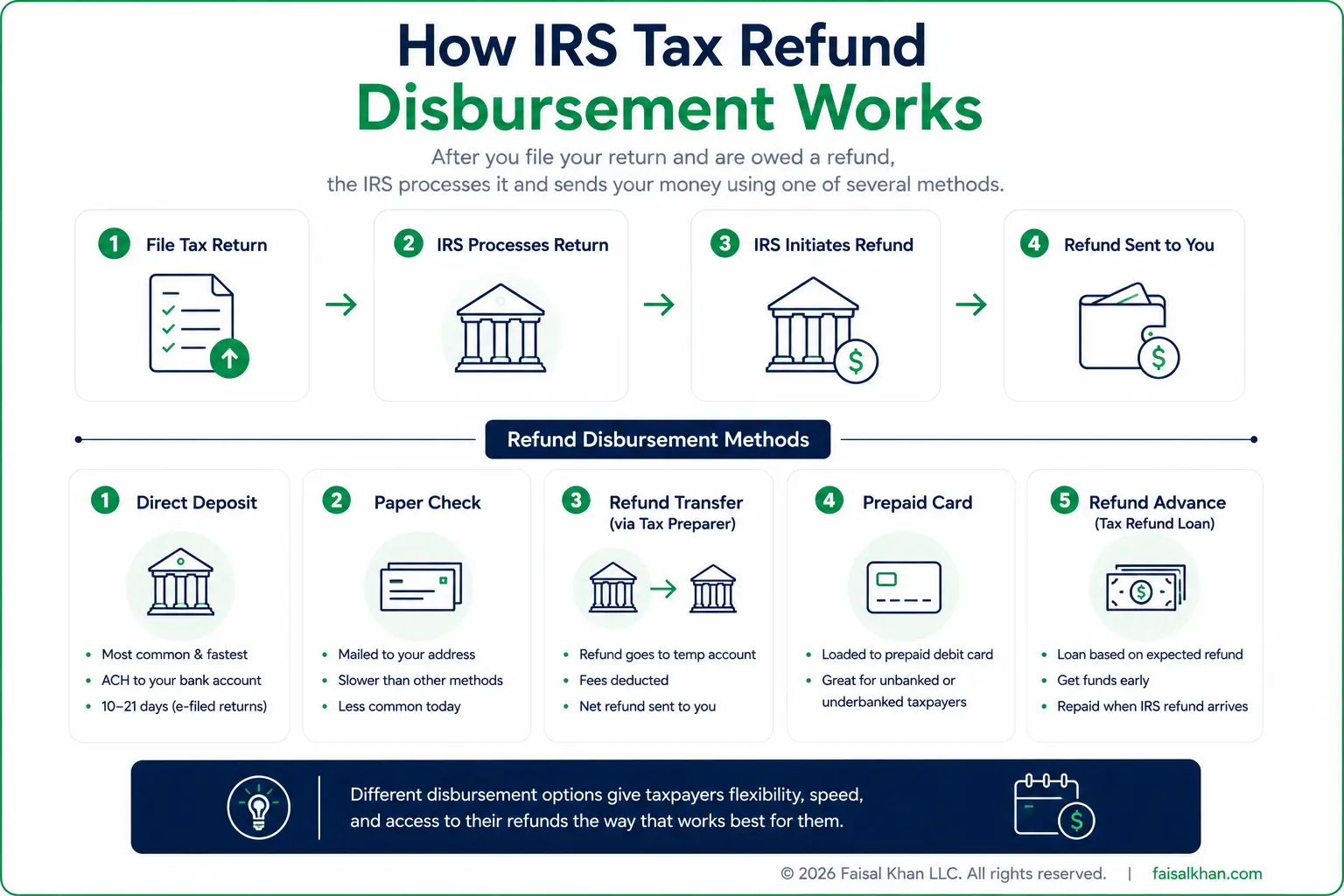
How IRS Tax Refund Disbursement Works
When a taxpayer files their return and is owed a refund, the IRS processes the return and initiates disbursement through one of several channels:
Direct deposit: The most common method. The taxpayer provides their bank account number and routing number on their return. The IRS transmits the refund via ACH directly to the designated account. Fast (typically 10 to 21 days from filing for electronically filed returns) and free.
Paper check: The IRS mails a physical check to the taxpayer's address on file. Slower and increasingly uncommon as direct deposit adoption has grown.
Refund Transfer products: A tax preparer-facilitated disbursement where the refund is first deposited into a temporary bank account established by the tax preparer's banking partner. Tax preparation fees are deducted from this account, and the net refund is then disbursed to the taxpayer via direct deposit, prepaid card, or check. This structure allows taxpayers to pay tax preparation fees out of their refund rather than upfront.
Prepaid card disbursement: The refund is loaded directly onto a prepaid debit card. This is particularly valuable for taxpayers who are unbanked or underbanked and cannot receive direct deposit. Several major financial institutions offer IRS prepaid card programs specifically for refund disbursement.
Refund Advance (tax refund loan) products: A short-term loan equal to some portion of the anticipated refund, extended by a banking partner of the tax preparer after the return is filed but before the IRS processes it. When the IRS refund arrives, it repays the loan. These products allow taxpayers to access refund funds before the IRS processes their return.
The Regulated Participants in the Tax Refund Payment Ecosystem
The tax refund payment industry involves several types of regulated entities:
FDIC-insured banks or credit unions: The financial institutions that receive IRS refund ACH deposits, hold the temporary accounts for refund transfer products, extend refund advance loan products, and issue prepaid cards for refund disbursement. These institutions hold the banking charter and the federal regulatory relationships that allow them to participate directly in IRS disbursement.
Tax preparation companies: The companies (H&R Block, Jackson Hewitt, Liberty Tax, and thousands of independent tax preparers) that prepare returns and offer refund transfer and refund advance products to customers. They partner with bank partners to offer these products under the bank's license.
Payment processors and disbursement specialists: Companies that handle the ACH processing, prepaid card loading, and back-office settlement for refund transfer and refund advance programs on behalf of bank and tax preparer partners.
Program managers: Fintech companies that design and manage prepaid card programs used for tax refund disbursement, operating as program managers under banking partner sponsor banks.
How to Enter the Tax Refund Payment Industry
The tax refund payment industry is not open to unregulated entities. The IRS only transmits refunds to accounts at FDIC-insured institutions. Participating in the tax refund disbursement ecosystem requires either being a licensed banking institution or partnering with one.
For banks and credit unions: Participating in IRS refund direct deposit is straightforward if you are a participating ACH member. More sophisticated products like refund transfer and refund advance require specific program design, compliance infrastructure, and consumer credit licensing (for advance products). We advise banking institutions on how to build or expand their tax season product offerings.
For fintech companies and payment operators: Entering the tax refund payment space requires a banking partner willing to serve as the FDIC-insured institution behind the product. As a fintech or payment operator, you can design the product, manage the customer experience, and handle the distribution (through a tax preparation partner), while the bank holds the accounts and issues the disbursement. This is a Banking-as-a-Service (BaaS) structure applied to the tax refund use case.
For tax preparation companies: Offering refund transfer and refund advance products requires a bank partner agreement. The economics are significant: refund transfer fees average USD 30 to USD 60 per return, and at scale, these products represent a meaningful revenue line for tax preparers.
For prepaid card program managers: The IRS prepaid card space requires a bank sponsor, a card network agreement (Visa or Mastercard), a card processor, and compliance infrastructure including KYC of cardholders and AML monitoring. Program managers with existing prepaid card infrastructure can extend their programs to the tax refund use case with appropriate bank partner agreements.
Compliance and Regulatory Framework
The tax refund payment industry operates within a strict regulatory framework:
IRS ERO and ACH requirements: Tax preparers participating in IRS e-file (Electronic Return Originators) must meet IRS requirements. The ACH network has its own rules for tax refund deposits. Banks receiving IRS refunds must be ACH members.
Consumer financial protection: Refund advance products are consumer credit products subject to TILA (Truth in Lending Act) disclosure requirements and state consumer credit regulations. The CFPB monitors refund advance products closely. Prepaid card products are subject to Regulation E and the CFPB's prepaid account rule.
State licensing: Depending on the specific structure of the product (refund advance is a consumer loan), state consumer lending licenses may be required in states where the product is offered.
AML/BSA: Banks issuing prepaid cards for tax refund disbursement are subject to BSA/AML obligations and must conduct KYC on cardholders.
We advise businesses entering the tax refund payment space on the regulatory framework, connect them to bank partners and compliance infrastructure providers, and help them structure products that meet both regulatory requirements and consumer protection standards.
Frequently Asked Questions
Can a non-bank company receive IRS refund deposits directly?
No. The IRS only deposits tax refunds to accounts at FDIC-insured depository institutions. A non-bank company must partner with a bank to receive IRS refund deposits. This is the foundational constraint that shapes the entire industry structure.
What is a refund transfer product and how does it make money?
A refund transfer (sometimes called a Refund Anticipation Check or RAC) is a product where the tax preparer's bank partner opens a temporary account to receive the taxpayer's refund, deducts the tax preparation fee, and then disbursed the net refund to the taxpayer. The bank and tax preparer share the product fee (typically USD 30 to USD 60). No credit is extended; the bank is simply holding and disbursing a payment. This makes it a payment product rather than a loan product, with less regulatory complexity than refund advance.
What is the tax season opportunity for payment operators?
Tax season (January through April) represents a concentrated, predictable surge in refund disbursement volume. Prepaid card programs optimized for tax season see significant card loading during this window. Payment operators who build infrastructure for tax refund disbursement access a recurring, high-volume window each year. The demographic served (underbanked taxpayers, low-income households) is also underserved by mainstream financial products, creating genuine long-term customer relationships beyond tax season.
Does operating a tax refund payment product require a money transmitter license?
The refund transfer product typically does not require a money transmitter license because the bank partner holds the funds and the tax preparer is acting as the bank's agent. Prepaid card programs may require state licensing depending on the structure. Refund advance loan products require consumer lending licenses in most states. The specific licensing requirements depend on the product design and the states where it is offered. We advise on the licensing analysis for specific product structures.
Enter the IRS Tax Refund Payment Market With the Right Partnerships
The IRS tax refund payment industry is concentrated, regulated, and dominated by established players, but there is genuine opportunity for well-positioned entrants with the right bank partnerships, compliance infrastructure, and distribution relationships. Faisal Khan LLC advises businesses on how to structure participation in the tax refund payment ecosystem, connects them to banking partners willing to sponsor tax season programs, and helps them understand the regulatory and compliance requirements that the space demands. If you are building a tax refund product, launching a prepaid card for the unbanked tax filer market, or seeking to offer refund transfer products through a tax preparation distribution network, we can help you structure the right approach.