

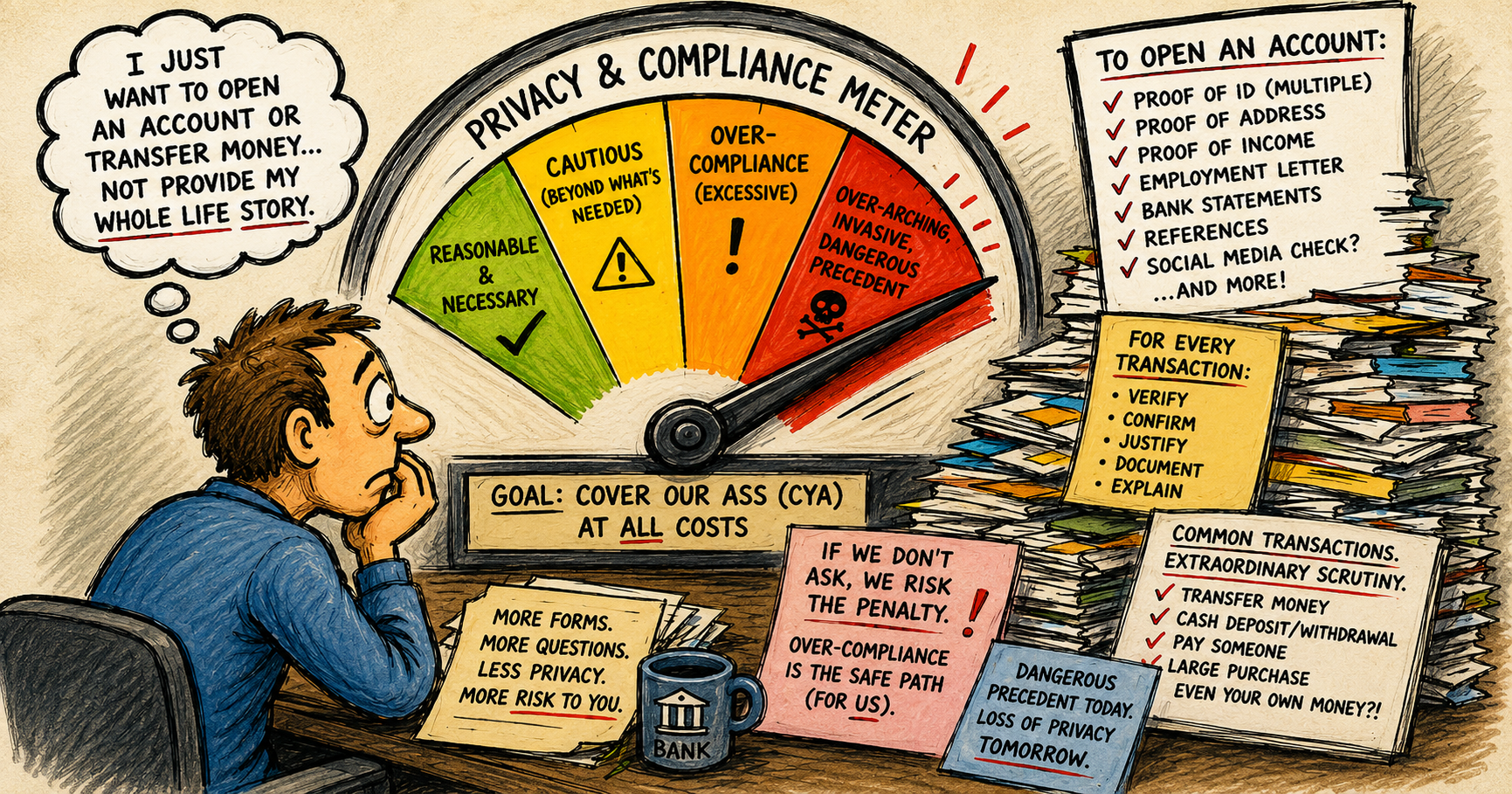
Banks question you for withdrawing your own cash, hold your wires for days with no explanation, and face zero consequences when they blow up the economy.
Let’s start with a simple idea.
You go to work. You get paid. The money is yours. You earned it. And now you want to spend it, move it, withdraw it, or send it to someone.
At what point did that become something you need to justify?
Because right now, in 2026, in some of the wealthiest and most developed economies on the planet, you can walk into a bank, ask to withdraw a large sum of your own money, and a teller will look at you and start asking questions. Not security questions. Not identity verification. Questions about what you are going to do with your own cash. Why you need it. Where it is going. What it is for.
A teller. Asking you to justify your own withdrawal.
I want to sit with that for a second, because people in this industry have become so used to it that they no longer hear how insane it sounds.
The U-Haul Analogy
Here is the closest comparison I can think of.
You are moving house. You pack up a truck. You start carrying boxes out. And the moment you try to leave with your own belongings, a police officer pulls you over and says: where are you going? Why are you moving? Where is your new place? Can I see the lease? Can I see proof that these boxes belong to you? Park the truck over here until we check everything out.
You would be outraged. You would call a lawyer. You would call the press. It would be a news story.
That is exactly what happens when you try to move large sums of your own money. The same invasiveness. The same presumption of guilt. The same demand for documentation before you are allowed to do something completely legal with what belongs to you.
The only difference is that in banking, this is normal. We have been trained to accept it.
Where This Started
This did not come from nowhere. It started in the United States, decades ago, with legitimate concerns about drug money moving through the banking system. The logic was reasonable at the time: flag unusual cash transactions, monitor suspicious activity, build a paper trail.
What happened over the following decades is that the monitoring apparatus grew, the thresholds dropped, the definitions of suspicious expanded, and the banks discovered something very useful. Compliance gave them cover. Any transaction they did not want to process, any customer relationship they found inconvenient, any payment type that carried even theoretical risk: compliance. Done. No further explanation required.
And the banks lobbied hard, consistently and successfully, to make sure that when something did go wrong inside their pipelines, they were not the ones holding the bag. They built the legal architecture that protects them from accountability while giving them almost unlimited discretion over whose money they will handle and on what terms.
That is not regulation. That is a protection racket with better furniture.
The Rules Nobody Can Show You
Here is what I find particularly maddening.
You go to a bank. You want to receive a third-party payment. Someone who has a fully verified, KYC’d account wants to send money to your fully verified, KYC’d account. Two identified parties. Clean accounts on both sides. Standard transaction.
The bank says no.
I wrote an article on this: Your Account is Blocked. No One Will Tell You Why.
You ask where it says that is not allowed. They cannot show you a law. They cannot point to legislation. What they can do is cite their internal risk policy, their own internal yellow card and red card system, their own referee’s whistle. It is their house. Their rules. And their rules say this is too risky.
Think about what that means. We live in a world where you can receive an email from a stranger. You can get a package delivered from someone you have never met. You can accept cash from anyone on the street. But accepting a digital payment from a KYC’d account into another KYC’d account is considered risky because the bank does not want to invest in understanding the origination.
They would rather ban the transaction than do the work. And the law lets them.
The Double Standard Is Not Subtle
You take money out of an ATM and the machine accidentally gives you two hundred dollars extra. You walk away with it. That is a felony. They will call you the next morning. You will be required to return it immediately.
The bank holds your incoming wire transfer for eleven days. No interest. No explanation. No compensation. No accountability whatsoever.
You made a mistake with their money: criminal liability, immediate consequences, zero tolerance.
They made a mistake with your money: process it at their own pace, take as long as they like, and when they are done inconveniencing you, they will not apologize and they will certainly not pay you for the time they had use of your funds.
The system is not broken. It is working exactly as designed, and it was not designed with you in mind.
When They Blow Up the Economy
The 2008 financial crisis. Collateralized debt obligations sold to the world as safe assets while the people packaging and selling them knew they were garbage. A global financial catastrophe that destroyed millions of lives, wiped out savings, collapsed housing markets, and required governments to step in with public money to save the institutions responsible.
Name five people who went to prison.
You cannot. Because nobody did. The people who ran those institutions collected enormous severance packages, took a couple of years off, and returned to finance. Some of them were hired to advise on the very regulations passed in response to the crisis they caused.
That is not a justice system. That is a club protecting its members.
Contrast that with what happens to a small business owner who accidentally receives a mislabeled wire transfer, or a customer who misses a compliance reporting deadline on a personal account. The consequences are swift, documented, and often career-ending.
One standard for the cartel. Another standard for everyone else.
The Toothpick Problem
Here is how I think about the power dynamic.
The entire banking and financial system is a massive structure. And it is supported by billions of individual customers, each one a toothpick in the foundation. You and me. Our deposits, our transaction fees, our overdraft charges, our currency exchange margins, our wire fees. All of it flowing upward, constantly, into that structure above.
If you leave, it does not matter. There are billions more toothpicks exactly like you. You are replaceable. You are interchangeable. You are, from the perspective of the cartel sitting on top of that foundation, entirely irrelevant as an individual.
That asymmetry is everything. It is why they can block your account without telling you why. It is why they can hold your money for days without paying interest. It is why they can refuse third-party payments without citing a law. It is why nobody went to prison in 2008.
You need them more than they need you. They have spent decades making sure that remains true.
The Boogeyman Always Appears on Cue
And if you try to build something different, watch how fast the script gets deployed.
Someone creates a new payment system. A new digital currency. A new way to move value without going through the existing rails.
Within weeks, sometimes days, the same talking points arrive. Drug cartels will use it. Terrorist financing will flow through it. Sanctions will be bypassed. Illegal gambling, money laundering, proliferation finance. Pick your boogeyman. The list is always ready.
Is there any truth to it? Sometimes. Some of it. In the same way that drug cartels use cars, phones, real estate, restaurants, and banks. The presence of a risk does not mean the technology is the problem. It means the technology is being used by humans, some of whom do bad things, exactly like every other technology ever created.
But the framing works because it is designed to work. It activates fear. It positions the existing cartel as the responsible steward of the financial system, the only thing standing between your savings account and the apocalypse. And it discredits any alternative before it can build enough trust to compete.
The regulators who are supposed to police this dynamic are, in many cases, drawn from the institutions they regulate, return to those institutions after their regulatory tenure, and are funded through a political system that runs on the same banking lobbying money. Calling that independent oversight requires a level of optimism I no longer have.
What Actually Has to Happen
I am not writing this to tell you the system is unfair and leave it at that. You already knew it was unfair.
I am writing this because the only thing that has ever shifted power in a system like this is enough people deciding, at the same time, that they are no longer willing to accept the terms.
That means understanding what the alternatives are. It means using them when they exist. It means building them when they do not. It means educating yourself beyond the mainstream financial press, which is largely funded by the same institutions whose behavior it is supposed to scrutinize.
If you are waiting for the system to hand you a better version of itself, you will wait forever. These structures do not self-correct. The incentives all point in the opposite direction.
But if enough toothpicks move together, the foundation does shift. That is not idealism. That is just how structural change has worked throughout history.
The cartel wins when you are isolated, uninformed, and convinced there is no alternative.
The moment you start looking for one, the calculation changes.