
Why “The Customer Was Credited” and “The Banks Settled” Are Not Always the Same Event
They do not necessarily.
For bank payments, two concepts matter enormously:
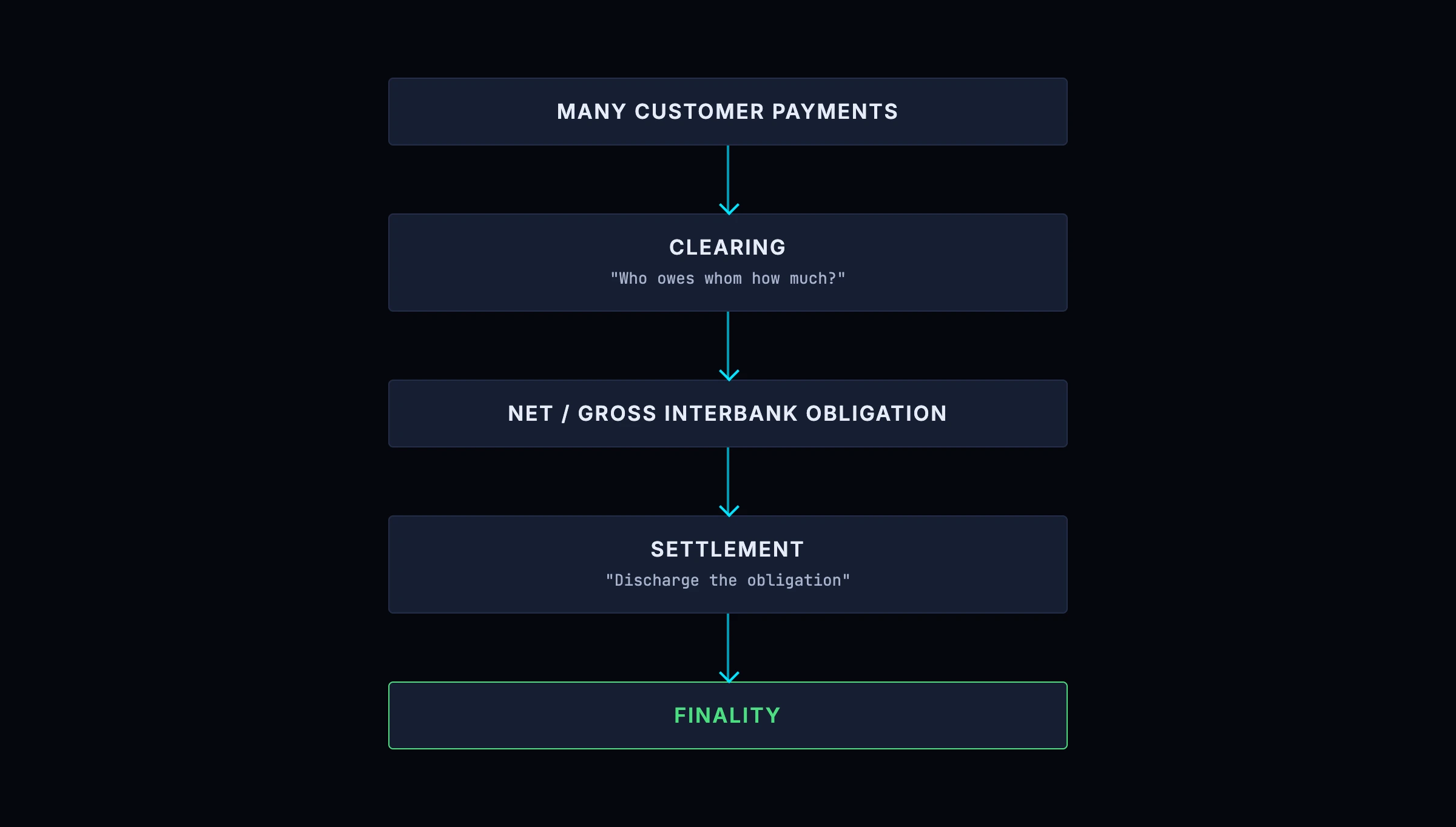
Clearing determines the obligation. Settlement discharges it.
1. Clearing vs Settlement: Clearing in Plain English
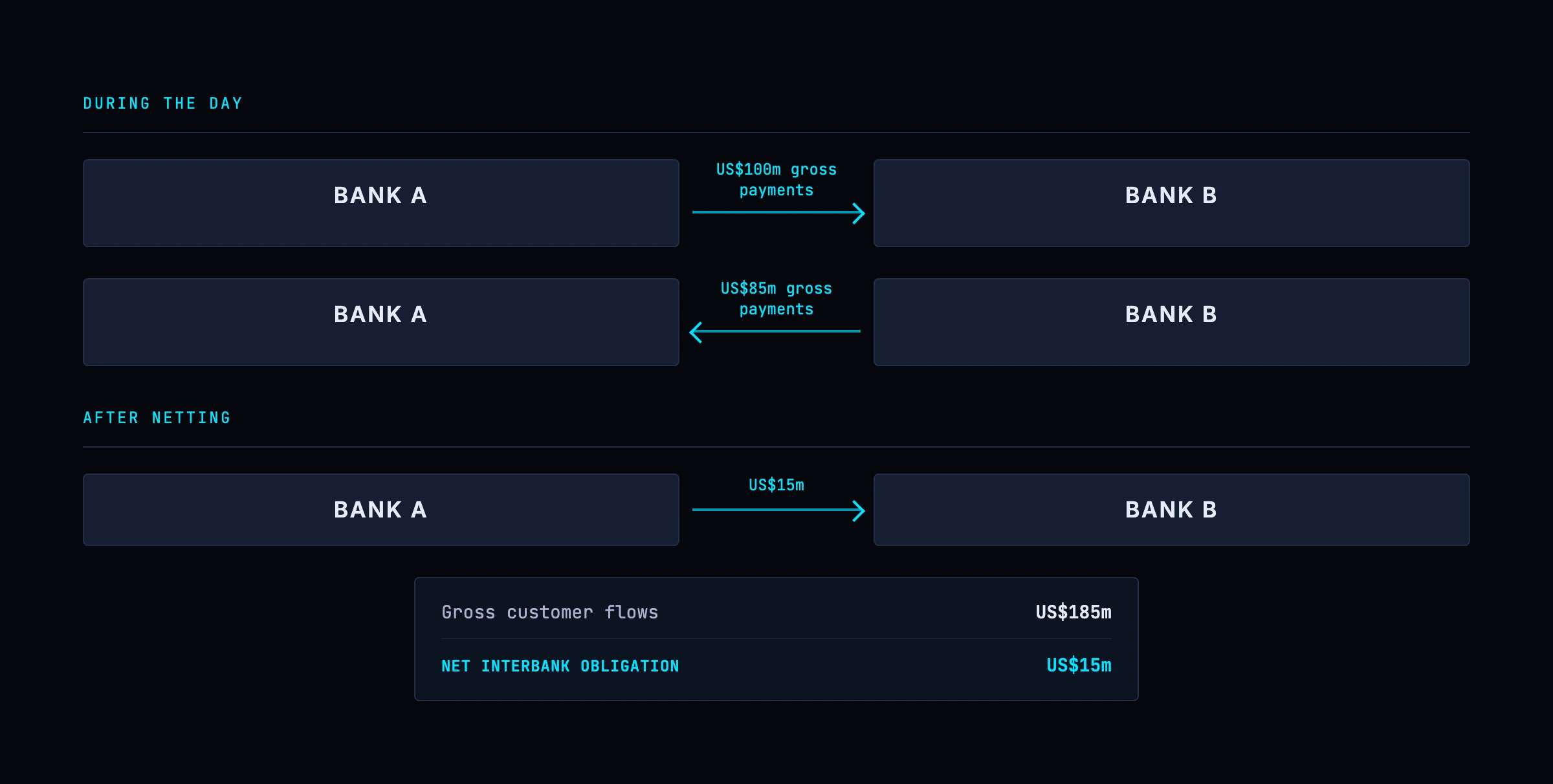
Suppose JPMorgan customers send US$100 million to Bank of America customers during the day.
BofA customers send US$85 million back to JPMorgan customers.
At the gross level:
JPM -> BofA       $100m
BofA -> JPM        $85m
Clearing determines the resulting obligations.
If the system nets them:
JPM owes BofA $15m netThat US$15 million is the settlement obligation after offsetting the two directions.
2. Settlement in Plain English
Settlement is the act that finally discharges the obligation.
If JPMorgan transfers US$15 million of Federal Reserve reserves to BofA:
JPM reserves       -$15m
BofA reserves      +$15m
then the commercial-bank obligation can be extinguished.
BofA no longer merely has a claim saying:
JPM owes us US$15 million.
It has received settlement value.
3. Why Netting Matters
Without netting, enormous payment systems would require correspondingly enormous amounts of intraday liquidity.
With offsetting:
Gross payment value      $185m
Net position              $15m
The banking system can support much more payment activity with less settlement funding.
This is not “creating free money.”
It is reducing the amount of settlement liquidity that must be committed at the same time by recognizing offsetting obligations.
4. Fedwire: Real-Time Gross Settlement and Finality
The Fedwire Funds Service is a high-value electronic funds-transfer service operated by the Federal Reserve Banks.
Its defining feature for this discussion is settlement finality through Federal Reserve accounts.
A simplified Fedwire transfer:
Sending bank reserve account      -$10m
Receiving bank reserve account    +$10m
The Federal Reserve's own service description emphasizes finality for payments credited to Federal Reserve master accounts.
Fedwire is therefore a central example of settlement in central-bank money.
5. CHIPS: High-Value USD Settlement With Liquidity Saving
CHIPS is a private-sector high-value USD clearing and settlement system operated by The Clearing House.
Its importance lies in combining final settlement with liquidity efficiency.
Rather than requiring every payment instruction to consume its full gross value in fresh liquidity independently, CHIPS can continuously match, offset, queue, and settle payment obligations according to its rules and available funding.
The Clearing House reported a roughly 26:1 liquidity-efficiency ratio for 2025 — meaning one dollar of funding supported approximately US$26 of settled payment value across the system.
That statistic demonstrates why gross customer payment value and required settlement liquidity are not the same thing.
6. Gross Settlement vs. Net Settlement
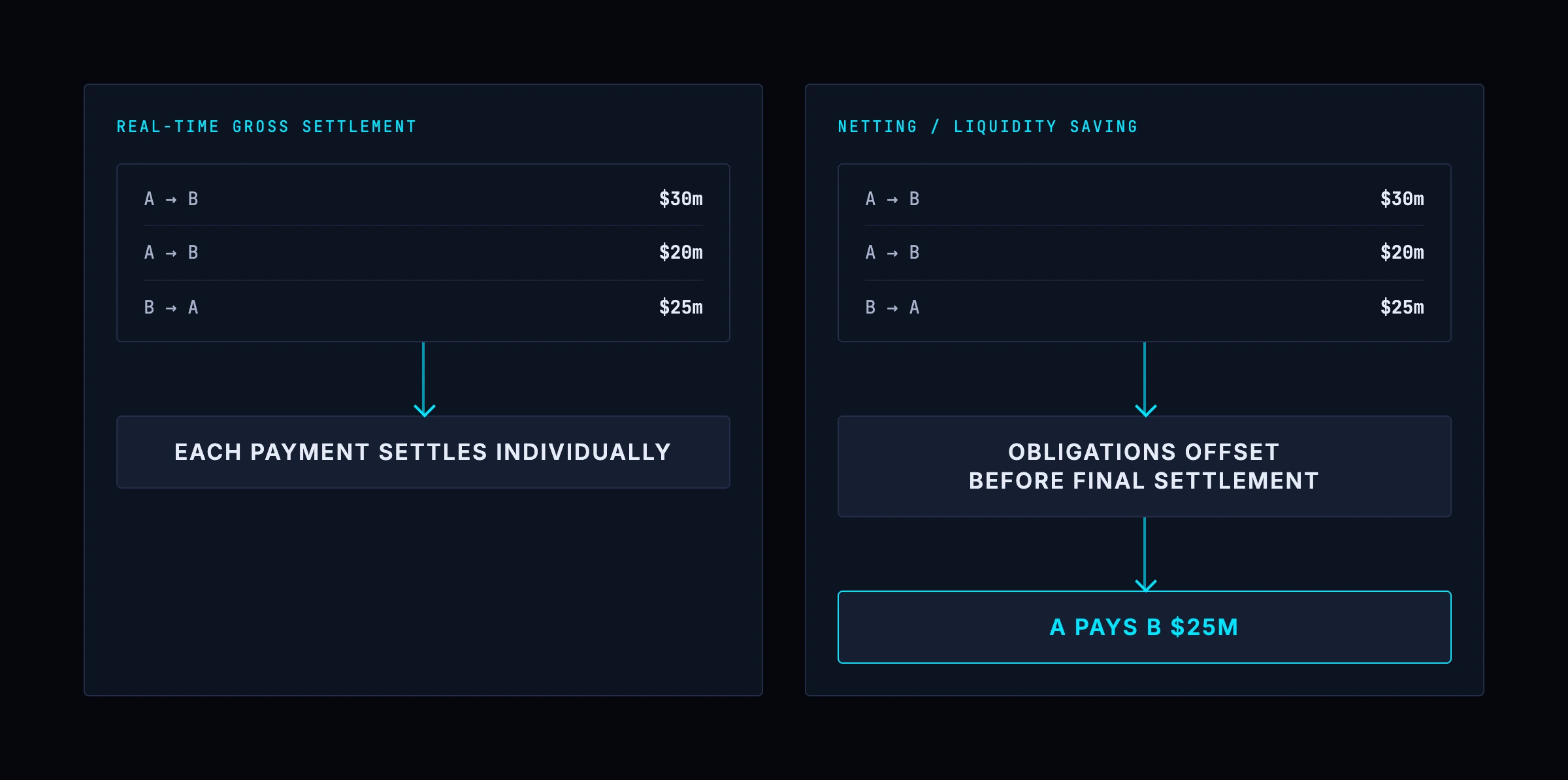
Gross settlement
Each qualifying payment settles for its full value.
Example:
Payment 1   $10m settles
Payment 2   $20m settles
Payment 3   $15m settles
Liquidity required can be substantial.
Net settlement
Offsetting payment obligations are combined so that participants settle net positions.
Example:
A owes B     $100m
B owes A      $95m
Net            $5m
Only the net amount remains after clearing.
Real payment systems can be more sophisticated than either simple cartoon, including continuous intraday settlement and hybrid liquidity-saving designs.
7. Does Netting Mean the Underlying Payments Were Not Real?
No.
Customers may have sent US$195 million of gross payments.
Net settlement of US$5 million does not mean only US$5 million of economic transactions occurred.
It means reciprocal obligations reduced the amount of settlement asset required to discharge the net interbank position.
This is analogous to two businesses invoicing each other.
If Company A owes Company B US$1 million and B owes A US$900,000, they can agree to settle the net US$100,000 rather than making two gross payments.
The gross economic obligations remain part of the history.
8. Payment Finality
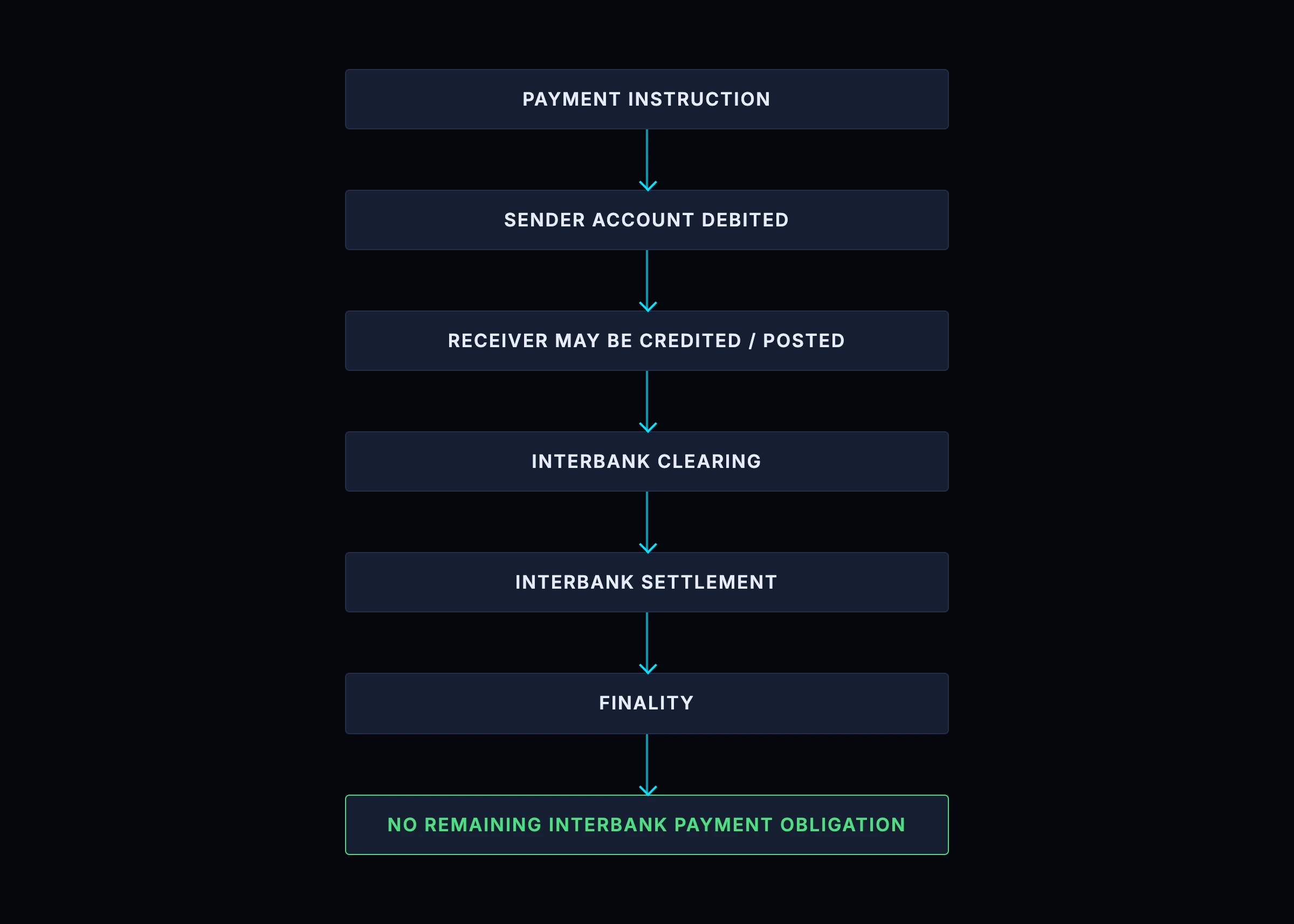
Finality answers a legal and operational question:
At what point can the settlement no longer be unwound merely because one participant later fails?
That question matters enormously in high-value payments.
A receiving bank does not want to treat a US$100 million incoming transfer as irrevocably settled if the underlying payment can later disappear because the sending bank failed before final settlement.
Systems therefore define legal rules for when settlement becomes final and irrevocable.
Fedwire and CHIPS both emphasize finality, though their mechanics differ.
9. Why Banks Care About Intraday Liquidity
A bank can be solvent and still experience a payment problem if it does not have the right liquid settlement asset at the right time.
Suppose Bank A owns:
Long-term loans            $10bn
Treasury securities         $2bn
Other assets                $1bn
but needs US$500 million of settlement liquidity immediately.
The value of its long-term assets does not automatically mean it has US$500 million immediately available in the form required by the payment system.
That timing problem is liquidity risk.
Liquidity-saving mechanisms reduce the amount of scarce intraday funding that must be committed to process large values.
10. Why This Matters for Cross-Border Payments
Cross-border USD payments frequently involve:
originator bank;
one or more correspondents;
U.S. high-value payment rails;
beneficiary bank;
underlying nostro/vostro positions.
A SWIFT instruction may tell the banks what to do, but clearing and settlement determine how the obligation is actually discharged.
This is why businesses designing international payment infrastructure must understand not only messaging but also correspondent banking and settlement-account structures.
11. A Complete Example
Alice at Bank A sends Bob at Bank B US$10 million.
Customer posting
Alice deposit       -$10m
Bob deposit         +$10m
Clearing
The payment system records Bank A's obligation to Bank B.
During the same cycle, suppose Bank B owes Bank A US$8 million from other customer payments.
Net:
Bank A owes Bank B $2mSettlement
US$2 million of settlement funding is transferred according to the rules of the system.
Result
US$18 million of gross payment flows occurred in the two directions, but only a US$2 million net settlement obligation remained.
That is the basic purpose of netting.
12. Common Misconceptions
“If US$100 million of payments occurred, US$100 million of Fed reserves had to move.”
Not necessarily. Netting and other settlement structures can reduce the amount of settlement liquidity required.
“Clearing means the payment is finally paid.”
No. Clearing establishes obligations; settlement discharges them.
“SWIFT is the settlement asset.”
No. SWIFT is primarily a messaging network.
“If the customer sees the credit, settlement must already be final.”
Not necessarily. Customer posting rules and interbank settlement status can differ.
This page is part of How the US Dollar Is Created, the full primer on where dollars come from and how they move.
Frequently Asked Questions
What is clearing?
The process of calculating and organizing payment obligations among participants.
What is settlement?
The final transfer of an accepted settlement asset that discharges those obligations.
What is netting?
Offsetting reciprocal obligations so only the remaining net amount needs settlement.
What is Fedwire?
A Federal Reserve high-value funds-transfer service providing final settlement through Federal Reserve accounts.
What is CHIPS?
A private-sector high-value USD clearing and settlement system that uses liquidity-saving mechanisms and provides finality under its rules.
Why is liquidity efficiency important?
Because banks can process much larger payment values without locking up the full gross value in settlement funding at once.
Conclusion
Payment is not one event. Customer accounts can be updated, obligations can be cleared, positions can be netted, and final settlement can occur through a separate settlement layer.
Understanding that sequence explains why trillions of dollars of payment activity can be supported by much smaller quantities of immediately committed settlement liquidity.
Authoritative Sources
Federal Reserve Financial Services — Fedwire Funds Service
https://www.frbservices.org/financial-services/wires
The Clearing House — CHIPS
https://www.theclearinghouse.org/payment-systems/chips
The Clearing House — Modern Liquidity Management and the Strategic Role of CHIPS